

Academic Integrity Violation Guide: Types and Response

Most instructors picture an exam room when they hear about cheating. A student glances at a phone, copies from a neighbor, or hides notes under a desk. That picture misses where most problems start. Written work, shared files, unclear rules about help, and now generative tools create far more cases, and they leave far messier evidence. If you handle these cases, you need a clear definition first, then a way to tell one type of academic integrity violation from another, and finally a process that doesn't treat a software flag as a verdict.
What Counts as an Academic Integrity Violation
In large U.S. surveys compiled by the International Center for Academic Integrity, 68% of undergraduates admitted to at least one behavior involving cheating on tests or written assignments, according to the University of Nebraska-Lincoln academic integrity summary. That number should change how you plan. This isn't a problem created by a few determined cheaters. It's a routine risk built into how work is assigned, explained, and checked.
An academic integrity violation is an action that breaks the rules meant to make a grade or credential reflect a student's own learning. Think of a referee in a race. The referee doesn't ask whether a runner was fast enough to win fairly. The question is whether the runner followed the rules of the race. A student can break those rules on purpose, but carelessness can also break them, for example by copying source wording and forgetting to cite it.
The same survey summary puts the pattern in context. Between fall 2002 and spring 2015, it covered approximately 71,300 undergraduate students and 17,000 graduate students. Among undergraduates, 39% admitted cheating on tests and 62% admitted cheating on written assignments. Graduate students reported 17% for tests, 40% for written assignments, and 43% for either behavior.
Why Those Numbers Need Careful Reading
Those figures are self-reported, so they only capture students willing to disclose misconduct. They don't count formally detected cases. Official disciplinary records have the opposite limit. They mostly measure how much enforcement happened, not how much misconduct occurred. A department with few reports may have honest students, weak detection, unclear reporting routes, or all three.
The pattern hasn't disappeared in newer cohorts. Across six schools surveyed during the 2023-2024 academic year, 72.06% of students reported engaging in at least one academically dishonest behavior during the preceding month, according to a study in Educational Technology Research and Development. Written assignments deserve the most attention because that's where students most often cross lines around copying, collaboration, and outside help.
Violation Types and What They Look Like
Use this classification before you investigate anything. The category tells you what evidence to look for and what evidence won't help.
| Violation | Typical example | Common warning sign |
|---|---|---|
| Plagiarism | Copying a paragraph from a website without citation | Matching text and a sudden shift in writing voice |
| Unauthorized collaboration | Sharing answers on a problem set meant to be solo | Near-identical solutions across students |
| Test cheating | Hidden notes or a phone used during an exam | Identical wrong answers among seated neighbours |
| Contract cheating | Paying a ghostwriter or service to complete work | Work far above the student's in-class performance |
| Fabrication or falsification | Inventing survey data or lab results | Results that cannot be reproduced |
| Duplicate submission | Reusing a paper from another course without permission | Match against an earlier submission in a repository |
| Facilitation of cheating | Writing an assignment for a classmate | Shared files or near-identical drafts in submission logs |
Plagiarism Versus Collaboration
Plagiarism usually leaves a trace you can point to. A paragraph matches a website, a journal article, or another student's paper, and the student's own voice changes around the copied material. You can show the source next to the submission. That side-by-side comparison is the core evidence, not your general impression that the writing sounds polished.
Unauthorized collaboration looks different. Two problem sets may share the same unusual error, the same order of steps, or the same odd phrasing in a short answer. One matching error can happen by chance, especially if you taught a method in class. A pattern of matching errors across several questions is harder to explain as coincidence, and that's what you should document.
Contract Cheating and Fabrication
Contract cheating rarely produces matching text because the work may be written from scratch for that student. The warning sign is a mismatch you can verify. The submitted essay uses methods, vocabulary, or structures the student can't explain and hasn't shown in supervised work. Don't rely on that mismatch alone. Ask the student to walk through choices in the work, and compare drafts, notes, and earlier verified writing.
Fabrication or falsification is about invented evidence, not borrowed words. A student reports survey responses that were never collected or adjusts lab results to fit an expected outcome. Your check is reproducibility and records. Raw data files, timestamps, lab notebooks, and instrument logs matter more than writing style.
AI-assisted work and image misuse don't fit neatly into one row because the same tool can be allowed help in one course and prohibited substitution in another. Treat that category through disclosure and assignment rules, which is why it needs separate handling.
Practical rule: Name the category in your notes before you collect evidence. If you can't name it, you aren't ready to decide what to check.
How Institutions Detect Violations
Detection works best in layers, and each layer answers a different question. The image below shows the kind of document review that starts many cases, but that review is only the first filter.
Text-similarity software compares a submission against websites, publications, and stored student work. It answers a narrow question. Does this text match other text, and where? A high score can come from properly quoted material, a reference list, common phrases, or a template you provided. A low score doesn't clear the student, because paraphrased copying and commissioned work may match nothing in the database.
Instructor review adds context the software can't see. You know the student's prior work, the sources you assigned, and whether the submission answers the actual prompt. Learning management system records add another layer. Draft timestamps, version history, file names, and submission logs can show whether work developed over time or appeared in one upload minutes before the deadline. Short oral follow-up questions then test authorship directly. Ask why the student chose a source, how a calculation works, or what an earlier draft contained.
Why Purchased Work Slips Past Similarity Checks
Contract cheating exposes the limits of that first layer. A systematic review in Frontiers in Education covered 65 studies involving 54,514 participants and estimated that 1,919 students, or 3.52% of the pooled sample, self-reported commercial contract cheating. In samples from 2014 onward in that review, the reported rate rose to 15.7%, although changing survey methods, wording, sampling, and willingness to disclose can inflate apparent trends.
Copied text produces measurable similarity. Purchased work can be linguistically original, so it can pass a similarity check cleanly. Experienced markers in one experimental sample in that review detected contract-cheating papers in only 62% of cases. That's a warning against overconfidence in both directions. Human suspicion and automated scores are triage signals. They tell you where to look closer, not what happened.
The short video below is useful background for staff training discussions about how detection fits into a wider integrity process.
Image Checks and What a Score Means
Image detection follows the same logic. A tool such as AI Image Detector analyzes patterns such as lighting inconsistencies and characteristic artifacts, then returns a confidence score across a spectrum from Likely Human to Likely AI-Generated. That score is a probability estimate based on visual signals. It can't tell you whether the course allowed the tool, whether the student disclosed it, or whether the image was central to the assessed learning.
Two related distinctions help staff avoid confusion. First, watermarks and detectors work differently, and Simple Unmark's guide to AI watermarks explains that difference in plain terms for reviewers who see both mentioned in vendor claims. Second, every detector has error rates, so teams should read guidance on false positive rates in AI image detection before setting any local threshold for escalation.
A flag starts a review. It never finishes one.
Use staged drafts, personalized data, supervised checkpoints, and comparison with verified in-class performance when the assignment is high stakes. Those design choices create evidence of process before anyone suspects a problem, which makes later reviews fairer and faster.
Where AI and Image Misuse Crosses the Line
A high AI score does not equal misconduct. That's the assumption to drop first. A detector can estimate how an image was probably made, but an academic integrity violation depends on the rule for that assignment, what the student claimed about the work, and whether required disclosure happened. The same generated image can be permitted brainstorming in a design studio and misrepresentation in a photography course.
Recent university guidance shows why local rules matter. The University of Edinburgh treats submitting AI-generated images without acknowledgment as misconduct, while University of Westminster guidance for students permits some complementary uses but prohibits presenting generated visuals as original work. Neither approach says every generated pixel is automatically cheating. Both turn on acknowledgment and honest presentation.
| Scenario | Usually misconduct? | Deciding check |
|---|---|---|
| AI-generated image submitted as own photography or art without acknowledgment | Yes, under most policies | Course rule on generative tools and disclosure |
| Generative tool used for brainstorming or mood boards and disclosed | Usually permitted | Disclosure statement in the submission |
| Complementary AI visuals clearly labelled as generated | Often permitted | Labels and attribution on the work |
| Generated visuals presented as original work | Yes | Course rule and presentation in the final file |
| Heavily edited photo with partly generated content | Set by assignment rules | Original file, edit history and student workflow description |
| Tool banned by the assignment brief | Yes | Tool list in the syllabus |
| Translation, editing or assistive tool used for language or access | Usually support, not substitution | Assignment policy and whether the student wrote the content |
The Grey Cases Staff Actually Face
Say a student submits a poster built around a photograph they took, then used a generative fill tool to extend the background. Is the final image human-made, AI-generated, or both? A detector score won't settle authorship because the file contains both kinds of input. Ask for the original photo, the edit history if available, and a short workflow description. Then apply the assignment's stated criteria. If the assignment requires unedited photography, the edit matters. If it assesses layout and typography, it may not.
Say another student uses translation software to turn their own draft into the language of instruction. That's usually support, because the ideas and structure started with the student. It's different from asking a tool to produce the analysis itself. Policies often blur that line, so ask one deciding question. Did the student create the content that the tool then helped express, or did the tool create the content being graded?
Institutions also apply different rules to images, audio, video, translation, and text. Don't assume a rule written for essays covers a generated diagram, or that permission for a mood board covers a final submitted artwork. Write the rule for each medium you assess, and give one allowed example and one prohibited example for each.
What Institutional Policies Should Spell Out
Check your current policy against seven elements. If any element is missing, staff will improvise, and improvised decisions are hard to defend on appeal.
- A plain definition: State that a violation is work presented for credit that doesn't accurately reflect the student's own learning under the rules for that assessment.
- A permitted help line: List what's allowed and what's banned for tutoring, collaboration, editing, translation, and generative tools, by assignment type where needed.
- A sanction ladder: Separate a first, minor citation failure from repeat misconduct and from contract cheating, so outcomes stay proportionate.
- Investigation steps and timelines: Say who preserves evidence, who meets the student, who decides, and how long each stage should take.
- An appeal route: Give the grounds, deadline, and decision maker for appeals, and state what happens to the grade while an appeal runs.
- Student education requirements: Require instruction on citation, paraphrase, collaboration limits, and disclosure before major assessments, not only after a first offence.
- Assessment design expectations: Expect drafts, oral checks, personalized prompts, or process evidence for high-stakes unsupervised work.
Education as Prevention, With Limits
Education belongs in policy because some plagiarism is preventable misunderstanding. In a 12-semester institutional study published through Springer, researchers analyzed 12,937 student submissions and identified 448 plagiarism offences. After an academic-misconduct education intervention, the mean detected-plagiarism rate fell from 4.81% across 3,137 pre-intervention submissions to 3.03% across 9,800 post-intervention submissions, a 37.01% relative reduction.
Read that result carefully. The study used an observational design, so it can't isolate education from changes in assessment, student populations, marking, or enforcement. It also found no direct evidence that the intervention reduced contract cheating. That's consistent with how detection works. Teaching attribution can reduce unattributed copying, but it won't stop a student who decides to buy original work.
Still, the practical direction is sound. Pair detection with explicit instruction, examples of acceptable paraphrase and citation, and repeated policy communication at the moment students start an assignment. Guidance on educational integrity in course design can help departments turn those expectations into syllabus language that students read.
Track your own rates with discipline. Use consistent assessment types and denominators over time, and record detection effort alongside outcomes. A falling rate can mean better student behavior, but it can also mean fewer checks, different assignments, or staff too busy to report. Policy reviews should ask which explanation the evidence supports before anyone claims success.
Respond to a Suspected Violation
When you suspect a problem, slow the process down at the start so you don't have to rebuild it later. The infographic below summarizes the core sequence, and the numbered steps add the detail you'll need for a defensible record.
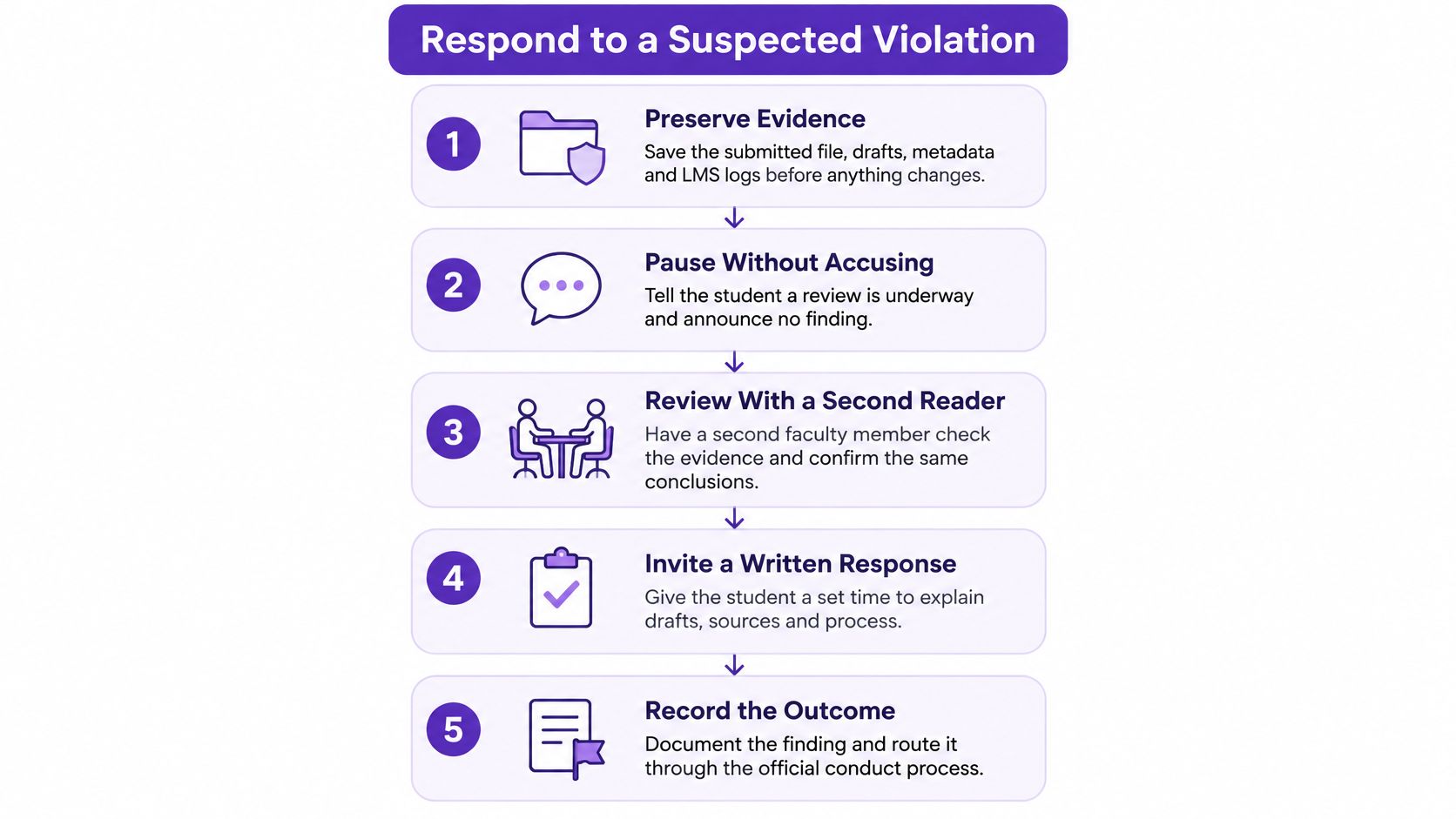
Preserve evidence first. Save the submitted file exactly as received, plus drafts, metadata, similarity reports, and learning management system logs. Don't ask the student to resend a clean copy, because that can overwrite the record you need. Note who accessed the file and when.
Pause without accusing. Tell the student a review is underway and that no finding has been made. Give a realistic timeline and a contact person. Language matters here. You're opening a review of authorship or attribution, not announcing that the student cheated.
Compare with verified work. Check the submission against in-class writing, supervised tasks, earlier coursework, and cited sources. Look for specific matches or specific gaps. A general feeling that work seems too good isn't evidence. A paragraph that matches a source, or a method the student has never been taught and can't explain, gives you something concrete to test.
Invite the student's explanation. Meet the student and ask open questions about workflow, sources, drafts, and tools. Let them show notes, earlier versions, raw data, or source files. Take notes on what they claim, then check those claims. A student who explains an unusual process clearly may resolve the case. A student who can't explain basic choices in work submitted under their name raises a different concern.
Weigh at least two independent signals. Match the evidence against the written policy for that assignment. Don't decide on one detector score, one similarity percentage, or one staff member's impression. Faculty research discussed in Higher Education Quarterly recommends human validation, multi-source verification, transparency, and accountability rather than reliance on a single automated judgment.
Record the decision and reasoning. Write down the rule involved, the evidence considered, the student's response, and why the evidence did or didn't meet the policy threshold. If a second reader reviewed the case, record that too. This record protects the student, the instructor, and the institution if the decision is appealed.
Apply the sanction ladder and state the appeal route. Use the outcome your policy sets for that category and history, not the outcome that feels right in the moment. Tell the student in writing what was decided, what sanction applies, and how and by when they can appeal.
Track patterns across cases. Look for repeated problems with the same prompt, deadline cluster, or unclear instruction. Fix the assessment where cases keep arising. Oral defenses, process portfolios, version history, reflective explanations, and prompts tied to local or personal contexts all make authorship easier to show and harder to fake.
Matching Evidence to an Outcome
A detector flag with a plausible explanation should lead to no sanction and, if needed, more evidence collection. Say a student's authentic image is classified as AI-generated, but they produce the original file, earlier versions, and a coherent workflow account. Record why the flag didn't hold up. Closing a weak case clearly is part of fair process, not a failure of enforcement.
Clear uncited copying is different. If you can place the source beside the submission, the student received prior instruction and warning, and the policy covers the behavior, move up the sanction ladder as written and provide the appeal route. For a first, limited citation failure with no prior warning, your ladder may call for education and resubmission rather than a formal penalty. Follow the ladder either way.
An undisclosed AI image in a course that bans generative tools should go to formal review under the written policy. Your evidence package should include the submitted file, any detector result with its score and reasoning recorded, the original file request, the student's workflow account, and the exact syllabus rule. Guidance on a safe assignment check workflow can help staff keep that package consistent across cases. The score supports the review. The rule and the student's presentation of the work decide whether an academic integrity violation occurred.
Language or accessibility support needs special care. If a student used translation, editing, or assistive tools and your policy doesn't clearly distinguish support from substitution, treat that silence as a policy gap. Decide the individual case on its merits, focusing on who created the graded content, and flag the rule for revision before the next cohort. Students shouldn't carry the cost of unclear institutional drafting.
Fair process check: Could an appeals panel reconstruct your decision from the file alone, including the student's side? If not, the record isn't finished.
Confusion itself is evidence you should act on. When students repeatedly say they don't know how integrity rules apply after generative AI, more detection won't fix the underlying problem. Clearer briefs, worked examples of allowed and banned help, and assessments that require visible process will prevent more cases than another warning email. Your goal is twofold. Decide this case fairly, and make the next case less likely.
If a submitted image is part of your next review, run it through AI Image Detector as one documented signal, save the confidence score and explanatory verdict with the case file, and weigh it alongside the original file, the student's workflow account, and your written course policy. The tool checks JPEG, PNG, WebP, and HEIC files in seconds without storing images, so you can triage visual work quickly while keeping the final judgment where it belongs, with the evidence and your institution's process.