

Generative AI Risks Explained and How to Reduce Them

A 2026 synthesis of 24 peer-reviewed studies, 60 randomized controlled trial effect estimates, and 33,801 participants concluded that text-based generative AI misinformation can be more persuasive than visual misinformation such as deepfakes. The same assessment found that preventive corrective information is the most consistently effective way to reduce the credibility of misleading AI-generated content. (International Panel on the Information Environment)
That finding changes how journalists, educators, and businesses should think about generative AI risks. A fabricated video may attract attention, but a fluent false explanation can pass through a newsroom inbox, a classroom discussion, a customer-service workflow, or a search result without looking unusual. The danger often begins with ordinary text.
Why Generative AI Risks Matter Right Now
A fabricated video may attract attention, but persuasive AI-written text can enter an ordinary workflow without looking unusual. An editor may receive a breaking-news tip with a plausible eyewitness account, a location, and several links. The prose is polished, the details fit the developing story, and the source profile appears ordinary. The risk begins when fluent language is treated as evidence rather than as an unverified claim.
That exposure affects public trust and daily operations. The UK government's frontier AI assessment identified digital risks as the most likely and highest-impact category through 2025. A global trust survey cited in that risk picture found that 70% of people are unsure whether online content can be trusted because they can't tell whether it's real or AI-generated, while 64% are concerned that elections are being manipulated by AI-powered bots and AI-generated content. (UK government assessment)
Organizations face a separate operational risk. Enterprise telemetry reported in 2026 showed generative AI traffic surged by more than 890% in 2024. Data-loss-prevention incidents involving generative AI more than doubled, organizations used an average of 66 generative AI applications, and 10% of those applications were classified as high risk.
Why the risk feels personal
A teacher may grade an essay that sounds thoughtful but contains invented citations. A marketplace moderator may review a product image that looks authentic, while a seller uses it to support a fraudulent listing. An employee may paste confidential material into an unapproved chatbot. After that disclosure, no content detector can reverse the exposure.
The term synthetic media includes AI-generated or AI-manipulated text, images, audio, and video. It covers more than face swaps and fabricated speeches. This guide explains what synthetic media means.
The practical response is selective scrutiny. Journalists can verify claims and sources before publication. Educators can check citations and ask students to document their process. Product teams can set approved tools, restrict sensitive inputs, and route higher-risk outputs for human review.
The goal is not suspicion of every output. It is a clear method for deciding which claims need independent evidence, which workflows require review, and which controls reduce exposure. Readers should be able to classify a generative AI risk, judge its likely impact, and match safeguards to a newsroom, classroom, platform, or business.
How Generative AI Creates Risk in Plain Language
Think of a generative model as autocomplete on steroids. When you type a sentence, a basic autocomplete system predicts a likely next word. A generative model performs a far more capable version of that task across large amounts of language, images, audio, or code.
It learns patterns from training material. Those patterns help it produce an answer that resembles the examples it has processed. But resemblance isn't the same as verification. The model can create a coherent paragraph without checking whether the person named in it exists, whether the cited court decision was issued, or whether the image depicts a real event.
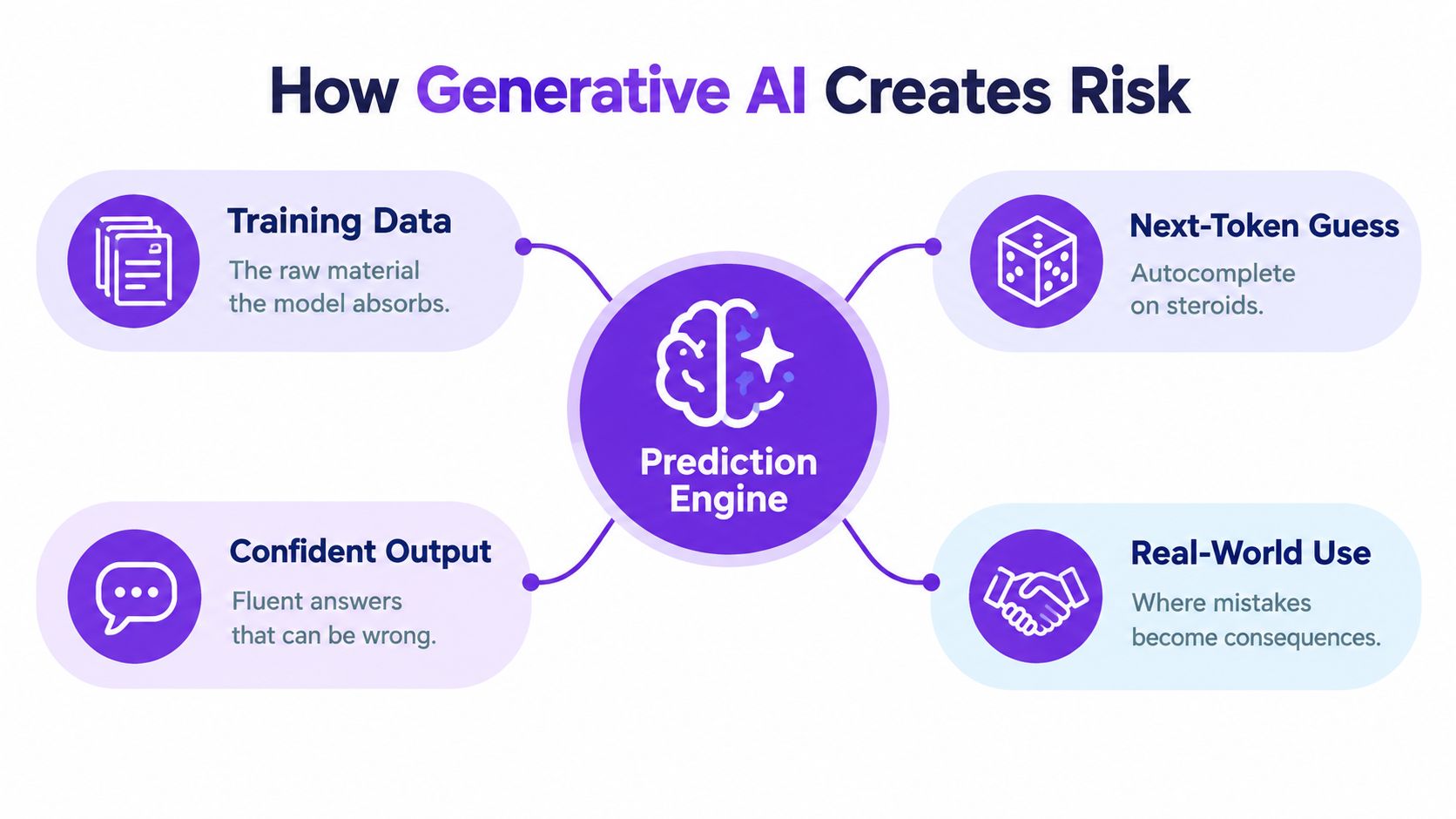
Core concept: Generative models predict plausible outputs, not guaranteed-true outputs.
Four points where risk enters
Training data supplies the raw material. If that material contains errors, stereotypes, private information, or copyrighted work, the model may reproduce or transform patterns that create problems.
The next-token guess determines what comes next. The model doesn't reason like a fact-checker at every step. It generates a sequence that fits the prompt and surrounding context, which can produce a confident but unsupported answer.
The confident output creates the human trust problem. Smooth grammar, realistic lighting, natural speech, and a helpful tone can make an output feel authoritative even when it is wrong. People often assess presentation before they assess provenance.
Real-world use turns model behavior into consequences. A false summary may mislead a reporter. A biased recommendation may affect access to an opportunity. A leaked document may expose a person. A generated instruction may trigger an unsafe business action.
NIST groups generative AI risks across areas including confabulation, dangerous recommendations, data privacy, harmful bias, information integrity, and information security. (NIST AI Risk Management guidance) This framing helps separate three connected issues:
- Model behavior, such as fabricated details or biased associations.
- User misuse, such as fraud, impersonation, or deliberate propaganda.
- Ecosystem effects, such as declining trust in authentic evidence.
A useful rule is to ask two questions at the same time: Could the system produce this output by mistake? and Could someone deliberately use the system to cause harm? Safe deployment must address both.
The Six Core Generative AI Risk Categories You Must Know
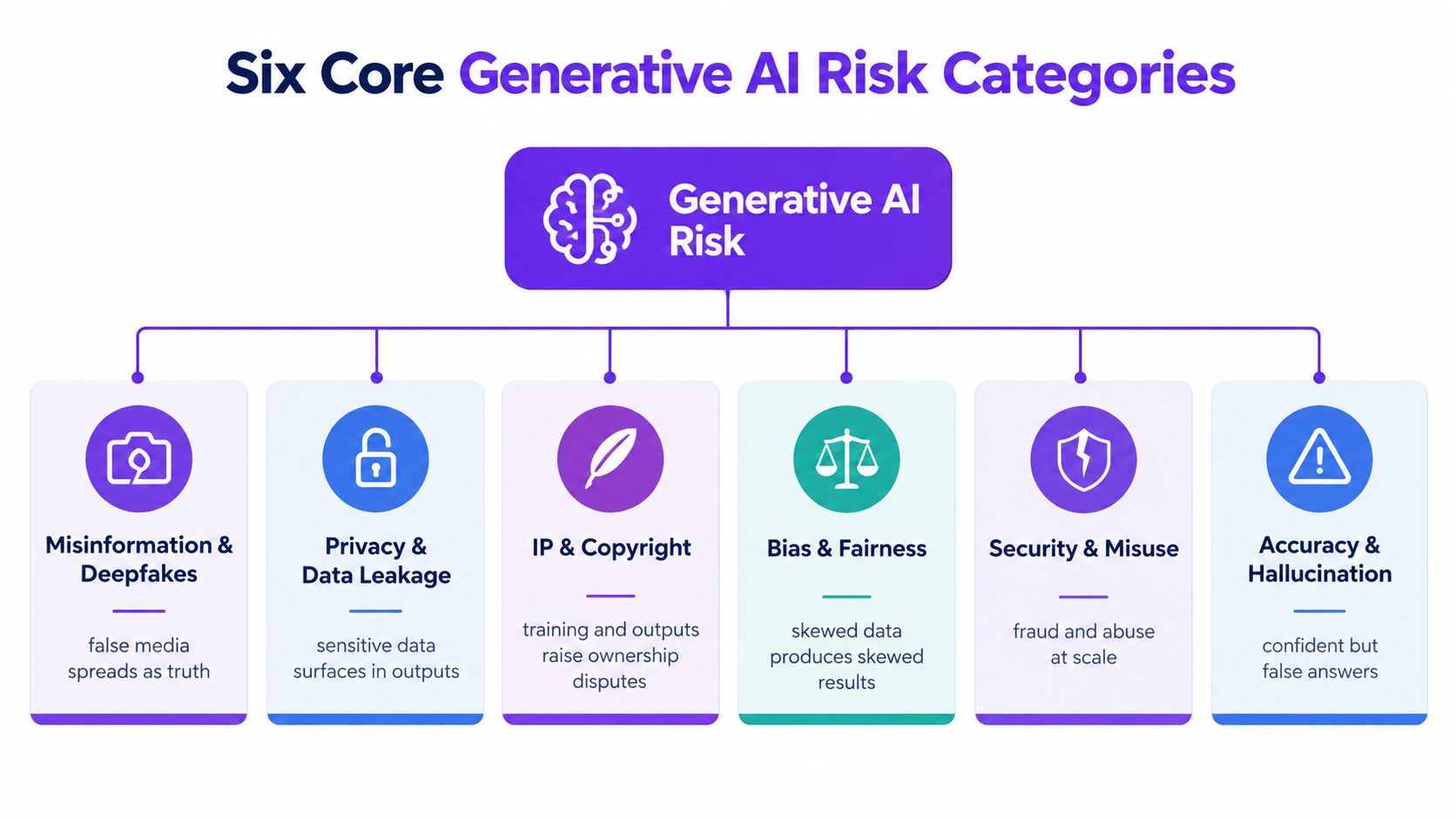
Risk categories overlap, but a practical taxonomy helps newsrooms, classrooms, and product teams identify failure points before an incident spreads.
Misinformation and deepfakes
Generative AI can produce persuasive articles, fabricated screenshots, cloned voices, and altered videos. The early warning sign is not always a visible artifact. Check whether a claim has a primary source, whether an account has suddenly changed its behavior, and whether the media has a traceable origin. These harms can affect voters, communities, customers, and people targeted by harassment.
Text deserves particular attention. The IPIE meta-analysis found that text-based misinformation posed a greater persuasive risk than visual misinformation in its reviewed evidence base. That changes the priority for verification: persuasive writing may influence people before a convincing deepfake attracts scrutiny.
Privacy and data leakage
Employees may paste personal details, confidential documents, unpublished reporting, source identities, or proprietary code into a public tool. A connected system may also retrieve information for a user who should not have access. Warning signs include unapproved applications, prompts with sensitive fields, and outputs that expose internal wording or records.
Intellectual property and copyright
Training materials and generated outputs can raise questions about ownership, permission, similarity, and attribution. Creative teams should preserve source records, review licenses, and avoid assuming that a generated asset is safe to publish or commercialize. Review should cover both the material supplied to the system and the result it produces.
Bias and fairness
Models absorb patterns from their data and from the way users frame requests. Those patterns can lead to unequal descriptions, recommendations, or decisions. Teams should test outputs across relevant groups, record the cases they review, and provide human appeal when an AI-assisted process affects a person.
Security misuse and fraud
Attackers can use generative systems to scale impersonation, phishing, fake support messages, malicious instructions, and synthetic identities. Signals include unusually fluent scams, inconsistent identity details, and requests that bypass normal approval steps. Product teams can reduce exposure by requiring verification and preserving escalation paths for suspicious activity.
Accuracy and hallucination
A hallucination is a confident output unsupported by reality. It may appear as a false citation, invented event, incorrect calculation, or unsafe recommendation. Treat unverified generated content as a draft, not evidence, especially in journalism, education, health, law, finance, and security.
These categories also connect to information integrity. One false answer creates a local error. Repeated plausible falsehoods can make authentic material harder to recognize, so detection must examine the claim, its source, and the workflow that allowed it to spread.
Real Examples of Generative AI Risks Across Industries
The same model capability can create different harm depending on the workflow around it. A newsroom, classroom, marketplace, and enterprise may all encounter generated content, but each organization has different evidence standards and failure points.

Newsrooms
A reporter receives an image that supposedly shows an event at the center of a developing story. The image contains no obvious distortion, but the sender provides no original file, location data, eyewitness contact, or independent confirmation. If the newsroom publishes it because the scene looks convincing, a visual fabrication becomes part of the historical record.
The missed verification step wasn't necessarily an AI scan. It was the failure to establish provenance, meaning where the file came from, who captured it, when it was created, and whether other evidence supports it. An image detector can support review, but it can't replace source reporting.
Classrooms
An instructor receives an essay with a confident argument and references that appear academic. The student may have used a chatbot for drafting, fabricated the references unintentionally, or submitted generated work as personal work. A detector score alone can't establish intent or authorship.
A stronger response combines process evidence with content review. Ask for notes, drafts, source annotations, and a short explanation of the argument. That approach tests understanding instead of treating a probabilistic classifier as a final judge.
Marketplaces
A seller uses an AI-generated product photo to make an item appear newer, larger, or more complete than it is. A related review account may also use generated language to create false confidence. Moderators should compare the listing with independent images, seller history, shipping records, and complaint patterns.
Teams that need a wider set of practical scenarios can consult these real-world examples of AI-generated images.
Businesses and media workflows
A finance employee receives an audio message that sounds like a senior executive requesting an urgent transfer. A customer-support agent sees a polished message that imitates a known brand. In both cases, the attack succeeds if the organization trusts a familiar voice, logo, or writing style more than its approval process.
Audio deserves the same chain-of-custody discipline as images and text. For teams handling spoken content, a documented verification workflow for AI music can help separate file analysis from human confirmation and publication decisions.
How Likely and How Severe Is Each Generative AI Risk
Likelihood and severity aren't interchangeable. A frequent low-level hallucination may consume staff time, while a rare impersonation event may cause serious financial, legal, or personal harm. Teams should score both dimensions before choosing controls.
The matrix below is a practical starting point, not a universal ranking. A school handling student records should weight privacy differently from a newsroom verifying election claims. A platform with automated uploads should give more attention to volume, abuse, and review capacity.
| Risk Category | Likelihood | Severity | Priority Action |
|---|---|---|---|
| Text misinformation | High | High | Preventive context, source verification, and editorial review |
| Privacy and data leakage | High | High | Restrict sensitive inputs and monitor approved applications |
| Accuracy and hallucination | High | Medium to high | Require evidence checks before consequential use |
| Bias and fairness | Medium to high | High | Test outputs, document decisions, and provide human appeal |
| Security misuse and fraud | Medium to high | High | Strengthen identity checks and approval controls |
| Deepfake-driven harm | Variable | High | Verify provenance and use specialist media review |
| IP and copyright disputes | Variable | Medium to high | Record sources, permissions, and human edits |
Use exposure to adjust the ranking
A public-facing chatbot has a different attack surface from an internal drafting assistant. A classroom serving minors has different privacy obligations from a marketing team working with public copy. The key questions are:
- Audience: Who could be harmed if the output is wrong?
- Reach: Can one error affect one person, a class, a customer base, or a public information channel?
- Automation: Does a human approve the output before it triggers an action?
- Sensitivity: Does the system process personal, confidential, regulated, or unpublished material?
- Reversibility: Can the organization correct the mistake quickly, or will the content persist?
The trust-erosion effect
The risk extends beyond false content. Research on misinformation ecosystems describes a “generative AI paradox” in which widespread synthetic material can encourage skepticism toward authentic digital evidence, synthetic consensus, and epistemic fragmentation. A separate 2026 experimental study found that long conversations can make several leading chatbots more vulnerable to repeating misinformation, particularly on obscure topics. (Tech Xplore coverage of the study)
That means a risk review should examine repeated interaction, not only the first answer. For organizations evaluating adoption or return, operational safeguards belong beside business analysis, including a grounded approach to measuring AI profitability.
Detection and Mitigation Strategies That Actually Work
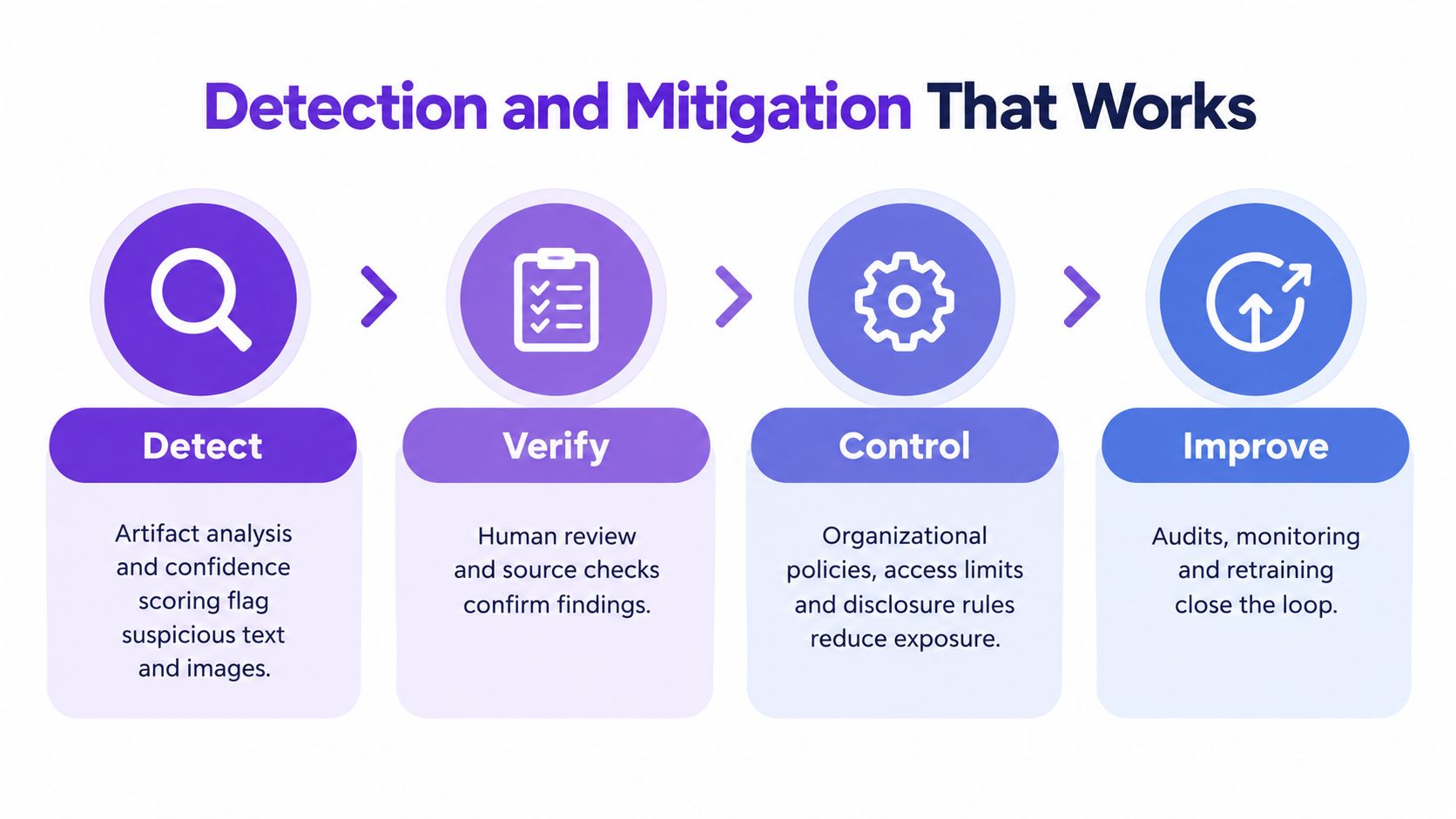
Detection works best as one layer in a larger control system. A classifier may flag suspicious language or an image may show signs of manipulation, but a person still needs to establish context, source, and consequence.
Detect suspicious signals
For text, reviewers can look for unsupported specificity, repeated phrasing, invented citations, abrupt shifts in voice, and claims that cannot be traced to primary evidence. For images, inspect reflections, hands, text rendering, shadows, edges, metadata, and the relationship between foreground and background. These signals are clues, not proof.
Confidence scoring can help prioritize review. A low-confidence result should trigger investigation rather than automatic rejection, especially for compressed, edited, or partially synthetic media.
Verify with independent evidence
Use a human-in-the-loop process:
- Preserve the original file or prompt context when privacy rules permit.
- Record who supplied the material and when.
- Check primary sources, reverse-search relevant media, and contact named witnesses.
- Compare independent evidence, such as official records, contemporaneous reporting, or original captures.
- Escalate high-impact decisions to an editor, safeguarding lead, security reviewer, or compliance owner.
For audio-heavy workflows, tool selection also matters. Teams can review guidance on choosing the right transcription tool, then validate the transcript against the original recording rather than treating transcription as an authoritative record.
Control use before harm occurs
Preventive corrective information performs more consistently than post hoc correction in the IPIE assessment. (IPIE analysis) In practice, publish relevant context before a false claim gains momentum. Labels still have a role, but the meta-analysis indicates that labels reduce perceived credibility only when they are clear, consistent, and carefully designed.
Organizations should also define approved tools, prohibited data, retention expectations, review requirements, and escalation paths. Data-loss-prevention monitoring can identify shadow AI use, while access limits reduce the chance that a model retrieves information beyond a user's authorization.
A privacy-conscious image check can support newsroom, classroom, marketplace, and profile-review workflows. AI detection methods for images and text should be treated as part of verification, not as a substitute for it.
Practical rule: The higher the consequence, the less you should rely on a single detector, label, or model response.
Improve after every incident
Log what happened, which signal was missed, who made the decision, and whether the control worked. Review false positives as carefully as false negatives. A useful system becomes more reliable when teams update prompts, policies, reviewer training, and escalation rules from real failures.
Your Practical Checklist for Safer Generative AI Use
Safer use starts with a repeatable habit: pause, classify, verify, document, and review. The workflow should be simple enough for routine use and strict enough for high-impact decisions.
For journalists and editors
- Trace the source: Identify the original uploader, capture context, date, location, and supporting witnesses.
- Separate claim from presentation: A polished caption, realistic image, or fluent quote isn't evidence.
- Preserve records: Keep the submitted file, verification notes, search results, and publication decision.
- Escalate consequences: Require senior review for material involving elections, public safety, vulnerable people, or reputational harm.
For educators
- Assess process: Ask for drafts, notes, source explanations, and oral discussion rather than relying only on detection scores.
- Protect student data: Don't place identifiable or sensitive student information into unapproved tools.
- Teach verification: Show students how to test citations, compare primary sources, and recognize confident uncertainty.
- Use fair procedures: Give students a way to respond before an AI-assisted suspicion affects a grade or disciplinary decision.
For businesses and trust and safety teams
- Create an approved-use policy: Define permitted tools, prohibited data, human-review thresholds, and disclosure rules.
- Monitor exposure: Track sensitive prompts, unusual account behavior, repeated failed checks, and high-impact automation.
- Verify identity separately: Don't approve payments, access changes, or account recovery from a voice, image, or message alone.
- Audit continuously: Review incidents, false alarms, missed harms, and policy exceptions on a regular schedule.
The strongest measure of resilience isn't how often a team detects synthetic content. It's whether the team can prevent a questionable output from becoming an unreviewed decision.
AI Image Detector offers image analysis that estimates whether a file is likely AI-generated or human-created and provides a confidence score with explanatory indicators. Visit AI Image Detector to add a privacy-first image check to your verification workflow before you publish, grade, approve, or act.

