

How to Prevent Corporate Fraud: Controls That Work

Most victim organizations already had codes of conduct, audits and management reviews when fraud happened. That uncomfortable fact should shape how to prevent corporate fraud. You don't start by buying more paperwork. You start by ranking controls by whether they detected anything, then you build workflows where no single person, message or convincing image can move money alone.
The Controls That Catch Fraud and the Ones That Only Look Good
The Association of Certified Fraud Examiners' 2024 Report to the Nations analyzed 1,921 occupational-fraud cases across 138 countries and territories, with more than $3.1 billion in documented losses, and it estimates a typical organization loses about 5% of annual revenue to fraud. The same report records which controls victims had in place and which ones successfully detected the scheme. Those are different questions, and the answers point in different directions.
Prevalence Is Not Effectiveness
A code of conduct sets expectations. It doesn't test a journal entry or stop a payment. External audits and management certification add accountability, but they're periodic and sample based. Internal audit and management review sit closer to daily transactions, so they detect more. Neither comes close to tips.
| Control | Present in victim organizations | Share of cases detected |
|---|---|---|
| Code of conduct | 85% | Not reported |
| External financial-statement audit | 84% | 3% |
| Internal-audit department | 80% | 14% |
| Management certification of financial statements | 77% | Not reported |
| Management review | 72% | 13% |
| Tips from a hotline or reporting channel | Not reported | 43% |
Read the table as a detection ranking. Tips surfaced 43% of cases, more than internal audit and management review combined, yet the control checklists I've reviewed put their thickest chapters on policies and the thinnest on the reporting channel. When I examine corporate risk management strategies inside client organizations, that imbalance shows up constantly: well-documented expectations, an underused hotline, nobody watching transaction data week to week.
The audit row needs an honest reading. External financial-statement audits detected 3% of cases, and that isn't an audit failure. Audits verify financial statements on a sample; they were never designed to find fraud inside transactions, and fraudsters know the sample covers a slice of the year. Asking an annual audit to do the job of continuous monitoring is a category error I've seen sink more than one program.
This ranking matters more now that supporting evidence can be fabricated. A synthetic invoice, a cloned voice, or a convincing deepfake on a video call all present as authorized requests, and every paper control on the list waves them through. What stops them sits in the detection column: a channel employees actually report through and monitoring that tests transactions instead of trusting appearances.
A control that exists on paper but is never tested gives management comfort, not protection.
How to Design Controls Managers Cannot Quietly Override
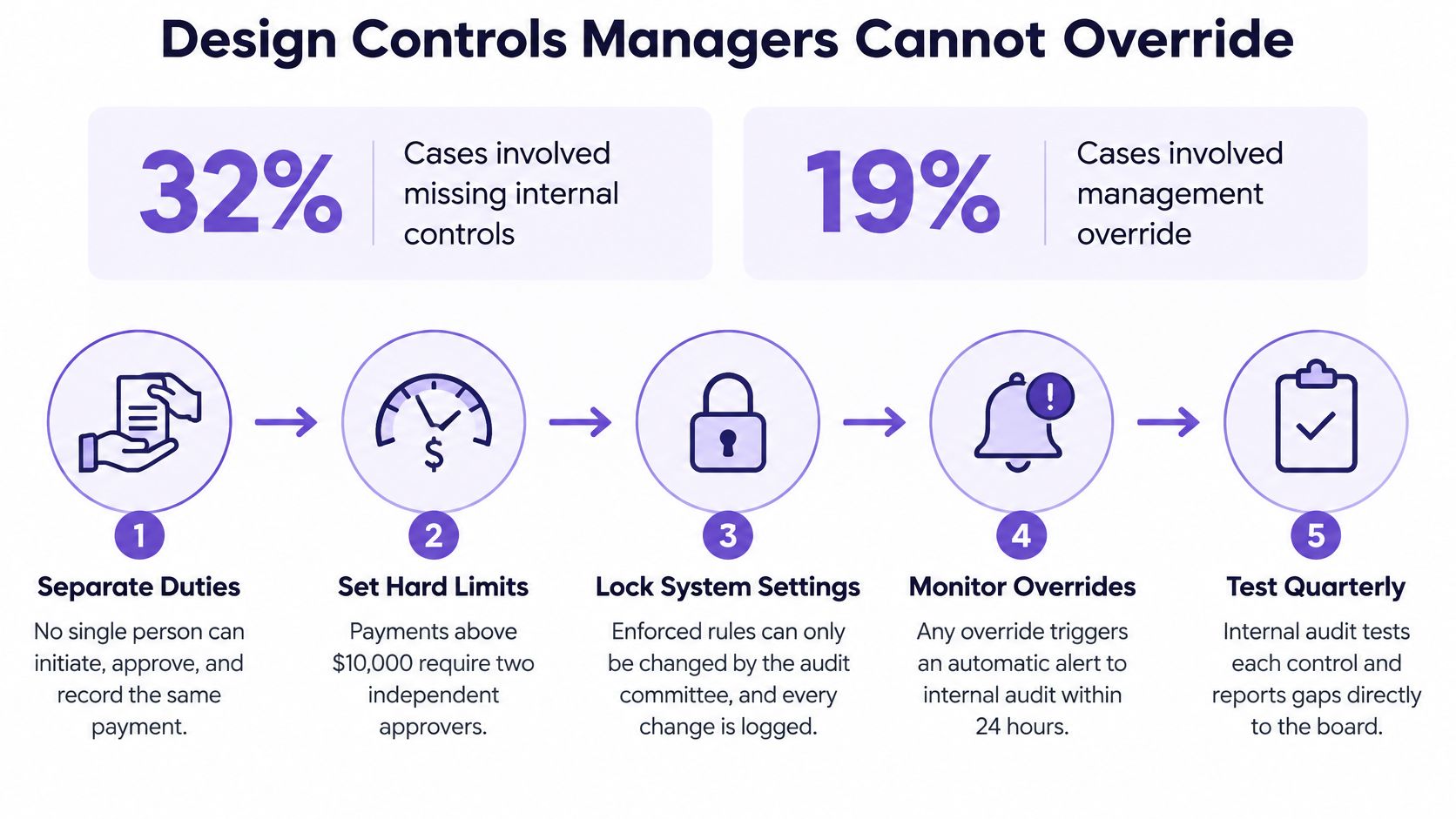
A rule a senior manager can switch off alone is a suggestion, not a control. In the ACFE 2024 Report to the Nations, 32% of occupational fraud cases involved a lack of internal controls and 19% involved management override of controls that did exist. A single case can show both weaknesses, so treat them as a large share of failures rather than a combined total. Either way, the failure starts at design, before anyone attempts anything clever.
The flow below shows the build order I recommend.
Build in This Order
- Get board-level ownership and a written fraud-risk policy. Name who's accountable when a control fails. Without that, finance will design rules that operations treat as optional. The common slip is a policy signed once and never tied to budgets or reporting.
- Map schemes by process. Walk through procurement, revenue recognition, payroll, expense reimbursement, financial reporting and third-party relationships. Ask how someone could steal, conceal it and convert it to cash in each one. Don't start with a generic risk register copied from another company.
- Assign a named owner and write segregation-of-duties rules. The person who creates a vendor can't approve its payment. The person who changes bank details can't release the next payment run. And no approval chain should treat a document, image or video as proof on its own. A convincing invoice scan or a video call that looks like your CFO can both be synthetic, so the control is the callback to a known number, not what the request looks like. Small teams can't separate everything, so add independent review where separation isn't possible.
- Log every override and send the log to someone independent monthly. Overrides aren't always wrong, emergencies happen. They become dangerous when they're invisible. Internal audit or the audit committee should see who overrode what, why, and whether it was reversed.
- Test high-risk controls quarterly and score outcomes, not completion. Annual testing lets a broken control fail for three quarters unnoticed. Pick the controls protecting cash, vendor master data and manual journals, then test them with real transactions, not interviews alone. Track time-to-detection, median loss, alert-to-case conversion and repeat-finding rates. A training completion rate tells you people clicked through slides. It doesn't tell you whether anyone can still bypass approval.
Teams often report that a control exists when nobody has ever tried to break it. That's the pitfall to avoid. Test whether a manager can create a vendor, approve it and pay it under time pressure, because that's exactly how override happens in practice.
By the end of this work you should have three documents on paper. Keep them short and current.
- Owner list: Every key control with one named person responsible for it.
- Segregation matrix: Incompatible duties shown by role, with compensating reviews where staffing is thin.
- Override log: Date, person, reason, approver and independent reviewer for every exception.
If you can't produce those three, you don't yet know how to prevent corporate fraud in your own processes. You're hoping good people won't be tempted or pressured.
How to Build a Reporting Channel Employees Trust
A reporting channel earns trust after the first hard case, when a report names someone with power and the process still moves.
Employees close to procurement, payroll and vendor setup often see pressure or favoritism before a reconciliation flags it. That makes the channel a detection control with legal exposure. A vivid screenshot, image or video can be fabricated, so media should start an investigation and never authorize a high-value payment by itself.
Research summarized in a 2025 study of whistleblowing implementation identifies four operating requirements: anonymity, independence, accessibility and follow-up, with protection of reporters' personal data and a defined evaluation process. The same research describes PT Pos Indonesia as having a formal system that still needed stronger protection and clearer follow-up. Private companies show the same gap.
What the Four Requirements Look Like in Practice
Anonymity means a third party or properly separated intake route, with no path back through the reporter's manager. Route complaints away from shared mailboxes that local leadership can read.
Independence means intake and triage sit apart from anyone implicated. If a report names a finance director, finance doesn't decide whether it's credible. Give the audit committee direct access to complaints and outcomes.
Accessibility is practical. Field staff, warehouse teams and vendors need mobile access and multilingual options where your workforce needs them. If only headquarters staff can use the channel easily, you've excluded the people most likely to see procurement and payroll problems.
Follow-up decides whether people report again. Publish response-time targets, give confidential status updates where possible, and report aggregate outcomes to the audit committee. Silence after a report teaches everyone else to stay quiet.
Anti-retaliation protection needs the same specificity. Staff should understand whistleblower rights and reporting duties before they need them, including what counts as retaliation and who investigates it. Handle false reports through the same triage process, document why a report was closed, and don't punish good faith reports that turn out to be mistaken.
Cross-border privacy needs decisions before launch. Confirm which data-protection rules govern intake, storage and disclosure in each jurisdiction where staff or vendors may report. Tell reporters to upload original, unedited files through the secure intake channel and to avoid annotating, cropping, renaming or stripping metadata. Investigators can protect identity during preservation while keeping receipt time and chain of custody intact. Log how each file was received and preserved so the evidence trail survives later scrutiny.
Trust test: If employees can't describe what happens in the first week after a report, they won't assume the process protects them.
I would rather run a plain form with disciplined triage than a polished portal nobody believes in. A channel that produces a case file people can trust is worth more than a slogan on a poster.
Red-Flag Transactions to Monitor Every Week
Waiting is expensive. In Australia's Counter Fraud digest of the ACFE 2024 report, median scheme duration was 12 months, and median losses rose from USD 30,000 for schemes detected within six months to USD 250,000 when schemes lasted two to three years. Your monitoring rhythm therefore matters as much as your rules.
Analytics complements human reporting, it doesn't replace it. Use it to cover transaction volume that no reviewer can read line by line, then send a small number of well chosen alerts to people who can investigate properly.
| Red flag | Scheme it signals | Check to run |
|---|---|---|
| Duplicate vendors sharing bank account, address or tax ID | Phantom vendor | Match vendor master file monthly |
| Purchases split to stay below approval threshold | Approval avoidance | Cluster purchases by vendor over 7 days |
| Unusual journal entries after period close | Financial misstatement | Review all manual entries above a set amount |
| Round-dollar payments | Manual or unauthorized payment | Filter for exact round amounts weekly |
| Bank details changed then paid within a short window | Account takeover | Hold payment until callback verification |
| Dormant account suddenly active | Payroll or vendor fraud | Flag any account inactive for 12 months or more |
| Transactions outside normal hours | Unauthorized access | Review logins and postings outside business hours |
How to Avoid Drowning in False Positives
Start with exact matches, not vague anomalies. Duplicate bank accounts across vendors are rarely innocent and they're quick to clear. Split purchases need context, so cluster by requester and vendor over a short window before you accuse anyone of approval avoidance.
Manual journals after close deserve a different review. Ask who posted it, who approved it and what source document supports it. This is also where document fraud detection disciplines help, because a clean looking invoice or approval screenshot isn't evidence if nobody verifies it against an independent record.
Round-dollar payments and out-of-hours postings are weaker signals on their own. Treat them as sorting tools for weekly review unless they involve new vendors, senior staff or recently changed bank details. Combining two weak flags often produces one strong lead.
Send two categories to an investigator the same day. Bank-detail changes followed quickly by payment, and dormant accounts that suddenly move money, shouldn't wait for a weekly meeting. Hold the payment where your policy allows it and verify through a known contact route.
Put the rest into a weekly review with a named owner and a closure reason for every alert. An alert that nobody closes properly will reappear next week and train the team to ignore the report.
How to Verify Executive, Vendor and Identity Requests
A finance manager gets a 40-second video from the chief executive asking for an urgent, confidential transfer before a deal closes. The face and voice look right. The pressure is the payload: urgency is meant to make the approver skip the one step that matters. Verification has to hold in that moment, when the request feels too important to question.
The team verifying a request together is the control point, not an afterthought.

The useful ranking is simple: callbacks, dual approval and master-data change holds catch attempts because they interrupt the payment path. Policy wording, awareness posters and annual attestations look reassuring but rarely stop a well-timed request by themselves. Treat synthetic voice and video as a finance authorization problem that also needs security input. The question is how your team confirms authority before money, access or vendor data moves.
| Request type | Confirm with | Hold until confirmed |
|---|---|---|
| Urgent payment or invoice change | Callback to a number already on file | Yes, no exceptions |
| Executive voice or video instruction to transfer funds | Second approver using a known channel | Yes |
| Vendor bank-detail update | Callback plus dual approval | Yes, for the first payment |
| Onboarding identity document | Check against an independent registry or record | Yes, until verified |
| Profile image or document of a contact | Triage with an image detection tool, then manual review | No, but flagged for review |
The callback rule only works if the number comes from the vendor master file or a contact record maintained before the request arrived. A number supplied inside the suspicious message reaches the impersonator. For supplier changes, pair the hold with third-party vendor risk assessment so the onboarding file, bank details and approval history are reviewed as one record rather than three separate inboxes.
Where Image Screening Fits
Use image and document screening as triage. A tool such as AI Image Detector can flag whether a profile photo, invoice scan or approval screenshot looks synthetic enough to deserve a second human review. That helps sort work; it does not prove authenticity. Edited, compressed or hybrid media can produce a clean result, so a pass should never release payment, create a vendor or grant access by itself.
If you use an outside clip in approver training, vet it like evidence: confirm the source, check whether it shows a real attempt or a reconstruction, and map the exact moment where a callback would have stopped it.
Adopt a no exceptions rule for urgent payment changes. Seniority does not waive it, deal pressure does not waive it, and a convincing video does not waive it. If the request is genuine, a short callback protects the executive as much as the company.
Design the workflow so a convincing image or video cannot independently trigger a high-value action. That is stronger than asking every employee to spot every fake by eye, and it matches how detection data usually sorts controls: independent confirmation catches more attempts than visual judgment alone.
Training Staff and Measuring Whether Controls Work
The Center for Audit Quality summary of anti-fraud evidence reports that tips exposed 43% of fraud cases, and that organizations with external audits suffered losses 52% smaller and detected fraud about twice as fast. Employees who report are the most productive detection channel available, so sessions should cover what a reportable attempt looks like and exactly where to send it. Recognition by eye is a weaker skill, because a convincing synthetic video will beat most viewers. The reporting route is what catches the attempt.
The infographic below sets out the training and measurement priorities.
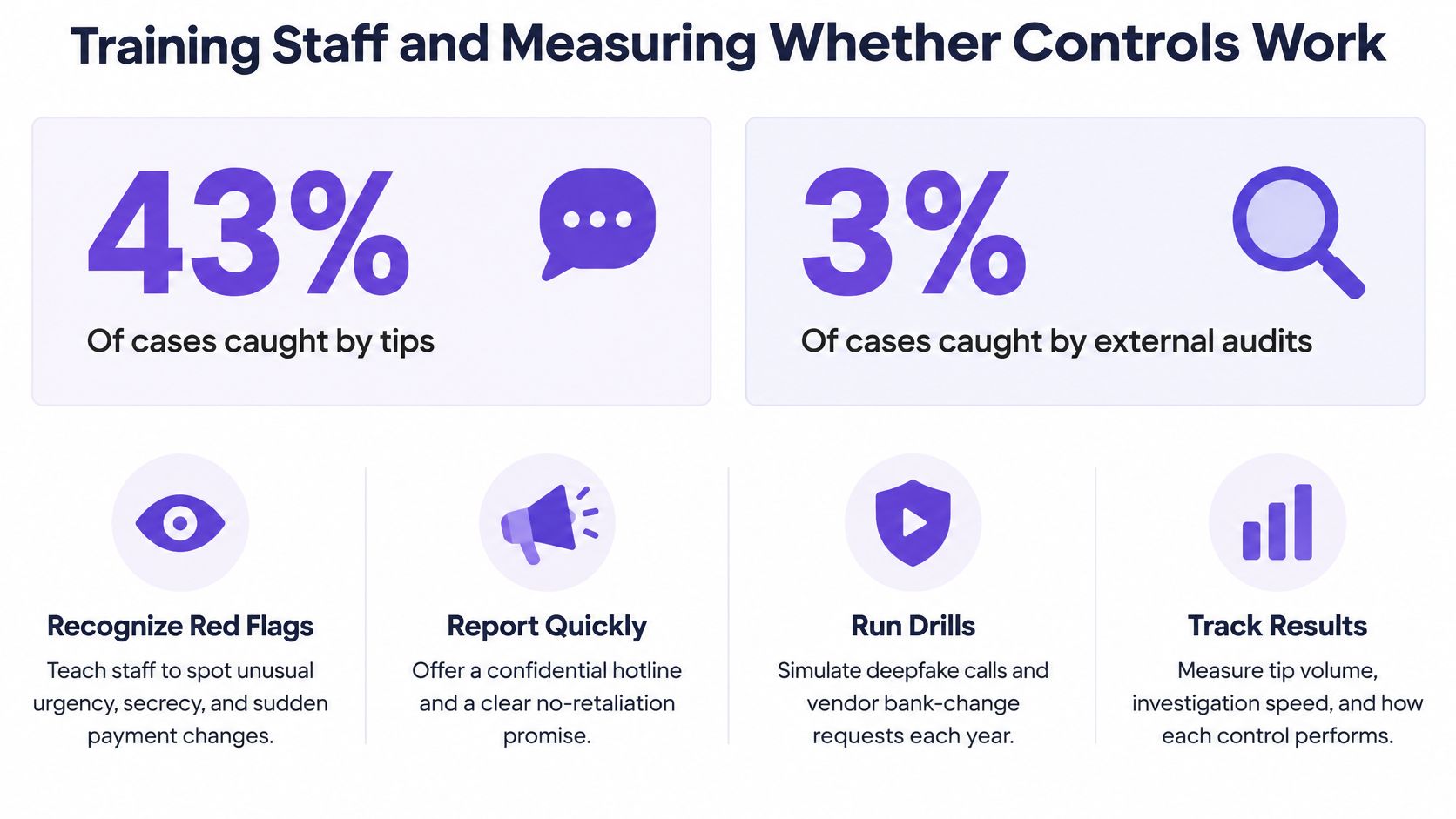
Build each session around attempts your team could plausibly receive: a fake vendor invoice, a spoofed executive request for an urgent transfer, a changed bank-detail email arriving just before a payment run. Show the exact reporting route for each scenario, and state plainly that anonymous reporting and anti-retaliation protections apply to good-faith reports.
Prioritize finance approvers, procurement, payroll and anyone who can change vendor or bank data. Refresh the scenarios yearly with the newest attempts you have seen, because last year's phishing example will not prepare staff for this year's impersonation.
Measurement needs named owners and numbers reviewed with the audit committee each quarter:
- Drill pass rate: the share of tested staff who report the simulated attempt through the right channel within the exercise window. Set a target, for example nine in ten, and retrain every group below it.
- Report yield: reports received per quarter and how many produce a substantiated finding or a stopped transaction. Rising volume after training is healthy; a flat zero is not.
- Escalation time: the hours between a suspicious request arriving and the report reaching its owner.
If a control passes every test yet never produces a finding, change the test before accepting the clean result.
Start With a 30-Day Fraud Prevention Plan
A team of three to five can make real progress in a month without new software. Don't try to redesign every process at once. Fix the routes cash takes.
Week by Week
- Week one: Get board or audit-committee sign-off on a short fraud-risk policy and name one owner. Keep it brief enough that managers will read it.
- Week two: Map the top schemes in your highest-spend areas, usually procurement, payroll and expense reimbursement. Write down how each scheme would be concealed.
- Week three: Set up or audit the reporting channel. Confirm anonymity in practice and assign report receipt outside the normal reporting line.
- Week four: Run the first red-flag checks on vendor master data and bank-detail changes. Write the verification rule for urgent payment changes and brief every approver.
Skip expensive detection platforms until basic controls are tested. A platform layered over broken segregation of duties will generate alerts that the same overloaded person can still override. Also skip any tool that promises certainty about documents or images, because that promise encourages staff to stop verifying through independent channels.
One decision can't wait until next quarter. Ask whether any single person can both change vendor data and release a payment. If the answer is yes, fix that first, even if the workaround is a temporary independent review.
That's the practical core of how to prevent corporate fraud. Separate the duties, make reporting safe, monitor weekly and verify outside the channel that made the request.
When a suspicious executive photo, identity document or vendor profile image lands in your review queue, use AI Image Detector as a fast triage step to assess whether the image appears AI generated before your team completes callback and dual approval checks. It gives compliance, finance and trust and safety teams a clear signal to prioritize manual review without treating any single image as proof on its own.