

Que Es Proverbios Explained with Clear Examples

Proverbios are short traditional sayings, and Proverbios is also the Spanish name of the biblical Book of Proverbs. The first meaning names a kind of expression; the second names a particular collection of wisdom literature.
Can a saying your grandmother repeats and a passage attributed to Solomon really be treated as the same thing? They can share a memorable style, but they don't have the same origin, context, or authority. Understanding that distinction makes it easier to learn Spanish expressions, read the biblical book, and check a quotation before sharing it.
What Que Es Proverbios Usually Means
Someone searching que es proverbios may be asking about an everyday Spanish word or the title printed in a Bible. The search phrase leaves out the accents and punctuation of a formal Spanish question, but the practical uncertainty is about meaning, not spelling.
A proverbio is a brief traditional saying that expresses an observation or offers advice. Proverbios, with a capital letter when used as a book title, identifies the biblical wisdom anthology known in English as Proverbs.
Four things people mean by proverbios
| What someone means | What it is | Typical form | Where you meet it |
|---|---|---|---|
| Spanish proverbio or dicho | A traditional saying in everyday Spanish | One memorable sentence, often rhymed or balanced | Speech, family advice, headlines, classroom Spanish |
| Book of Proverbs | Biblical wisdom anthology titled Proverbios in Spanish | Written collections of instructions and short sayings | Hebrew Bible and Christian Old Testament |
| One saying inside the book | A single aphorism quoted apart from its chapter | Usually a paired-line Hebrew saying | Sermons, devotionals, and isolated quotes |
| English proverb | The same popular genre in English | A short traditional sentence | Conversation and writing, with no required Bible connection |
The everyday Spanish words dicho, refrán, and proverbio overlap, although speakers don't always use them identically. Dicho can refer broadly to a familiar expression, while refrán often suggests a traditional saying used to comment on a recognizable situation. For a beginner, recognizing the situation matters more than drawing a rigid boundary between these labels.
The biblical book belongs with wisdom literature, alongside books such as Job and Ecclesiastes. That label describes writing concerned with understanding life, conduct, suffering, and judgment. It doesn't mean every passage uses the same literary form.
A book title isn't a genre definition
Calling something a proverb doesn't make it biblical. An English speaker can use a proverb about patience without referring to scripture, just as a Spanish speaker can repeat a family refrán without quoting Proverbios.
Conversely, not everything inside the Book of Proverbs is a standalone sentence suitable for a poster. Readers also encounter sustained instruction, speeches, and literary portraits. Treating the whole book as a bag of detachable quotations hides those differences.
Quick distinction: A proverb is a kind of saying. Proverbs is the name of a book that contains sayings and other kinds of instruction.
Both meanings involve compressing a judgment about behavior into memorable language. If the question mentions Solomon, chapters, or a Bible, it concerns the book; if it mentions a dicho a grandparent used, the everyday genre is probably the better match.
Spanish Proverbs People Still Use
A familiar saying does more than communicate its literal words. A speaker uses it to encourage, warn, soften criticism, or signal agreement, which is why learning the expression without learning its social setting can lead to awkward conversations.
Six Spanish proverbios and when people use them
| Spanish saying | Plain sense | Typical use |
|---|---|---|
| A quien madruga, Dios le ayuda | The early riser gets help | Praising a prompt start |
| Más vale tarde que nunca | Better late than never | Accepting a delayed effort |
| En boca cerrada no entran moscas | A closed mouth stays out of trouble | Advising silence |
| No hay mal que por bien no venga | No harm fails to bring some good | Reframing a setback |
| Dime con quién andas y te diré quién eres | Company reveals character | Commenting on someone's friends |
| El que mucho abarca, poco aprieta | Grasp too much and you hold little | Warning against overload |
These sayings generally circulate without an author's name attached. You may hear regional variations or a shortened version that assumes the listener already knows the ending. Don't mistake a different wording for a different underlying lesson.
Their English explanations aren't exact translations of every word. For example, the saying about a closed mouth mentions flies, but its conversational purpose is usually to recommend restraint. Understanding the image helps you remember it; understanding the situation helps you use it.
Hear the saying in a situation
Say a colleague volunteers to organize a launch, redesign the presentation, and handle customer questions while still doing their normal job. Another colleague might use El que mucho abarca, poco aprieta to suggest narrowing the workload. The useful follow-up isn't another slogan, but an offer to decide which responsibilities to hand over.
In a family setting, suppose someone finally calls a relative after postponing it. Más vale tarde que nunca can acknowledge that the call was overdue while welcoming the effort. Said warmly, it encourages repair; said sharply, it can sound like another accusation.
Tone changes the effect. The saying about good emerging from harm may help someone describe their own disappointment, but applying it to another person's fresh grief can dismiss what they're experiencing. Likewise, a warning about someone's friends can express concern or become an unfair judgment by association.
- Learn the occasion first. Record what happened immediately before someone used the expression.
- Separate image from meaning. Explain the point in ordinary English before trying to reproduce the rhythm.
- Check your relationship. Advice that sounds affectionate from a parent may sound patronizing from a stranger.
Practicing how to paraphrase a poem can help with the same distinction between memorable wording and underlying meaning. Preserve the point without assuming that every image should be read exactly as written.
These expressions aren't verses from Proverbios, even when they resemble ideas found in the Bible. Learn the situation before the rhyme, and you're less likely to turn a useful saying into an unwanted lecture.
How a Proverb Makes Its Point
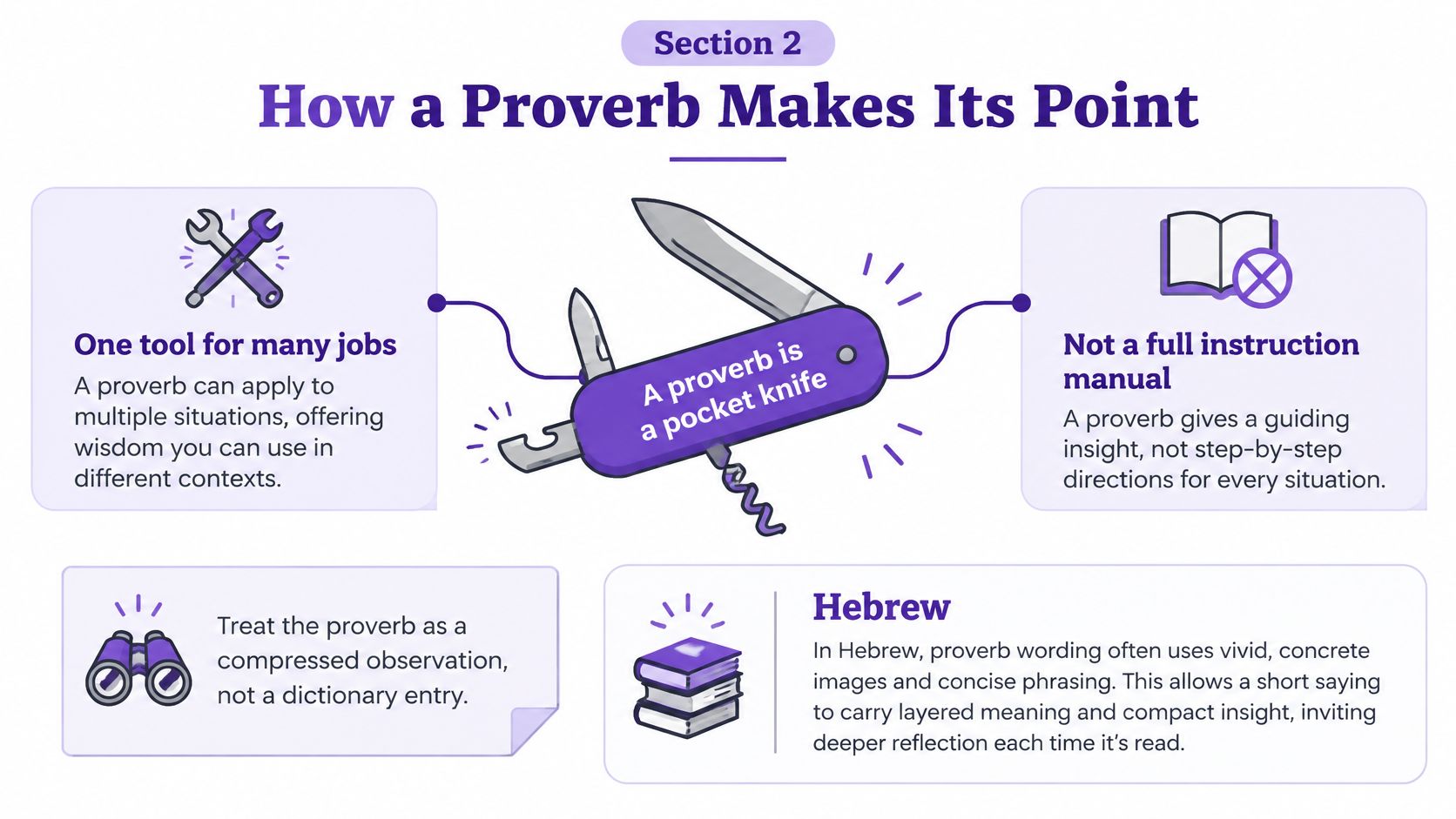
What can a short saying explain, and what must the reader supply? A proverb works like a pocket knife: it offers a compact tool for thinking about a situation, not a full instruction manual. It can point to a pattern without spelling out every condition, exception, or next step.
The visual below shows the difference between a useful saying and a complete explanation.
Read the relationship between the lines
Biblical Proverbs often uses Hebrew poetic parallelism: two lines reinforce, contrast with, intensify, or extend each other. The Oxford University Press discussion of proverbial reasoning explains how these paired lines work together. It also describes sayings as linking enduring character traits with recurring consequences, rather than presenting each act as a mechanism that guarantees a result.
The second line can explain the first line's image, set an opposing behavior beside it, or sharpen its consequence. Read the lines as a pair. A translation may preserve individual words yet obscure the relationship between them, changing the emphasis.
Consider this invented teaching example, not a Bible quotation:
A careful listener leaves room for correction.
A proud speaker answers before understanding.
The contrast is between teachability and pride, shown through behavior. Read only the first line, and the comparison that sharpens the lesson disappears.
A proverb's force comes from the connection a reader notices and considers. In this example, the two lines make a reasoned comparison, while the contrast in their wording can also stir a response. The terms pathos, logos, and ethos in rhetoric can help distinguish emotional appeal, reasoning, and credibility, though the key task here is to examine how the proverb's lines relate.
Use a character-to-consequence reading
Try this sequence before turning a saying into a command:
- Name the posture. Is the person prudent, arrogant, honest, lazy, or willing to learn?
- Name the behavior. What does that posture look like in speech, work, spending, or relationships?
- Name the probable consequence. How might other people respond, and what practical result could follow?
In the invented example, the posture is teachability, the behavior is listening before answering, and a likely benefit is a better-informed response. That reading is more precise than concluding that silence is always good.
A video can complement close reading. Keep the wording of the saying beside you as you watch.
Injustice, suffering, and unexpected outcomes complicate any simple pattern. Read a saying as guidance for recognizing recurring tendencies, not as an explanation for everything that happens.
Apply the same method to a Spanish dicho: identify the habit, the action, and the likely result. Rhyme or balance may make the saying memorable, but the reader still has to judge whether it fits.
Why the Book of Proverbs Is an Anthology
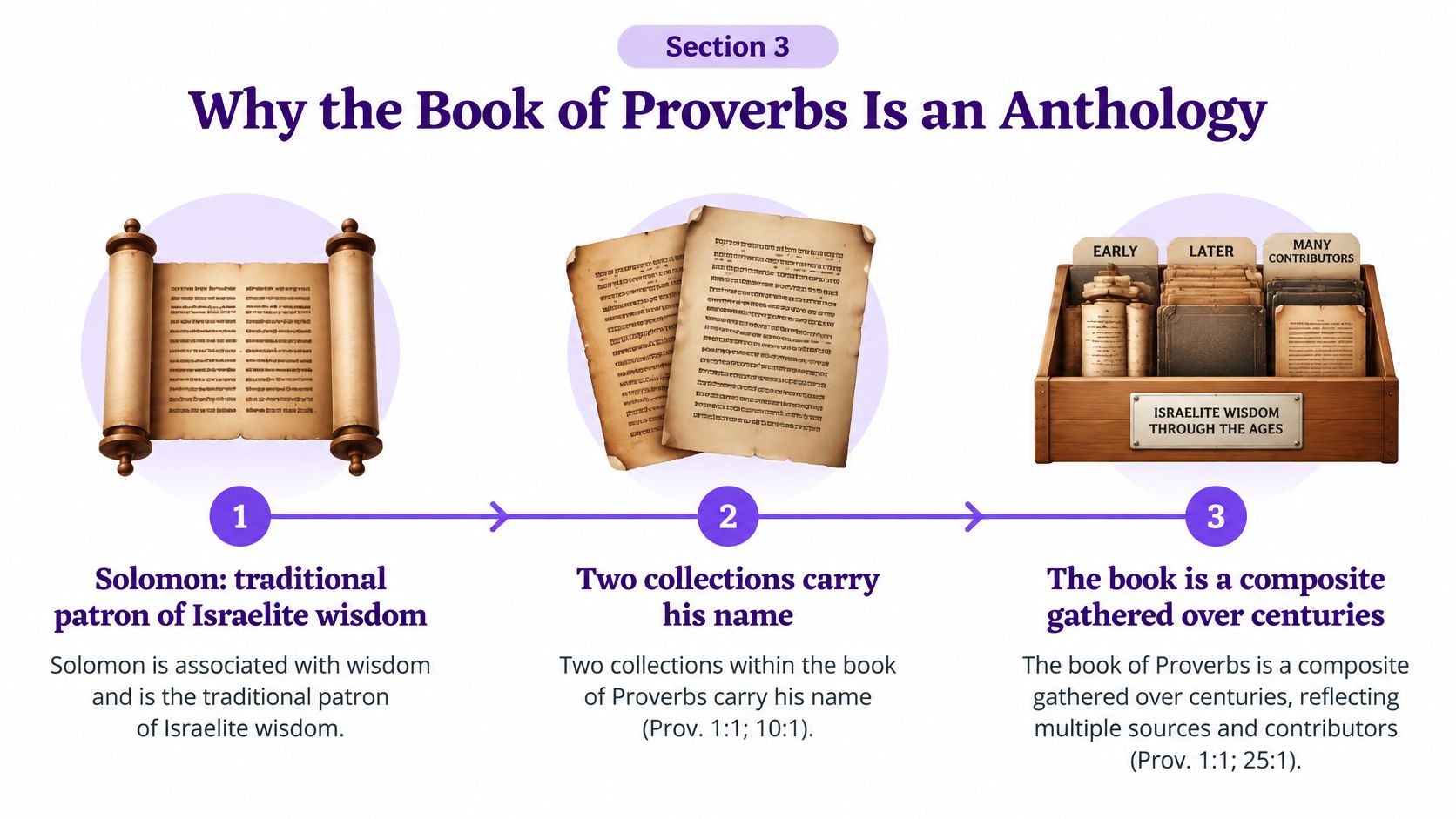
Solomon's name matters, but it doesn't identify a single author for every passage. Proverbs preserves collections associated with different figures and groups, along with evidence that people gathered and transmitted material over time.
The historical overview below distinguishes attribution from the later work of collection.
Where each block sits in Proverbs
The Encyclopedia of the Bible entry on Bible Gateway identifies the chapter blocks below, including 375 independent aphorisms in Proverbs 10:1–22:16, and places Hezekiah's reign at approximately 716–687 BCE.
| Chapters | Literary unit | Reading role |
|---|---|---|
| 1–9 | Parental instructions and speeches about Woman Wisdom | Forms the learner before the short sayings begin |
| 10:1–22:16 | Solomonic collection of 375 independent aphorisms | Parallelistic couplets with no obvious thematic sequence |
| 22:17–24:34 | Sayings of the wise | Short instructional sayings |
| 25–29 | Further Solomonic sayings copied under Hezekiah, identified at 25:1 | Compact couplets for comparison |
| 30–31 | Appendixes linked with Agur and King Lemuel | Concluding material, including the portrait of a capable woman |
The opening instructions address someone learning how to live and choose well. Their longer speeches establish the seriousness of learning before readers encounter the more compressed collections. Woman Wisdom is part of that literary teaching strategy, not another named contributor.
The Solomonic aphorisms require a different reading pace. Because the sayings don't follow an obvious thematic sequence, the reader shouldn't force every neighboring statement into a continuous argument. Sometimes comparison is more useful than searching for a plot.
Attribution and compilation answer different questions
The reference to Hezekiah's officials is especially revealing. Copying additional Solomonic sayings is an editorial activity: people preserve material already associated with an earlier authority. That distinction explains how a collection can bear Solomon's name while also showing later human involvement.
Attribution asks whose tradition a collection represents. Compilation asks how its material reached its present arrangement. Confusing those questions creates the misleading picture of a finished book written in a single sitting.
The United States Conference of Catholic Bishops introduction to Proverbs describes the work as an anthology of collections, with some material possibly originating in the monarchic period and complete editing generally associated with the early postexilic period. Its discussion also helps readers recognize the concluding portrait of the capable woman as part of the book's designed shape.
Israelite wisdom belongs within a wider ancient world of instruction, advice, and reproach. Comparing such traditions doesn't by itself establish that a particular sentence was borrowed. It does prevent the mistaken assumption that giving compact advice was unique to this biblical book.
For sustained reading, The Bible Seminary offers a reading plan for Proverbs that can help you approach the text as a study rather than a quotation hunt. Keep the collection headings visible as you read.
The result is best understood as an anthology of anthologies. Before treating a favorite verse as the book's entire message, identify which collection contains it and what kind of writing surrounds it.
Themes the Sayings Keep Returning To
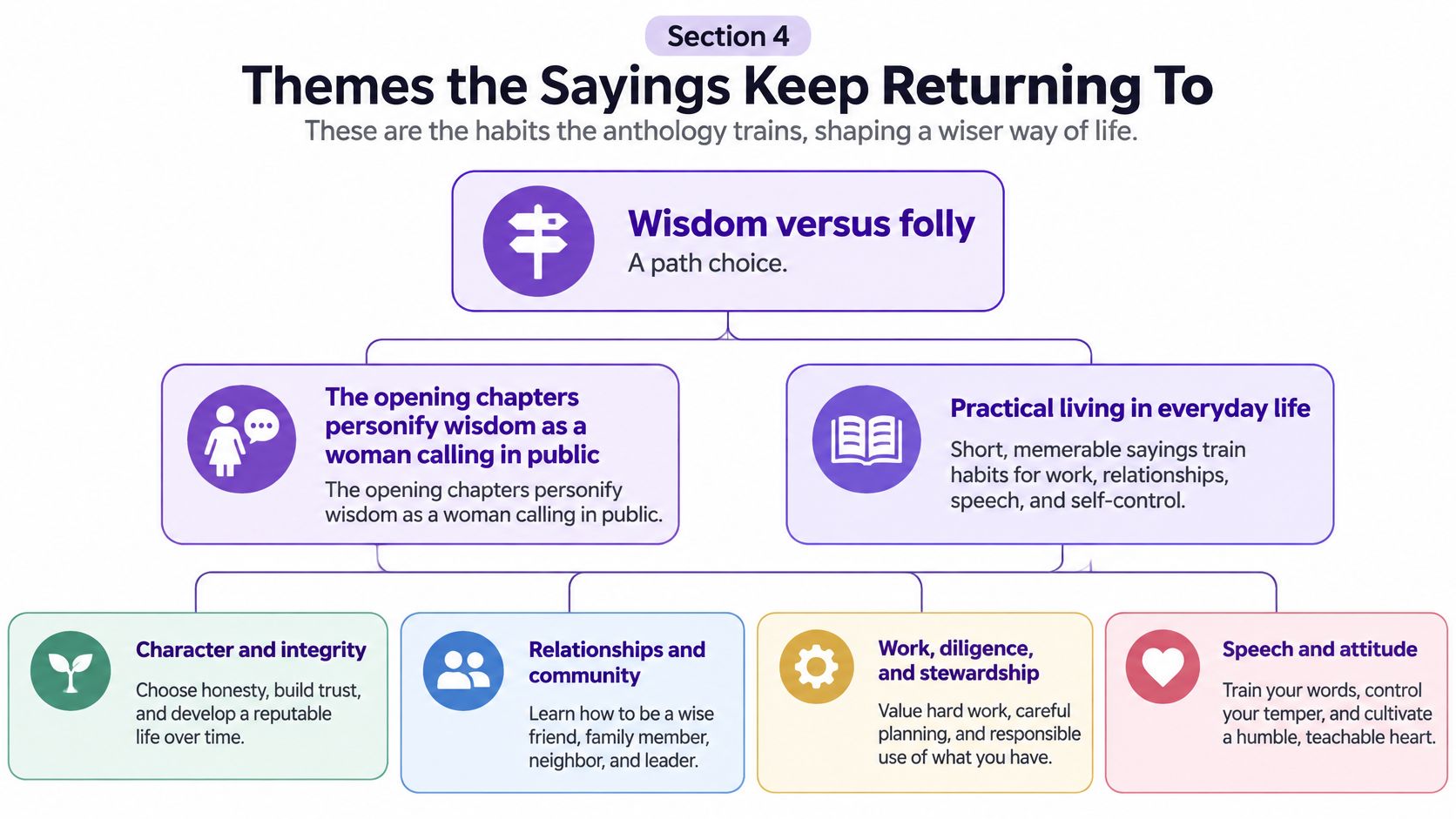
The book's recurring concerns are easier to understand as habits readers are being asked to develop than as a list of subjects to memorize. A saying about money can also concern honesty; a saying about speech can reveal whether someone accepts correction.
This diagram groups those overlapping concerns around practical judgment.
Wisdom begins with a choice
Wisdom versus folly is more concrete than intelligence versus ignorance. In the opening literary speeches, readers encounter wisdom as a woman calling publicly and folly as a competing attraction. The question is which invitation a person will follow.
A practical example is the decision to investigate an appealing offer rather than accept it because it sounds flattering. The wise response may require patience, advice, or admitting that you don't yet understand the terms. Cleverness alone doesn't supply that willingness.
Speech makes private attitudes audible. Truthfulness, gossip, rash commitments, and harsh replies matter because other people have to live with what a speaker says. A concrete habit is refusing to forward an accusation before checking whether it's accurate and necessary to share.
A useful theme question is not simply what topic the saying mentions, but what habit the reader is being asked to practice.
Work, relationships, and correction
Work and money concern how someone earns, manages, and risks resources. Diligence differs from frantic activity, just as honest gain differs from securing an advantage through deception. Before agreeing to guarantee another person's obligation, for example, a prudent reader would examine what responsibility they're accepting.
Relationships make those decisions personal. Parents and children, neighbors, friends, and spouses encounter each other repeatedly, so reliability matters beyond a dramatic gesture. Keeping a confidence is a concrete way to protect a friendship; repeatedly exposing private information undermines it.
The treatment of sexual fidelity belongs within that concern for trust and commitments. Reading it merely as a warning about an isolated temptation can obscure the wider issue of what a person's repeated choices do to a household.
Finally, correction tests whether someone wants to improve or merely appear right. The teachable person can investigate a rebuke without accepting every accusation uncritically. A scoffing response rejects the possibility of learning before examining the substance.
- In a classroom, ask a student to identify the behavior being encouraged, not just label a passage as being about wisdom.
- At work, distinguish a disagreement over evidence from resentment at being corrected.
- In personal reading, note where an appealing saying challenges your own conduct rather than someone else's.
When a quoted line feels random, place it within wisdom, speech, work and money, relationships, or correction. Naming the habit gives you a more useful starting point than treating the sentence as a free-floating slogan.
Misreadings to Avoid and a Quoting Check
A memorable sentence is easy to repeat and easy to misuse. The scholarly introduction available through JSTOR treats Proverbs as a composite anthology whose compact sayings require comparison and contextual judgment, not as a uniform set of unconditional predictions.
Assumptions that distort the reading
Solomon wrote every line. Check the collection heading before assigning authorship. A name associated with one block doesn't automatically identify the speaker or contributor elsewhere.
A proverb guarantees an outcome. Ask whether you're turning guidance about conduct into a promise about circumstances. Advice about diligence doesn't justify blaming someone whose honest work meets exploitation, illness, or disaster.
A single couplet settles the dispute. Examine what question the saying addresses. A warning about reckless speech doesn't settle every question about when someone should speak against wrongdoing.
A Spanish dicho is interchangeable with a Bible verse. Identify the expression's source before attaching a scriptural label. Religious vocabulary inside a traditional saying isn't enough to establish that it comes from a biblical passage.
Woman Wisdom and the capable woman define all women. Distinguish personification and literary portrait from a universal description. Ask what each passage contributes to its collection before using it to judge an actual person.
Check the quotation before sharing it
For an everyday dicho, begin with the occasion. Ask whether the person needs encouragement, caution, practical help, or someone willing to listen. Then select the expression that fits, rather than choosing the most impressive-sounding line.
For a biblical saying, open an actual Bible text instead of relying on a quote graphic. Read the collection heading, the complete saying, and enough surrounding material to understand its function. An introductory note that explicitly identifies the book as an anthology is more helpful here than an unattributed list of favorite verses.
Use critical evaluation techniques to separate the wording you can verify from the conclusion someone has attached to it. A genuine quotation can still be paired with a misleading interpretation.
Before you post: Check the words, identify the source, and explain the situation the saying addresses.
If isolated quotations are your main exposure to the Bible, HolyJot's guidance to build a consistent Scripture reading habit offers a practical way to make contextual reading part of your routine. Keep a brief note beside passages you may want to share.
Choose a saying now and write down a situation where it fits and a situation where it doesn't. Keep both notes with the quotation, so its memorable wording doesn't replace your judgment.
AI Image Detector offers image analysis to help you assess whether a visual may have been generated by AI. If you encounter a proverb on a quote card or in an illustrated teaching resource, verify the wording against its text and visit AI Image Detector to examine the image separately. An image assessment can inform your visual checks, but it doesn't establish a quotation's authorship or meaning.