

Una Onza Cuantos Gramos Tiene: Exact Grams

One avoirdupois ounce equals exactly 28.349523125 grams, commonly rounded to 28.35 g for household use. The exception is the troy ounce used for precious metals, which equals exactly 31.1034768 grams.
The important question isn't just how to convert an ounce. It's which ounce the product uses. A recipe, a parcel label, and a silver listing can all mention ounces, but you shouldn't automatically apply the same conversion to each.
How Many Grams One Ounce Has
28.3495 grams is a useful reference figure for the ordinary ounce. For everyday weighing, 28.35 grams is the more convenient rounded value.
This ordinary ounce is called the avoirdupois ounce. The unfamiliar name doesn't mean it's a specialist measurement. It's the ounce you'll generally encounter when weighing food, parcels, and ordinary retail goods.
A search for una onza cuantos gramos tiene often produces a short answer without identifying that system. That's enough for a quick kitchen estimate, but not enough to interpret every product label correctly.
Start with the product
Before opening a calculator, identify what you're weighing:
- Food or ingredients: Use the ordinary household ounce when the recipe specifies weight.
- Parcels or retail goods: Read the weight declaration, taking care to distinguish product weight from packaged weight.
- Gold, silver, or platinum: Check for troy measurement rather than assuming the household conversion.
- Liquids: Look for a fluid-ounce abbreviation before treating the quantity as a weight.
The practical difference is between oz, which generally identifies the ordinary ounce, and oz t, which identifies the troy ounce. Product context matters too, particularly when a precious-metal seller abbreviates the unit loosely.
Exact definitions and usable measurements
An exact conversion factor and a scale reading serve different purposes. The conversion factor defines the relationship between units. Your scale determines how finely you can measure the result.
Don't mistake a display rounded to whole grams for a different definition of the ounce. Likewise, don't add decimal places to a measurement and assume you've made the weighing more accurate.
Practical rule: Identify the ounce system first, calculate with its full conversion factor, and round the result to suit the task.
A whole-number shortcut can help you estimate whether an answer looks reasonable. It shouldn't replace the proper factor when you're scaling a recipe, checking a shipment, or comparing a metal weight with a price quote.
Use 28.35 grams for food and everyday goods, and 31.1035 grams for precious metals.
Quick Ounce to Gram Lookup Chart
Avoirdupois ounces to grams
These calculated examples use the exact household-ounce factor and round the final gram result to two decimal places.
| Ounces | Grams | Typical item |
|---|---|---|
| 0.5 oz | 14.17 g | Half-ounce packet |
| 1 oz | 28.35 g | Standard household ounce |
| 2 oz | 56.70 g | Small retail pack |
| 3 oz | 85.05 g | Hypothetical cooked meat serving |
| 4 oz | 113.40 g | Quarter-pound portion |
| 6 oz | 170.10 g | Hypothetical cheese or produce portion |
| 8 oz | 226.80 g | Half-pound portion |
| 12 oz | 340.19 g | Hypothetical large food pack |
| 16 oz | 453.59 g | One avoirdupois pound |
Treat the item descriptions as illustrations, not prescribed serving sizes or guaranteed package formats. The table converts a stated weight; it doesn't tell you how much food you should serve.
Use it for ordinary weight labels, not for a listing marked troy, oz t, or fine gold. A liquid container marked fl oz also falls outside this chart.
How to read a package against the chart
Suppose you're portioning cheese and the recipe calls for 6 oz. The corresponding calculated weight is 170.10 g. Put the plate or bowl on your scale, tare it, and weigh the cheese itself.
For a hypothetical 3 oz meat serving, the conversion gives 85.05 g. Check whether the recipe means raw or cooked meat before weighing. Unit conversion doesn't resolve a difference in preparation state.
A hypothetical 0.75 oz spice packet converts to 21.26 g. Because that amount isn't a listed row, calculate directly rather than guessing between the nearest entries.
Working with fractions
For a hypothetical quarter-ounce amount, the calculated result is 7.09 g. For a half-ounce amount, use the half-ounce row rather than rounding the ordinary ounce to a whole number and dividing that shortcut.
The same principle applies when increasing a recipe. If you need several identical portions, calculate their combined ounce weight first, then convert that total.
- For a single portion: Choose the matching row and use the displayed gram value.
- For a scaled batch: Multiply the original ounce quantity by the batch size, then convert.
- For an unfamiliar fraction: Enter the fraction as a decimal and use the full conversion factor.
- For bullion or jewelry: Leave this chart aside and confirm the metal's stated weight system.
Rounding a table entry is convenient for weighing a portion. Repeatedly adding rounded entries can produce a slightly different answer from converting the full batch at once.
Don't reuse this household chart for precious metals. A familiar-looking ounce label on a silver round requires a different interpretation from the same label on a food packet.
Ounce Categories and When Each Applies
Which ounce the label means
| Category | Exact measure | Grains | Abbreviation | Use it for |
|---|---|---|---|---|
| Avoirdupois ounce | 28.349523125 g | 437.5 | oz | Food, shipping, retail, body weight |
| Troy ounce | 31.1034768 g | 480 | oz t | Gold, silver, platinum, jewelry |
| US fluid ounce | A volume measure, not a fixed gram weight | Not applicable | fl oz | Liquid volume only |
The NIST weights-and-measures appendix distinguishes the avoirdupois ounce of 28.349523125 grams and 437.5 grains from the troy ounce of 31.1034768 grams and 480 grains. The troy ounce is therefore about 9.7% heavier than the ordinary ounce.
The comparison below separates mass measurements from liquid volume.
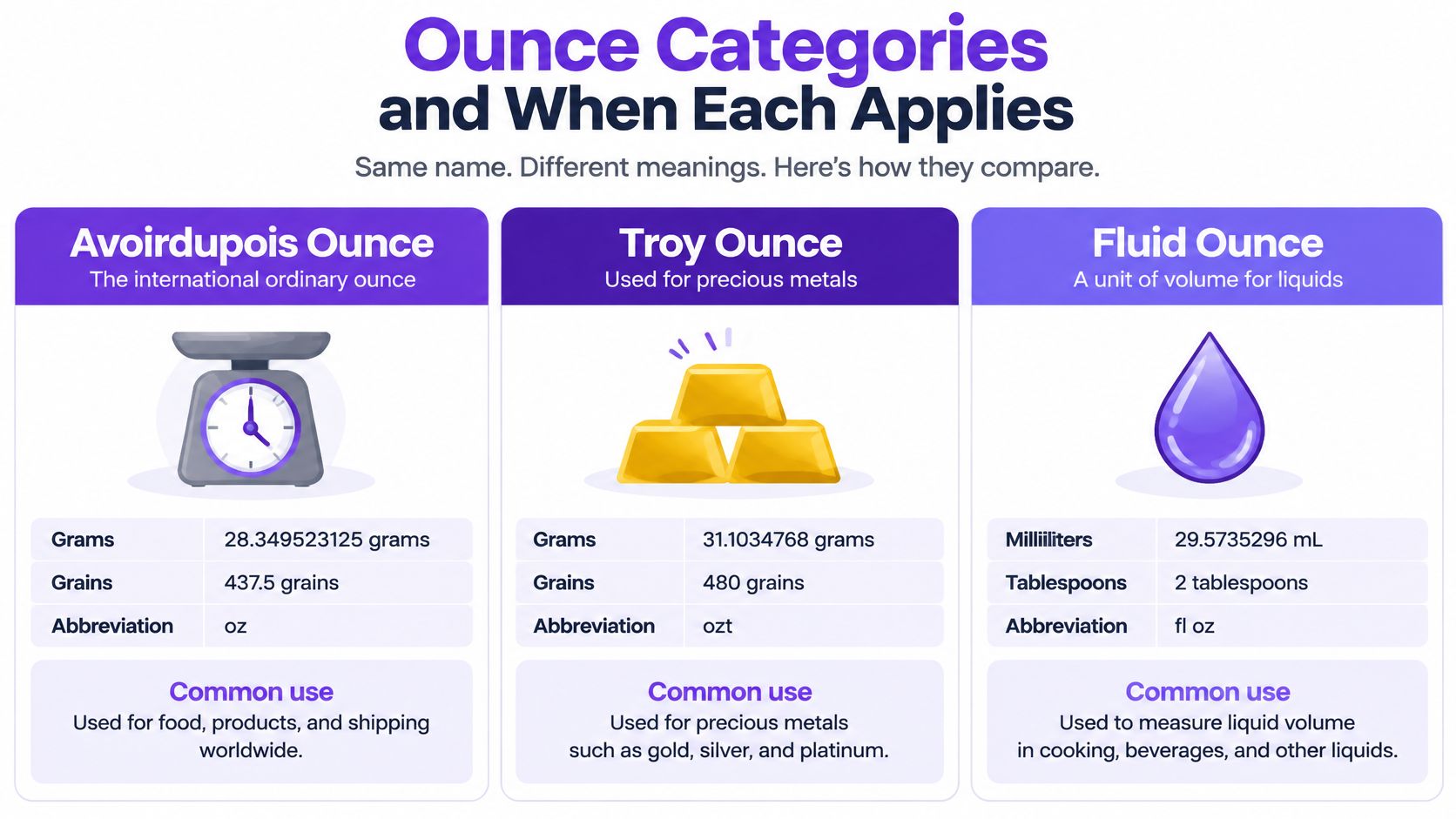
Why the grain counts matter
A grain is a unit of mass, not a reference to a grain of rice or wheat. Both ounce systems can be expressed in this shared unit, which makes their difference easier to understand.
The troy ounce contains more grains. It isn't just the ordinary ounce written with extra decimal places, and the difference isn't caused by rounding.
For a hypothetical metal order, subtracting the ordinary-ounce factor from the troy factor gives a calculated difference of 2.753953675 g per ounce. Across a hypothetical 10-ounce order, that becomes approximately 27.54 g.
That's why a generic conversion can produce a misleading bullion comparison. A buyer might perform the multiplication correctly while choosing the wrong unit at the outset.
Fluid ounces answer a different question
A fluid ounce measures volume. Grams measure mass. You can't convert between them using either of the weight-ounce factors.
To convert a liquid volume into grams, you need the liquid's density under the relevant conditions. Oil, milk, and syrup don't necessarily weigh the same when poured to the same volume mark.
The distinction also applies to US and British imperial fluid-ounce systems. Both describe volume, so neither should be treated as a universal gram weight.
- Kitchen, grocery, or postal context: Ordinary weight ounces are the usual interpretation when the label specifies mass.
- Mint or bullion context: Expect troy measurement, then confirm the written specification.
- Jewelry context: Prefer an explicitly stated gram weight; don't infer metal content from the ounce alone.
- Liquid-capacity context: Keep the quantity as volume unless you have a justified density conversion.
When a label is ambiguous, ask the seller which system it uses. A clear unit declaration is more useful than a highly precise calculation built on an assumption.
Avoirdupois Ounce in Food and Retail
For food and ordinary retail weighing, the material doesn't change the ounce-to-gram relationship. An ounce of flour and an ounce of cheese have equal mass, even though they occupy different amounts of space.
The exact household factor is 28.349523125 grams per ounce. Keep it in your calculator and choose a practical display only after completing the multiplication.
Match rounding to the job
| Display choice | Calculated household-ounce value | Appropriate purpose |
|---|---|---|
| Two decimal places | 28.35 g | A conversion reference or suitably precise scale |
| One decimal place | 28.3 g | A measurement recorded to tenths |
| Whole grams | 28 g | A rough estimate or whole-gram display |
These are different displays of the same conversion, not competing definitions. A scale's resolution limits what it can show, while its accuracy determines how close its reading is to the actual mass.
For cooking, set the scale to grams, place the empty bowl on it, and press tare. Add the ingredient until you reach the converted target.
Worked kitchen and retail examples
Suppose a recipe calls for 5 oz of flour. The calculation is:
5 × 28.349523125 = 141.747615625 g, rounded to 141.75 g.
Weighing avoids the extra uncertainty of interpreting a cup measure. Flour can settle or become compacted, so a volume scoop doesn't directly establish its mass.
For a hypothetical 7 oz snack pack, the calculation is:
7 × 28.349523125 = 198.446661875 g, rounded to 198.45 g.
Use the label's existing gram declaration if it provides one. Converting a rounded ounce figure back into grams can introduce a small mismatch that doesn't necessarily mean the package is incorrectly labeled.
Shipping requires the right thing on the scale
A hypothetical parcel weighing 10 oz converts to 283.49523125 g, or 283.50 g after rounding. Using a whole-number shortcut of 28 g per ounce would give 280 g, understating that calculated weight by about 3.50 g.
For an actual shipment, weigh the sealed parcel rather than relying on the product's net weight. Include the box, mailer, cushioning, tape, and anything else traveling with it.
- Net weight: The contents without their packaging.
- Tare weight: The empty container or packaging.
- Gross weight: The contents and packaging together.
Keep the calculation precise, but weigh the object the task actually concerns. A correct conversion of net contents won't give you the shipping weight of a packed parcel.
For nutrition tracking, retain a gram-based serving declaration rather than converting it into ounces and back. Conversion helps reconcile different units; it shouldn't add unnecessary steps to an already usable measurement.
Troy Ounce for Gold Silver and Jewelry
Precious-metal comparisons require a troy-ounce factor, not a kitchen-scale shortcut. The exact factor is 31.1034768 grams, commonly displayed as 31.1035 g or 31.10 g, depending on the required precision.
The following hypothetical calculations show both the correct troy conversion and the result of incorrectly multiplying by the rounded household factor. The headings distinguish exact products from rounded error figures.
Troy ounce multiples in grams
| Troy measure | Exact grams | Wrong 28.35 g figure | Calculated shortfall |
|---|---|---|---|
| 1 troy oz | 31.1034768 g | 28.35 g | 2.75 g |
| 5 troy oz | 155.517384 g | 141.75 g | 13.77 g |
| 10 troy oz | 311.034768 g | 283.50 g | 27.53 g |
| 100 troy oz | 3,110.34768 g | 2,835.00 g | 275.35 g |
| 12 troy oz | 373.2417216 g | 340.20 g | 33.04 g |
The wrong column consistently uses the rounded household factor named in its heading. Using the exact household factor would produce slightly different results, but it still wouldn't be a valid troy conversion.
Read metal listings as specifications
For a coin or bar, separate gross mass, purity, and fine-metal content. Converting a mass into troy ounces doesn't tell you whether the item is pure metal or an alloy.
Jewelry creates a similar distinction. Karat describes purity, not weight. A gram measurement tells you the item's mass; a purity marking addresses its composition.
Before comparing an asking price with a bullion quote, check:
- The quoted unit: Is the price per gram or per troy ounce?
- The stated content: Does the weight describe the whole item or its fine-metal content?
- The documentation: Do the listing, product markings, and certificate describe the same item?
- The scale setting: Is the instrument displaying grams, ordinary ounces, or troy ounces?
If you're evaluating a silver listing, Idaho Pawn & Gold Exchange offers a practical resource to help you verify silver bullion before you buy. Use buying guidance alongside the seller's written specifications, not instead of them.
Handle discrepancies before pricing
Don't automatically select whichever printed weight produces the more attractive deal. If a certificate, listing, and product marking disagree beyond an understandable rounding difference, ask for clarification before buying.
A gram-based scale setting can reduce confusion when your scale's ounce mode is unclear. Record the measured grams and convert explicitly to the unit used by the quote.
Buying check: Confirm the weight unit and purity separately. Neither a correct conversion nor a convincing product photograph establishes authenticity.
Jewelry already listed in grams needs no ounce conversion unless you're comparing it with an ounce-based quote. Even then, keep the purity adjustment separate from the unit conversion so you can check each operation.
Formulas to Convert Ounces and Grams
Use the same factor in both directions. Multiplication changes ounces into grams; division changes grams into the corresponding kind of ounce.
This process graphic highlights the label check before the calculation.
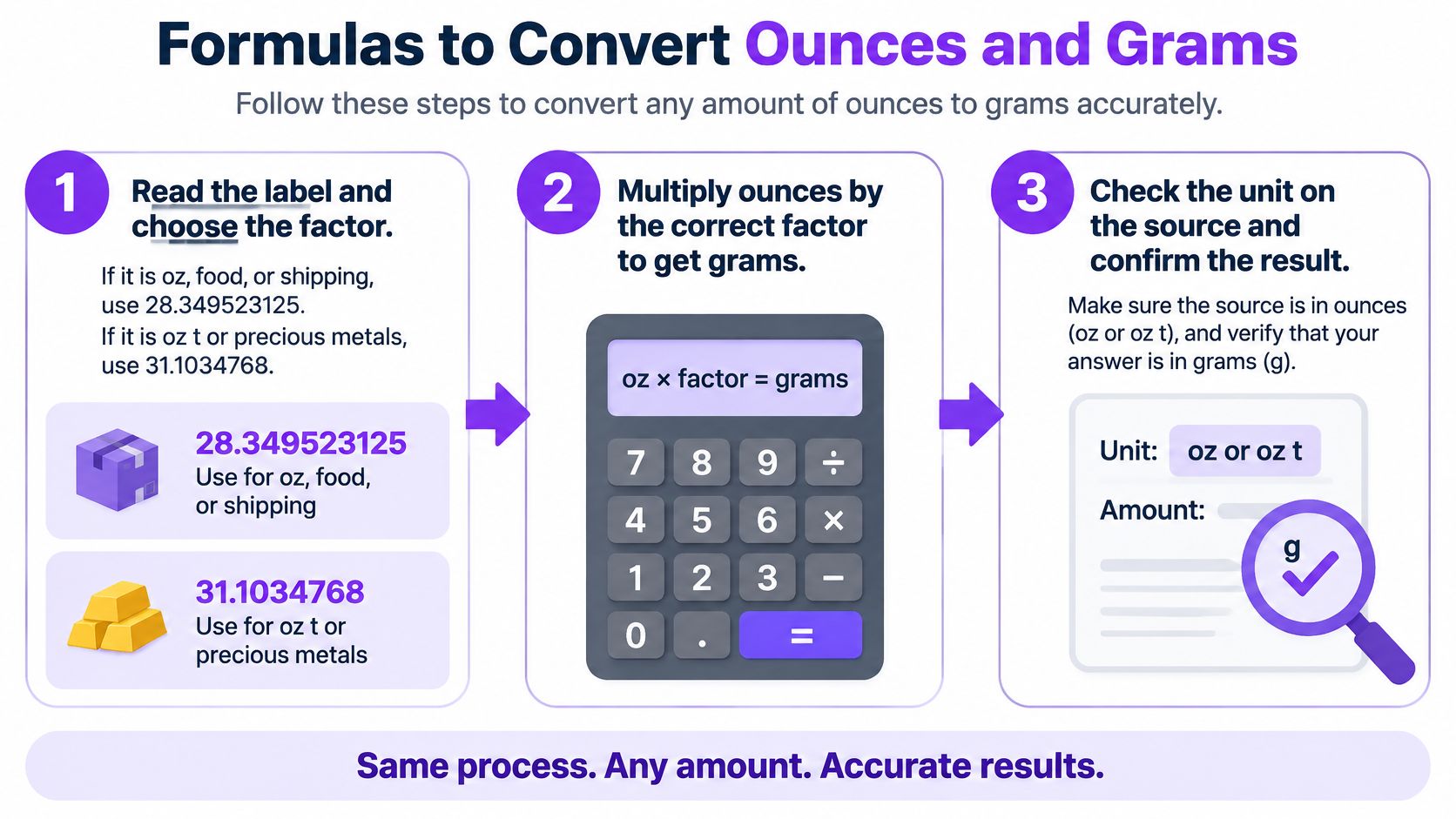
A reusable calculation procedure
- Read the unit. Choose the household factor for ordinary weight ounces or the troy factor for a confirmed precious-metal weight.
- Multiply to obtain grams. Enter the ounce quantity, multiply by the selected factor, and retain the calculator's extra decimals.
- Divide to obtain ounces. Start with the gram quantity and divide by that same factor.
- Round the final answer. Match the displayed precision to the scale, document, or comparison you're making.
The reusable formulas are:
Grams = ounces × grams per ounce
Ounces = grams ÷ grams per ounce
Write the system beside the result. A bare “oz” in a spreadsheet can become ambiguous when someone later uses the calculation for a different product.
Household examples in both directions
For a hypothetical 2.5 oz ingredient quantity:
2.5 × 28.349523125 = 70.8738078125 g, rounded to 70.87 g.
For a hypothetical 100 g grocery quantity:
100 ÷ 28.349523125 ≈ 3.5274 avoirdupois oz.
The reverse calculation is a useful check. Multiply the unrounded ounce result by the same factor and you should recover the starting gram quantity, apart from the calculator's display precision.
Troy examples in both directions
For a hypothetical 2.5 troy oz metal quantity:
2.5 × 31.1034768 = 77.758692 g, rounded to 77.7587 g.
For a hypothetical 50 g silver quantity:
50 ÷ 31.1034768 ≈ 1.6075 troy oz.
Don't convert grams into household ounces and then attach a troy-ounce price to the result. The arithmetic may look orderly, but the units no longer match.
For a visual demonstration of the conversion process, use the video below.
When building a calculator or spreadsheet, name the factor cell explicitly, such as household grams per ounce or troy grams per ounce. Keep the numeric result separate from its unit label so you can audit the formula without losing the meaning of the answer.
Related Units Cross Referenced from the Ounce
Unit conversions become confusing when a label changes not only the unit but also the measurement system. A pound reference, a grain count, and an ounce quantity should describe a consistent chain of mass measurements.
The concept map below illustrates the relationships you need to distinguish.
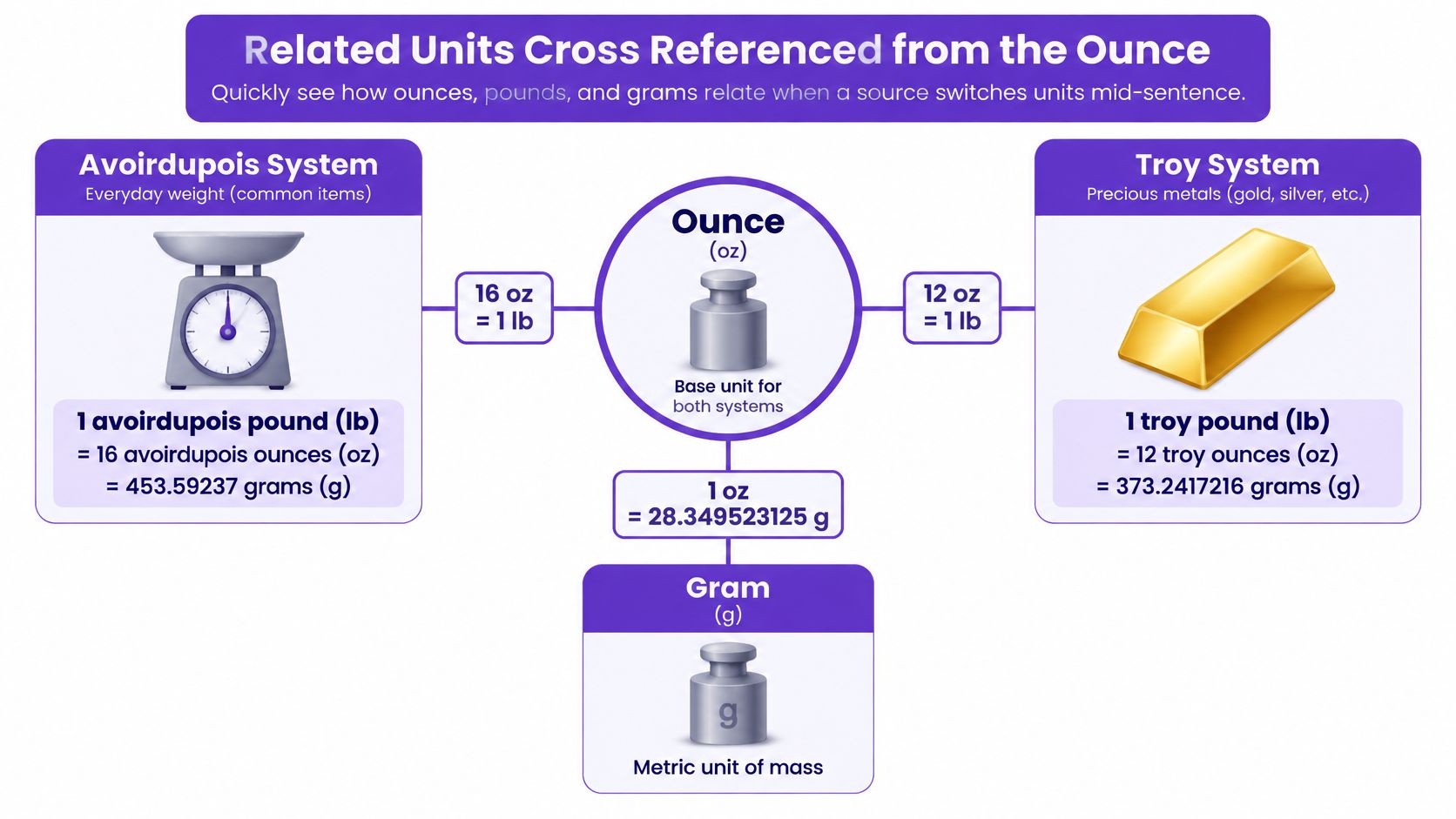
Use grains as a common bridge
The grain counts provide a way to compare the ounce systems without pretending they're interchangeable. Dividing each ounce's exact gram mass by its grain count produces the same mass per grain.
The calculation is:
28.349523125 ÷ 437.5 = 0.06479891 g per grain
And independently:
31.1034768 ÷ 480 = 0.06479891 g per grain
These derived results agree because the grain is the shared unit. The systems differ in how many grains they assign to an ounce.
A grain is therefore useful for checking a definition, but it's rarely a necessary intermediate step when a gram conversion is already available. Adding extra conversions creates more opportunities to round prematurely.
Keep pound references attached to their system
A pound label needs its system identified just as an ounce label does. Don't assume that an ordinary grocery pound and a troy pound represent the same mass.
For a separate explanation of the household relationship, consult this guide to how many ounces are in a pound. When reading a metal document, check whether its pound reference explicitly belongs to the troy system.
- Starting with an imperial weight: Identify the system, then convert directly to grams.
- Starting with a metric weight: Retain grams until you need a comparison in a named ounce system.
- Starting with a grain count: Use the shared grain definition rather than substituting an assumed ounce.
- Starting with a regional metal unit: Obtain its stated gram definition before calculating an ounce equivalent.
Regional names such as tola deserve the same care. Don't guess their value from a familiar-looking fraction of an ordinary ounce.
Choose the shortest valid route
If a supplier provides grams and your worksheet requires grams, no conversion is necessary. If a quote uses troy ounces, convert directly from the supplied gram weight into troy ounces.
Avoid routes that pass from grams through household ounces, then through pounds, and finally into a metal quote. Each step requires another unit decision without improving the original measurement.
Fluid ounces never belong in a dry-weight conversion chain. A volume declaration requires density information before it can become a mass, regardless of which weight unit you ultimately want.
Choose the Ounce Before You Convert
The safest conversion starts with a label check, not a multiplication. You're choosing a measurement system before you're choosing a rounded answer.
This decision graphic summarizes the distinction between household weight, precious-metal weight, and liquid volume.
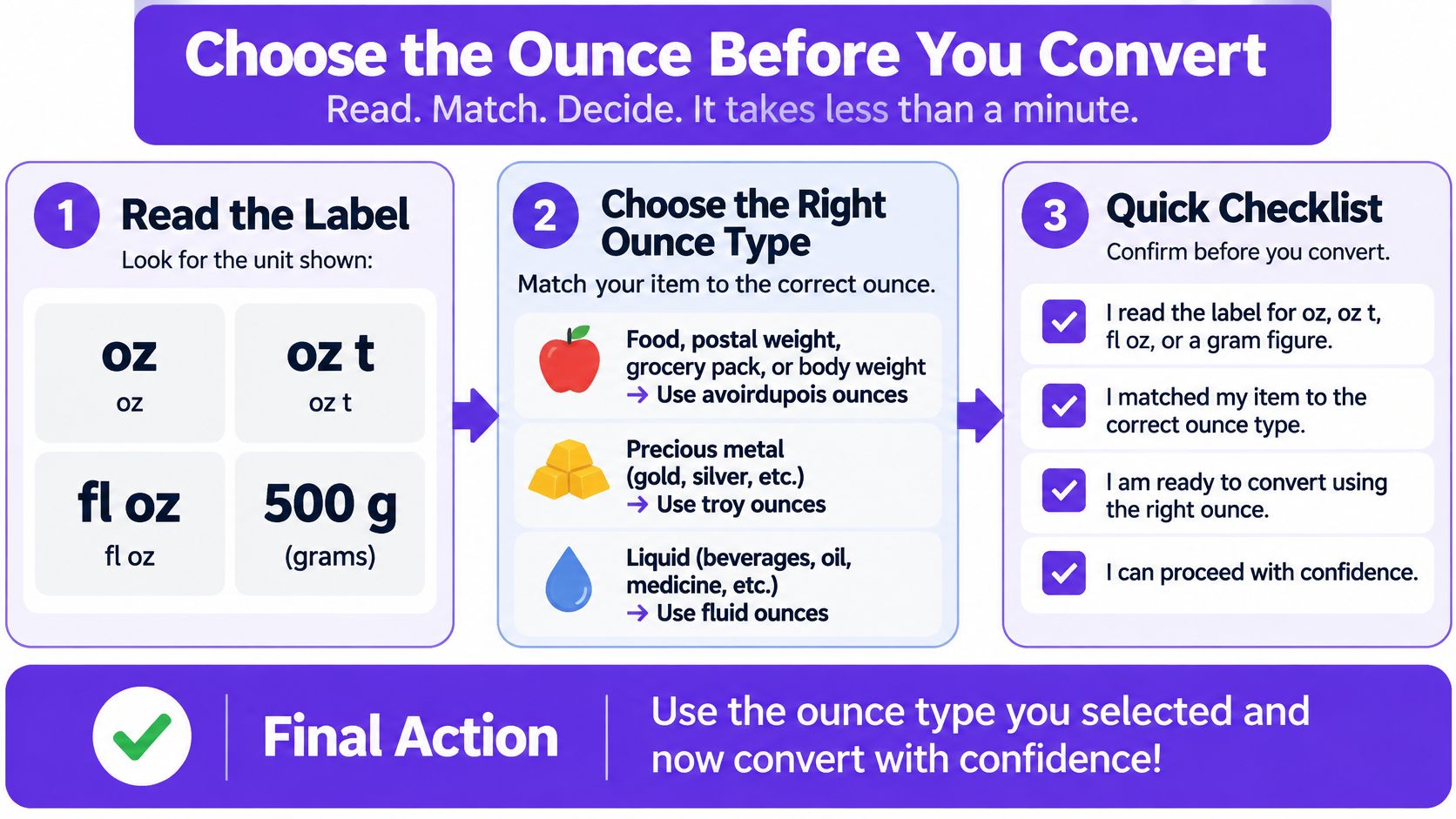
A label check you can reuse
- Read the complete declaration. Look for oz, oz t, fl oz, troy, grams, or a metric volume unit.
- Classify ordinary goods. For food, parcels, and general retail weights, select the household system unless the specification says otherwise.
- Confirm precious-metal weights. For bullion, minted coins, and precious-metal listings, verify the troy declaration and distinguish total mass from fine-metal content.
- Stop at fluid ounces. Treat fl oz as volume. Don't apply a weight-ounce factor to it.
- Compare printed units sensibly. Use an explicit gram declaration directly when grams are what you need, and investigate discrepancies that rounding doesn't explain.
The printed unit matters more than the product's appearance. A liquid can be sold by mass, and a container can show capacity rather than the mass of its contents.
Apply the choice to real tasks
Suppose you're converting a hypothetical 16 oz bag of rice. Treating that declaration as ordinary net weight gives a calculated 453.59 g. The bag's packaging would need separate consideration if you were preparing a shipment.
For a hypothetical 1 troy oz silver round, the calculated mass displays as 31.10 g on a two-decimal reference. That conversion interprets the stated weight; it doesn't verify the round's purity or authenticity.
For a glass marked in fl oz, don't use either weight conversion. If you need the drink's mass, tare the empty glass on a scale and weigh the contents, or use an appropriate density-based calculation.
Make the final check before multiplying
Write the unit next to your input and output. For a recipe, that might mean household ounces to grams; for a bullion comparison, grams to troy ounces.
If the label is incomplete, pause and obtain the specification. Extra decimal places can't repair an unidentified unit.
Before pressing the multiplication key, check oz versus oz t, and make sure you haven't overlooked fl oz.
AI Image Detector helps assess whether an image was AI-generated or human-created, which can support a separate visual check when you're reviewing product photos or conversion graphics. Visit AI Image Detector to examine a questionable image, while verifying weight, purity, and unit declarations through the product's documentation.