

AI Content Detector: How It Works and When to Trust It

An AI content detector estimates whether text or media was machine-generated, and its result is a probability, not proof. The safest interpretation is risk assessment, especially because research found that only 38% of examined AI-image generators used adequate watermarking and only 8% used deepfake labeling.
A viral image lands in a newsroom chat. A student submits an unusually polished essay. A marketplace seller uploads a property photograph that looks real, but the lighting feels wrong. In each case, an ai content detector can help decide what deserves closer attention, but it can't establish authorship or intent by itself.
The distinction matters because detection tools examine the file or text currently in front of them. They don't automatically know who created it, which generator was used, whether someone edited it, or what happened before the upload. A responsible result should therefore guide verification, not replace it.
What an AI Content Detector Actually Does
A reporter sees a dramatic photograph spreading across social media and submits it to an image detector. A teacher checks an essay that sounds unusually uniform. A trust-and-safety reviewer examines a listing that may use synthetic staging. The detector returns “Likely AI” or “Likely Human,” often with a confidence value.
That output is an estimate based on patterns, not a forensic verdict. A text detector may examine word predictability, sentence rhythm, repetition, and structure. An image detector may inspect pixels, textures, lighting, resampling traces, or other signals associated with synthetic generation. Audio and video systems use different evidence, including voice patterns, frame consistency, lip movement, and provenance information.
The result is a decision aid
“Likely AI” means the sample resembles patterns the system associates with generated material. It doesn't prove that a particular model created it. “Likely Human” means the detector didn't find enough of those patterns. It doesn't prove that a human created the original, because editing can remove or obscure evidence.
For text, readers should be especially careful with short passages, formulaic subjects, translated writing, and polished academic prose. A detector may confuse a person's style with the patterns in its training data. Anyone deciding how to detect AI writing reliably should treat the score as one input alongside drafts, revision history, source checks, and a conversation with the writer.
Image verification also requires a separate mental model. Pixel-level analysis and broader AI content analysis aren't interchangeable, because each answers a different question about the material.
Practical rule: Use a detector to decide what to investigate next, never as the only reason to accuse, reject, publish, or penalize.
How Detection Models See the Difference
A useful analogy is a music listener who has heard thousands of recordings from many genres. They may notice a synthetic shimmer, a repeated rhythm, or an unnatural transition in a new song without knowing which studio produced it. An ai content detector works in a similar way. It learns recurring signals from known human and machine-generated examples, then compares a new sample with those learned patterns.
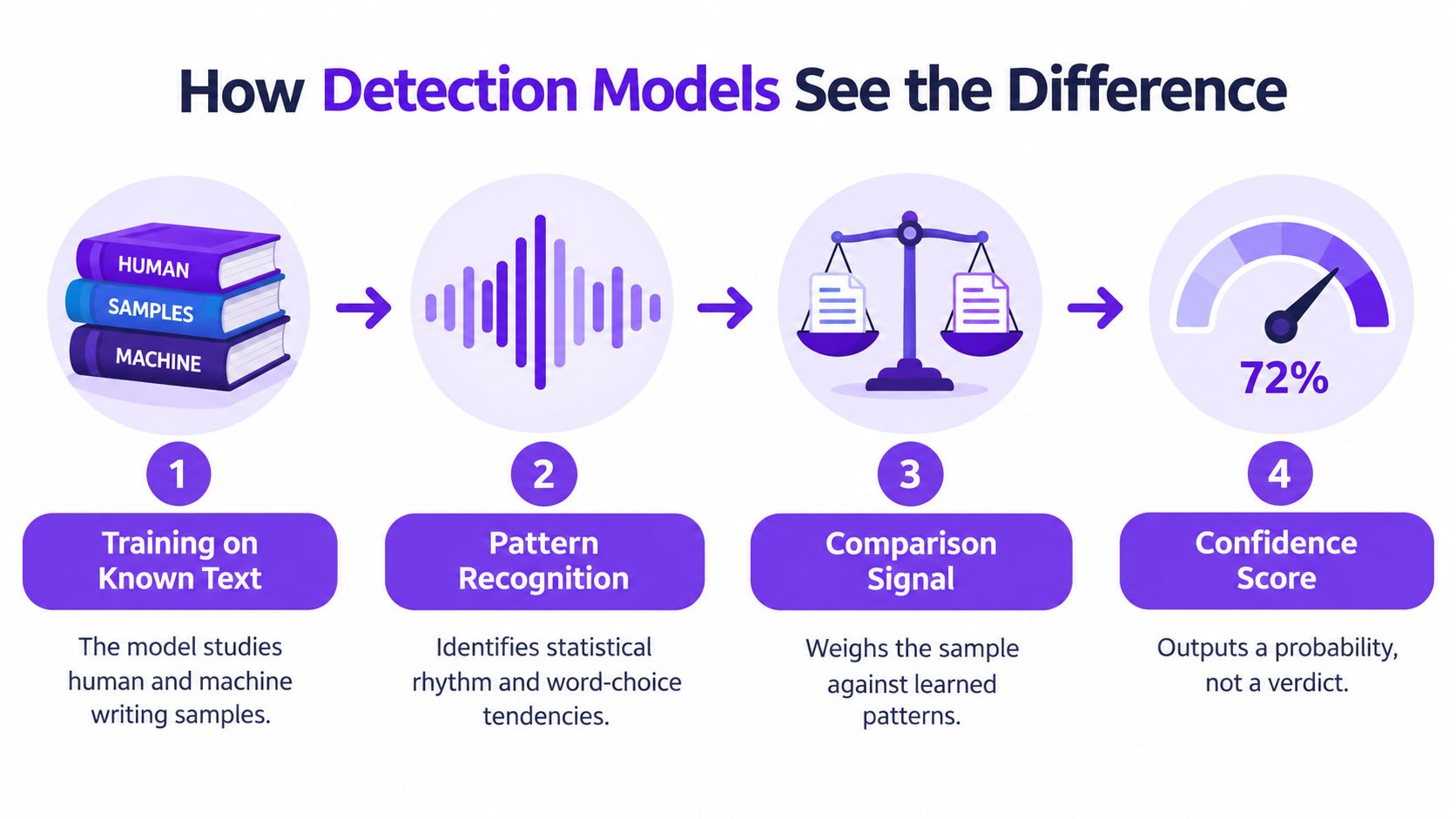
The main signal families
A detector might combine several kinds of evidence:
- Text patterns: Token-level predictability, repeated phrasing, sentence structure, and unusually consistent rhythm can influence a text classification.
- Image artifacts: Frequency spectra, denoising traces, resampling patterns, texture behavior, and inconsistent lighting can reveal traces of synthesis.
- Audio and video clues: Frame-to-frame continuity, facial movement, voice characteristics, and synchronization can contribute to a media assessment.
- Provenance evidence: Metadata, cryptographic credentials, and C2PA-style records can indicate how a file was created or handled.
The first three categories are generally passive detection. They inspect the content as it exists. Provenance is different. An active system asks the generator to attach a watermark or machine-readable mark at creation time. That mark can be stronger evidence, but it depends on whether the generator supports it and whether later edits preserve it.
A modern detector may combine multiple classifiers and signals. Its displayed confidence value is usually a processed and calibrated output, not a direct measurement of truth. Two tools can therefore disagree about the same file without either score proving what happened.
This video offers another accessible explanation of the general detection problem:
The practical vocabulary is simple. Passive detection looks for traces. Active provenance records origin. Calibration asks whether a confidence score corresponds reasonably to observed outcomes. Generalization asks whether the detector works on unfamiliar generators rather than only the systems represented in its training data.
Why Accuracy Numbers Are Easy to Misread
A headline accuracy figure can sound decisive while answering a narrow question. The GenImage benchmark contains more than one million real to synthetic image pairs across multiple GAN and diffusion generators, and within-subset train and test accuracy can exceed 98.5% (GenImage benchmark). That result doesn't establish that a detector will perform equally well on images from an unseen generator.
Familiar data versus unfamiliar data
In-distribution testing gives a model material resembling what it saw during training. Cross-generator testing asks a harder question: can a detector trained on one generator recognize output from another? A high score in the first setting may partly reflect generator-specific fingerprints, such as frequency behavior or denoising traces. Those fingerprints can inflate benchmark performance without demonstrating broad real-world reliability.
Dataset shortcuts create another problem. Research found that detectors can learn JPEG quality and image-size biases rather than intrinsic synthesis artifacts. Removing those biases improved cross-generator performance by more than 11 percentage points for ResNet-50 and Swin-T models (research on detector shortcuts and robustness). The same work reported that natural-image classification accuracy rose from 80.4% on uncompressed PNGs to 100% on low-quality JPEG-60 images, showing how compression can become an unintended cue.
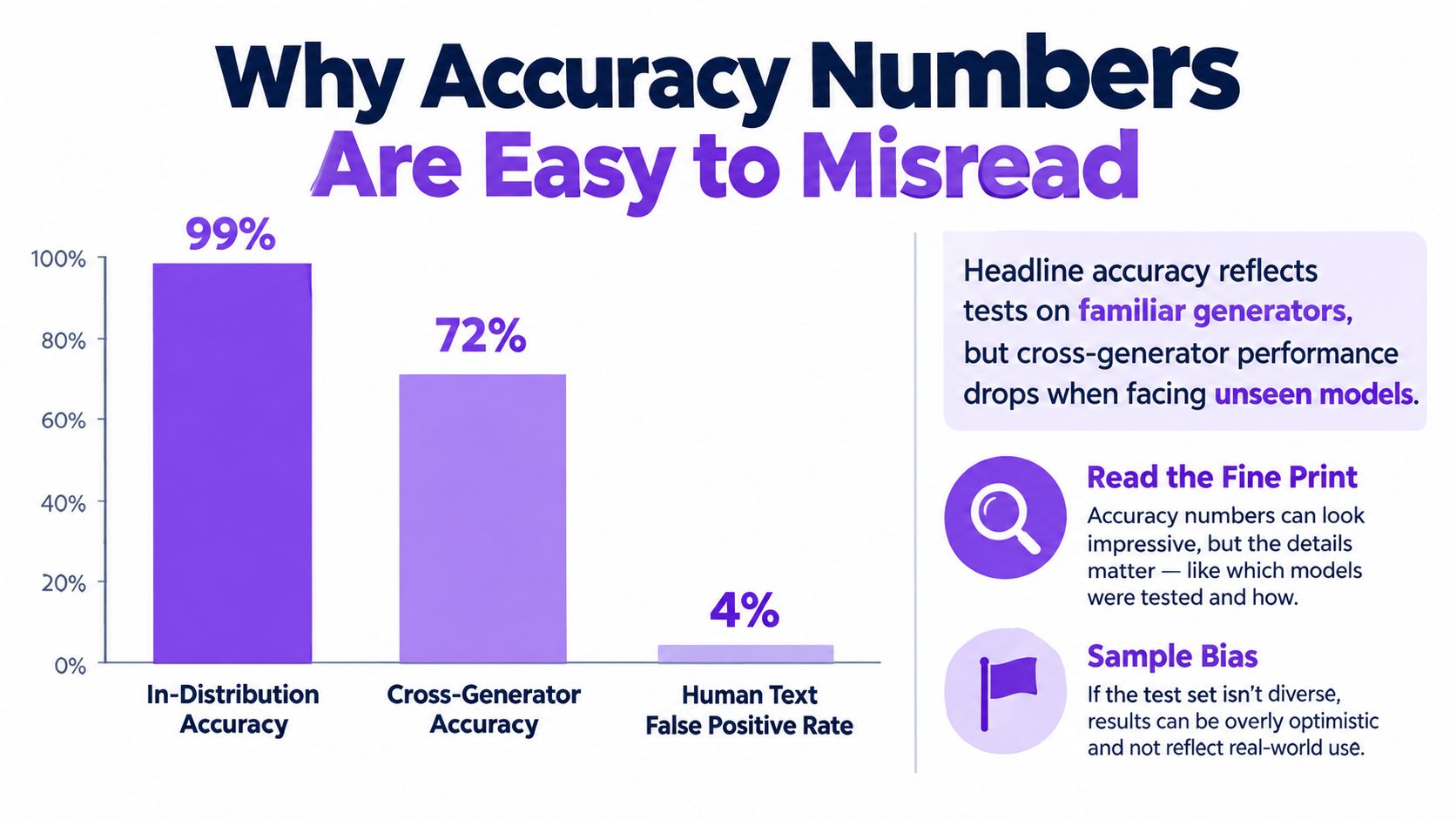
A vendor's single accuracy number is therefore insufficient. Ask for:
- Per-generator results: Does testing separate generator families and include current diffusion systems?
- Error breakdowns: Are precision and recall reported separately?
- Calibration evidence: Does a stated confidence level match observed outcomes?
- Uncertainty reporting: Are confidence intervals available?
- Stress tests: How does the tool behave after resizing, blur, screenshots, compression, or re-digitization?
The difference between probability and certainty is central to interpreting any detector score. A score can rank investigative priority while still leaving authorship unresolved.
What Edits Do to a Detector Result
A detector sees a file, not its complete history. Cropping, resizing, recompression, screenshots, color adjustments, and re-digitization can remove genuine generative traces or add artifacts that resemble them. The score may change even though the underlying image originated from the same source.
Reuters analyzed 40 images generated by Meta's Muse Image. Meta's detector identified all the original images but failed on 55% of the same images after they were cropped to roughly one-third to one-half of their original size (Reuters analysis of cropped AI images). That finding illustrates why a result attached to one version of a file shouldn't automatically be transferred to every later version.
Three things a responsible result should show
- Provenance evidence: Does the file contain credentials, metadata, or a generator-supplied mark?
- Transformation warnings: Has the image been cropped, resized, recompressed, screenshot, or otherwise altered?
- A confidence band: Is the result strong, borderline, or materially weakened by missing or conflicting evidence?
A 2026 CVPR workshop evaluation found that watermark-based approaches outperformed passive detectors on untouched, commonly altered, and adversarial images, while also emphasizing that performance depends on whether the watermark survives manipulation. Provenance can therefore be valuable, but it isn't magic. A missing mark may mean the generator didn't add one, the platform removed it, or the file passed through an editing workflow.
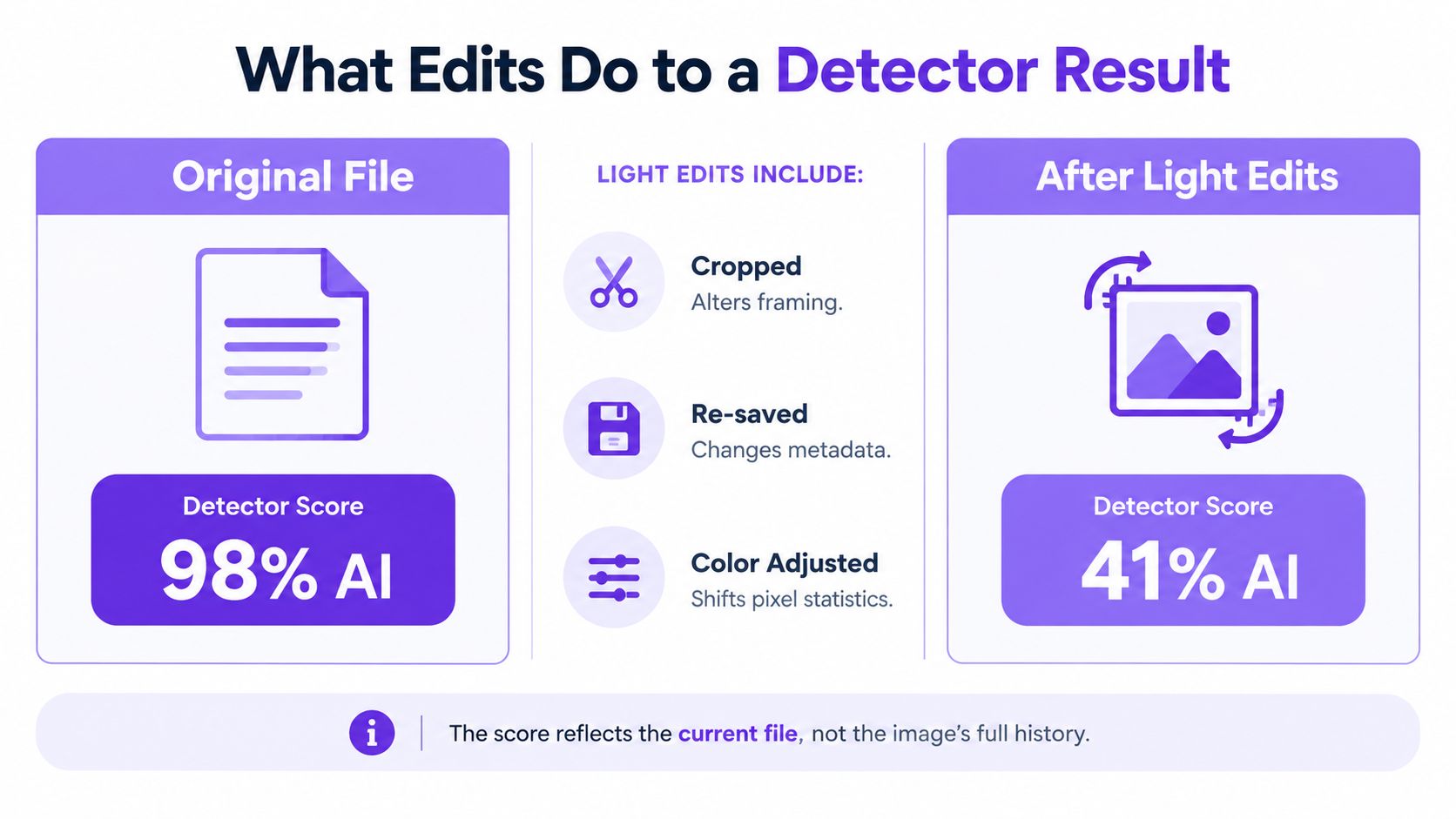
The score describes the current file. It doesn't certify the file's history.
A “Likely Human” result doesn't establish human authorship after heavy editing. A “Likely AI” result doesn't identify the generator or prove that every visible element was synthetic. The correct response is to preserve the original, record transformations, and compare the score with independent evidence.
How Different Audiences Use Detection in Practice
The same result can support different decisions depending on who receives it. A newsroom, classroom, platform, and legal department don't have the same burden of proof or the same consequences for error.
Journalists and fact-checkers
A “Likely AI” image should trigger source outreach, reverse image search, metadata review, and provenance checks. It might affect the order of verification, but it shouldn't become a publication claim without corroboration. A “Likely Human” result also doesn't authenticate a scene, date, location, or caption.
Educators
Teachers can use a text result as a prompt for discussion, not as an accusation. Drafts, revision history, notes, citations, oral explanation, and the student's established work provide context that a classifier can't see. A conversation about process is fairer and more informative than treating a percentage as a disciplinary finding.
Trust-and-safety teams
Platforms may use detector outputs as one feature in a broader risk system. The useful design question is what happens after the score. A borderline result might request additional context, reduce automated distribution, or send the item to review rather than trigger immediate removal.
Legal, compliance, and marketplace teams
A detector entry is best treated as part of an audit trail. Preserve the original file, timestamps, upload context, provenance records, transformation history, and reviewer notes. A score can help prioritize a case, but chain-of-custody evidence carries a different kind of weight.
Consumers deserve the same honesty. An interface that labels uncertainty plainly helps people slow down before sharing or purchasing. One that presents a guess as a verdict encourages overconfidence.
Regulation, Privacy, and the Compliance Layer
Detection is becoming a compliance capability because regulators are placing responsibility on systems that generate synthetic media. Article 50 of the European Union's AI Act requires providers of systems that generate synthetic images, audio, video, or text to apply effective, reliable, resilient, and interoperable machine-readable markings so content can be detected as AI-generated or manipulated (EU transparency rules for AI systems).
The transparency obligations are scheduled to apply on 2 August 2026 across the EU's 27 member states. Deployers must disclose deepfake content clearly and distinguishably no later than a person's first exposure. For certain systems already on the market before that date, the machine-readable marking requirement has a limited transition period until 2 December 2026. Content generated before 2 August doesn't require retroactive labeling.
A two-layer operating model
The rules point toward two complementary defenses:
- Generation-time provenance: The provider adds a machine-readable signal when the system creates or alters content.
- Independent assessment: A detector evaluates content when markings are absent, stripped, unsupported, or unreliable.
A deepfake under the rules is AI-generated or altered image, audio, or video content that resembles real people, objects, places, entities, or events and could falsely appear authentic. Disclosure must be clear enough for people to understand what they're seeing, not buried in technical metadata alone.
Organizations also need a privacy policy for detection. Before sending files to a vendor, ask whether uploads are stored, whether humans can review them, how long logs remain available, which data is used for model improvement, and whether deletion can be verified. A data-processing agreement should address those points, especially for student work, unpublished journalism, identity documents, or confidential business material.
Property platforms and agents should also consider practical disclosure rules for staged listing images, because a synthetic or materially altered room can affect how a buyer interprets the listing.
Using AI Image Detector as Part of a Workflow
A privacy-first image detector can fit between a first suspicion and a fuller verification process. For example, a user can upload a JPEG, PNG, WebP, or HEIC file up to 10MB, receive analysis in seconds, often under ten, and review a result ranging from Likely Human to Likely AI-Generated. The stated workflow performs analysis in real time and doesn't store images on servers after returning the result.
The useful part isn't a dramatic label. It's the combination of a confidence score, visual indicators, and reasoning that helps a reviewer understand why the file received its assessment. Core detection is free and requires no registration, while accounts add history and faster workflows. An API supports integration into platforms that need image-level screening.
That still leaves important work outside the tool. Pair the result with:
- Reverse image search: Look for earlier versions, unrelated captions, or the original publication.
- Provenance checks: Review C2PA credentials and EXIF metadata where available.
- Source verification: Contact the uploader, photographer, publisher, or platform.
- Chain of custody: Record how the file was obtained, copied, edited, and reviewed.
The tool can quickly tell you how the visible file resembles known synthetic or authentic patterns. It can't tell you whether a human retouched an AI image, which generator created it, or whether the scene itself is truthful.
A Practical Workflow You Can Use Tomorrow
Start with the decision, not the detector. Ask whether you're checking a publication, a classroom submission, a marketplace listing, a moderation queue, or a personal post. The consequence of a false accusation should determine how much corroboration you require.
Then follow five steps:
- Preserve the original: Save the received file and record its hash before opening it in an editor.
- Run a detector: Use a fast tool for a calibrated indication, and document the score, explanation, and any transformation warning.
- Inspect provenance: Check C2PA credentials, EXIF data, platform signals, and the source's account history.
- Corroborate independently: Use reverse image search, contact the source, compare versions, and preserve chain-of-custody evidence.
- Communicate uncertainty: Report what the detector assessed, what edits occurred, what evidence supports the conclusion, and what remains unknown.
For teams building automated review, an AI content detector API can place the score inside a wider process rather than making it the final action. Creative users may also encounter synthetic media in tools such as the LunaBloom AI app, which makes clear labeling and provenance habits useful at the point of creation.
A confidence score is a starting point for verification, not a substitute for it.
AI Image Detector offers fast, privacy-first image analysis with explanatory confidence results, so you can assess a questionable file without treating automation as proof. Visit AI Image Detector to test an image and build the result into a verification workflow that includes provenance, source checks, and human judgment.


