

Your Essential Compliance Risk Assessment Template and Guide

A good compliance risk assessment template is more than just a checklist; it’s a structured way to find, understand, and deal with potential legal and regulatory headaches before they become full-blown crises. Think of it as the tool that shifts your company from putting out fires to preventing them in the first place, systematically shielding your business from fines, a damaged reputation, and operational chaos.
Building Your Modern Compliance Risk Assessment Framework
Let’s be honest, those static checklists and once-a-year reviews just don't work anymore. The regulatory world is constantly changing, and your approach to compliance has to keep pace. A modern risk assessment isn't just administrative paperwork; it's a strategic map for navigating a complicated environment with real confidence.

The goal here is to create a living framework that becomes part of how you operate every day. This means going beyond a simple list of what could go wrong. You need a system that scores risks, prioritizes them, and gives someone clear ownership to fix them. Many of the core ideas here overlap with a security risk assessment, which also focuses on identifying and mitigating threats, just from a different angle.
The Shifting Sands of Regulatory Complexity
The need for a solid framework is more urgent than ever. Compliance has become incredibly complex, with a staggering 85% of global organizations saying that requirements have gotten more complicated in just the last three years. That number jumps to 90% in heavily regulated industries like financial services. If you want to dive into the data, PwC’s 2025 Global Compliance Survey sheds more light on these shifting regulatory demands.
What this means for you is that your template has to be flexible, easy to understand, and thorough. It becomes the single source of truth for your entire team to make sense of the tangled web of rules that govern your industry.
A well-structured compliance risk assessment template is more than a document—it's a communication tool that aligns legal, operational, and executive teams on what matters most. It transforms abstract legal language into tangible business risks with clear action plans.
Core Components of an Effective Template
A truly effective template is built on a few key pillars, with each one playing a specific role in managing risk from start to finish. It needs to cover everything from the initial brainstorming of potential risks all the way to reviewing the controls you've put in place. This organized method makes sure nothing important gets missed.
A huge piece of this puzzle is understanding the risks your partners and suppliers introduce. You absolutely have to integrate their assessments into your own, which is why a strong third-party risk management framework is a non-negotiable part of the bigger compliance picture.
The following table breaks down the essential pillars that form the backbone of any modern compliance risk assessment.
Key Pillars of a Modern Compliance Risk Assessment
This table summarizes the core components covered in our compliance risk assessment template, outlining the purpose and key activities for each stage of the process.
| Pillar | Purpose | Key Activities |
|---|---|---|
| Risk Identification | To catalog all potential compliance risks your organization faces. | Brainstorming sessions, reviewing regulations (e.g., GDPR, HIPAA), analyzing past incidents, consulting legal experts. |
| Risk Analysis & Scoring | To systematically evaluate the likelihood and potential impact of each identified risk. | Using a risk matrix (e.g., 1-5 scale for impact and likelihood), calculating a risk score for each item, documenting the rationale. |
| Risk Prioritization | To create a clear hierarchy of risks based on their scores. | Ranking risks from high to low, focusing resources on the most critical threats first, creating a "Top 10" list for executive review. |
| Mitigation & Control Planning | To develop specific, actionable strategies to address each prioritized risk. | Defining controls (e.g., new policies, software implementation), creating action plans with timelines, documenting mitigation strategies. |
| Ownership & Monitoring | To assign clear responsibility and establish a process for ongoing oversight. | Assigning a "risk owner" to each mitigation plan, setting up regular review meetings, creating dashboards for tracking progress. |
These pillars work together to create a continuous cycle of improvement, ensuring your compliance efforts are always relevant and effective.
Putting Your Risk Assessment Template to Work: A Practical Walkthrough
Let’s be honest, staring at a blank compliance risk assessment template can feel a bit overwhelming. It’s just a grid of empty boxes. But this is where theory meets reality. We're going to bridge that gap by walking through a real-world scenario, showing you exactly how to populate the template and turn it into a powerful tool that maps out your company's risk landscape.
Imagine a mid-sized tech company we'll call "InnovateTech." They're on the verge of launching a new SaaS product in Europe, which is exciting, but it also means they're now on the hook for the General Data Protection Regulation (GDPR)—a whole new world of compliance for them. Their immediate goal is clear: find and fix any compliance holes before launch day.
Starting with Risk Identification
The first move for InnovateTech’s compliance team is a brainstorming session. But this isn't something they can do locked in a room by themselves. Real insight comes from talking to the people on the ground, so they set up quick interviews with the heads of Engineering, Marketing, and HR to see how data is actually handled day-to-day.
Right away, a few potential risks bubble to the surface:
- Engineering: The dev team has been using copies of production data in their staging environment to test new features. This is a common shortcut, but it's a potential violation of GDPR's data minimization principle.
- Marketing: They rely on a third-party analytics tool from a vendor based outside the EU. When asked, no one is quite sure if a proper Data Processing Addendum (DPA) is in place to legitimize that data transfer.
- HR: Resumes and personal data from EU applicants are all stored on a shared server, but the access controls are murky at best. This creates a serious risk of an internal data breach.
Each of these findings gets logged in the "Risk Description" column of the template. For the marketing issue, it’s not just "bad vendor," but something specific: "Use of non-compliant third-party analytics vendor for processing EU user data, potentially lacking a valid DPA and adequate data transfer mechanisms."
This initial step of identifying and analyzing risks is the foundation of the entire process, as illustrated below.
The flowchart makes it clear: after you've spotted the hazards (your risks), the real work of evaluating them and figuring out the right precautions begins.
Backing It Up: Gathering Evidence and Context
A list of risks is just a list. To make it actionable, you need evidence. The compliance lead doesn't just take people at their word; she asks for proof. For the engineering risk, she asks to see their documented testing procedures. For the marketing vendor, she needs to see the contract and any DPA they have on file.
A critical mistake many teams make is relying on hearsay. Always seek documentation. If a process isn't written down, it's not a reliable control.
If the HR manager says, "Oh, only I can access that folder," the immediate follow-up has to be, "Great, can you show me the permission settings that prove that?" This is how you move from assumption to verification.
This is also where specific tools can become your best friend. Let's say one of the risks involves marketing materials potentially using unauthorized AI-generated images. Instead of guessing, the team could use a tool like an AI Image Detector to scan their asset library. The resulting report provides documented proof of an image's origin, which can be attached directly to the risk entry as concrete evidence.
Digging Deeper for Operational Risks
The most dangerous risks are often the ones hiding in plain sight, buried in routine operational workflows. This is why stakeholder interviews are so valuable. You have to ask the right kind of questions.
Instead of a generic, "Are you compliant with GDPR?" try asking operational questions that reveal how things actually work:
- "Can you walk me through the exact steps you take when a customer requests to have their data deleted?"
- "When a new person joins your team, what's the process for giving them access to sensitive systems?"
- "Show me how you vet a new software vendor before signing a contract."
These kinds of questions get people talking about their daily reality. At InnovateTech, this approach uncovered a major issue. While they had a policy for data deletion, the actual process was a mess—it was manual, prone to human error, and often took more than 45 days. That's a clear violation of GDPR's 30-day requirement. This "Process Failure" risk immediately went into the assessment template.
Finding Reliable Regulatory Information
To properly score these risks, the team needs to ground their assessment in the actual regulations, not just what they read in a blog post. Official sources are non-negotiable.
- For GDPR: The official legal text is on the EU's website, but for practical guidance, the UK's Information Commissioner's Office (ICO) offers excellent breakdowns in plain English.
- For industry-specific rules: Groups like the SEC (for finance) or HHS (for healthcare) are the go-to sources for updates, FAQs, and enforcement actions.
The InnovateTech team bookmarks these key resources and assigns one person the job of monitoring them for any changes. This ensures their risk assessment is always based on the latest requirements.
This focus on documented processes and official guidance is what elevates a compliance risk assessment from a simple checklist to a defensible record of your company's due diligence. It proves to regulators that you not only found your risks but also took credible, informed steps to understand and address them.
The importance of this function isn't just a theory; it's a clear industry trend. Risk assessment and management is now the top priority in compliance, with a staggering 94% of organizations actively focused on it. And the effort is working: 57% of organizations now report having a mature compliance program. You can explore more statistics about the state of compliance to see just how central this has become.
Ultimately, a well-executed risk assessment is no longer just a legal task. It’s a core business process that gives you a strategic edge. By following a structured approach like InnovateTech's, you can turn regulatory headaches into a genuine opportunity to build a more resilient and trustworthy operation.
How to Score and Prioritize Compliance Risks
So, you've done the hard work of identifying all the potential compliance landmines. Now you’re staring at a long list, and it's easy to feel overwhelmed. Where do you even begin? You can't tackle everything at once, and frankly, you shouldn't. This is the moment where a smart scoring system turns that list from a source of anxiety into a clear, actionable roadmap.
The goal is to methodically assign a score to each risk. This lets you focus your team’s finite time, energy, and budget on the issues that truly matter most.
It all comes down to two simple but powerful questions for every risk on your list: How likely is this to happen? And if it does, what’s the impact? This approach gives you an objective way to weigh completely different types of threats against each other—pitting something like a minor data handling error against a major regulatory reporting failure. It’s the engine that drives any effective risk assessment.
This data highlights a common challenge: while many teams are engaged in risk management, their programs often lack the maturity to prioritize effectively. This is exactly the gap a solid scoring model is designed to fill.
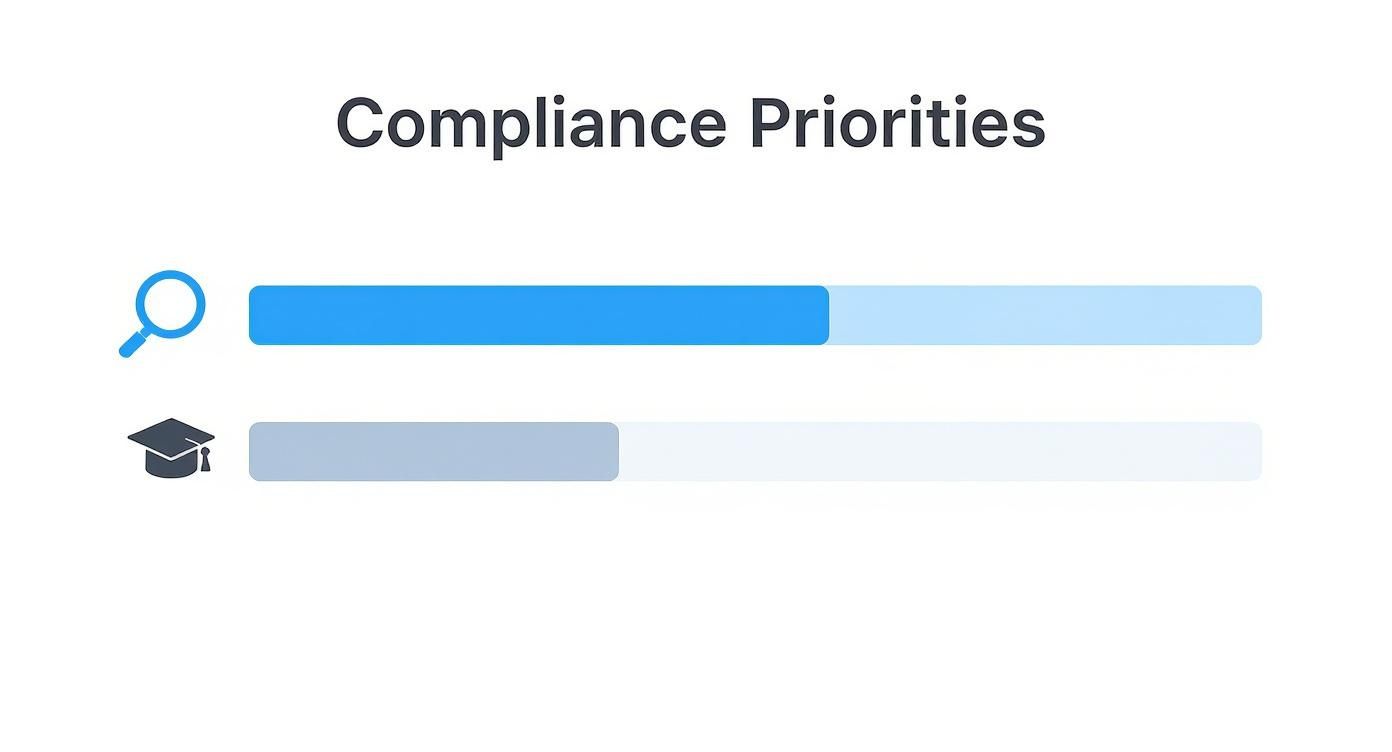
As you can see, high engagement doesn't always translate to a mature program. A disciplined approach to scoring and prioritization is what bridges that divide and leads to real risk reduction.
Defining Your Scoring Criteria
Before you start assigning numbers, your team needs to agree on what those numbers actually mean. This is non-negotiable. If you skip this, you’ll have different people evaluating risks with completely different yardsticks. A simple 1-to-5 scale for both Likelihood and Impact is a great place to start.
Here's how you might define Likelihood:
- 1 (Highly Unlikely): Extremely rare. We're talking less than a 10% chance of this happening in the next year.
- 2 (Unlikely): It’s on the radar, but just barely. Think an 11% to 40% probability.
- 3 (Possible): This could realistically happen. A roughly 41% to 60% chance means it needs watching.
- 4 (Likely): More likely to happen than not. The odds are somewhere between 61% and 90%.
- 5 (Highly Likely): It's almost a certainty, with a greater than 90% probability.
And for Impact, you need to consider everything from money to reputation:
- 1 (Insignificant): A minor hiccup. Financial loss is negligible (under $1,000), and there's no hit to our reputation.
- 2 (Minor): Causes a small operational headache and a minor financial sting (up to $10,000). Any reputational scuff is easily polished over.
- 3 (Moderate): You'll feel this one. It causes a noticeable disruption, moderate fines (up to $100,000), and some negative headlines.
- 4 (Major): A serious blow. We're looking at significant business disruption, hefty penalties (up to $1,000,000), and widespread damage to our brand.
- 5 (Catastrophic): This is an existential threat. It could mean massive fines, a complete operational shutdown, or irreparable harm to our reputation.
The key is consistency. Whatever definitions you land on, document them. Share them. Make sure that "Major" means the same thing to the folks in IT as it does to the legal team.
Calculating the Risk Score
Once your criteria are locked in, the math is refreshingly simple. Just multiply the two scores to get a final risk rating.
Risk Score = Likelihood Score x Impact Score
This formula gives you a score from 1 (a 1x1) to 25 (a 5x5). Suddenly, every risk has a single, comparable number attached to it.
Let's walk through a quick example. Say you've identified two big worries:
- Risk A (Data Breach): A known vulnerability in a server could expose customer data.
- Risk B (Record-Keeping): Our manual process for maintaining regulatory documents is prone to error.
The team sits down to score them. For the data breach, the server vulnerability is a known issue, making the Likelihood a 4 (Likely). A breach of customer data would be devastating, so the Impact is a 5 (Catastrophic). That gives Risk A a total score of 20 (4 x 5).
For the record-keeping problem, errors happen all the time, so the Likelihood is a 5 (Highly Likely). But the consequence is a small fine and no real public fallout, making the Impact a 2 (Minor). Risk B gets a score of 10 (5 x 2).
Visualizing Priorities with a Risk Heat Map
You have your scores, but a long spreadsheet of numbers can still be tough to act on. The magic happens when you visualize it with a risk heat map. It's a simple grid that plots Likelihood against Impact, using colors to show you where the real danger lies.
- High-Risk (Red Zone): Scores from 15-25. These are your five-alarm fires. Drop everything and address these now.
- Moderate-Risk (Yellow Zone): Scores from 8-12. These need a plan, but they aren’t as urgent as the red zone risks.
- Low-Risk (Green Zone): Scores from 1-6. Keep an eye on these, but they might be risks you can live with for now.
In our scenario, the data breach (score of 20) is glowing red. It's your absolute top priority. The record-keeping issue (score of 10) lands in the yellow zone. It needs attention, but only after you’ve patched that critical server. This simple visual makes it incredibly easy to show leadership where the problems are and justify where you're putting your resources.
Developing Actionable Mitigation and Control Plans
Let's be honest: identifying and scoring risks is only half the job. A beautiful, color-coded heat map is great for presentations, but it's completely useless if it doesn't drive real action. This is the moment your compliance risk assessment template pivots from being a diagnostic tool to a strategic roadmap. The whole point of this exercise is to create clear, effective mitigation plans that tangibly reduce your company's risk exposure.

Put simply, a mitigation plan is your game plan for tackling a prioritized risk. For every single high-risk item glowing red on your assessment, you need a corresponding plan that is specific, has a clear owner, and is tied to a firm deadline. Without these pieces, accountability just melts away, and those critical risks are left to fester.
Choosing Your Mitigation Strategy
You can't eliminate every risk, and frankly, you shouldn't try. The goal is a response that's proportional to the risk's severity. Most responses fall into one of four primary strategies. I've always found the acronym ARTA to be a helpful way to remember them.
- Avoid: This one is straightforward—you decide to stop the activity causing the risk entirely. For instance, if a new product line requires navigating an incredibly complex and expensive regulatory minefield, you might avoid the risk by shelving the project.
- Reduce: This is your most common play. You implement controls to bring down the risk's likelihood or its potential impact. A classic example is installing a more advanced firewall to reduce the risk of a data breach.
- Transfer: This is about shifting the financial fallout of a risk to someone else. The most obvious way to transfer risk is by purchasing insurance. Getting a comprehensive cyber liability policy, for example, transfers the massive potential costs of a breach to the insurer.
- Accept: For those low-likelihood, low-impact risks, sometimes the smartest move is to do nothing. If the cost and effort of mitigation far outweigh the potential damage, you can formally accept the risk. The key here is that this must be a conscious, documented decision—not just forgetting about it.
Your mitigation plan must document which of these four strategies you're using. It brings clarity to your approach and justifies the resources you're about to spend—or not spend—on the issue.
From Strategy to Actionable Steps
A strategy on its own is just an idea. The real work is in hammering out the specific controls and actions that will bring that strategy to life. A control is any measure—a policy, a new procedure, a technical safeguard—that you put in place to modify a specific risk.
Let's go back to our earlier example: "Use of non-compliant third-party analytics vendor for processing EU user data." This scored a 20, putting it squarely in the critical, high-priority zone.
The strategy we chose is Reduce. Here’s how that breaks down into concrete, actionable controls:
- Control 1 (Legal Review): The legal team must immediately review the vendor’s contract and Data Processing Addendum (DPA) to check for GDPR compliance.
- Control 2 (Technical Block): IT needs to temporarily block all data feeds to this vendor until the legal review is signed off.
- Control 3 (Vendor Replacement): Marketing Ops will begin researching and vetting alternative analytics providers with proven GDPR compliance.
Notice how these aren't vague goals. They are specific, tactical instructions that people can actually execute.
I've seen so many mitigation efforts fail because the plans were too high-level. "Improve vendor management" is a wish, not a plan. "Implement a mandatory security questionnaire for all new vendors by Q3" is a real, actionable plan.
Assigning Ownership and Setting Deadlines
Every single item in your action plan needs a name next to it. The "Risk Owner" is the one person ultimately accountable for getting that plan done. They might not be doing all the legwork, but they're the one on the hook for reporting progress and explaining any delays.
And just as important as an owner is a realistic deadline. Without a due date, even the most urgent tasks have a funny way of getting pushed to the back burner.
For our vendor risk scenario, it would look like this:
- Control 1 Owner: Jane Doe (Legal Counsel), Deadline: 5 business days.
- Control 2 Owner: John Smith (IT Director), Deadline: 24 hours.
- Control 3 Owner: Emily White (Marketing Ops), Deadline: 30 days.
This level of detail creates instant clarity and a healthy sense of urgency, effectively turning your assessment document into a living project management tool.
Verifying Control Effectiveness
So, how do you know if your plan actually worked? The final step is defining how you'll test and verify that your new controls are effective. For example, after you roll out a new data access policy, you should schedule a follow-up audit to confirm permissions are set correctly and that the risk score has actually dropped.
For more complex issues, like ensuring user-generated content on your platform stays compliant, verification is more of an ongoing process than a one-time check. This is where modern tools and services become essential. To see how this works in practice, you can learn more about how content moderation services use a mix of AI and human review to constantly verify that platform content meets compliance rules. This approach effectively reduces legal and reputational risk in real-time. This continuous loop of action and verification is what ensures your efforts lead to genuine risk reduction, not just a paper trail.
Embedding Compliance into Your Company Culture
A solid compliance risk assessment template is an excellent start, but its real power is unlocked when it becomes more than just a one-off project. The goal here isn't to create a static, annual checklist. It's to build a living, breathing process that weaves risk awareness and compliance duties into the very DNA of your company.
When compliance is part of the daily conversation, it breaks out of its silo in the legal department. It morphs into a shared responsibility—a proactive advantage that shapes smart decisions everywhere, from engineering and product development right through to your marketing campaigns.
From Static Spreadsheets to Dynamic Risk Management
Let’s be honest, the days of relying only on spreadsheets are numbered. They can be great for getting an initial assessment done, but they just don't have the speed or flexibility to keep pace with today's ever-changing regulatory world. That's why forward-thinking organizations are adopting more dynamic risk management platforms and tools to automate and smooth out the entire process.
This change is about making your compliance efforts truly operational. Instead of your team manually tracking down updates or sending endless reminders to stakeholders, modern systems can handle the heavy lifting.
- Automated Reminders: They can nudge people about control reviews and follow-ups on mitigation plan deadlines.
- Real-Time Dashboards: Leadership gets a clear, immediate picture of the current risk landscape at a glance.
- System Integration: They can connect with your other business systems to pull in relevant data automatically.
This kind of automation frees up your team from mind-numbing administrative work. It allows them to pivot from simple data entry to high-value strategic analysis, which is where their expertise truly shines.
In 2025, compliance risk assessments are becoming far more tech-driven, leaving old-school frameworks behind for interactive and even predictive models. A major evolution is dynamic risk scoring, which continuously updates your company’s risk profile with real-time data instead of relying on periodic manual checks. If you're curious about how these technologies are changing the game, you can find more insights on the best compliance risk assessment tools.
The Power of Continuous Monitoring
The real secret to making compliance a part of your culture is continuous monitoring. This isn't about micromanaging your team; it's about building a feedback loop that keeps you one step ahead of new threats and opportunities. Adopting a continuous monitoring mindset means you're constantly asking questions and testing your controls.
For instance, your marketing team could regularly use a tool to scan for unauthorized AI-generated images, which might carry a copyright or disclosure risk. This constant vigilance is a cornerstone of building a robust culture of trust and safety, making sure your operations stay solid. This proactive approach helps catch small issues before they snowball into major compliance headaches.
Continuous monitoring transforms compliance from a reactive, fear-based activity into a proactive, intelligence-driven business function. It gives you the foresight to adapt to regulatory changes before they become urgent problems.
By making compliance a continuous, integrated part of how you do business, you build a more resilient, trustworthy, and competitive organization. It’s a cultural shift that pays for itself through fewer fines, a stronger reputation, and better decision-making at every level. This ensures your compliance risk assessment template isn't just a document, but the foundation of a genuinely proactive strategy.
Your Top Compliance Risk Assessment Questions, Answered
Alright, you've got the template and you understand the theory, but let's be honest—the real questions pop up when you try to put it all into practice. I've been there. Let's tackle some of the most common questions I hear from teams who are rolling up their sleeves and getting started.
How Often Should We Really Be Doing This?
The easy answer is annually, and that's a decent starting point. But if you want to build a truly resilient program, you can't just set it and forget it for 364 days. Think of your risk register as a dynamic, living part of your operations.
Beyond a full-blown annual review, you need to pull the trigger on a fresh assessment anytime something significant changes. What qualifies as "significant"?
- A new major regulation drops (think GDPR or CCPA).
- You're expanding into a new country with a whole different set of rules.
- A new flagship product or service is about to launch.
- You experience a security breach or a major compliance failure.
In those moments, your old assessment is officially out of date.
Who Needs to Be in the Room for This?
One of the biggest mistakes I see is when companies try to do this in a vacuum, letting the legal or compliance team handle it all. That's a surefire way to miss critical risks hiding in plain sight. You need boots on the ground and eyes from every angle.
For a truly holistic view, you have to pull in leaders from across the business. Your core team should have senior folks from:
- IT & Cybersecurity: They live and breathe technical vulnerabilities.
- HR: They're on the front lines of employee conduct, data privacy, and internal policies.
- Finance: They understand the financial reporting landscape and can quantify the real dollar impact of fines.
- Operations: These are the people who know how things actually work day-to-day, not just how the policy manual says they should.
And here’s the most important part: you need executive buy-in. Without it, you're just conducting a theoretical exercise. Senior leadership provides the authority and resources to make your mitigation plans a reality.
Isn't This Just the Same as an Audit?
This question comes up all the time, and it's a great one. While they're related, they serve two very different functions. The easiest way to remember it is this:
An assessment is proactive and forward-looking, asking, "What might happen?" An audit is reactive and backward-looking, asking, "Did we do what we were supposed to do?"
Your compliance risk assessment template helps you map out potential future threats and vulnerabilities. An audit, on the other hand, is a formal review that tests whether your existing controls are actually effective and being followed. The two work together beautifully—your assessment findings should absolutely help shape the scope of your next audit.
We Have Nothing in Place. Where Do We Even Begin?
Staring at a blank page is intimidating. My advice? Don't try to assess the entire organization right out of the gate. That's a recipe for getting overwhelmed and stalling out.
Instead, start with a pilot program. Pick one high-impact, high-risk area of your business and focus all your energy there. Data privacy is a common and excellent place to start because it touches so many departments. Run through the entire process, from identification to mitigation, for just that single area.
This approach lets your team learn the ropes in a lower-stakes environment. You’ll refine your scoring, smooth out the workflow, and learn what works for your culture. More importantly, a successful pilot gives you a concrete win to show leadership, making it infinitely easier to get the buy-in you need to expand the program company-wide.
Ready to build a more resilient compliance framework? AI Image Detector provides the tools you need to verify visual assets and mitigate content-related risks in real time. Start protecting your brand today.