

Digital Media Forensics: A Practical Guide to Verification

49% of people say they run into false or misleading images online daily or weekly, and only 30% feel totally or very confident judging whether an image is authentic and reliable. That gap is exactly why digital media forensics matters when a file lands in your inbox and the decision can't wait.
A breaking-news photo, a disputed classroom submission, or a piece of evidence in a legal packet can look convincing at first glance. The problem is that visual confidence is not the same as verification, and a rushed yes or no can create real damage.
The Verification Crisis That Demands Digital Media Forensics
An editor gets a photo from social media minutes after a major event. The scene feels urgent, the caption is specific, and the pressure is obvious, publish fast or lose the moment. At the same time, an educator sees a student submission that looks polished in a way that doesn't match the student's prior work, and a legal team receives a file that could affect credibility in court.
That's the reality of modern verification work. The file might be genuine, altered, repurposed, or partially synthetic, and the cost of guessing wrong changes with each context. In journalism, a bad call can spread misinformation. In education, it can trigger an unjust accusation. In legal settings, it can weaken the evidentiary chain.
The broader public is already living inside this problem. A 2023 global study found that 49% of respondents believed they encountered false or misleading images online daily or weekly, with social media identified as the primary environment, and 70% said they were not totally or very confident in judging authenticity and reliability, according to the study report on image-information literacy (Poynter's published study PDF).
Why intuition breaks down
People can spot obvious fakes, but most verification failures happen in the gray zone. Compression, reposting, cropping, and light editing can make a real image look suspicious. Synthetic images can also borrow realistic textures, camera-like blur, and plausible lighting, which makes gut checks unreliable.
Practical rule: treat first impressions as a lead, not a verdict.
Digital media forensics is useful because it replaces snap judgment with documented examination. It asks what the file contains, where it came from, how it changed, and which signals support or weaken authenticity. That matters because the question is rarely just “Is this fake?” It's usually “What can I defend, and how strongly?”
How Digital Media Forensics Evolved from Computer Investigations
A disputed image rarely starts with an obvious forgery. More often, it arrives as a screenshot, a repost, or a file with missing context, and the job is to determine what can still be defended. That workflow comes from the older discipline of computer investigations, not from modern image tools alone. U.S. agencies were already doing digital investigations in the mid-1980s, and the FBI created its Computer Analysis and Response Team in 1984. The field then expanded through the 1990s into a broader practice that covered evidence stored or transmitted across computers, mobile phones, audio and video systems, fax machines, and other digital platforms (ERAU history of digital forensics).
The field matured around evidence discipline
The useful takeaway is not the list of milestones, it is the standard they produced. Computer forensics was defined in 1991, the first International Law Enforcement Conference on Computer Evidence followed in 1993, and later work pushed the field toward common procedures for handling evidence. As documented in the ERAU history cited above, the Scientific Working Group on Digital Evidence formed in February 1998, NIST began a tool-validation program in 1999, and by 2001 the discipline was increasingly called digital forensics because it had moved beyond one device category.
That history still shapes image verification. Screenshots, reposted clips, and AI-generated media do not change the basic job. Preserve the original when possible, record where it came from, separate what you observed from what you inferred, and check the tools before you rely on their output in a report or in court.
Why old rules still govern new media
The file may be new. The forensic logic is familiar.
A metadata field can help, but it is never proof by itself. A detector score can guide review, but it does not replace chain of custody. A provenance record can be persuasive, but only if the record is intact and trustworthy. Clean workflows start by asking what can be preserved, what can be verified, and what can only be inferred.
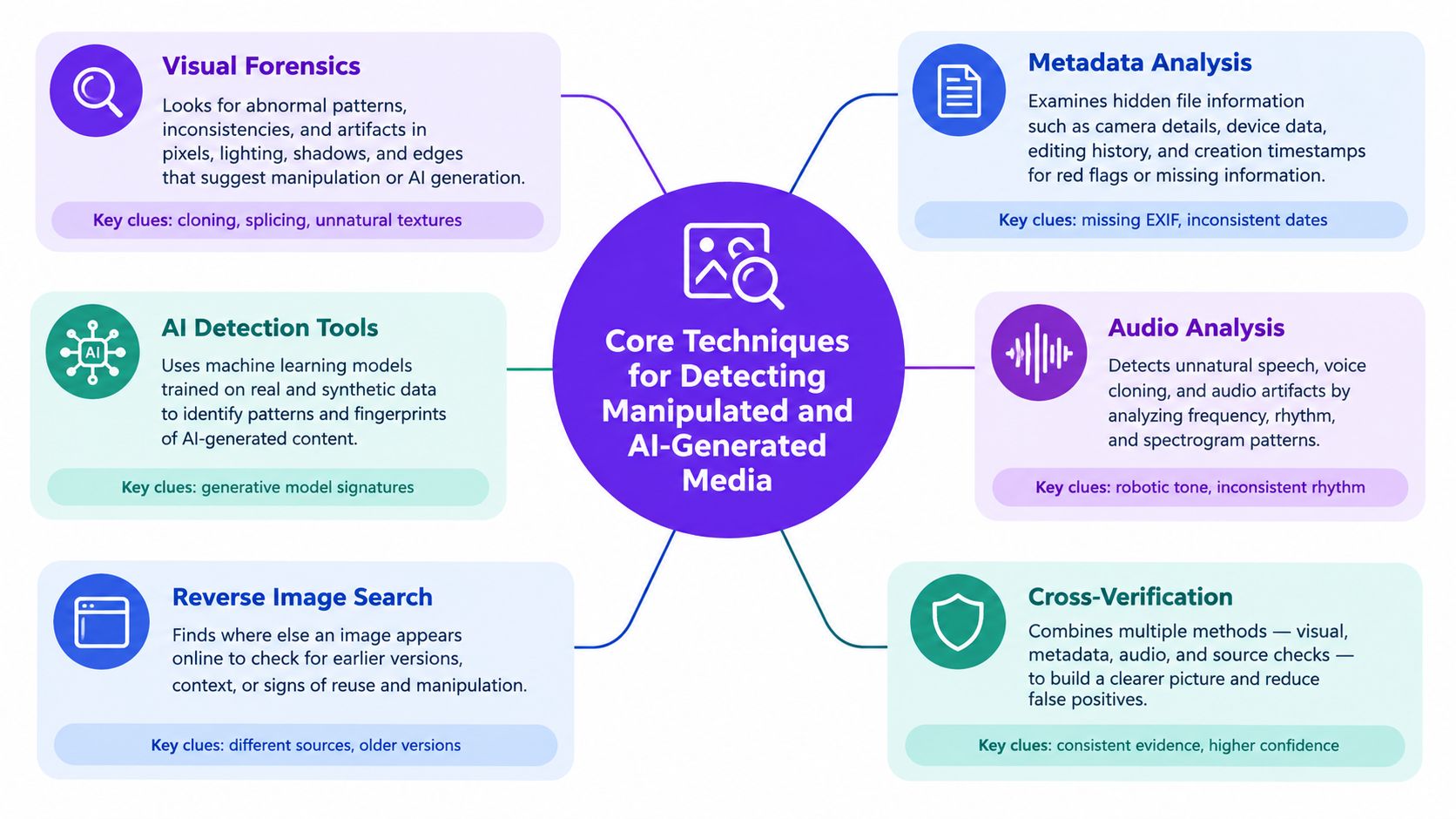
The lesson for journalists, educators, and legal teams is straightforward. Digital media forensics is not a binary real-versus-fake test, it is a method for making uncertainty visible, comparing evidence streams, and stating exactly how much confidence the record supports.
Core Techniques for Detecting Manipulated and AI-Generated Media
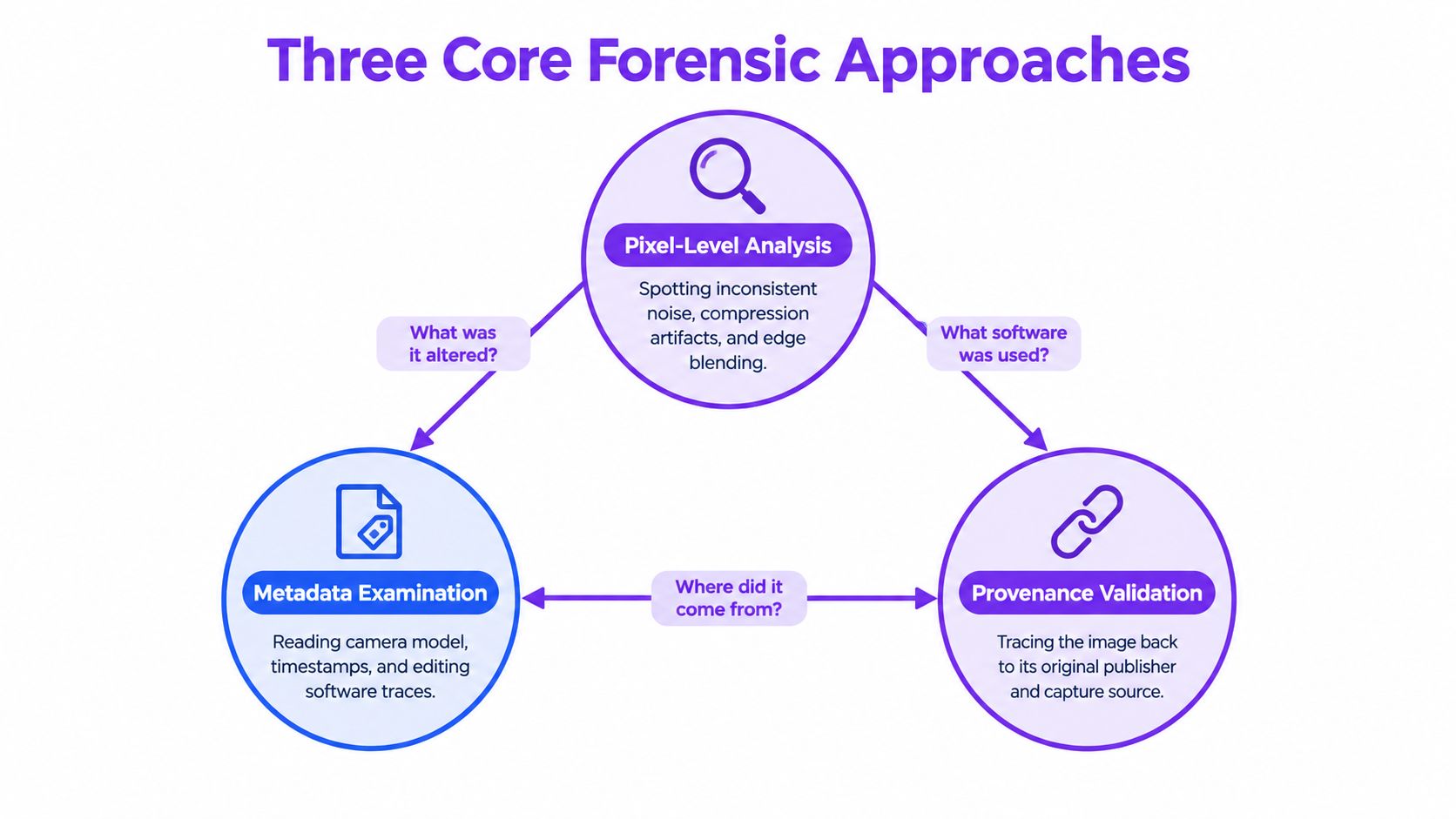
Most verification work starts with three questions, and each one needs a different kind of evidence. What do the pixels suggest. What does the file metadata say. What does the provenance trail actually prove.
Pixel-level analysis tells you what the image looks like
Pixel inspection is where people often begin because it reveals visual inconsistencies. You look for odd lighting, mismatched shadows, unnatural edges, repeated textures, blur that doesn't fit the rest of the frame, and compression patterns that don't behave as expected. In AI-generated or heavily edited images, these clues can appear around hands, hair, teeth, reflections, or the border where one element was inserted into another.
That said, pixel-level analysis can be fooled by ordinary processing. Social platforms recompress files, and legitimate edits can create artifacts that look suspicious. A noisy screenshot of a real photo can look more artificial than a clean synthetic image that was generated to look polished.
Metadata examination adds context, not certainty
Metadata can tell you the camera model, timestamps, software traces, and sometimes a trail of edits. It is often the fastest way to spot a mismatch between the story a file tells and the file's technical history. If an image claims to be a fresh capture but carries editing software traces or inconsistent dates, the file deserves deeper review.
Still, metadata is fragile. It can be stripped, altered, or lost when a file is moved between platforms. That means missing metadata does not equal fake, and present metadata does not equal truth.
For a practical overview of how forensic analysts combine these signals, the workflow example in image forensics analysis guidance is a useful companion read.
Provenance validation checks the file's history
Provenance is about origin and transformation, not a magical authenticity stamp. The C2PA framework stores a signed manifest with assertions about capture device, edits, software, timestamps, and AI involvement. Analysts should validate the manifest signature, certificate trust chain, timestamp, revocation status, and any linked ingredient assets before treating it as evidence (C2PA explainer).
Important distinction: a valid provenance record shows the integrity of the signed record. It doesn't independently prove that every assertion inside it is true.
These methods work best together. Pixel analysis helps identify suspicious structure, metadata gives context, and provenance can confirm whether a record of handling exists. For creators worried about deepfakes and copied likenesses, this resource on deepfake threats to digital creators is relevant because the same verification logic often appears in rights and reputation disputes.
Building a Practical Verification Workflow for Real-World Use
A usable workflow starts with the file you have, not the ideal file you wish you had. If the image is in a message thread, save the original version before anyone screenshots it again. If it's a social post, preserve the post, the caption, the account details, and any visible timestamp or engagement context.
Start with preservation and screening
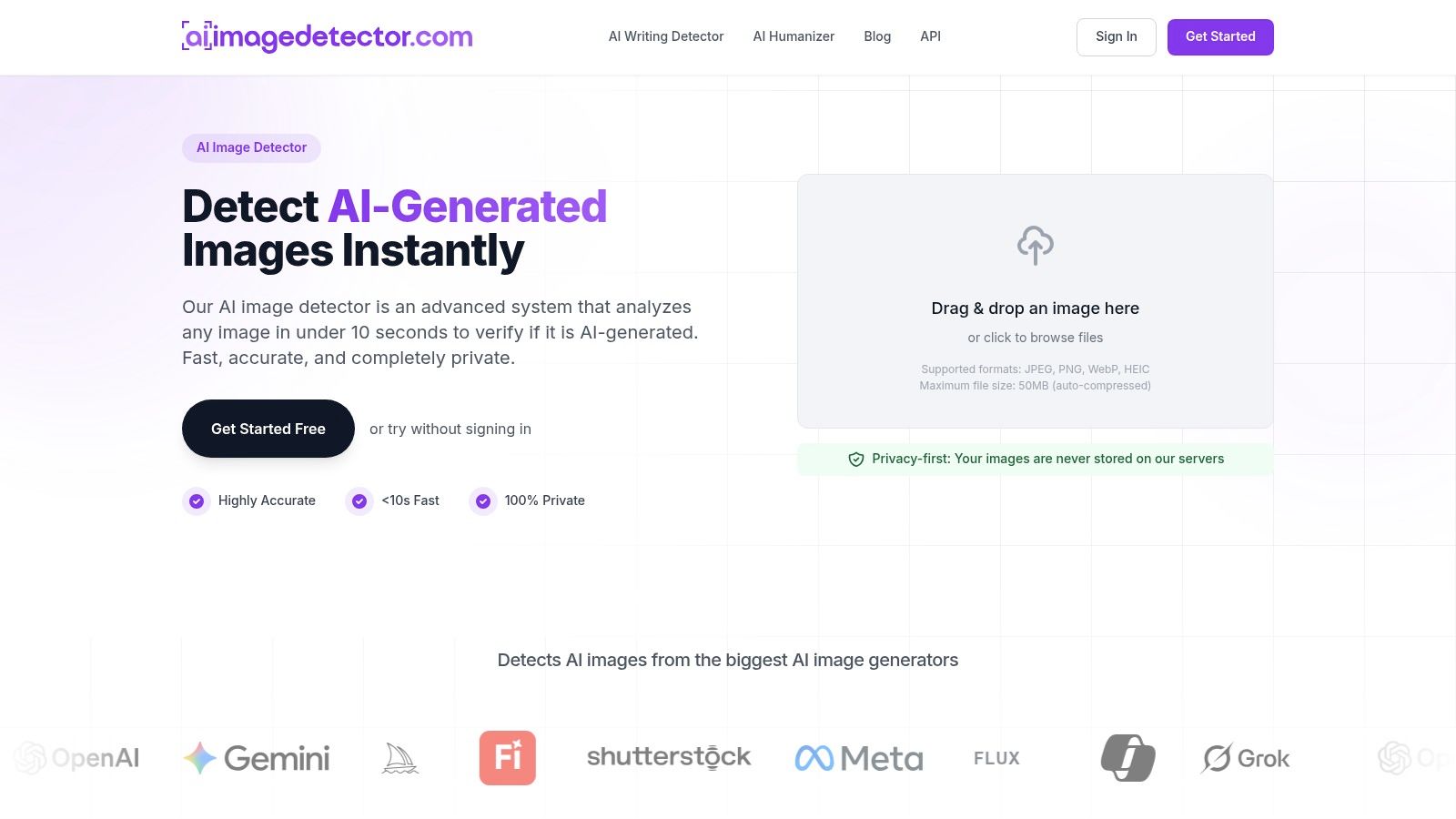
Open the file in a tool that gives you an initial confidence signal, then inspect the image manually. AI Image Detector is one option for fast screening because it analyzes visual patterns and artifacts, returns a confidence score, and explains the verdict in practical terms. That kind of result is useful as a triage layer, not as the end of the case.
If the file looks suspicious, move to the next step. If the confidence is unclear, don't force a conclusion. Request the original file, ask for the earliest available copy, and document the handoff. If provenance exists, check it. If it doesn't, note that absence without assuming guilt.
Escalate based on the question, not the tool
The right next step depends on what you need to prove. A journalist may need to know whether the image was published before a breaking event was reported elsewhere. An educator may need to know whether the submission shows signs of synthesis or unauthorized editing. A legal team may need a defensible chain of custody rather than a quick authenticity guess.
The basic workflow looks like this:
- Screen first: use automated analysis to flag obvious red flags and triage volume.
- Inspect the file: review pixels, metadata, and visible signs of recompression or editing.
- Check provenance: validate credentials if they exist, and record whether they're missing.
- Ask for originals: compare versions when the first copy is a repost, export, or screenshot.
- Escalate when needed: hand off to specialist review if the result affects publication, grading, or evidence use.
For teams that want a deeper process map, the workflow guidance at workflow optimization for image review fits well with this kind of staged review.
A short video walkthrough can also help teams standardize how they move from screening to documentation.
A consistent goal is key. If every reviewer follows the same steps, your conclusions become easier to defend and easier to audit.
Comparing Tool Approaches for Different Verification Scenarios
No single tool answers every verification question. An AI classifier is fast at spotting suspicious visual patterns, but it's not the best choice when you need to reconstruct a file's origin. Metadata software is useful when the file still carries useful tags, but it won't rescue a repost that stripped them away. Reverse image search helps with prior publication and reuse, while provenance validators focus on whether a signed record exists and still matches the asset.
Choose by question, not by brand
If you're checking a newly captured image, provenance validation and metadata inspection can be more useful than a pure visual detector. If you're reviewing a screenshot or compressed social post, pixel-level analysis and reverse search may tell you more than the file's lost metadata. If you're working with a pristine original in a legal context, it can make sense to use several methods in sequence.
| Verification need | Stronger fit | Main limitation |
|---|---|---|
| Fresh capture from a known device | Provenance validation, metadata review | Depends on preserved credentials and intact file handling |
| Reposted social image | Reverse search, pixel analysis | Original metadata may be gone |
| Suspected AI-generated image | Visual classifier, artifact review | Confidence can drop after editing or recompression |
| Historical image with unknown source | Reverse search, contextual review | Often no credential trail exists |
Trade-offs matter in the field
Speed matters to editors. Repeatability matters to legal teams. Ease of use matters to educators and moderators. Some tools are built for quick screening, others for deeper analysis, and some can support both but still need an operator who knows what the result does and doesn't mean.
The best tool is the one that answers the specific question without pretending to answer a bigger one.
In practice, strong teams combine a fast detector, a file inspection step, and a provenance check when possible. That approach keeps you from treating one signal as if it were the whole story.
Interpreting Uncertainty Instead of Chasing Binary Answers
The hardest part of digital media forensics is not finding clues. It's deciding how much confidence those clues deserve when the image has been resized, recompressed, or passed through unfamiliar editing tools. Automated classifiers can be sensitive to small changes in the file, which means a result that looked strong on one version can weaken on another.
Separate the claims before you answer them
A responsible review keeps four questions distinct. Do the pixels look synthetically generated. Was the image altered after capture. Is the depicted event true. Can the file be tied to a particular source, device, or generator. Those are not the same question, and they rarely have the same answer.
That distinction matters in real workflows. A detector can suggest that an image may be AI-generated while the underlying event is still real. A file can be authentic as a file and still portray a staged or misleading scene. A valid provenance credential can support file history without proving the truth of the scene itself.
Report confidence, not theater
A good forensic note doesn't overstate certainty. It says what was observed, what was inferred, what failed, and what would change the conclusion. If the file came from an unknown source, note that. If compression likely degraded the signal, say so. If the evidence is strong but incomplete, recommend escalation instead of pretending the gap isn't there.
Practical standard: when the file is messy, the answer should get more careful, not more confident.
The same logic applies to AI-assisted fact-checking. A 2025 study on AI use in news fact-checking emphasizes that models can make errors and need specialist oversight, with human judgment still decisive for the final verdict (arXiv study). That aligns with field practice. Tools are there to help narrow the problem, not to replace the decision-maker.
For journalists, educators, and legal teams, uncertainty is not a failure state. It's part of a defensible conclusion. The work is to describe it clearly enough that another reviewer could reproduce the reasoning.
Legal and Ethical Considerations in Media Verification
A forensic conclusion can influence a publication decision, a grade, a disciplinary action, or a court argument, so the ethical standard rises fast. That means every meaningful step should be documented, from receipt of the file to the final interpretation. If the original file was unavailable, say so. If a signal was weak or missing, record that too.
Chain of custody changes how findings are used
The same analysis can function as internal guidance in one setting and evidence in another. In journalism, a verification memo might be enough to decide whether to publish. In academia, a review may support an integrity decision. In legal work, the same material may need to stand up as evidence or expert support, which puts more weight on provenance, repeatability, and documentation.
That is why a validator, a metadata check, or a visual classifier should be described with the right level of authority. Advisory opinions should stay advisory when the record is thin. Evidence should be labeled as such only when the underlying handling supports that claim.
Ethics starts with restraint
Don't turn a tool result into an accusation. Don't describe a probability as proof. Don't hide uncertainty because a cleaner sentence sounds stronger. If a result could harm someone's reputation, the burden is on the analyst to explain the basis, the limits, and the next step with unusual care.
The C2PA and evidence-handling issues discussed in legal evidence standards for image review are especially relevant when findings cross into formal proceedings. The same principle applies across contexts, transparency strengthens trust more than overconfident language ever will.
Next Steps for Journalists, Educators, and Verification Professionals
Journalists should save originals, compare the earliest available versions, and document what the file can prove before publication. Educators should pair detector results with a review of source material, version history, and assignment context before making an integrity call. Legal teams should preserve custody, note every transformation, and treat provenance as one evidence stream among several.
A simple field checklist
- Journalists: verify source, compare prior publication, and keep a written record of uncertainty.
- Educators: inspect metadata, ask for working files, and review whether the image fits the student's normal output.
- Legal teams: preserve originals, validate provenance if present, and separate file history from scene truth.
The best practice across all three groups is the same. Use multiple evidence streams, write down the limits, and escalate when the file matters more than the first impression.
Digital media forensics will keep evolving as generative tools get better and platform workflows keep changing. The core discipline will stay recognizable, because the fundamentals still come down to preservation, documentation, validation, and clear interpretation. That's the part that holds up when the file, the tool, or the platform doesn't.
If you want a faster way to screen suspicious images before you escalate them, AI Image Detector analyzes visual patterns and artifacts, returns a confidence score, and helps teams decide whether to trust a file or dig deeper. It's a practical starting point for verification work when you need a quick, defensible read before moving to manual review or provenance checks.
