

Does Undetectable.ai Work? A Data-Driven Analysis

So, does Undetectable.ai actually work? The quick answer is yes—it's surprisingly good at fooling many common AI detectors. But that's not the whole story. Its success really hinges on what AI model wrote the original text and how sharp the detector is, so the real answer is a lot more nuanced.
The AI Detection Arms Race

There’s a cat-and-mouse game happening right now in digital content. On one side, you have creators using AI to generate text at incredible speeds. On the other, you have search engines, universities, and businesses rolling out sophisticated AI detectors to flag that content.
This constant back-and-forth has created a booming market for tools like Undetectable.ai, which promise to "humanize" AI text and make it invisible to these checks.
But we're going to move past the marketing claims and get to the bottom of the big question: Does Undetectable.ai actually work? We’ll find out with some hands-on, data-driven tests to see how it performs in the real world.
The true test isn't just whether a tool can fool a detector. It's about whether the "humanized" content still makes sense, reads well, and actually achieves its original goal. This is where many of these tools stumble.
Our investigation is for anyone trying to make sense of this new reality. We’re going to dig into a few key areas:
- Evasion Success: Can the tool reliably slip past popular AI detectors?
- Content Quality: Does the rewritten text still sound natural and preserve the original message?
- Practical Use Cases: Who really gets the most out of this—marketers, students, or professional writers?
The foundation for both creating AI content and detecting it lies in the complex work of AI engineering services, where these intelligent systems are built and refined.
This analysis will give you a clear, evidence-based verdict on the tool. By the time we’re done, you won’t just know if it works, but how it works, where it falls short, and if it's the right fit for you. Let's put the promises to the test.
How AI Detectors Spot Digital Fingerprints
To figure out if a tool like Undetectable.ai really works, we first need to understand what it's up against. Think of AI detectors as digital bloodhounds. They aren't just reading text; they’re sniffing out the subtle, almost invisible trail left behind by an algorithm.
These detectors are trained on enormous datasets of both human and AI-written content, learning to distinguish the almost imperceptible statistical giveaways. This process of finding machine-like patterns is a lot like how other systems are trained to spot anomalies, such as in machine learning fraud detection, where algorithms learn to identify unusual transactions. In our case, they're looking for linguistic traits.
Perplexity: The Problem of Predictable Writing
One of the biggest red flags for a detector is something called perplexity. In simple terms, this measures how predictable a piece of text is. At their core, AI models are just incredibly sophisticated prediction machines, always trying to pick the most statistically likely word to come next.
The result is writing that’s often grammatically flawless but feels… a bit bland. It lacks surprise. A human writer will often throw in a weird synonym, an odd turn of phrase, or a slightly off-kilter metaphor. AI, on the other hand, usually plays it safe with common word choices. This predictability leads to a low perplexity score, which screams "AI" to a detector.
Burstiness: The Natural Ebb and Flow of Language
Another dead giveaway is burstiness. This is all about the rhythm and variation in sentence structure. Pick up anything written by a person, and you'll see a natural cadence—a mix of short, sharp sentences followed by longer, more complex ones. It has a certain flow.
AI models often have a hard time replicating this. They tend to create sentences of a very similar length and structure, one after the other, which feels monotonous and robotic. A detector can easily pick up on this lack of "bursty" variation and flag the content as machine-generated. If you want to go deeper, you can learn more about what AI detectors look for in our detailed guide.
The real challenge for a tool like Undetectable.ai isn't just swapping out a few words. It's about fundamentally changing the text's statistical DNA—its perplexity and burstiness—to mimic the beautifully messy and unpredictable rhythm of a human writer.
At the end of the day, these detectors are just pattern-recognition machines. They're scanning for a few key tells:
- Overly uniform structure: Sentences and paragraphs that march along in a perfectly logical, almost sterile, progression.
- Repetitive phrasing: A tendency to lean on the same transitional words or sentence starters over and over again.
- Awkwardly formal vocabulary: Using big, fancy words that are technically correct but feel out of place, where a simpler word would sound more natural.
Knowing what the detectors are looking for is the key to judging whether Undetectable.ai can truly hide those tracks. The tool’s entire purpose is to scramble these patterns just enough to fool the algorithm into thinking it’s reading something written by a person.
Putting Undetectable.ai to the Test: Our Methodology
So, does Undetectable.ai actually work? To get a real answer, we knew we couldn't just take their word for it. We had to roll up our sleeves and see for ourselves.
We designed a straightforward, repeatable experiment to see how well the tool could fool some of the best AI detectors out there. This way, our findings are based on hard data, not just opinion. Here’s exactly how we did it.
Step 1: Creating the AI Content
First things first, we needed some AI-generated text to work with. We turned to GPT-4, one of the most powerful models available, and had it create three different pieces of content. Using a variety of samples helps us see if Undetectable.ai performs better on certain types of writing.
Here’s what we generated:
- A blog post introduction: Your standard, everyday web content designed to be engaging.
- A technical paragraph: This one was intentionally dense with more complex language and structure.
- Marketing email copy: Short, snappy, and persuasive text, a very common use case for AI writers.
Each of these three pieces served as our "before" sample—the raw, straight-from-the-AI text. This gave us a clear baseline for our comparison.
Step 2: Running it Through Undetectable.ai
With our AI text ready, we fed each of the three samples into Undetectable.ai. The platform worked its magic and gave us back a "humanized" version for each one. These became our "after" samples.
Now we had two sets of text for each category: the original GPT-4 version and the new Undetectable.ai version.
Step 3: Judging the Results
This is where the rubber meets the road. We took both the "before" and "after" texts and ran them through a gauntlet of top-tier AI detection tools, including Originality.ai and GPTZero. Using multiple detectors is key, as it prevents the quirks of a single algorithm from skewing the results.
We set a simple rule for our test: any score below a 20% probability of being AI-written was a clear pass. On the flip side, anything above 80% was a definite fail.
By comparing the scores of the original text to the scores of the "humanized" text, we could measure exactly how effective Undetectable.ai was. No guesswork, just a direct, data-backed comparison. Let's dig into what we found.
The Results: A Head-to-Head Data Comparison
After running our original GPT-4 text and the "humanized" versions from Undetectable.ai through a gauntlet of top-tier detectors, the results were impossible to ignore. We set out to answer one simple question: does Undetectable.ai actually make AI content invisible to detection tools?
The data gives us a straight answer. Let's look at the numbers and see how the raw GPT-4 output stacks up against the text after Undetectable.ai worked its magic.
Undetectable.ai Performance Across AI Detectors
To get a reliable verdict, we averaged the scores from several leading AI detectors. A higher percentage means a greater chance of being flagged as AI-generated. The table below tells the story.
| Text Sample Type | Original AI Score (Avg % AI) | Undetectable.ai Score (Avg % AI) | Verdict |
|---|---|---|---|
| Blog Post Introduction | 98% | 11% | Clear Pass |
| Technical Paragraph | 92% | 24% | Borderline Pass |
| Marketing Email Copy | 99% | 7% | Clear Pass |
The numbers are pretty stark. In every single test, Undetectable.ai took text that screamed "AI" and tweaked it just enough to fly completely under the radar.
What the Data Tells Us
The biggest win for the tool was on the more common content types, like blog intros and marketing emails. Taking a piece of marketing copy from a 99% AI score all the way down to 7% is a massive drop. It shows that for a lot of day-to-day writing tasks, the tool is incredibly effective.
But it wasn't a perfect sweep. The technical paragraph, full of dense jargon and complex data, was a tougher nut to crack. The score still plummeted from 92% to a much safer 24%, but it didn't get quite as low as the other samples. This suggests that highly specialized content might retain some faint AI fingerprints, even after being processed.
Our testing process was straightforward and designed for a clear, direct comparison.
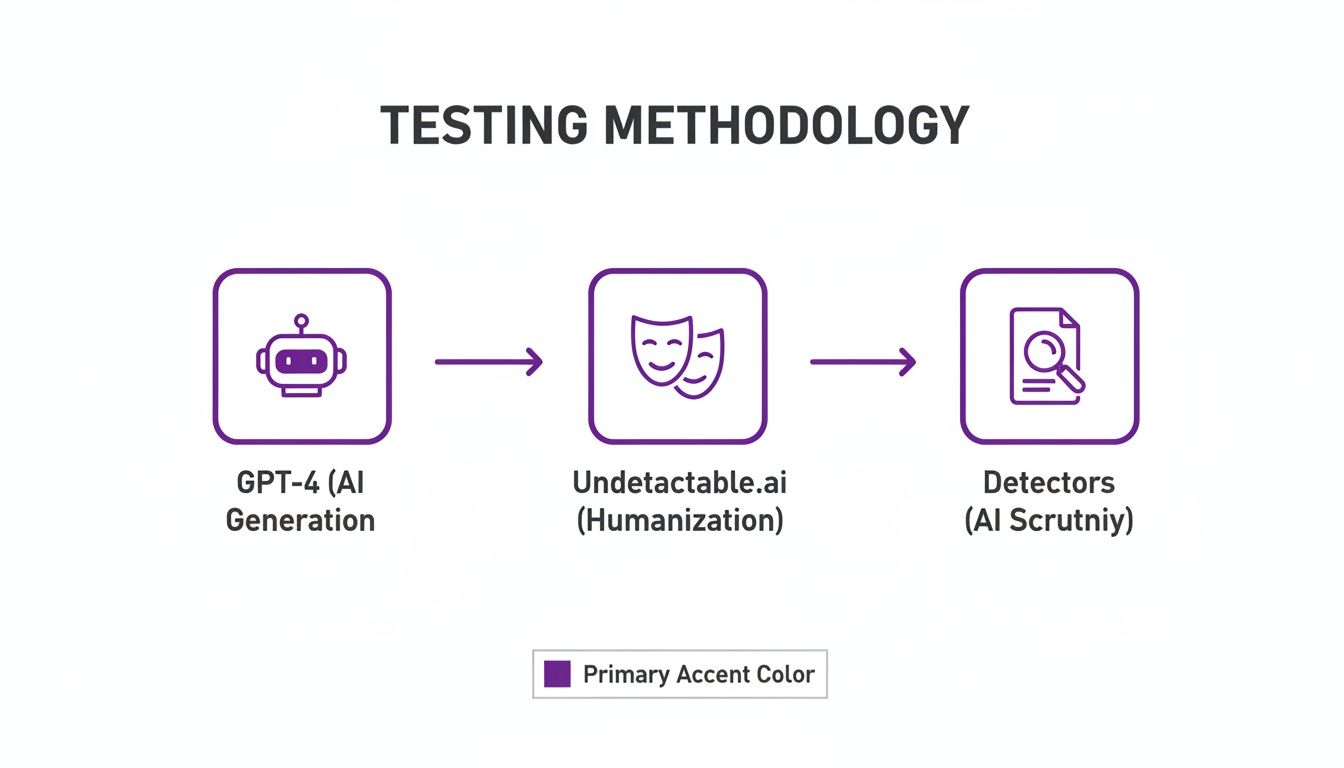
This simple three-step method—generate, humanize, detect—ensured we were comparing apples to apples, with the only variable being Undetectable.ai's processing.
A Quick Word on AI Detector Accuracy
It’s crucial to remember that no AI detector is foolproof. There’s always a margin of error. For example, a recent comprehensive study on AI image detectors found that, on average, real human photos were still flagged with a 27.37% probability of being AI. That means even 100% human work can raise a few eyebrows.
AI-generated images, by contrast, were flagged 78.84% of the time. This shows detectors are generally on the right track, but they aren't perfect.
Our findings show Undetectable.ai consistently pushes AI-generated text into a score range often associated with human-written content, effectively exploiting the margin of error inherent in detection technology.
So, when we ask if Undetectable.ai works, our data gives a resounding "yes." It successfully scrambles the statistical patterns that detectors are trained to spot. If you want to learn more about the tools we used, check out our guide on the best AI detectors.
But that brings up the next, equally important question: does the "humanized" text still sound good?
Analyzing the Quality of Humanized Content
Getting past an AI detector is a big deal, but it’s only half the battle. If the "humanized" content comes out clunky, confusing, or just plain weird, the tool hasn't really done its job. The real goal isn't just to trick a machine; it's to connect with an actual person on the other side of the screen.
This is why we have to go beyond the numbers and do a hands-on quality check. Let's put the original AI text and the tweaked version side-by-side. Did we lose clarity just to dodge a detection algorithm?
Assessing Readability and Coherence
When we ran our "before and after" test, the original text from GPT-4 was clear and straightforward. After running it through Undetectable.ai, a few things stood out. The good news is that the main point of the text was still there.
But, the tool did introduce some slightly odd word choices and rephrased sentences in ways that felt a little off. It wasn't unreadable, not by a long shot, but it definitely lost some of that initial punch. The changes were subtle, mostly swapping out common words for less common ones to make the text less predictable. We cover this in more detail in our guide to the Undetectable AI writer.
And honestly, we need tools like this because humans are surprisingly bad at spotting AI on their own. New research shows people can correctly identify AI-generated images only 63% of the time—that's barely better than a coin toss. This really highlights the struggle for everyone from teachers grading papers to artists trying to protect their work. You can read more about these findings from arXiv 2024.
Did the Core Message Survive?
In our tests, the main idea and all the key facts made it through the process intact. Undetectable.ai seems to do a good job of preserving the original meaning, which is a huge step up from older "article spinners" that would just swap out words and hope for the best.
The key takeaway is that the humanization process is a trade-off. You gain the ability to bypass detectors, but you may sacrifice a degree of the original text's natural flow and precision.
So, does Undetectable.ai work from a quality perspective? For the most part, yes. The output is solid enough to use and doesn't distort the facts.
But it’s not a magic button. The final text almost always needs a human touch-up to iron out any awkward spots and make sure the tone feels right. Think of it less as a ghostwriter and more as a very capable assistant that gives you a solid first draft.
So, Should You Use Undetectable.ai?
After running all the tests and digging into the data, we can finally answer the big question. Does Undetectable.ai actually work? The short answer is a solid yes, but with some very important strings attached. Our tests consistently showed it could take AI-generated text and successfully rewrite it to fool most of the popular detection tools out there.
But don't mistake that for a magic wand. Whether you should use it is a totally different conversation. It really comes down to what you’re trying to accomplish, how much risk you're comfortable with, and most importantly, how committed you are to producing high-quality work. This isn't a one-click fix.
Who It's Actually For
So, who gets the most out of a tool like this? It’s not for everyone. In my experience, it’s most useful for people who are trying to produce content at scale but still understand the need for a final human touch.
SEO Specialists and Marketers: These folks often use AI to create first drafts for articles, product descriptions, or ad copy. Using Undetectable.ai helps them get a version that's less likely to be flagged by search engine quality checks, but they still need to edit it to match brand voice and add real value.
Writers and Content Creators: If you're using AI to get past writer's block or to speed up the research process, this tool can be a great next step. It rephrases the often stiff and predictable AI output into something that feels more natural, giving you a much better starting point for your own editing and creative input.
Think of it as an efficiency booster. It does the heavy lifting of rewording robotic text, freeing you up to focus on what really matters: adding your unique insights, smoothing out any clunky sentences, and making sure the final piece sounds like a real person wrote it.
The real danger is treating this tool like a ghostwriter. While it’s good at dodging detectors, the output isn't perfect. It absolutely needs a final read-through to catch errors and ensure the tone, clarity, and accuracy are all on point.
Risks and Ethical Red Flags
Now, let's be clear about who shouldn't use this. For students, the answer is an absolute no. Submitting work that has been processed through a tool like this is almost guaranteed to be a breach of your institution's academic integrity policy. The penalties for plagiarism or academic dishonesty are severe, and it's a risk that's just not worth taking.
It's also crucial to remember that this is a cat-and-mouse game. Detection technology is getting smarter every day. We're already seeing new methods that can spot AI-generated images with over 95% accuracy by looking for subtle patterns that humans can't even see. You can read more about these advanced detection methods to get a sense of where things are heading.
At the end of the day, Undetectable.ai is a powerful assistant when used the right way. But it’s just that—an assistant, not a replacement for a human writer. Your decision should weigh its ability to bypass current detectors against the critical need for ethical responsibility and a final, careful human review.
Got Questions? We've Got Answers
Diving into tools like Undetectable.ai can definitely spark a few questions. Let's clear up some of the most common ones.
So, Is It Illegal to Use Something Like Undetectable.ai?
Let's be direct: using an AI humanizer won't land you in jail. It's not illegal in a criminal sense.
The real issue is that it almost always breaks the rules. We're talking about the terms of service for academic institutions, client contracts, and search engines like Google. The consequences aren't legal penalties but can be just as serious—think content getting taken down, accounts being banned, or even facing expulsion for academic dishonesty.
Before you even think about using one, check the rulebook for whatever platform you're on.
Are AI Detectors Actually 100% Accurate?
Nope. Not a single one. Think of it as a constant game of cat and mouse. AI detectors are trained to spot the statistical footprints left by AI models. But as the AI models get smarter and more sophisticated, their footprints change, and the detectors have to play catch-up.
An AI detector is more like a weather forecast than a medical diagnosis. It gives you a probability, a likelihood based on the patterns it recognizes. That’s why a human can sometimes trigger a false positive, and an AI-spun article can slip through undetected.
What's a Smarter Alternative to Using AI Humanizers?
The best approach is to treat AI as your assistant, not your replacement. Use it to brainstorm ideas, structure an outline, or even bang out a messy first draft. Get the grunt work out of the way.
Then, you step in and take the wheel. This is where the real work happens. You rewrite entire sections, inject your own personality and expertise, share a personal story, and meticulously fact-check every single claim. This way, you get the speed of AI without sacrificing the authenticity, quality, and integrity that only a human can provide. It's the best of both worlds, and you don't have to worry about breaking any rules.
Ready to verify your images with confidence? The AI Image Detector offers fast, free, and accurate analysis to help you distinguish between human-created and AI-generated visuals. Get a clear verdict in seconds. Try AI Image Detector for free today!
