

The 12 Best AI Detectors to Trust in 2026

In a world where AI-generated content is becoming nearly indistinguishable from human work, the need for reliable verification has never been more critical. From ensuring academic integrity and protecting creative ownership to combating misinformation and securing online platforms, the ability to accurately identify AI-generated text and images is essential for professionals across numerous fields. The expanding landscape of artificial intelligence introduces a new challenge for content authenticity, especially with the widespread use of the best AI tools for content creators.
But with a flood of tools on the market, how do you choose one that is accurate, fast, and respects your privacy? This guide cuts through the noise to help you find the best AI detectors for your specific needs. We will dive into a curated list of the top 12 tools available today, breaking down their specific strengths, limitations, and ideal use cases. Each review is designed for quick scanning and includes screenshots and direct links to help you evaluate the platforms efficiently.
Whether you're a journalist verifying a source, an educator checking assignments, a compliance officer mitigating corporate risk, or a platform moderator ensuring content authenticity, this resource will equip you with the knowledge to select the right detector. We provide hands-on guidance for testing, highlight crucial privacy considerations, and offer actionable next steps for integrating these tools into your workflow. Our goal is to empower you to make an informed decision and implement a solution effectively.
1. AI Image Detector
Best For: Privacy-conscious users needing rapid, on-demand image verification.
AI Image Detector establishes itself as a top-tier choice among the best AI detectors by masterfully balancing speed, privacy, and user experience. It delivers a streamlined, no-nonsense workflow for determining the origin of an image, making it an indispensable tool for journalists, educators, and trust-and-safety teams who require immediate, reliable analysis without compromising data security. The platform's core strength lies in its privacy-first architecture; images are analyzed in real time and are not stored on its servers, addressing a critical concern for users handling sensitive or proprietary content.
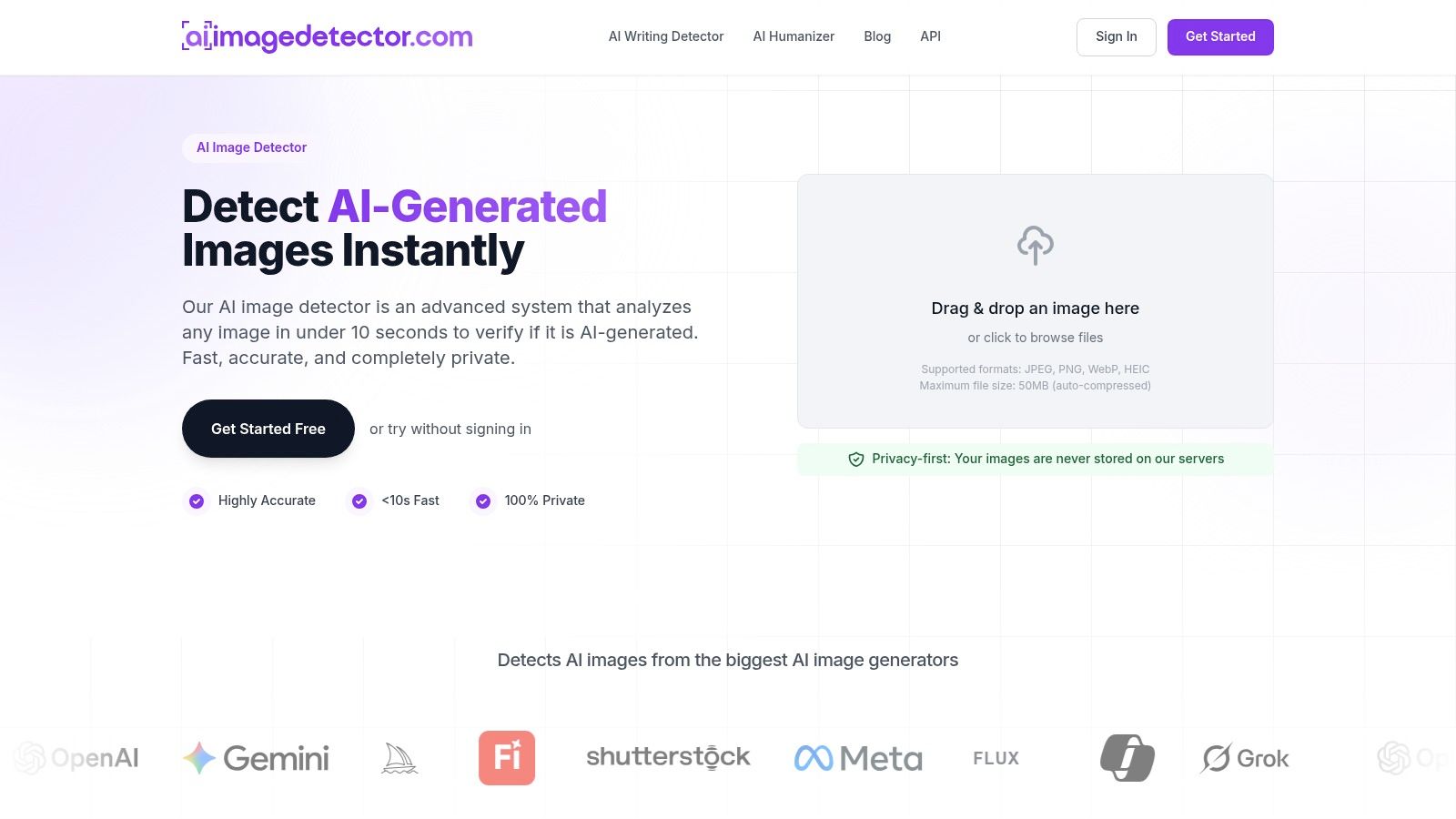
The user interface is exceptionally responsive, often returning a verdict in under ten seconds, and frequently in as little as two. The results are presented with a clear confidence score and a human-readable explanation, a significant advantage over tools that provide only a simple binary "AI" or "Human" output. This detailed feedback, which points to specific artifacts and inconsistencies, helps users understand why an image was flagged, which is crucial for nuanced investigations.
Key Features & Analysis
- Real-Time, Serverless Analysis: Its standout feature is the commitment to privacy. By processing images without storing them, it mitigates risk and builds user trust, a vital consideration for legal and corporate applications.
- Detailed Verdicts: Instead of a simple pass/fail, the tool provides a spectrum from "Likely Human" to "Likely AI-Generated," including an "Unclear/Mixed" category. This nuance is critical for evaluating heavily edited or composite images.
- Developer API: For platforms, marketplaces, or any organization needing to scale content moderation, the available API allows for seamless integration of its detection capabilities into existing workflows, automating the fight against synthetic media fraud.
- Broad Format Support: It accepts common formats like JPEG, PNG, and WebP, ensuring wide compatibility with images from various sources.
Core detection is free and requires no registration, making it one of the most accessible and powerful tools available. While it lacks public third-party accuracy audits, its real-world performance and focus on speed and privacy make it a formidable and highly recommended AI detector.
- Website: https://aiimagedetector.com
2. Originality.ai
Originality.ai is a comprehensive suite designed specifically for professionals managing high volumes of content. It positions itself as more than just a scanner; it's an end-to-end content integrity tool for publishers, SEO agencies, and academic institutions. Its primary distinction is combining a powerful AI detector with a robust plagiarism and readability checker, all within a single, streamlined dashboard.
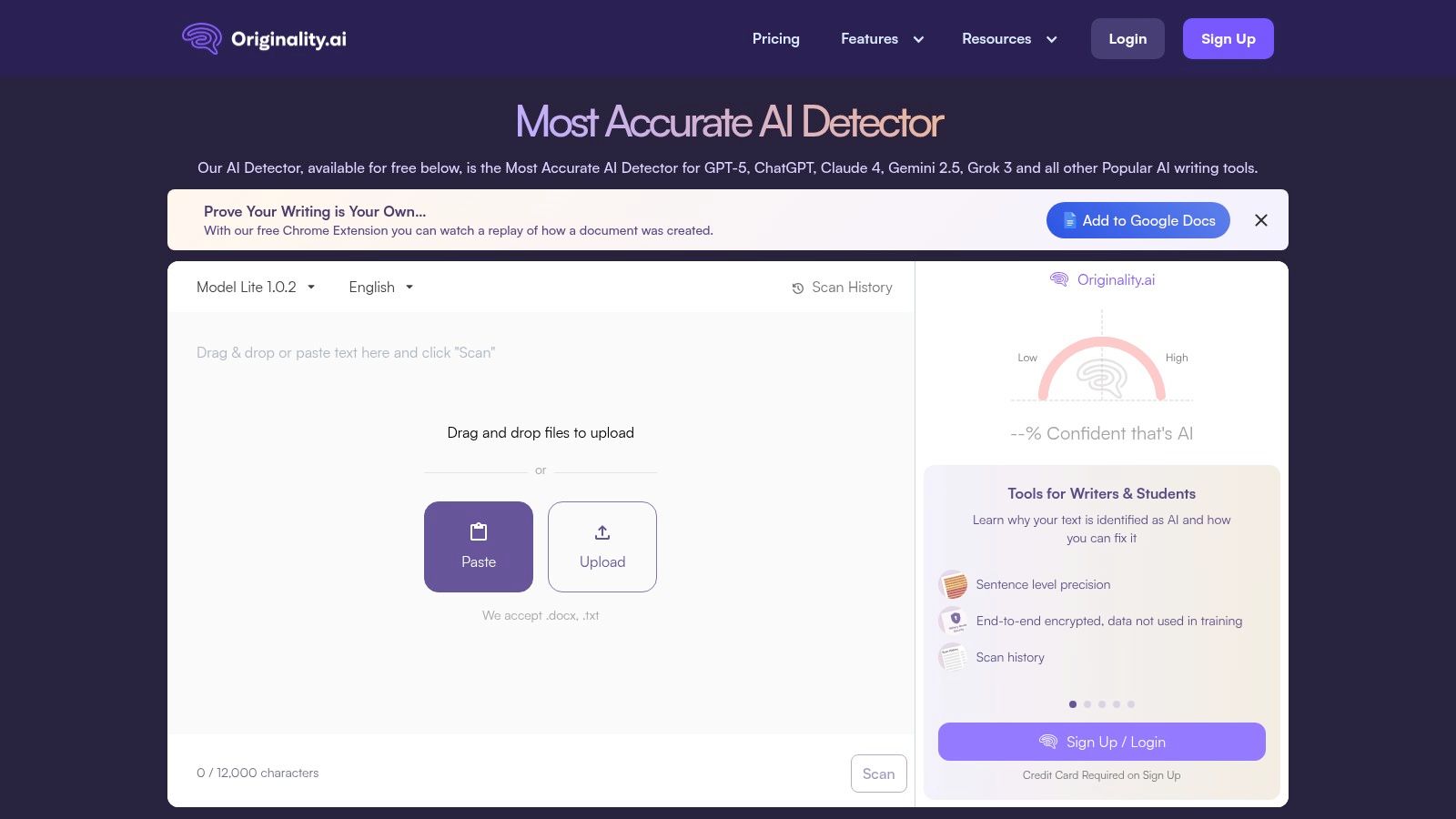
This platform excels in workflow integration, offering a Chrome extension and WordPress plugin that allow teams to check content directly within their existing environments. This focus on operational efficiency makes it one of the best AI detectors for teams that need to scale their content review process without adding cumbersome extra steps. The tool is tuned to identify text from modern LLMs like GPT-4o, Gemini, and Claude, and understanding how AI detectors detect AI can help you interpret its detailed results more effectively.
Key Features & Assessment
- Integrated Toolkit: The platform’s strength lies in bundling AI detection, plagiarism checking, and readability scores. This consolidation simplifies the editorial process significantly.
- Workflow Integrations: Direct integration with Chrome and WordPress is a major advantage for content teams, enabling on-the-fly checks.
- Billing Model: It operates on a credit-based system. Users can purchase one-time credit packs or subscribe to a monthly plan. While flexible, this model can be a drawback for infrequent users, as monthly credits expire if unused.
- Limitations: The lack of a permanent free plan means users must commit financially to test its capabilities beyond a very limited scope. It is also exclusively focused on text-based content, offering no image or video detection.
Visit: https://originality.ai
3. GPTZero
GPTZero has established itself as a leading AI writing detector, particularly within the education sector. It was one of the first widely accessible tools and has built a strong reputation among educators for its straightforward approach to identifying AI-generated text. The platform is designed for individuals, teams, and large institutions, offering a clean interface that provides detailed, sentence-level analysis to pinpoint specific areas of a document that are likely AI-generated.
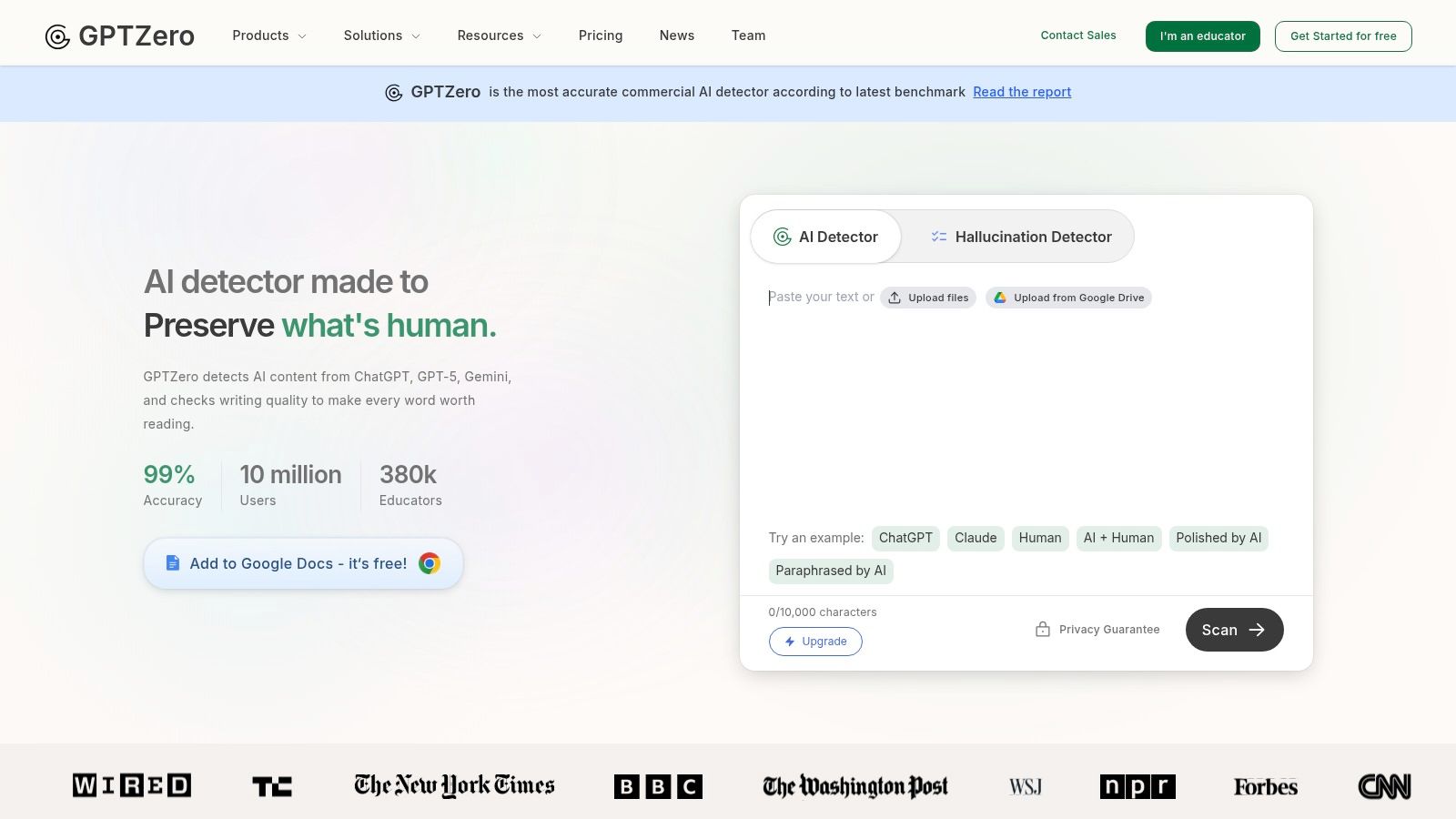
This tool is one of the best AI detectors for academic environments because it focuses on providing actionable insights rather than just a simple probability score. Its detailed reports and sentence highlighting help instructors have more nuanced conversations with students about academic integrity and proper AI usage. GPTZero also offers a powerful API, making it a viable option for developers and organizations looking to integrate AI detection into their own applications and workflows.
Key Features & Assessment
- Sentence-Level Highlighting: Its ability to highlight individual sentences likely written by AI provides granular feedback, which is invaluable for both educators and editors.
- Strong Educational Focus: GPTZero is heavily adopted by schools and universities, offering specific plans and team billing options tailored to institutional needs.
- Pricing Tiers: It provides a range of options, including a free tier, premium subscriptions for individuals, and enterprise-level plans. This flexibility makes it accessible to a wide audience.
- Limitations: The free version is quite restrictive in terms of word count and the number of scans, pushing frequent users toward a paid plan. Higher-volume team and enterprise pricing often require direct contact with their sales team, which can slow down the adoption process for organizations.
Visit: https://gptzero.me
4. Copyleaks
Copyleaks is an enterprise-grade platform that has evolved from a robust plagiarism checker into a comprehensive content integrity solution. It primarily targets the education and enterprise sectors, offering sophisticated tools that go beyond simple detection. Its main differentiator is its powerful multilingual support and deep integrations into existing academic and corporate workflows, making it a go-to for institutions operating on a global scale.
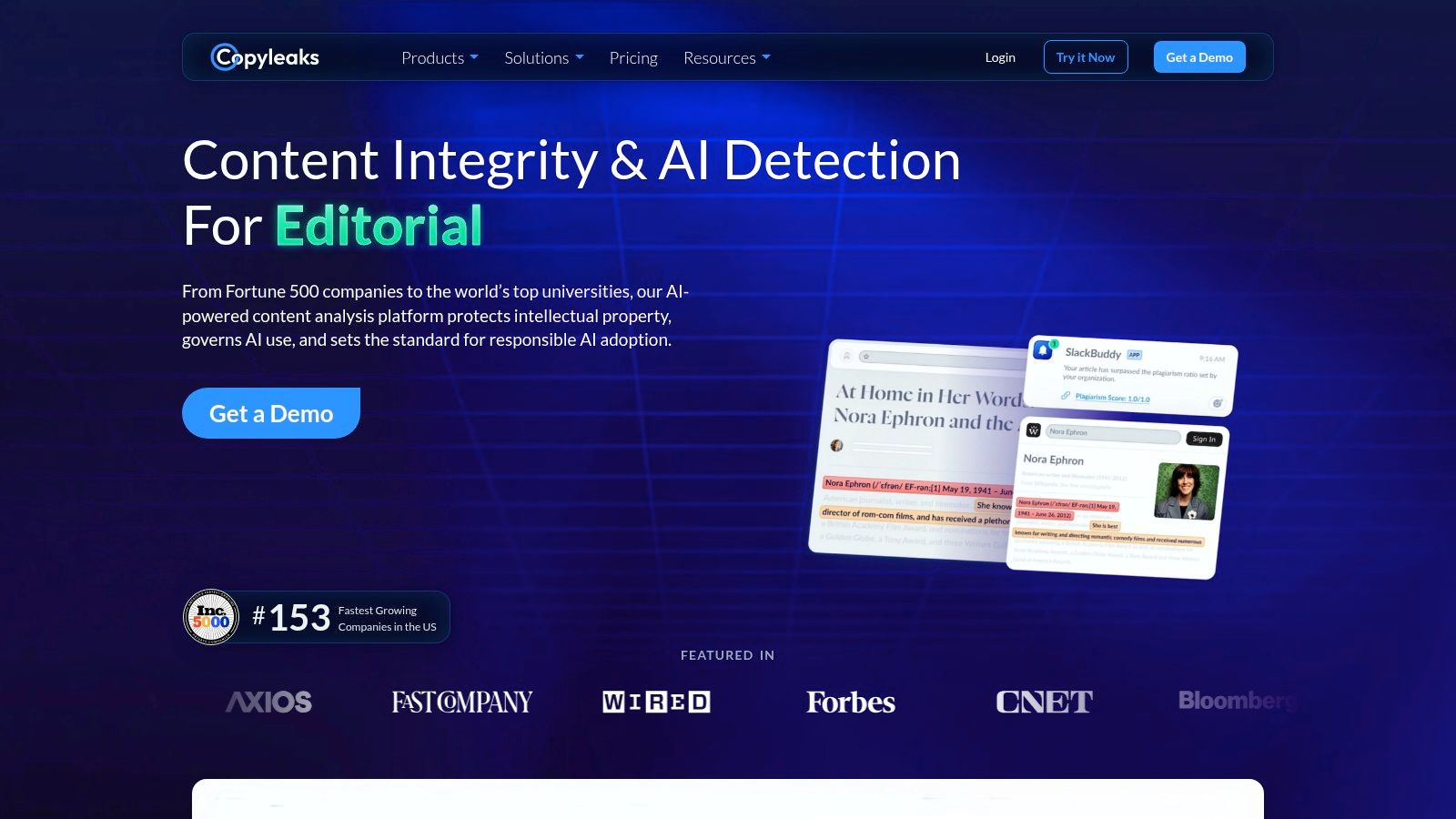
The platform is recognized for its accuracy and its "Explainable AI" reports, which provide a logical breakdown of why certain text sections are flagged, adding a layer of transparency missing in many other tools. With extensive language support and direct add-ons for Google Docs and Chrome, Copyleaks is positioned as one of the best AI detectors for organizations that need verifiable, detailed, and multilingual content analysis integrated directly into their existing systems.
Key Features & Assessment
- Multilingual Powerhouse: The ability to detect AI content in over 30 languages and check for plagiarism in more than 100 makes it invaluable for international organizations and academic institutions.
- Deep Integrations: Copyleaks offers seamless integrations with Learning Management Systems (LMS) like Canvas and Moodle, alongside API access and add-ons for Google Docs, solidifying its role in educational and enterprise environments.
- Institutional Focus: Features like institutional analytics and website-wide scanning are tailored for large-scale deployments, providing administrators with high-level oversight.
- Limitations: There is no permanent free plan; users get a limited trial before needing to subscribe. Pricing for enterprise and educational tiers requires contacting sales, which may be a hurdle for smaller teams looking for transparent, immediate pricing.
Visit: https://copyleaks.com
5. Winston AI (gowinston.ai)
Winston AI presents itself as a highly versatile and comprehensive solution for educators, publishers, and content creators who need to verify both text and visual media. It stands out by offering a unified platform for detecting AI-generated text, AI images, and deepfakes, alongside traditional plagiarism checking and Optical Character Recognition (OCR) technology. This multi-modal capability makes it a robust tool for environments where content integrity is paramount across different formats.
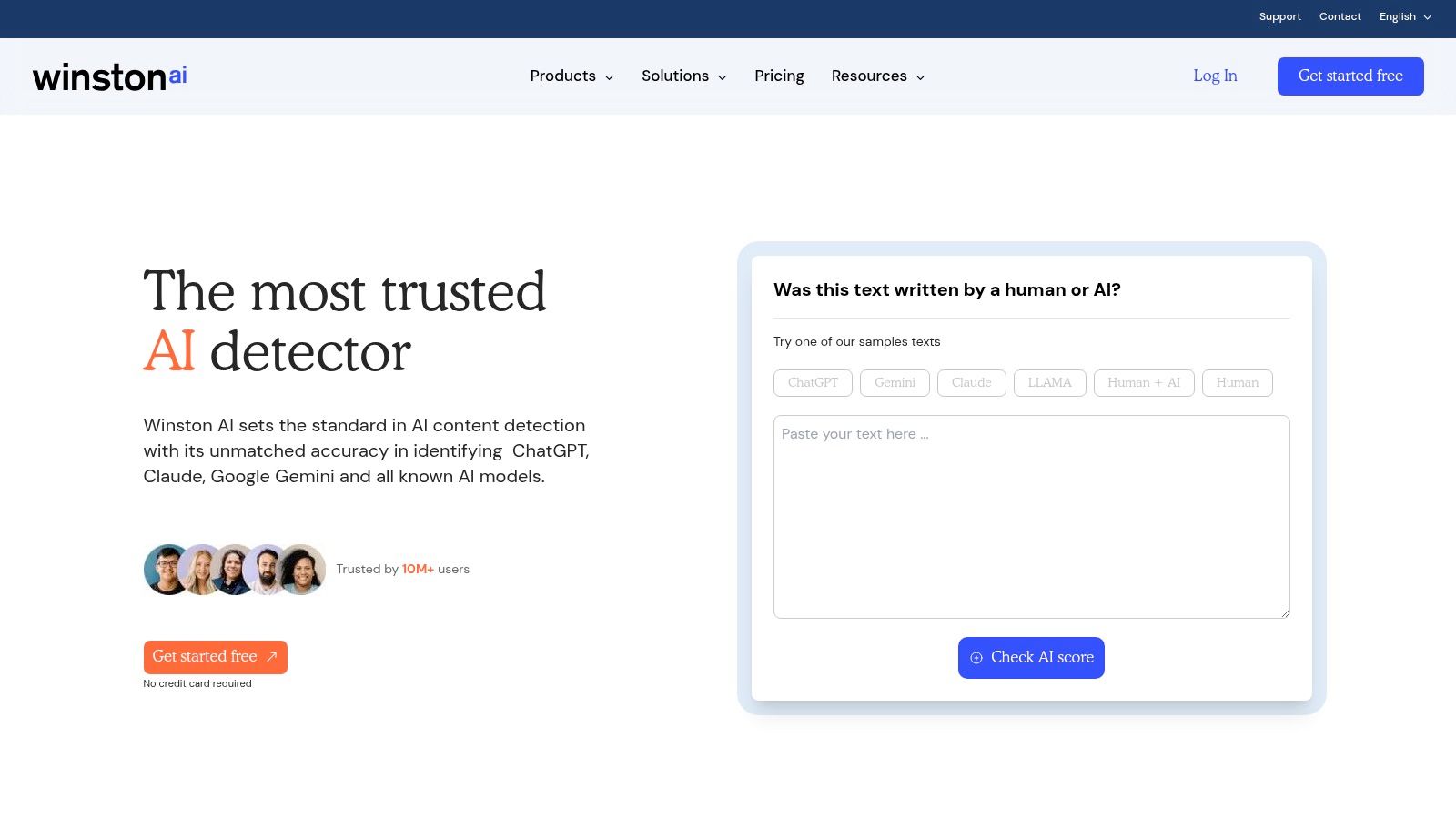
The platform is designed to provide detailed, evidence-based reports, which can be exported as PDFs, a feature particularly useful in academic and professional settings for documentation. Its ability to scan documents and images for text via OCR adds another layer of utility. This positions Winston AI as one of the best AI detectors for users who require a single subscription to manage the authenticity of a diverse range of content types, from essays and articles to digital art and profile pictures.
Key Features & Assessment
- Multi-Modal Detection: Its core strength is the ability to analyze text, images, and deepfakes within one interface, making it a powerful all-in-one tool.
- Documentation & Reporting: The generation of shareable PDF reports provides clear, actionable evidence, which is crucial for academic integrity and editorial review processes.
- Credit-Based System: Winston AI uses a flexible credit model, with a free trial to start. While plans offer generous allotments, the cost per check varies by media type, which can be confusing.
- Limitations: The credit consumption for image detection is significantly higher than for text, which may make it costly for users primarily focused on visual media. The platform also offers a "HUMN-1" website certification, but this feature is more of a niche offering.
Visit: https://gowinston.ai
6. ZeroGPT
ZeroGPT is a widely recognized and accessible AI detector known for its straightforward, no-frills approach. It caters primarily to individual users like students, bloggers, and casual content creators who need a quick and easy way to check text. The platform’s main appeal is its freemium model, allowing users to paste text or upload files for an instant AI-likelihood score without needing to register for an account, making it a go-to for on-the-fly verification.
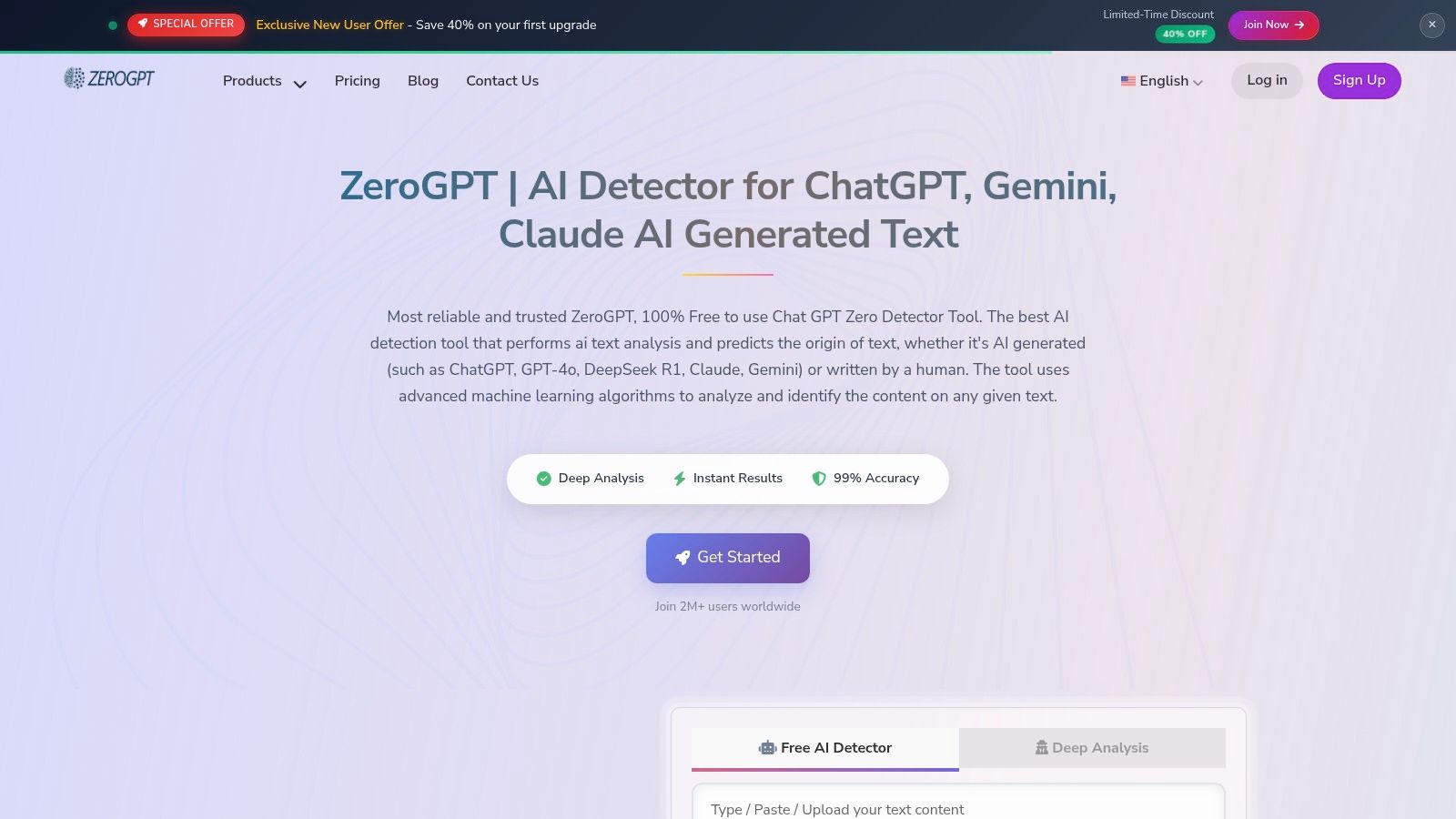
The platform distinguishes itself with a suite of adjacent tools, including a paraphraser, plagiarism checker, and an "AI humanizer," positioning itself as a multipurpose writing assistant rather than just a detection tool. While these features broaden its utility, its core function remains AI text analysis. For users needing a simple, fast, and free solution for occasional checks, ZeroGPT is one of the best AI detectors due to its low barrier to entry and immediate usability.
Key Features & Assessment
- Accessible Freemium Model: The generous free tier provides a high word count per scan (up to 15,000 characters), which is sufficient for most articles and essays. Paid plans are available for heavy users who require more frequent or larger volume checks.
- Simple User Interface: The tool is incredibly easy to use. You simply paste your text into a box and click a button to get an instant percentage score and sentence-level highlighting.
- Billing Model: Beyond the free daily limit, ZeroGPT offers monthly and yearly subscriptions for its Pro and Max plans, which remove ads, increase character limits, and provide access to premium features like the plagiarism checker.
- Limitations: The user experience on the free tier can be hampered by ads and frequent pop-ups promoting its paid services. Furthermore, user reports and independent tests show its accuracy can be inconsistent, occasionally flagging human-written text as AI-generated.
Visit: https://zerogpt.org
7. Turnitin (AI Writing Detection)
Turnitin is an established giant in academic integrity, and its AI writing detection feature is a natural extension of its core mission. Rather than being a standalone tool for the public, it is deeply integrated into the existing Turnitin ecosystem used by universities and schools worldwide. This positions it not as a simple scanner, but as an institutional-level solution designed to be part of a broader academic honesty workflow for educators.
The platform’s key differentiator is its seamless integration into Learning Management Systems (LMS) like Canvas, Moodle, and Blackboard. For instructors, the AI writing indicator appears alongside the familiar Similarity Report, providing a consolidated view of potential academic misconduct. This focus on institutional deployment makes it one of the best AI detectors for academic environments, as it leverages existing infrastructure and provides centralized administration and reporting, which is a critical feature for schools managing academic integrity policies at scale.
Key Features & Assessment
- LMS Integration: Its primary strength is its native integration within the Turnitin workflow that educators already use, eliminating the need for separate tools or processes.
- Institutional Control: Administrators can enable or disable the feature at an account-wide level, giving institutions control over its implementation based on their specific academic policies.
- Combined Reporting: The AI score is presented within the same report as the plagiarism check, offering educators a holistic view of a submission's integrity in one place.
- Limitations: Access is strictly limited to institutions with a Turnitin license; it is not available for individual purchase by students or the general public. There have also been ongoing discussions within academic circles regarding its accuracy and the transparency of its detection model.
Visit: https://www.turnitin.com
8. Microsoft Azure AI Content Safety
Microsoft Azure AI Content Safety is an enterprise-grade solution designed for platforms that need to moderate content at scale. Unlike tools focused on detecting AI-generated content origin, Azure's service classifies text and images based on whether they violate specific safety policies, such as hate, violence, or self-harm. This makes it a powerful tool for trust and safety teams needing to identify and filter problematic content, including harmful AI outputs.
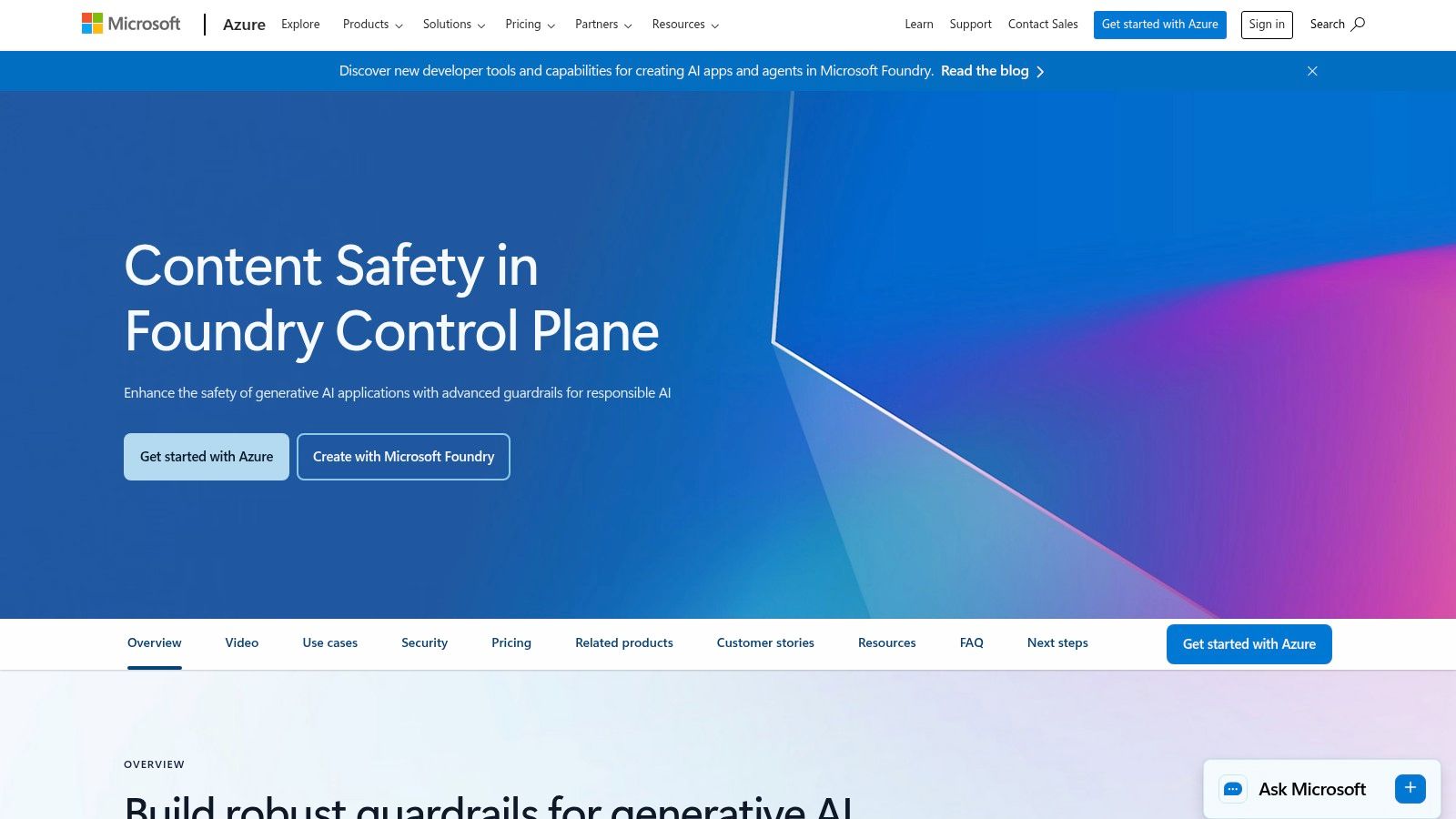
The platform provides developers with robust APIs and an Azure Studio UI to configure and deploy moderation models. Its value lies in its granular, policy-focused approach, offering severity scores for different types of harmful content. This enables automated, nuanced moderation workflows that go beyond a simple AI vs. human classification. As platforms grapple with sophisticated misuse, understanding how to detect AI in the context of policy violation becomes critical, and Azure provides the necessary industrial-strength tooling.
Key Features & Assessment
- Policy-Based Moderation: Instead of just identifying AI, it flags content against configurable safety policies for both text and images, providing severity scores for precise action.
- Enterprise Integration: As part of the Azure ecosystem, it integrates seamlessly with other Microsoft cloud services, making it one of the best AI detectors for companies already invested in the platform.
- Scalability & Pricing: It offers a generous free tier for initial testing and a pay-as-you-go model that scales for high-volume, real-time analysis.
- Limitations: This is not a classic AI provenance detector; it will not tell you if an image was made by Midjourney. It is a content moderation tool that requires technical implementation and policy tuning to be effective, making it less suitable for casual users.
Visit: https://azure.microsoft.com/products/ai-services/ai-content-safety
9. Reality Defender
Reality Defender is an enterprise-grade deepfake detection platform designed for organizations where media authenticity is non-negotiable. Its RealScan technology moves beyond simple AI content checks, offering a comprehensive solution for analyzing images, audio, and video files. The platform is engineered for high-stakes environments like newsrooms, forensic investigations, and corporate security, providing detailed, explainable reports that stand up to scrutiny.

What sets Reality Defender apart is its focus on deployment flexibility and defensible findings. Unlike many consumer-facing tools, it can be deployed on-premises or in a private, air-gapped cloud, meeting the stringent security and compliance needs of government and enterprise clients. This makes it one of the best AI detectors for teams that handle sensitive information and require a robust, scalable system for verifying the authenticity of multimedia content. Its clear, evidence-based reports are tailored for editorial and investigative use cases.
Key Features & Assessment
- Multi-Modal Detection: Excels at scanning images, audio, and video, providing a holistic solution for multimedia verification.
- Enterprise Deployment: Offers SaaS, on-premises, and private cloud options, catering to organizations with strict data privacy and security requirements.
- Explainable Reports: Generates clear, defensible findings suitable for journalistic, legal, and forensic purposes, detailing why a piece of media was flagged.
- Limitations: The platform is not designed for casual or individual users. Its enterprise focus means pricing is significantly higher than consumer-grade tools, and it lacks a simple, free-to-use web interface for quick checks.
Visit: https://www.realitydefender.com
10. Sensity AI
Sensity AI is an enterprise-grade platform built to combat the growing threat of deepfakes and synthetic media. It moves beyond simple text analysis, offering a multilayered detection system that covers pixel-level forensics, file metadata, and audio manipulation. This specialization makes it an essential tool for organizations in finance, media, and security where the authenticity of visual and audio content is paramount.
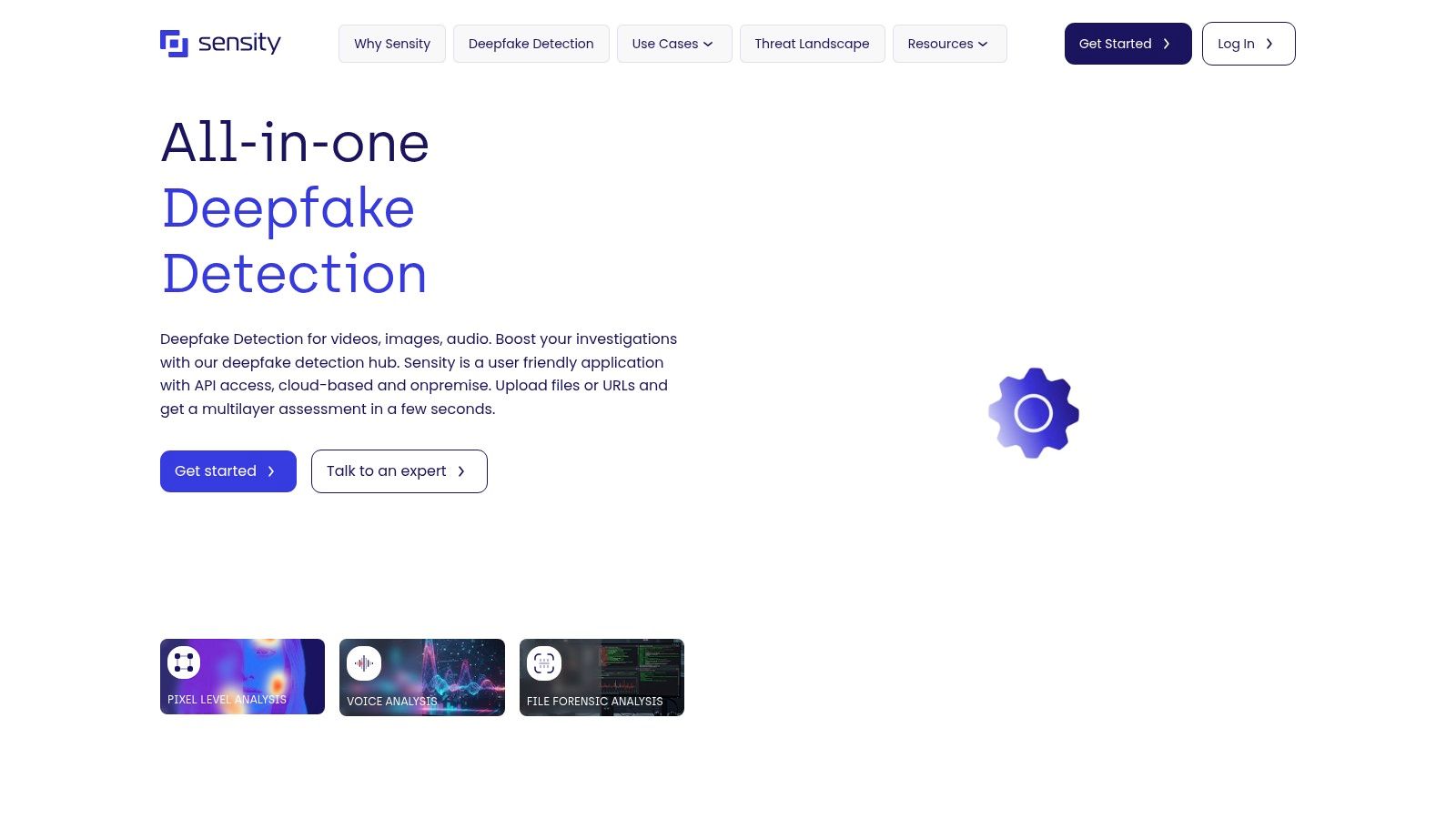
The platform’s core strength is its forensic depth, providing court-ready reports complete with explainability heatmaps that pinpoint manipulated areas in an image or video. With flexible deployment options including a web app, API/SDK, and on-premise solutions, Sensity AI is one of the best AI detectors for businesses requiring scalable, verifiable, and legally defensible content analysis. It is specifically designed to identify face swaps, lip-sync deepfakes, and cloned voices with high precision.
Key Features & Assessment
- Multilayer Forensics: Sensity combines pixel, file, and voice analysis for comprehensive deepfake detection, a critical feature for high-stakes verification.
- Court-Ready Reporting: The generation of detailed forensic reports with visual heatmaps provides a level of explainability and legal credibility that most consumer-grade tools lack.
- Flexible Deployment: Offering cloud, on-premise, and even portable field options via SDK, it caters to diverse enterprise security and operational needs.
- Limitations: This is not a low-cost or free consumer tool. Pricing is available via sales consultation, and accessing its full capabilities through the API requires a formal onboarding process, creating a barrier for casual users.
Visit: https://sensity.ai
11. Truepic (Truepic Vision)
Truepic offers a fundamentally different approach to image and video authenticity, focusing on provenance and secure capture rather than post-hoc analysis. Truepic Vision is a platform designed for high-stakes environments like insurance, marketplaces, and remote inspections where verifying that a visual is real, untampered, and captured at a specific time and place is critical. It ensures integrity from the moment of creation.
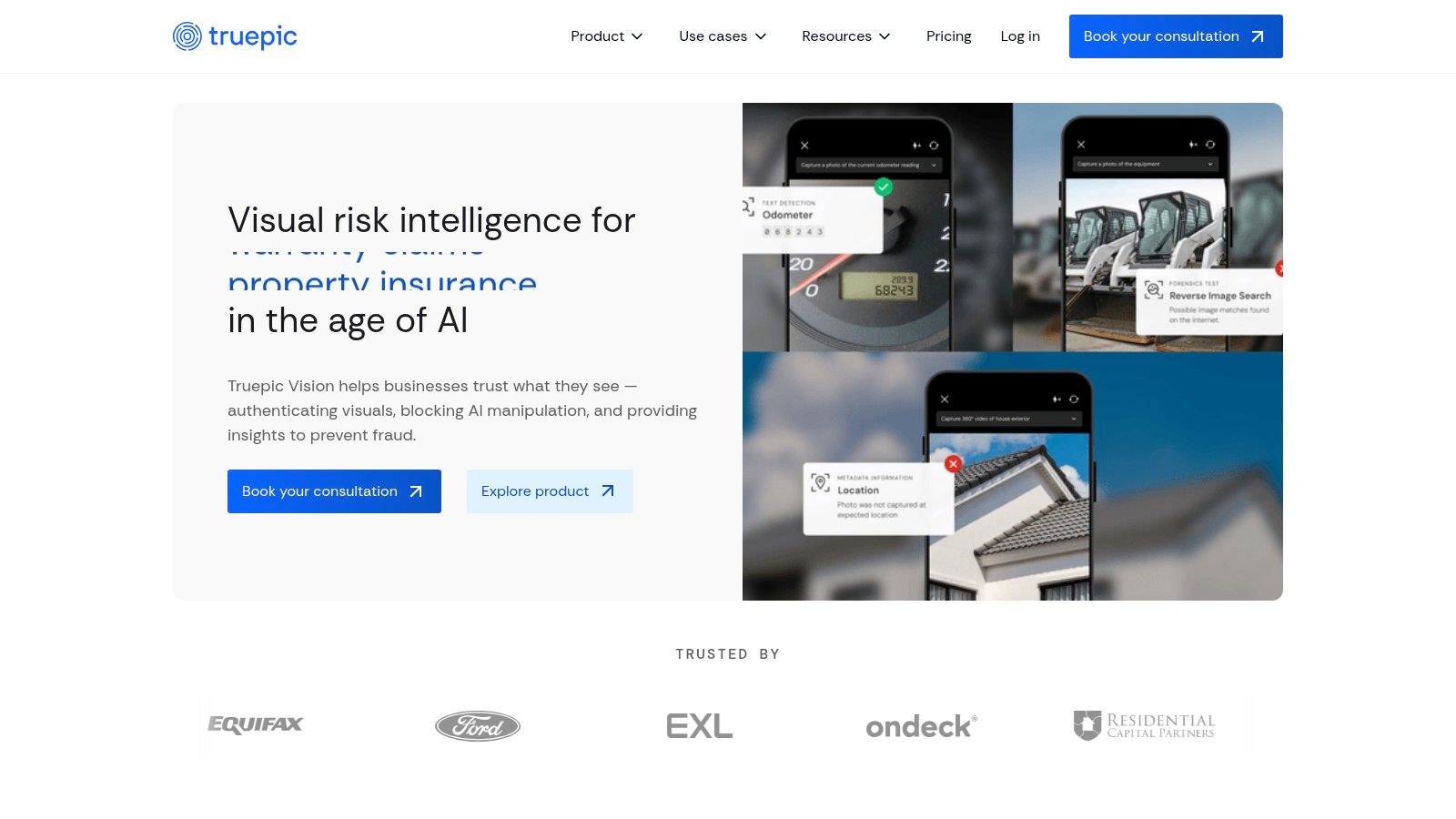
Instead of scanning an existing file for AI artifacts, Truepic's technology verifies media at the point of capture through its secure web or app-based camera. It runs over 35 fraud-risk checks, including geofencing, device integrity, and reverse image matching, to establish a verifiable chain of custody. This makes it one of the best AI detectors for preventing fraud before it happens, which is a crucial capability for any organization relying on user-submitted visuals. The platform's proactive verification is a powerful tool against sophisticated manipulation, making it an essential component in the fight against manipulated media, a topic further explored in how to use a deep fake detector.
Key Features & Assessment
- Secure Capture Technology: Its core strength is verifying images and videos at the moment of capture, providing a tamper-resistant "digital birth certificate" for visual media.
- Comprehensive Fraud Checks: The platform analyzes over 35 data points, including location, device, and capture integrity, offering a robust defense against digital forgery.
- Business-Oriented APIs: Truepic is built for integration into existing business workflows, such as insurance claims or inspection processes, via a powerful API.
- Limitations: The per-inspection pricing model is designed for business volume and can be prohibitively expensive for casual or infrequent use. It is not a tool for analyzing pre-existing images; it only works on media captured through its own secure system.
Visit: https://www.truepic.com
12. Hive (thehive.ai)
Hive is a developer-centric AI platform offering a suite of content moderation APIs, positioning itself as an essential tool for platforms prioritizing trust and safety. It goes beyond simple text analysis by providing dedicated endpoints for detecting AI-generated images, audio, video, and text. This multi-modal approach makes it one of the best AI detectors for companies needing to integrate comprehensive content verification directly into their own applications and moderation workflows at a massive scale.
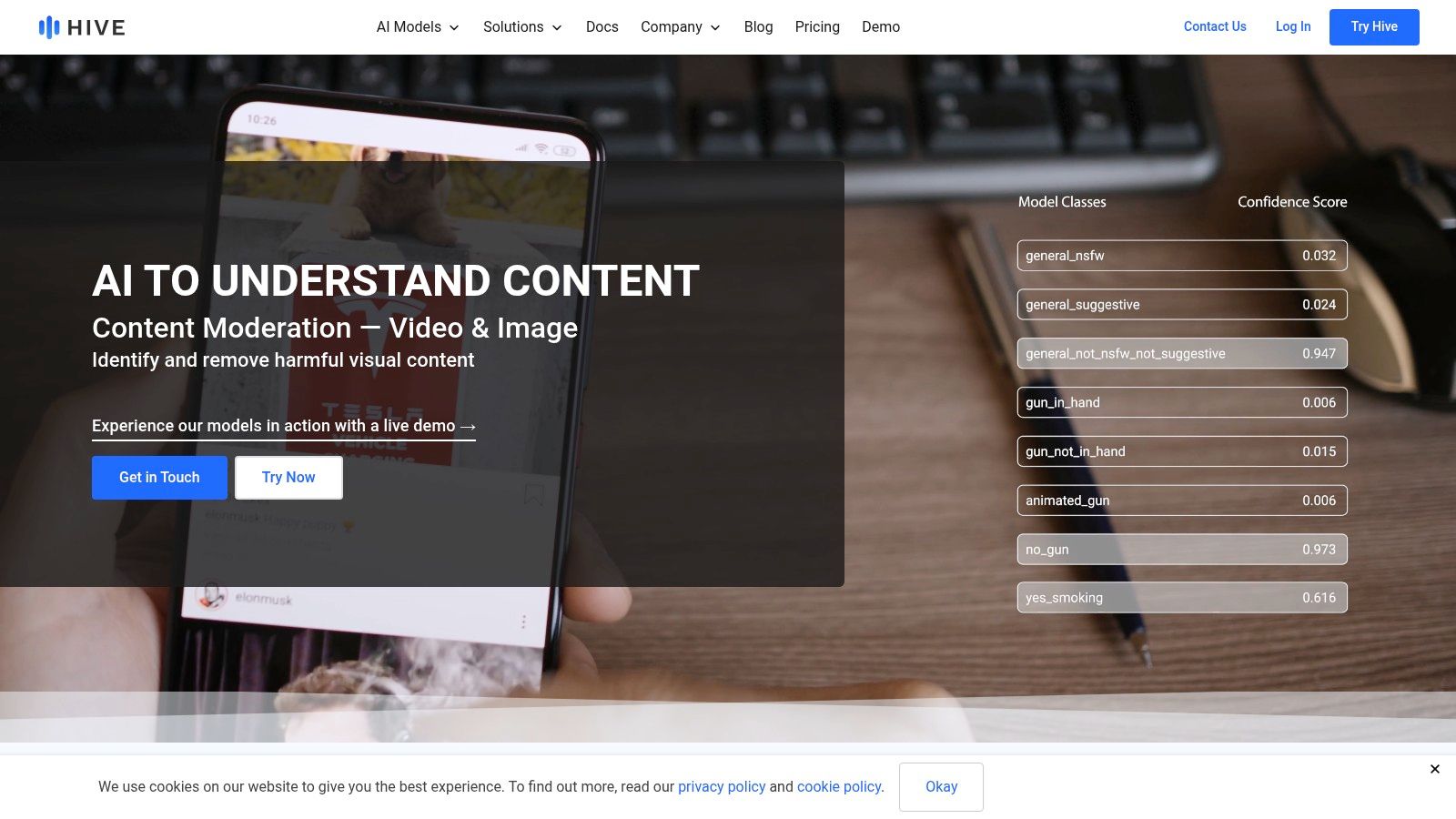
The platform is designed for technical users, such as developers and fraud teams, who require reliable, high-volume processing. Its strength lies in consolidating various AI-driven moderation tools, including deepfake detection and text-to-image classifier, under a single, well-documented API. This simplifies the engineering effort required to build sophisticated, automated content safety systems, allowing businesses to focus on policy and enforcement rather than building detection models from scratch.
Key Features & Assessment
- Multi-Modal API: Hive’s core advantage is its unified API that can classify text, images, audio, and video content for AI generation, making it a versatile solution for platforms handling diverse media types.
- Developer-First Experience: The platform offers clear documentation, a self-serve dashboard, and an API playground. Users get free credits upon adding a payment method, allowing for accessible initial testing.
- Billing Model: It primarily uses a pay-as-you-go credit system for self-serve users. High-throughput use cases require contacting sales for an enterprise plan, which may be a hurdle for some mid-sized businesses.
- Limitations: While powerful, it is not a simple, user-facing tool for a quick one-off check. Per-model pricing is not entirely public for all classifiers, and the platform is geared toward integration rather than standalone use.
Visit: https://thehive.ai
Top 12 AI Detectors Comparison
| Product | Core features & formats | Speed / Privacy / UX | Best for (target use cases) | Pricing / Access | Key differentiator |
|---|---|---|---|---|---|
| AI Image Detector | Image provenance detector (JPEG, PNG, WebP, HEIC); API | Real-time checks (often <10s); images not stored; visual explanations | Journalists, educators, artists, trust & safety, marketplaces, developers | Core detection free, no registration; accounts add history/faster workflows (verify upload limits) | Privacy-first, very fast UI with confidence scores and human-readable reasoning |
| Originality.ai | AI-writing detector + plagiarism + readability; Chrome & WP plugins; API | Dashboard for high-volume review; paid-focused UX | Publishers, SEO teams, agencies | Credit-based billing (pay-as-you-go); no permanent free plan | Combined AI detection + plagiarism workflow for editorial teams |
| GPTZero | Sentence-level analysis, detailed reports, API | Simple UI; education-oriented features | Educators, institutions, academic integrity teams | Free/Pro/Lifetime tiers; team billing; limited free volume | Strong adoption in education with sentence-level detail |
| Copyleaks | AI detection + plagiarism across 30+/100+ languages; LMS add-ons | Enterprise UI, explainable "AI Logic" reports | Education institutions, multilingual teams, enterprises | Trial credits; enterprise pricing via sales | Multilingual coverage and deep LMS integrations |
| Winston AI (gowinston.ai) | Multi-modal (text, images, deepfakes), OCR, PDF evidence reports | Credit-based model; free trial; mixed-media UX | Teams needing combined text/media verification | Credit pricing (different costs per media); mid-tier credit bundles | One subscription for both text and media plus certification options |
| ZeroGPT | Instant AI-likelihood scoring for pasted text/uploads; extras (paraphraser) | Quick checks, freemium with ads and pop-ups | Individual users and occasional heavy users | Freemium daily limits; paid tiers to increase quotas | Accessible free tier with extra writing tools |
| Turnitin (AI Writing Detection) | AI writing indicator integrated with similarity reports and educator tools | Embedded in Turnitin workflow; admin controls | Universities, schools, institutional academic integrity | Institutional licenses only (admin-controlled) | Deep LMS integration and established campus presence |
| Microsoft Azure AI Content Safety | Text & image moderation APIs, Prompt Shields, policy labels | Enterprise-grade, scalable; requires tuning; not a provenance detector | Platforms needing moderation and policy enforcement | Pay-as-you-go with free tier; Azure integration | Enterprise moderation tooling within Azure ecosystem |
| Reality Defender | Deepfake detection for image/audio/video; explainable forensic reports; on‑prem options | Forensic-grade outputs; enterprise security and scalability | Newsrooms, forensic labs, enterprises | SaaS and custom/on‑prem deployments; higher starting price | Defensible, investigation-ready findings and on-prem deployment |
| Sensity AI | Pixel/file/voice forensics; court-ready reports with heatmaps; SDK/API | Enterprise onboarding; forensic focus | Legal teams, enterprises, investigators | Pricing via sales; enterprise contracts | Comprehensive forensic approach with court-ready explainability |
| Truepic (Truepic Vision) | Verified capture (web/app), 35+ fraud checks (geofence, device integrity); API | Capture-time provenance; tamper-resistant workflows | Insurance, marketplaces, inspection and verification workflows | Tiered pricing; per-inspection costs (can be high for ad-hoc use) | Verification at capture time and device/capture integrity checks |
| Hive (thehive.ai) | Developer-first API for multi-modal AI detection & moderation; recognition models | Self-serve credits, dashboard, docs; developer playground | Trust & safety, fraud teams, platform operators, developers | Pay-as-you-go credits; free credits with payment method; enterprise quotes | Single API covering multiple modalities and moderation models |
Making Your Choice: Integrating AI Detection into Your Workflow
Navigating the landscape of AI detection can feel overwhelming, but as we've explored, a powerful and diverse set of tools is available to meet specific challenges. The journey from identifying a potential need to implementing a solution requires a clear understanding of your goals, volume, and technical requirements. This guide has provided a comprehensive look at the best AI detectors available, from simple, free-to-use web apps to sophisticated, enterprise-grade APIs.
The central takeaway is that there is no single "best" tool for everyone. The ideal choice is entirely dependent on your unique use case. An independent journalist verifying a single image for a story has vastly different needs than a university implementing a campus-wide academic integrity policy. Similarly, a social media platform building a real-time moderation pipeline requires a different solution than a legal team conducting a forensic analysis of digital evidence.
From Individual Checks to Enterprise-Scale Integration
Let's distill the selection process into actionable paths based on user profiles:
- For Individuals and Casual Users: Your primary needs are speed, accessibility, and privacy. Tools like AI Image Detector for visual media or ZeroGPT for quick text checks offer immediate, no-cost verification. These are perfect for fact-checking a social media post or satisfying personal curiosity without requiring a login or subscription.
- For Content Professionals and Academics: Publishers, editors, and educators require accuracy, robust reporting, and the ability to handle volume. Originality.ai and Winston AI are excellent for text, offering detailed analysis and plagiarism checks. For academic institutions, Turnitin remains the standard, integrating directly into existing educational platforms to streamline the integrity workflow.
- For Developers and Trust & Safety Teams: Scalability, automation, and deep integration are paramount. APIs from providers like Hive, Microsoft Azure AI Content Safety, and Reality Defender are the definitive choice. These solutions are built to be integrated into applications, content management systems, and moderation queues, providing automated, real-time analysis at an immense scale.
- For High-Stakes Verification (Legal, Corporate): When evidentiary quality and chain of custody are critical, specialized solutions are non-negotiable. Truepic Vision provides C2PA-compliant cryptographic verification, while Sensity AI offers deep forensic analysis for complex deepfake investigations.
Key Considerations for Implementation
Choosing a tool is only the first step. Successful implementation hinges on a strategic approach. Remember that no detector is infallible. False positives and negatives are a reality of the current technology, and the models are in a constant cat-and-mouse game with AI generators. Users and creators are also grappling with the rise of AI Text Humanizer tools, which attempt to make AI-generated content indistinguishable from human writing, further complicating the detection landscape.
Therefore, the most effective strategy is to treat these tools as a critical component of a larger verification process, not as a final arbiter. Combine their output with human judgment, contextual analysis, and source evaluation. Use the detector’s score as a signal to investigate further, not as a standalone verdict. By adopting a multi-layered approach, you can build a robust and resilient defense against the challenges of synthetic media and maintain trust in your digital ecosystem. As AI generation and detection technologies continue their rapid evolution, a flexible and informed strategy will be your greatest asset.
Ready to put these principles into practice? For fast, private, and reliable image verification, start with a tool designed for simplicity and accuracy. AI Image Detector offers a user-friendly platform that helps you instantly analyze images for signs of AI generation, making it an essential first-line-of-defense for anyone from cautious consumers to professional fact-checkers. Try the free AI Image Detector today and take the first step toward building a more secure digital workflow.


