

Image Forgery Detection: A Complete Guide for 2026

You're scrolling through a social feed when a striking photograph stops you. The subject looks plausible, but the shadow falls in the wrong direction, a hand has an awkward shape, or the background seems unusually smooth. A quick image forgery detection scan might label it suspicious, yet that result still won't answer the most important questions: what was changed, who changed it, and does the image support the claim attached to it?
Those questions matter to journalists, teachers, moderators, researchers, and anyone assessing evidence online. A detector can identify patterns associated with manipulation, but it can't establish intent or prove that an entire story is false. The responsible approach combines technical analysis with provenance, context, and human judgment.
The Reality of Image Manipulation in 2026
A newsroom receives a photograph during a breaking story. The sender says it shows the scene from that morning. The image looks convincing at first glance, so a rushed editor might publish it. A careful verifier pauses, saves the original file, checks whether the same photograph appeared earlier, and examines whether the lighting, edges, and surrounding claim agree.
That pause matters because manipulated visuals appear in more than obvious deepfakes. A person can crop a genuine photograph to remove essential context, retouch an object, splice elements from separate images, or repost an authentic image with a false date and caption. AI-generated content is only one category of visual deception.
Scientific publishing provides a concrete reason to treat image integrity as an operational concern. A 2018 analysis of 1,364 papers across 46 journals identified 78 papers, or 5.7% of the sample, with at least one suspected manipulated image (the published analysis). The broader estimate was approximately 6% of published papers, with manipulation particularly concentrated in gel-electrophoresis figures. In related biomedical literature, the estimated share reached 8.6%, although the researchers warned that their screening covered only a limited set of detectable patterns.
Newsroom rule: A suspicious image is a lead for verification, not a verdict.
The consequences extend beyond publication standards. A fabricated portrait, altered document, or misleading political image can trigger reputational, legal, and safety concerns. Teams assessing those risks may also benefit from an overview of the legal risks of deepfakes, especially when manipulated content depicts identifiable people or supports a damaging allegation.
How Forensic Systems Read Images
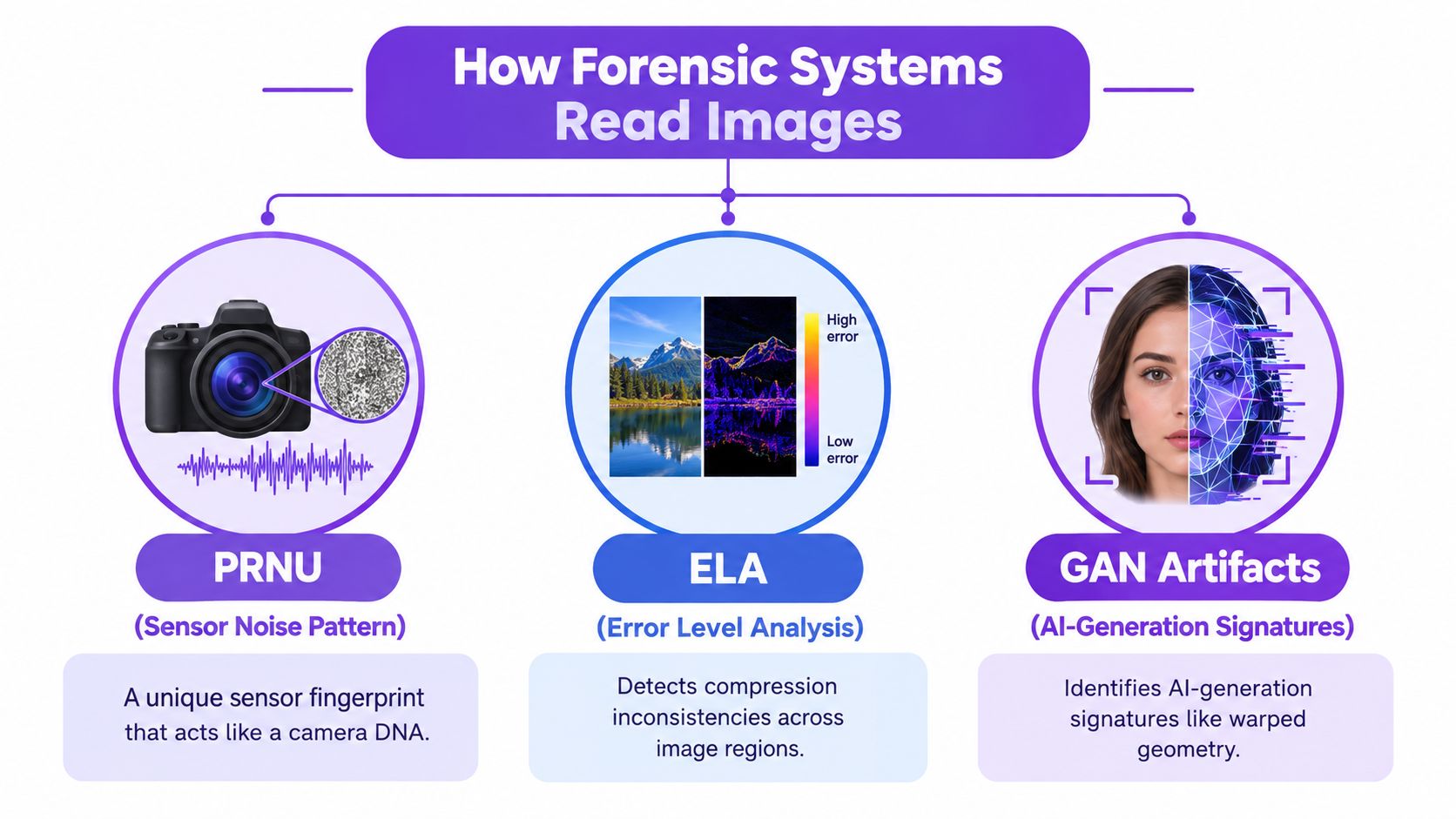
A digital image carries more than visible colors and shapes. It also contains traces of how a camera captured it, how software saved it, and how platforms transformed it. Image forgery detection systems inspect those traces as if they were parts of a fingerprint.
JPEG compression is one important signal. JPEG files divide images into 8×8 blocks and apply mathematical compression. If someone pastes a region saved at a different quality level into a host image, the pasted area may retain a different compression history. Neighboring regions can then show incompatible quantization patterns or signs of double compression.
Sensor noise offers another clue. Cameras introduce subtle, consistent variations during capture. Forensic systems may compare these patterns across regions, looking for a section whose noise behaves differently from the rest of the photograph. Edge continuity, lighting, brightness, and interpolation provide further evidence. A pasted object might have a sharpness level, shadow, or boundary that doesn't match its surroundings.
What the signals can and can't prove
These methods don't detect “fakeness” in the abstract. They detect inconsistencies that may have several explanations. A screenshot, export from editing software, or ordinary platform processing can alter the same traces that a forensic tool expects to find.
A useful technical distinction is between classification and localization. Classification asks whether an image appears manipulated. Localization asks which pixels or region may contain the alteration. The second task is harder when blending, resizing, and post-processing weaken boundaries.
For practical background on one of these signals, see this guide to JPEG image analysis. When you need broader human review alongside automated checks, guidance on trusted verification with Humantext.pro can help frame the result as evidence rather than certainty.
The key limitation is transformation. Resizing, recompression, cropping, screenshots, and social-media processing can erase or distort JPEG, sensor, and interpolation traces. Preserve the original file whenever possible, because every later copy may remove information that a forensic examiner could use.
Traditional Methods vs AI-Based Detection
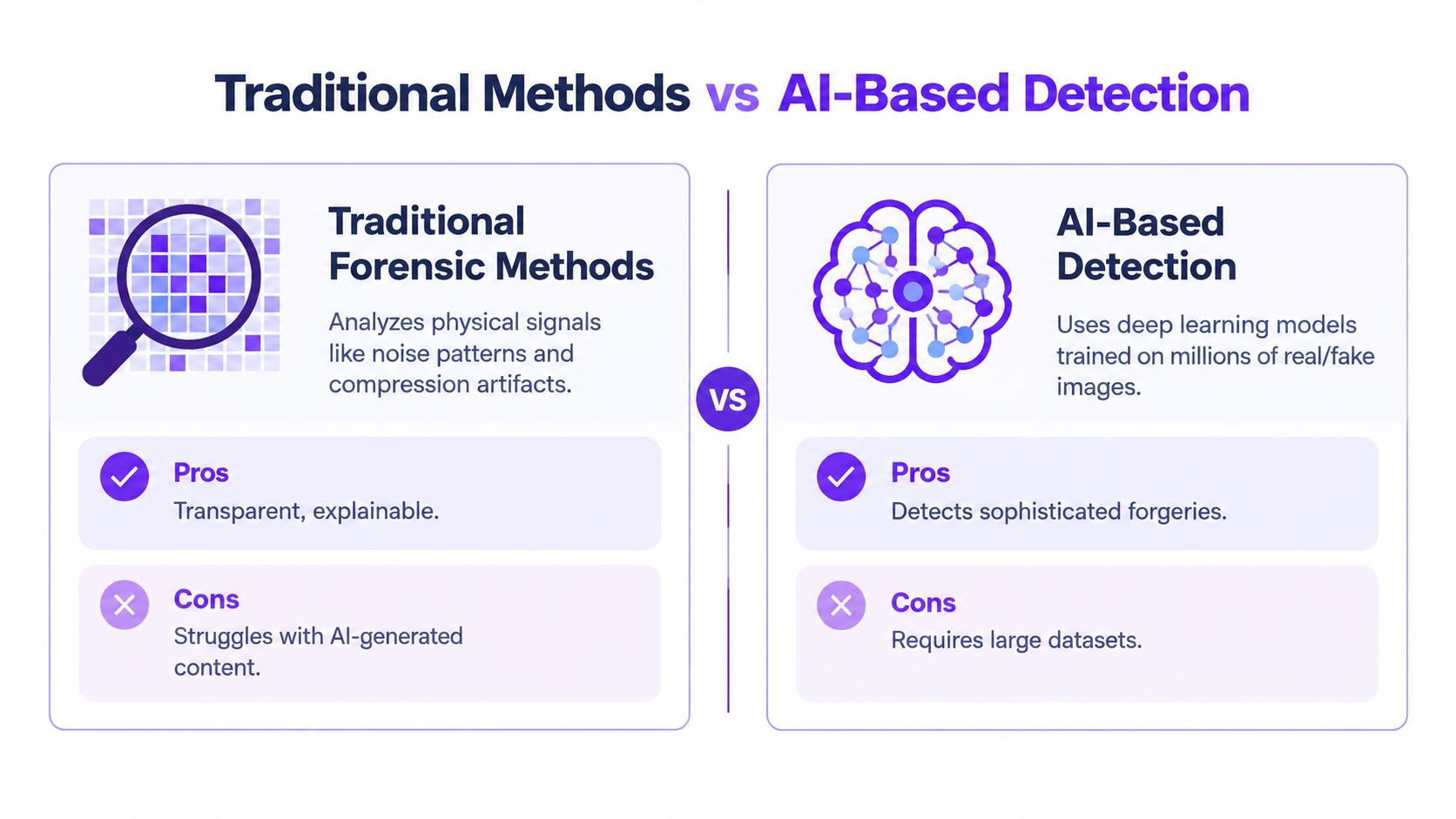
Traditional forensic analysis and AI-based detection answer related questions through different routes. Traditional methods inspect physical or mathematical traces inside the file. AI systems learn visual and statistical patterns from collections of authentic and manipulated images.
Neither approach deserves automatic priority.
Traditional techniques are often easier to explain. An analyst can point to a compression mismatch, duplicated region, inconsistent noise pattern, or abrupt edge transition. That transparency helps a journalist document why an image was flagged. These methods can also work without a large training collection for the precise manipulation under review.
Their weakness is fragility. Recompression, resizing, screenshots, and edits can weaken the clues. A method designed for copy-move manipulation may not identify a generative image, and a detector trained around one file history may struggle with another.
AI-based systems can recognize combinations of clues that are difficult to encode manually. Deep-learning models may detect unusual textures, facial geometry, lighting relationships, or generation artifacts. They can process large queues more consistently than a human reviewer, which matters for archives and trust-and-safety operations.
But machine learning introduces its own blind spots. A model can learn the style of a particular dataset, editing tool, or image source rather than the underlying truth. Performance can fall when the input comes from a different manipulation family or a new distribution of images.
| Method | Strengths | Limitations |
|---|---|---|
| Traditional forensic analysis | More transparent; can connect a flag to compression, noise, edge, or duplication evidence | Sensitive to resizing, recompression, screenshots, and unfamiliar manipulation types |
| AI-based detection | Finds complex visual patterns and supports large-scale screening | Depends on training data; may generalize poorly and can be difficult to interpret |
| Combined review | Pairs technical evidence with contextual checks and human judgment | Requires a documented workflow and careful interpretation of conflicting signals |
For a single image, a traditional inspection may reveal a useful anomaly that an AI classifier misses. For a large moderation queue, an AI system may prioritize cases for human review. The strongest practice treats both as instruments with defined scopes, not as authorities that can replace verification.
A Practical Workflow for Image Verification
A reliable investigation starts before you upload anything to a detector. The order matters because later handling can destroy metadata, alter compression traces, or make it harder to establish where the image came from.
Preserve the evidence first
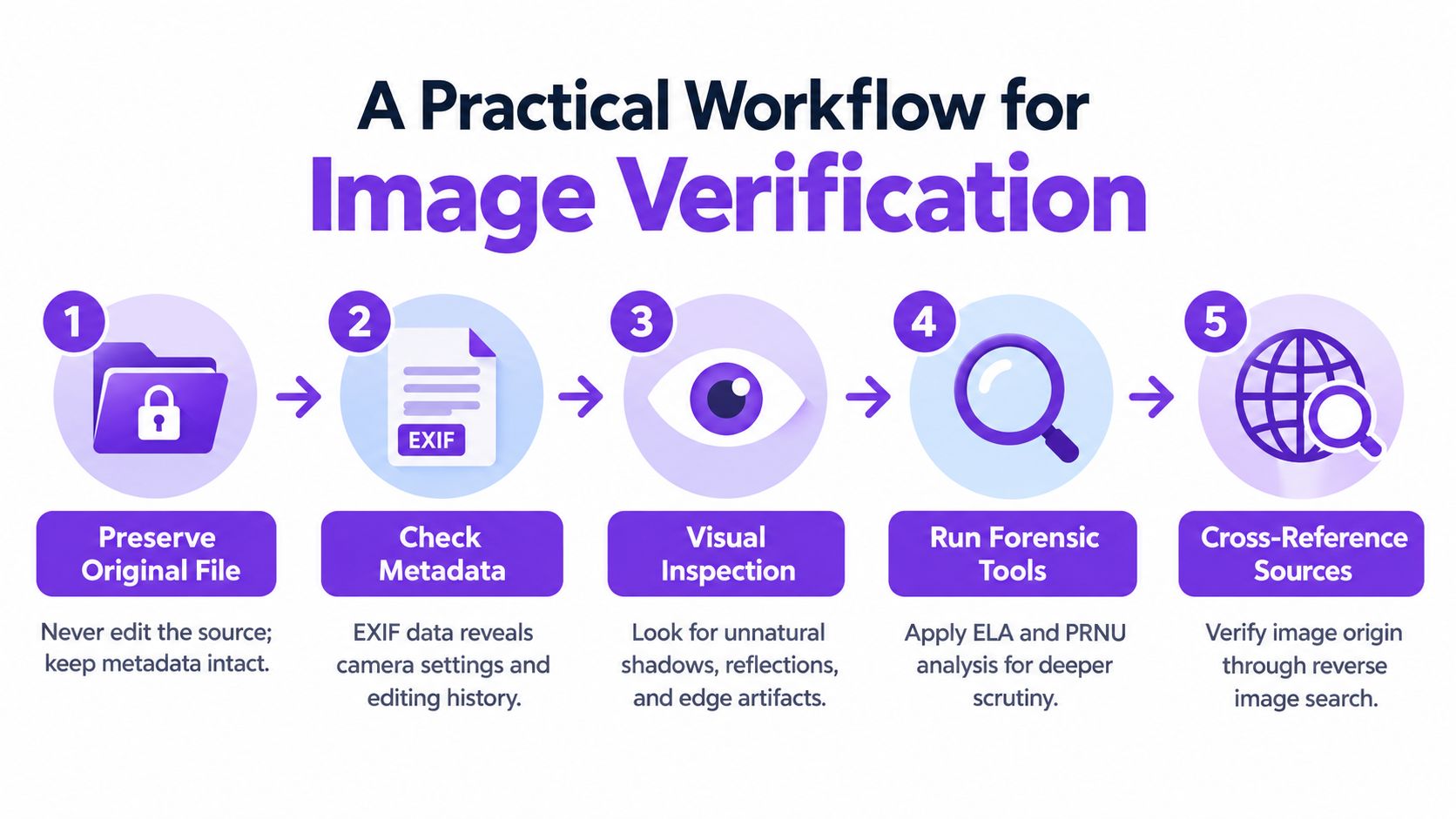
Save the original file exactly as received. Keep the attachment, download record, message, page URL, and any surrounding caption. Don't open and re-save the only copy in an editor, because that can change the file structure and remove useful history.
If the original isn't available, record that limitation. A downloaded social post is not equivalent to the camera original, and a screenshot is not equivalent to the file that produced it.
Check metadata and provenance
Review available EXIF information, including camera details, capture time, dimensions, and editing history. Missing metadata doesn't prove manipulation, and metadata can be changed, so treat it as a clue rather than a certificate.
Then trace the image's history. Use reverse image search, search distinctive visual details, compare older versions, and check whether reputable reporting places the image somewhere else. Provenance often answers questions that pixels alone can't.
Inspect the visual evidence
Look at shadows, reflections, repeated textures, facial features, text, object boundaries, and perspective. Zooming in can reveal inconsistent blur or edges, but visual inspection should generate questions rather than supply certainty.
Ask whether the caption matches the image. An authentic photograph can still mislead if someone assigns it the wrong event, location, date, or identity.
Run forensic tools carefully
Use image-level classification and, when available, pixel-level localization. Record the tool, file version, upload conditions, result, confidence, and limitations. Don't crop or enhance the only copy before testing it, because preprocessing may change the evidence.
This video provides a visual introduction to a professional verification sequence:
Cross-check before publishing
Compare the detector result with provenance, metadata, visual inspection, and independent reporting. If the signals conflict, escalate rather than forcing a binary decision. The same discipline applies to open source intelligence methods, where multiple public clues must be connected without overstating what any one clue proves.
For teams handling repeated investigations, document the process in a shared workflow optimization guide. A written procedure reduces inconsistent decisions and makes later review possible.
Why Benchmark Accuracy Misleads
A detector can perform impressively on a controlled benchmark and still struggle with an ordinary image downloaded from a social platform. The reason is not necessarily dishonesty or technical failure. The test image and the real-world image may no longer contain the same evidence.
Academic benchmarks commonly include CASIA v1 and v2, the Columbia Uncompressed Image Splicing Detection dataset, and MICC datasets such as MICC-F220, MICC-F600, and MICC-F2000. These collections cover operations including splicing and copy-move forgery, sometimes with scaling and rotation. Published studies frequently report 92% to 99% accuracy on controlled benchmarks (the benchmark review).
That range describes a test setting, not a universal property of a detector. A model trained on one dataset or forgery category may degrade on another manipulation type. The gap widens when the image comes from a platform that has resized, recompressed, filtered, or otherwise transformed the file.
Compression changes the question
A pasted region may originally have contained a detectable double-compression trace. After platform processing, that trace can weaken or disappear. A screenshot can remove the original metadata, while enhancement can introduce new edges and textures that confuse a model.
A benchmark built around social-media content makes this problem visible. FIDD-6000 contains 6,000 social-media images, including 1,000 authentic and 5,000 manipulated images, with pixel-level masks for splicing, copy-move, and retouching. Evaluations reported that 15 existing localization methods performed poorly after realistic platform-specific processing (the FIDD-6000 publication).
Interpretation rule: A confidence score describes the system's assessment of this file under its learned conditions. It isn't a universal probability that the image is true or false.
Good evaluations therefore separate precision, recall, F1, and localization IoU. They also include untouched images, recompressed images, screenshots, platform-resized copies, and an out-of-distribution holdout. For a practical discussion of AI image detector accuracy, focus on the test conditions rather than the headline number.
The Hidden Danger of Binary Thinking
“Likely AI-generated” sounds decisive, but it answers only a narrow question about patterns in the file. It doesn't prove who created the image, why they created it, whether they intended to deceive, or whether the caption attached to it is false.
A genuine photograph may be retouched, composited, cropped, or stripped of context without involving generative AI. Conversely, an AI-generated image may be used as an illustration and clearly labeled. “Manipulated” and “AI-generated” overlap, but they aren't interchangeable categories.
A useful newsroom classification separates three questions:
- Origin: Does the file appear to come from a camera, an editing workflow, or a generative system?
- Alteration: Has someone changed pixels, structure, framing, or content?
- Meaning: Does the image support the claim, date, location, and identity presented with it?
A positive detector result doesn't settle the second or third question. Research on real-world political deepfakes found maximum AUCs of 74.78% for images and 73.67% for videos among academic and government detectors (the political deepfake benchmark). A separate 2025 study found that models trained on millions of images could fail on a new dataset, with the best baseline reaching 65.77% accuracy (the study described in the research record).
The correct response is not to ignore tools. It's to use them to sharpen the next question. Trace the earliest known appearance, compare independent copies, verify the caption, contact relevant sources, and state exactly what the evidence supports.
Building a Layered Verification Strategy
An editor receives two versions of the same image. One arrives as a compressed social post, the other as an original attachment from a source. The first detector result is uncertain. A visual review notices a strange reflection, while the reverse search finds an older version from a different event. No single clue resolves the case, but the layers point in the same direction.
That is how trustworthy verification usually works. Each layer contributes a different kind of evidence:
- File preservation protects the material that later analysis needs.
- Metadata review identifies dates, device details, and editing clues without treating them as conclusive.
- Forensic analysis examines compression, noise, edges, duplication, and generation-related patterns.
- Contextual research tests the caption, location, date, identity, and surrounding claim.
- Human escalation handles uncertainty, conflicting signals, high-impact allegations, and sensitive subjects.
An AI classifier can help prioritize work, but the output should travel with an explanation. Record whether the system assessed the whole image or a region, whether the file had been compressed, and whether the confidence was strong, weak, or affected by missing evidence.
Deep-learning research illustrates why this discipline matters. One ViT-based study reported 96.4% accuracy, 94.8% recall, 95.0% F1, and 89.3% IoU on Columbia and related benchmark data (the reported evaluation). Those results demonstrate potential, but they don't remove the need for cross-dataset tests, real-world samples, and calibrated uncertainty.
What a responsible conclusion sounds like
Avoid writing, “The detector proves this image is fake.” Prefer a precise statement such as: “The file contains patterns associated with manipulation, but the available copy has undergone platform processing. Provenance checks found an earlier version with a different caption, so the image should not be published with the supplied claim.”
That wording distinguishes observation from interpretation. It also leaves room for correction if better evidence appears.
A privacy-first tool such as AI Image Detector analyzes uploaded JPEG, PNG, WebP, or HEIC files for patterns associated with AI generation and provides a confidence score with explanatory visual indicators. It can support initial screening, but it should sit inside the layered process rather than replace original-file preservation, source tracing, or editorial review.
For journalists and moderators, the practical standard is simple: show your evidence, state your uncertainty, and explain what the result does not prove. For educators, that same standard teaches students to question both the image and the confidence placed in the tool. For compliance teams, it creates an auditable path from intake to decision.
Use AI Image Detector to screen suspicious images for patterns associated with AI generation and review the result alongside provenance and contextual checks. Upload a preserved copy, read the confidence explanation, and use the output to decide whether the image needs deeper human verification.


