

Image Verification Online: How to Verify Photos in 2026

Only 0.1% of 2,000 consumers could correctly identify every deepfake and authentic image and video stimulus in a 2025 study. That means image verification online can't depend on what your eyes notice in a quick glance.
A convincing image may show a real location, a recognizable person, and believable lighting while still being fabricated, altered, or taken out of context. The practical question for a journalist, educator, moderator, or careful reader isn't, “Is this image fake?” It's, “What evidence supports the claim, how reliable is that evidence, and what should I do when the answer remains uncertain?”
Why Verifying Images Online Matters More Than Ever
Only 0.1% of 2,000 consumers correctly identified every deepfake and authentic image and video stimulus in a 2025 study. The study's findings show why unaided visual judgment cannot carry the full burden of image verification online.
Consider a photograph shared in a group chat that appears to show flooding near a city center. It looks plausible, so an editor posts it to a newsroom channel. Soon, a reporter contacts emergency services, a local official responds publicly, and residents circulate the image as evidence of a worsening crisis. Later, someone discovers that the photograph was fabricated or recycled from an unrelated event.
The mistake may not reflect carelessness. Human vision recognizes familiar patterns well, but it does not reliably expose every synthetic artifact, hidden edit, or misleading context. A busy editor might notice an unusual hand or strange reflection. Another manipulated image may contain neither clue.
The same risk appears in different settings
A professor may receive a student submission with an image said to document an experiment. A community moderator may assess a photograph attached to a harassment report. A designer may find a portfolio image used to support a copyright complaint. In each case, the responsible person must establish what the file shows, where it came from, and whether it has been altered.
The growth of generative AI adds pressure to ordinary review processes. These generative AI risks affect newsrooms, classrooms, platforms, and workplaces alike. Verification therefore works best as routine infrastructure, not as a specialist task reserved for unusual incidents.
Image verification online becomes a professional responsibility when a visual claim could affect someone's reputation, safety, grade, income, or understanding of a public event. A detector can provide a probabilistic signal, much like a warning light on an instrument panel. It cannot, by itself, establish the truth. The defensible decision comes from weighing that signal alongside provenance, context, and other available evidence.
What Image Verification Online Actually Is
Image verification online is the process of collecting evidence about an image's origin, history, editing, and visual consistency. It isn't a barcode scan that returns a perfect label. It's closer to a medical diagnosis, where several observations can raise or lower confidence without removing every possibility of error.
A useful workflow has three layers.
Provenance tells you where a file came from
Provenance records an image's creation and editing history. The Content Authenticity Initiative, launched by Adobe, The New York Times, and Twitter in November 2019, set out to build an open industry-wide system for digital content attribution. By April 2024, the initiative had more than 3,000 members, and by November 2024 it had surpassed 4,000 members worldwide, according to the CAI history.
Standards such as C2PA can attach cryptographically signed information to content. That record may show which device or software handled the file and whether later changes broke the chain of credentials. A valid provenance record can be powerful evidence, but an absent record doesn't automatically prove that an image is fake. Many legitimate files lose metadata during export, cropping, screenshots, or platform uploads.
Forensics examines what the pixels reveal
Forensic analysis looks below the level of ordinary visual inspection. It can examine compression patterns, sensor noise, resampling, edges, lighting, shadows, and other signals that may be inconsistent with a single original capture.
This layer can identify evidence of manipulation even when the file has no useful provenance. It can also produce uncertainty because the same visual irregularity may come from editing, social-media processing, or ordinary camera behavior.
Detectors convert signals into confidence
Probabilistic detectors combine visual clues and return an estimate, classification, or confidence score. The output answers a narrow question, such as whether the image resembles known synthetic imagery. It doesn't establish the image's full history or prove that every element is authentic.
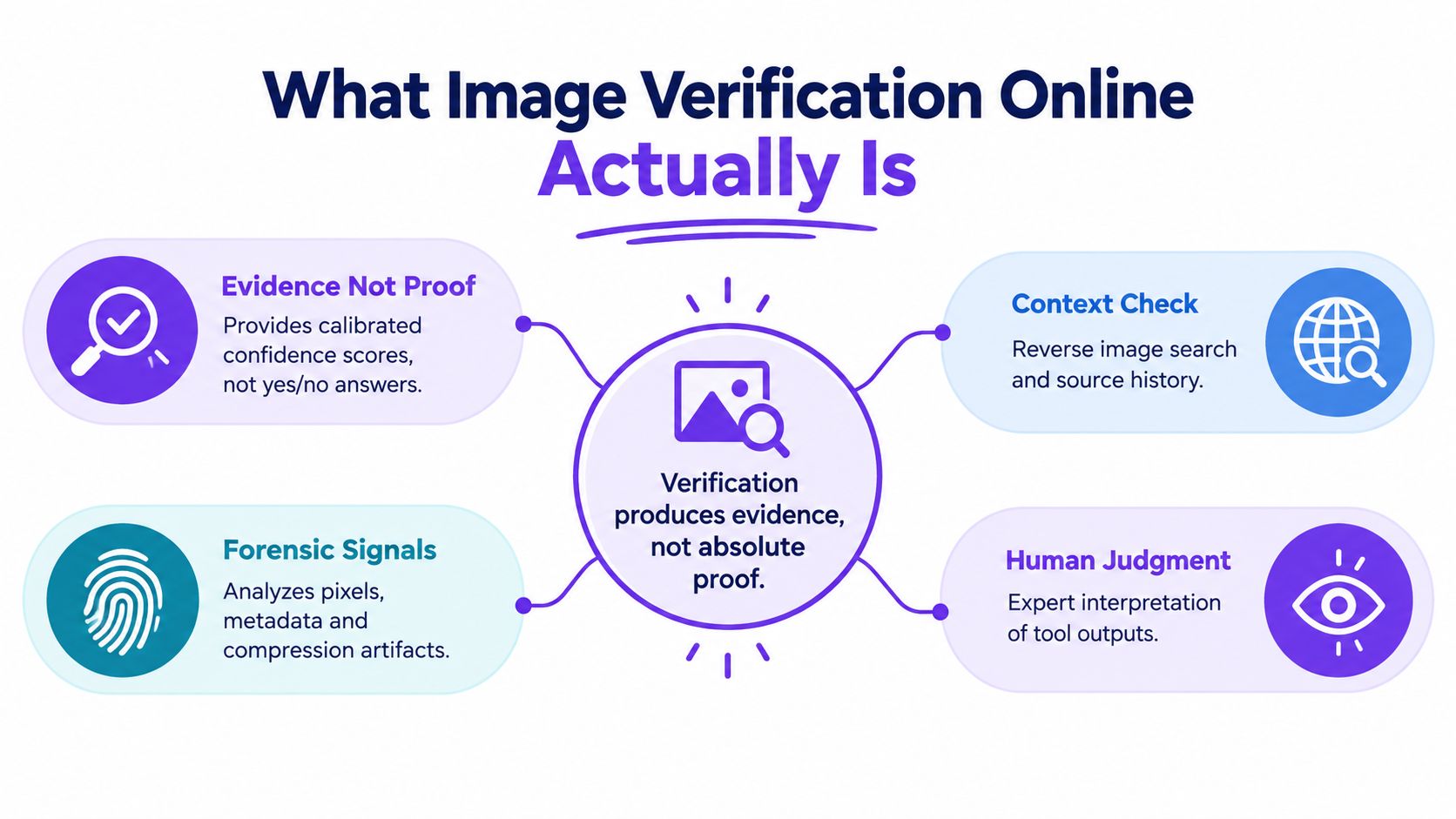
Practical rule: Treat verification as evidence assembly. Provenance, forensics, context, and human judgment answer different questions.
Organizations that need a structured record of origin and ownership can also review brand authenticity solutions from DPP Grid. The important distinction is that authenticity infrastructure supports traceability, while a detector evaluates the visual file itself.
How Detection Tools Actually Work Under the Hood
Modern image detectors don't usually search for one universal “AI mark.” They analyze combinations of small irregularities that humans may overlook. Those signals can include repeated textures, unnatural edges, inconsistent noise, improbable reflections, and lighting that doesn't behave as it should across the scene.
Lighting provides a physical consistency test
A physically plausible photograph should preserve a coherent illuminant model across objects, shadows, and bright reflective areas. Hany Farid's forensic work describes estimating lighting direction, specularity, and chromatic aberration from a single image. In that framework, blocks with an average angular error above 60° or average distortion above 0.15 pixels are treated as inconsistent with the global lighting estimate, as documented in Farid's forensic thesis.
That doesn't mean every flagged block proves manipulation. A complex scene can contain several light sources, reflective surfaces, or heavy compression. The result is best understood as a clue that deserves comparison with other evidence.
Classifiers turn weak clues into decisions
Deep-learning classifiers process visual patterns at scale. A recent ICCV workshop paper reported that ConvNeXt-Tiny reached 98.65% accuracy on an augmented CIFAKE benchmark, with 13.4 milliseconds of inference per image. After adversarial training, the reported accuracy was 96.80%, according to the published paper.
Those figures describe benchmark performance, not certainty on every image found online. A benchmark can control resolution, image classes, transformations, and training conditions. Real files may be cropped, recompressed, edited, rephotographed from a screen, or produced by a generator that the detector hasn't encountered.
The same paper describes using a cosine-similarity threshold of 0.05 to operationalize artifact presence. In plain language, the system compares a detected pattern with a reference representation, then converts a weak resemblance into a practical flag. That conversion helps a tool make a decision, but it also shows why thresholds matter.
For a broader explanation of how automated systems interpret visual signals, see how AI detection works.
Different tools catch different failures
| Method | What it can suggest | What it may miss |
|---|---|---|
| Provenance credentials | A recorded creation or editing history | Files without credentials or files whose metadata was removed |
| Forensic artifact analysis | Pixel-level inconsistencies and possible manipulation | Unusual but legitimate camera or compression effects |
| AI classifier | Similarity to known human or synthetic image patterns | New generators, heavily edited files, and domain-specific imagery |
| Reverse-image search | Earlier appearances, source history, or reused context | Brand-new images with no prior online footprint |
Every method has a blind spot. A defensible decision combines the methods that are available rather than treating one output as a final ruling.
Step-by-Step Verification Workflows for Different Audiences
A journalist, teacher, and platform moderator shouldn't use the same workflow in exactly the same way. Their risks, deadlines, and standards differ, but each can follow a layered process that separates clues from conclusions.
For journalists and fact-checkers
Start by preserving the original file and recording where you found it. Check available provenance, embedded metadata, the account that posted it, the stated date, and the claimed location. Then run a reverse-image search to look for earlier uses, altered captions, or an older event.
Reverse search has a decisive limitation. It works best when an image has already appeared online. A new synthetic image may have no searchable footprint, so an empty result doesn't validate it. That limitation is especially important for newly created AI visuals, as explained in this reverse-image-search guide.
Use forensic analysis or a detector as a further pass. If the result is medium confidence, treat it as a mandatory follow-up investigation, not a verdict. Contact the original uploader, seek independent photographs, compare landmarks and weather conditions, and document every step before publication.
For educators
Ask what role the image plays in the assignment. If it's supporting evidence, request the original file, source details, and a short explanation of how the student obtained or created it. Compare the image with the student's documented process and submission history, but don't treat stylistic differences alone as proof of misconduct.
A detector can prompt a conversation about process. It shouldn't replace a fair review, especially when a student may have edited a legitimate photograph or used ordinary enhancement tools.
For moderators and trust-and-safety teams
Moderation requires triage. Preserve the content, assign a confidence level, check for context, and route ambiguous cases to trained reviewers. Document the image, relevant account information, tool outputs, reviewer reasoning, and the policy decision.
| Question | Best tool or technique | Known blind spot |
|---|---|---|
| Is there a record of creation or editing? | Provenance credentials and metadata review | Records may be missing after reuploads or transformations |
| Has this image appeared elsewhere? | Reverse-image search and source-history checks | A new AI image may have no prior footprint |
| Does the file contain suspicious visual signals? | Forensic analysis and AI detection | Legitimate edits and compression can create similar signals |
| What action is proportionate? | Human review against documented policy | Reviewers can still misinterpret incomplete evidence |
For a more detailed discussion of the detection workflow, consult AI-generated image detection.
Decision rule: Escalate when the potential harm is high and the evidence is mixed. A low-confidence tool result shouldn't silently become a permanent label.
Where AI Image Detector Fits Into Your Workflow
AI Image Detector fits best as a rapid analysis layer, not as a replacement for provenance checks, source research, or editorial judgment. The service accepts JPEG, PNG, WebP, and HEIC files up to 10 megabytes. It analyzes the upload in real time without storing images on its servers and returns a confidence result ranging from Likely Human to Likely AI-Generated, with explanatory reasoning.

The core detection is free and doesn't require registration. Accounts provide history saving and faster workflows, which can matter when a user needs to compare many files or maintain an internal review record. The service is designed for uses including media verification, academic integrity, marketplace safety, and trust-and-safety review.
Use the result according to the risk
A clear high-confidence result can help prioritize obvious cases for further review. It may be useful when a moderator needs to sort a large queue or when a journalist wants an initial signal before spending time on source outreach. The explanatory output can also help reviewers record why an image received attention.
A result deserves secondary checking when the file is mixed, edited, cropped, recompressed, or surrounded by unknown provenance. Medium confidence should increase investigation, not reduce it. A detector can identify patterns associated with synthetic images, but it can't tell you whether a real photograph was miscaptioned, whether a legitimate file was retouched, or whether the person posting it is describing the event accurately.
Journalists can use the tool as a first pass before contacting a subject. Educators can place its output alongside peer review and a discussion of the student's process. Moderators can use it inside an escalation framework that records both the score and the evidence considered afterward.
The Hard Truths About Verification Limits and False Positives
Verification tools can fail in either direction. NewsGuard found that five commercial detectors mislabeled 13% of real photos as AI-generated in May 2026, according to the reported assessment. A false positive is more than a software mistake. It can cast doubt on a real person, an authentic event, or legitimate creative work.
A separate New York Times test across more than 1,000 trials found that detectors were more useful for confirming suspicions than issuing definitive rulings. The practical lesson is easy to miss: a result can justify closer examination without proving what happened, who created the image, or whether its caption is accurate.
False positives carry real ethical costs
A journalist who publishes a correction based only on a detector may damage a subject's reputation. An educator who treats a score as proof may punish a student unfairly. A moderator who removes authentic documentation may silence a legitimate report.
False negatives create the opposite risk. A fabricated image may continue circulating because the relevant artifacts were missed, the file was edited after generation, or the generator falls outside the detector's training experience.
Verification also weakens as an image moves through the world. The referenced coverage reports that only 20 scenarios reached high-confidence authentication across combinations of tools, content, and channels. Creation, editing, uploading, transformation, and viewing can each introduce uncertainty.
Responsible conclusion: A detector flag is a reason to investigate. It isn't permission to accuse.
Treat the score as a triage signal, much like a smoke alarm. It tells you where to look, not what caused the smoke. Seek corroborating evidence, contact creators where appropriate, inspect source history, compare independent material, and explain uncertainty to the audience. A confidence score should shape the next action, while the final claim rests on the wider evidence record.
Building a Defensible Verification Practice
A defensible practice begins with a simple change in mindset. Don't ask a single tool to settle a complicated question. Build a traceable chain of evidence that another reviewer could inspect and understand.
Use this sequence for most high-stakes images:
- Preserve the file and context. Save the original upload when possible, record the account, caption, timestamp, and claimed location, and avoid relying only on a screenshot.
- Check provenance first. Look for Content Credentials, metadata, creator information, and a consistent creation history. Missing provenance is an information gap, not a verdict.
- Run a detector pass. Record the tool, result, confidence level, and explanation. Don't paraphrase a probabilistic output as certainty.
- Search for prior appearances. Use reverse-image search to identify older events, altered captions, or recycled photographs. An empty search result leaves the image unresolved.
- Review ambiguous cases manually. Inspect lighting, shadows, reflections, anatomy, edges, compression, and the relationship between the image and the claim.
- Document the decision. Keep the evidence trail, rejected explanations, reviewer names or roles, and the reason for publication, escalation, removal, or continued review.
Apply the standard to the audience
A journalist should publish the image's verified context and describe meaningful uncertainty instead of overstating what a detector found. If the origin remains unknown, the article should say so and avoid presenting the image as confirmed evidence.
An educator should report process concerns and invite clarification before making an academic-integrity decision. The image itself may be only one part of the evidence.
A moderator should escalate content when the potential harm is serious, the image supports a consequential claim, or the available evidence conflicts. The escalation record should distinguish “likely synthetic,” “possibly manipulated,” “miscontextualized,” and “unverified,” because those are different findings.
The goal isn't perfect detection. It's responsible judgment under uncertainty. Replace “Is this image fake?” with two better questions: What evidence supports the claim, and how confident should I be in the decision that follows?
AI Image Detector lets you upload common image formats, receive a confidence-based assessment with explanatory reasoning, and use the result as one evidence layer in a broader verification process. Visit AI Image Detector to test an image and build a more careful first pass before publishing, teaching, or moderating visual content.

