

Regulatory Compliance Requirements Explained Simply

Your team is about to launch something ordinary. A new customer form. A newsroom workflow for checking photos. A classroom policy on AI-generated assignments. Then someone asks a question that stops the launch cold: “Are we compliant?”
That moment happens more often than many teams admit. The work is done, the tool is live, the vendor has been approved, and only then does the issue surface. What data are we collecting, where does it go, who reviews flagged content, how long do we keep records, and what proof do we have if someone asks later?
Most confusion around regulatory compliance requirements comes from treating them like a legal memo instead of an operating routine. Teams imagine a giant checklist hidden inside laws and regulations. In practice, compliance usually shows up as daily work. Approval steps. Logs. Training. Retention rules. Access controls. Vendor review. Escalation paths when something goes wrong.
That matters because the rules overlapping in 2025 and 2026 aren't neatly separated. A financial firm using AI to review customer-submitted media may face digital resilience duties, AI transparency duties, privacy duties, and internal audit expectations at the same time. A school reviewing synthetic images may not be “regulated like a bank,” but it still needs a defensible process for handling student data, documenting decisions, and responding to disputes.
The hard part isn't just knowing that a rule exists. It's turning scattered obligations into reusable controls that work across regions and teams.
Introduction to Regulatory Compliance Requirements
A common scenario looks like this. An editor adopts an image verification tool to screen submissions. The trust team likes it because it may catch synthetic media. Legal asks whether the tool stores images. IT asks whether the API sends files outside the region. The standards team asks what happens when the tool flags a real image by mistake. Suddenly, one simple workflow touches privacy, documentation, vendor oversight, and appeal handling.
That's why compliance can't sit at the end of the process. If you wait until launch week, you'll spend your time rewriting forms, pausing contracts, and explaining gaps to leadership. If you build it into the workflow early, compliance becomes much less dramatic. It starts to look like clear ownership and predictable evidence.
Why this feels harder right now
The pressure has increased because multiple frameworks are moving on different timelines. Recent compliance developments highlight the overlap problem directly: DORA became fully applicable on January 17, 2025, the EU AI Act's prohibited-AI rules started in February 2025, GPAI obligations began in August 2025, and high-risk system requirements are due in August 2026, as noted by this compliance trends summary.
For many teams, the question isn't “What does this one law say?” It's “Which evidence can we reuse across all of them?”
Practical rule: If two regulations ask for oversight, documentation, and incident handling, don't build two separate programs until you've tested whether one control can satisfy both.
Who needs this most
This topic isn't only for heavily regulated enterprises. It matters to:
- Editors and journalists who need review trails for manipulated or synthetic content
- Educators and schools that must handle disputes over AI-generated submissions fairly
- Platform teams that need moderation workflows they can explain later
- Compliance and legal teams that are tired of rebuilding controls for each new rule
- Developers and product owners who need to translate legal language into system behavior
Good compliance work doesn't start with panic. It starts with a plain question: what must we prove, to whom, and through which records?
What Regulatory Compliance Requirements Really Mean
At a simple level, regulatory compliance requirements are the rules an organization must turn into repeatable behavior and evidence. Not just promises. Not just policies sitting in a folder. Real steps that people follow and systems record.
A useful analogy is an operating system. You don't think about it every time you click a button, but it decides permissions, security, updates, and error handling. Compliance works the same way. It sets the conditions under which work can happen safely.
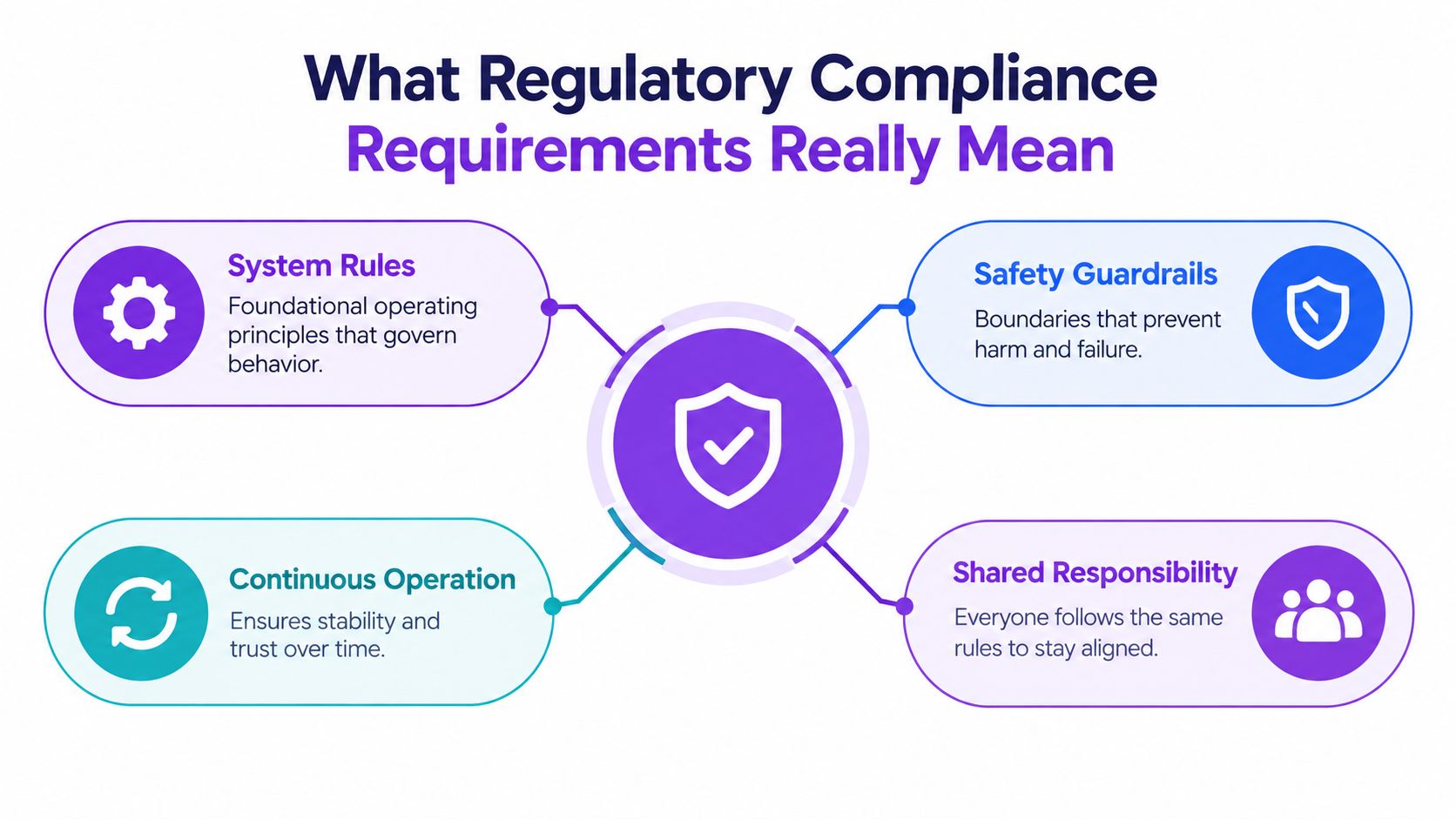
Compliance is paperwork, process, and proof
Readers often get stuck on the word “requirements” because it sounds abstract. In practice, requirements usually become three things:
- Paperwork such as notices, logs, approvals, contracts, and reports
- Processes such as access review, incident escalation, human review, and retention handling
- Proof such as timestamps, audit trails, machine-readable markers, and decision records
That burden is measurable, not theoretical. In Canada, a government survey effort designed to track paperwork burden over time collected responses from 10,477 businesses, and the resulting estimate put the cost of regulatory compliance for Canadian SMEs at $4.76 billion in 2011, using a definition focused on the formalities and paperwork businesses perform or outsource to satisfy government rules. The details are described in the Canadian SME regulatory compliance cost report.
Why leaders treat compliance as an operating cost
Once you look at compliance this way, the business impact becomes easier to understand. A widely cited U.S. study found that the average firm spends between 1.3% and 3.3% of its total wage bill on regulatory compliance, and the same research estimated regulation-related labor costs at 3.33% of total labor costs annually, with total wage costs devoted to compliance workers in 2014 ranging from $79 billion to $239 billion, rising to $289 billion when equipment was included, according to the Cato research brief on regulatory compliance costs.
Those numbers help explain why companies create dedicated compliance roles. Not because legal likes paperwork, but because unmanaged compliance work spreads everywhere. Operations improvises one process. Product invents another. Support keeps separate records. Audit later finds that none of them line up.
Compliance isn't just about obeying a rule. It's about making the rule visible in how work is assigned, reviewed, logged, and improved.
The plain-English test
If you're trying to tell whether something is a real compliance requirement, ask:
- What behavior must change
- What control makes that behavior consistent
- What record proves it happened
- Who owns the exception when it doesn't
If you can't answer those four questions, you probably don't yet have a compliance process. You have a policy statement.
Key Regulatory Categories Every Organization Should Know
Most organizations don't face one giant compliance obligation. They face several categories that overlap in uncomfortable ways. A photo moderation workflow, for example, can trigger privacy questions, content standards questions, intellectual property questions, and sector-specific questions all at once.
The easiest way to reduce confusion is to sort obligations by category first, then by workflow.
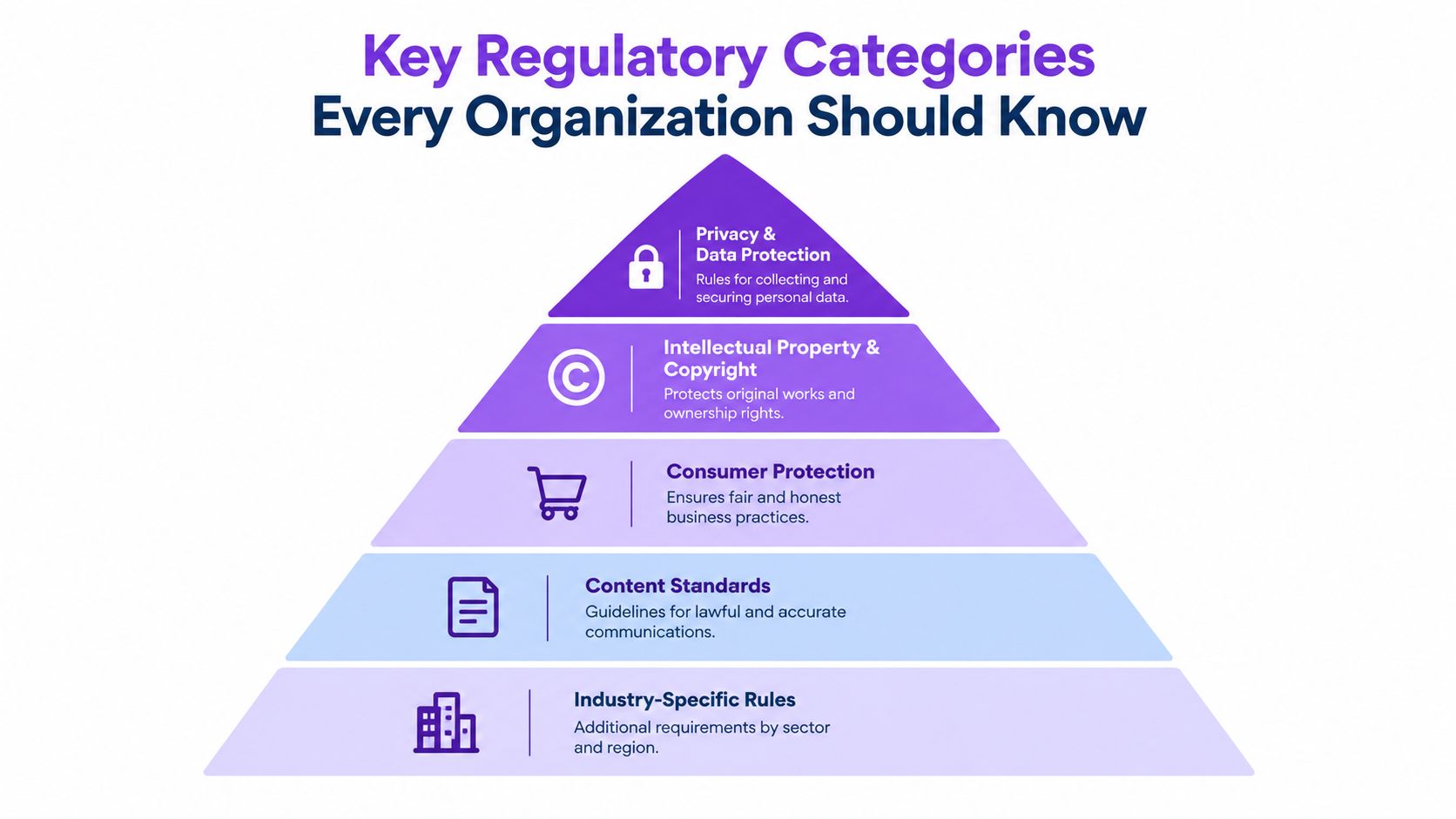
The five categories that show up most often
Privacy and data protection
These rules govern how you collect, use, store, share, retain, and delete personal data. Teams run into notice requirements, vendor oversight, access controls, and deletion workflows. If you're sending customer files to an AI service, privacy is usually the first category to check.
Intellectual property and copyright
This category deals with ownership and permitted use of creative material. Teams often miss it when they focus only on privacy. A workflow can be privacy-compliant and still fail because the organization doesn't have rights to use an image, font, or uploaded asset.
Consumer protection
These rules focus on fairness, transparency, and misleading practices. If your output influences customer decisions, labels, disclosures, and review paths matter. This is especially relevant when AI-generated or AI-reviewed content reaches the public.
Content standards
These include rules, policies, and expectations about lawful, accurate, and transparent communication. Media teams, schools, and platforms all feel this pressure, even when the legal trigger isn't about the image itself but about the process used to classify it.
Industry-specific rules
Finance, healthcare, education, and other sectors add extra duties. These often require stronger governance, more formal testing, tighter vendor review, and clearer evidence retention than a general business workflow would need.
Regulatory Categories and Core Obligations
| Category | Primary Obligation | Typical Evidence | Risk if Missed |
|---|---|---|---|
| Privacy and data protection | Handle personal data lawfully and securely | notices, consent records, processing logs, retention schedules | complaints, enforcement attention, forced process changes |
| Intellectual property and copyright | Use content only with proper rights or permission | licenses, assignments, source records, asset inventories | takedowns, disputes, blocked campaigns |
| Consumer protection | Avoid misleading claims and unclear practices | disclosures, review records, approval trails | customer harm, legal challenges, reputation damage |
| Content standards | Apply transparent review and escalation processes | moderation logs, appeal records, classification criteria | inconsistent decisions, trust loss, audit findings |
| Industry-specific rules | Meet sector controls for resilience, safety, or reporting | control testing, vendor reviews, incident files | operational restrictions, regulator scrutiny, remediation work |
Where overlap creates real work
The most important shift for 2025 and 2026 is that AI use cases don't sit in an “AI-only” box. The EU AI Act rollout and related digital compliance developments point toward obligations around data handling, vendor oversight, retention limits, incident response, documentation, and human review, not just model performance, as discussed in this overview of European digital compliance issues.
If you're trying to interpret how AI-specific obligations fit into existing programs, a focused guide to EU AI Act compliance can help frame the control mapping.
The category tells you what kind of obligation you're facing. The workflow tells you where the evidence must live.
How to Assess and Meet Your Compliance Obligations
Focusing on the law first makes compliance harder. A better approach is to start with the activity. What are you doing, what data does it touch, which tools are involved, and what decision gets made at the end?
That gives you a map you can use.
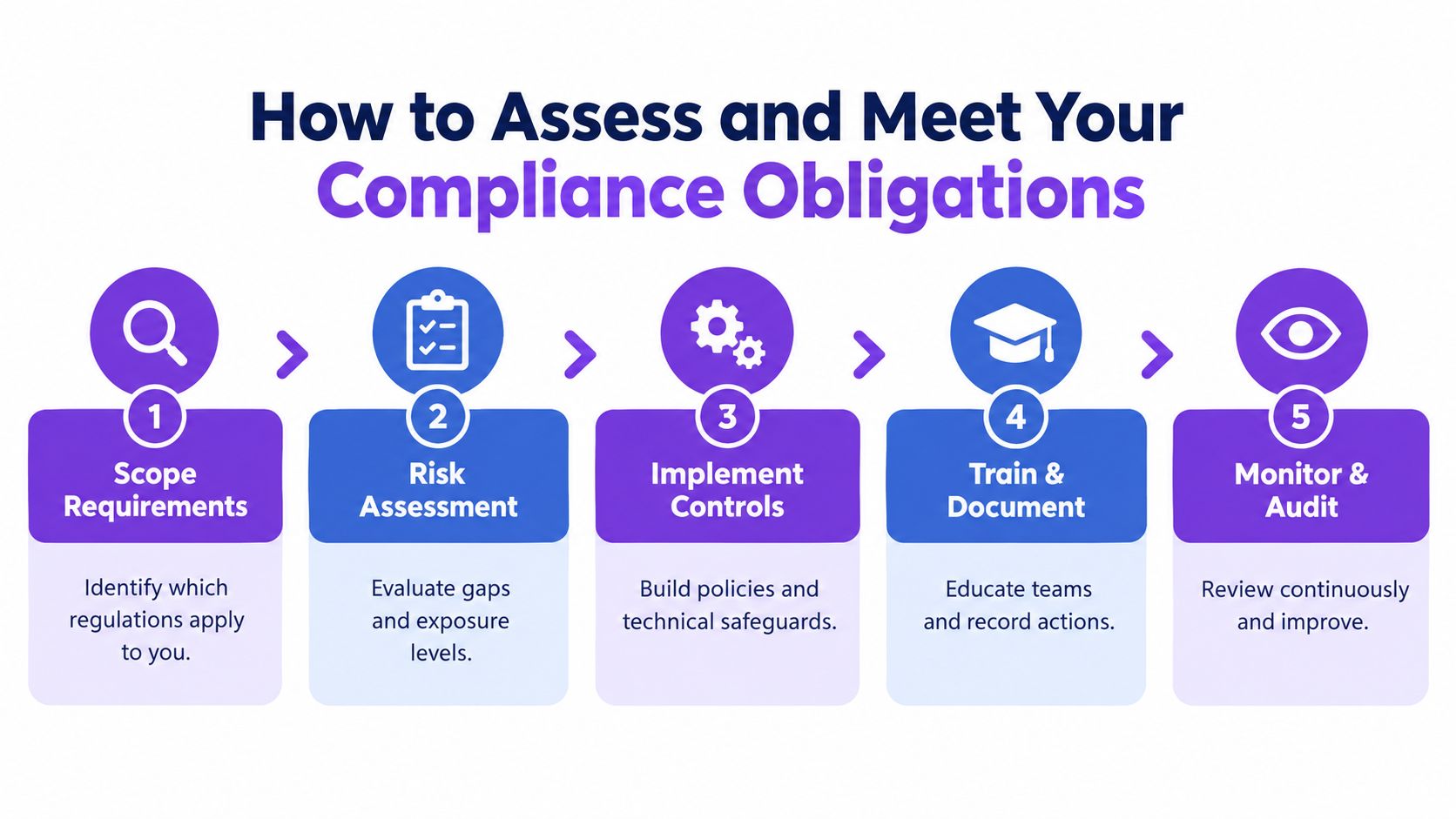
Start with scope, not assumptions
Before anyone writes a policy, list the actual business activities in play. “We use AI” is too vague. “We use a third-party tool to classify uploaded images submitted by customers and reviewers can override the result” is specific enough to assess.
Use a scoping pass like this:
- List the workflow. Intake, processing, review, output, storage, deletion.
- Name the data. Personal data, sensitive data, media files, metadata, account data.
- Identify the actors. Employees, vendors, moderators, students, customers, auditors.
- Mark the jurisdictions. EU, U.S., UK, state-level, sector-specific obligations.
- Describe the decision. Advisory flag, automatic rejection, manual escalation, publication approval.
Build controls that can be reused
Once the workflow is clear, map controls that can satisfy more than one rule set. Crosswalk thinking matters here. If DORA expects documented operational resilience, and an AI-related process expects vendor oversight and incident handling, one shared set of records may support both if designed carefully.
Useful reusable controls include:
- Vendor review files that document data handling, subprocessors, service boundaries, and security responsibilities
- Human review rules that define when automation can assist and when a person must decide
- Retention schedules that say what gets kept, for how long, and why
- Incident response playbooks that cover data misuse, false classification, service outages, and escalation paths
- Model or tool change logs that capture updates affecting output or risk
A structured worksheet can speed this up. This compliance risk assessment template is useful for turning obligations into owners, controls, and evidence fields.
Put documentation where the work happens
Many compliance programs fail because evidence lives in too many places. Legal has one set of notes. Operations has another. Product has tickets. Audit gets screenshots. That isn't a control environment. That's a scavenger hunt.
For adjacent areas that teams often forget, even design assets can create rights and audit issues. A practical example is managing web typography rights, where licensing, vendor use, and deployment records need the same disciplined handling as other compliance artifacts.
This short video gives a useful operational lens on turning obligations into routine practice.
Assign ownership before launch
A control without an owner won't survive first contact with real work. Every key obligation should have a named role for:
- Operation. Who runs the process daily
- Approval. Who signs off on exceptions or disputed outcomes
- Monitoring. Who checks whether the control still works
- Escalation. Who gets notified when something breaks
If your team can't answer “who decides when the tool is wrong,” your compliance process isn't finished.
Sector Specific Examples and Practical Checklists
The same compliance idea looks very different in different environments. That's why generic checklists often fail. A newsroom, a school, and a financial institution may all review synthetic media, but the evidence they need and the risks they care about aren't identical.
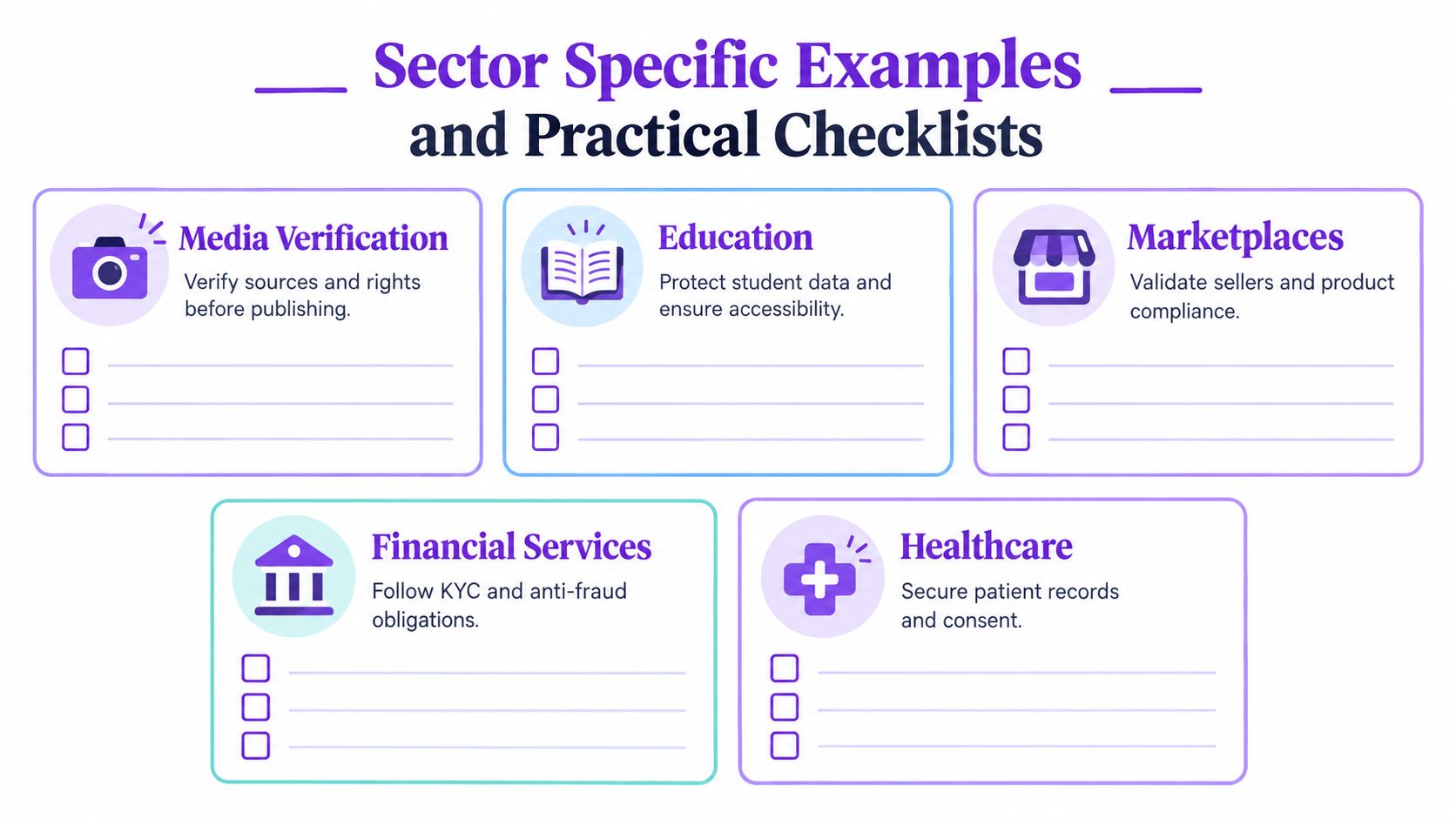
Media verification
A newsroom or fact-checking desk needs defensible review, not blind trust in a detector. If a submitted image is flagged as synthetic, the editor should know what happens next. Is publication paused, is the contributor contacted, is provenance checked, and who documents the final decision?
Checklist items that help:
- Source trail. Record where the file came from and who supplied it.
- Review notes. Keep the flag result, the human reviewer's conclusion, and the reason for override if any.
- Rights check. Confirm that use rights are documented before publication.
- Appeal path. Let contributors contest a classification with additional evidence.
Education
Schools and universities face a different problem. They need a fair process when a student disputes an AI-generated content finding. The issue isn't only whether a file appears synthetic. The issue is whether the institution can show consistent handling, limited access, and appropriate retention.
A workable checklist includes:
- Student notice about what tools may be used in reviews
- Human review requirement before penalties or academic findings
- Case file retention rule with clear deletion timing
- Staff guidance for documenting why a result was accepted or rejected
A tool result should trigger review, not replace judgment.
Marketplaces
Marketplaces often need to police listings, seller uploads, and brand misuse at scale. Here the risk isn't just fake media. It's deceptive product representation, IP conflict, and inconsistent moderation across sellers.
Focus on these controls:
- Seller verification records
- Listing review criteria
- Escalation for disputed removals
- Vendor contracts covering detection, storage, and support boundaries
Financial services
Financial firms face the sharpest overlap problem. DORA adds pressure around ICT risk, third-party oversight, and resilience. If a firm uses AI-supported verification in fraud prevention, document review, or content screening, those workflows can sit inside broader resilience and governance expectations.
Key checklist items:
- Third-party risk file for each detection or provenance vendor
- Fallback procedure if the tool is unavailable
- Incident classification rules for false positives, outages, and data exposure
- Evidence repository that audit, risk, and compliance teams can all access
Healthcare
Healthcare teams must be especially careful when images or documents can connect to patient information. Even where the main workflow is media review, patient privacy, access limits, and disclosure controls often become the compliance issue.
Use a narrow checklist:
- Minimum-necessary access
- Role-based permissions
- Retention schedule aligned to internal policy
- Exception log for disputed or sensitive reviews
Across all five sectors, the pattern is the same. The strongest programs don't ask, “Do we have a policy?” They ask, “Can we show what happened, who decided, and why?”
Using Verification Tools and APIs in Compliance Workflows
Verification tools are most useful when teams stop treating them like magic answers. In a compliance setting, they're better understood as evidence-generating controls inside a larger decision process.
That distinction matters. A regulator, auditor, editor, or school administrator usually won't ask only whether a tool flagged something. They'll ask how the result was produced, whether a person reviewed it, what records were kept, and what happened when someone challenged the decision.
Where provenance fits
For synthetic media, provenance controls are becoming especially important. The EU AI Act's transparency guidance says providers of AI systems that generate synthetic audio, images, video, or text must ensure outputs are marked in a machine-readable format and detectable as artificially generated or manipulated, which makes provenance a technical compliance control rather than just a disclosure idea, according to the EU guidance on AI transparency obligations.
A related technical standard comes from C2PA, which supports content provenance by securely binding statements about a digital asset's source and history to the content itself through tamper-evident, machine-readable Content Credentials, as described in C2PA resources on content provenance.
Together, those ideas answer a question many teams miss: compliance evidence for synthetic content may need to show not only what a reviewer thought, but whether origin information traveled with the asset in a durable way.
How to use detection tools without creating audit problems
A sound workflow usually looks like this:
- Intake the file and log source, timestamp, and purpose of review.
- Run automated checks such as detection or provenance inspection.
- Route flagged items to a human reviewer with written criteria.
- Record the final disposition and any override reason.
- Offer a challenge path when the result affects publication, discipline, access, or account status.
- Retain only what's necessary under your policy.
For teams that need operational support around documentation and review handling, external help can be useful. A directory of virtual legal assistants companies can help smaller organizations find support for intake logs, evidence preparation, and policy administration without building a full in-house compliance function.
If you're implementing this in a product environment, an API integration guide is the right place to think through request flow, human review hooks, and evidence capture points.
The rule many teams overlook
Don't let the API decision become the final decision unless your governance explicitly allows that use. In sensitive workflows, the system should produce a result, a confidence rationale, and a review trigger. A person should still own the consequential call.
Building Lasting Compliance Confidence
Strong compliance programs aren't built by collecting more policies. They're built by making obligations reusable, visible, and routine.
That matters even more now because the challenge isn't any single law. It's the overlap between resilience rules, AI governance rules, privacy rules, and sector-specific expectations. Teams that map these into shared controls do less duplicate work and produce cleaner evidence.
A practical rhythm that holds up
Keep the program steady with a simple operating cadence:
- Review workflows regularly when tools, vendors, or data uses change
- Refresh your control map when a new regulation affects an existing process
- Test evidence trails before an audit or incident forces the issue
- Update human review criteria when false alarms or edge cases appear
- Confirm ownership whenever a team restructure changes responsibilities
Good compliance feels boring on ordinary days. That's usually a sign it's working.
Confidence comes from being able to answer basic questions quickly. What rule applies, which control covers it, where is the evidence, and who owns the exception. If your team can answer those without scrambling through folders and chat threads, you're in a strong position.
The goal isn't perfection. It's a system that can adapt without starting over every time regulation changes.
AI-driven media review is easier to defend when your team can pair detection results with clear records, human review, and privacy-first handling. AI Image Detector helps organizations verify whether an image appears AI-generated or human-made, which fits naturally into compliance workflows for media verification, academic integrity, marketplace screening, and audit-ready review processes.