

Spoofing Attack Prevention: A Practical How-To Guide

The email arrives just before a payment deadline. It appears to come from the CFO, uses the correct executive name, and asks finance to release a wire transfer immediately. Your organization already publishes SPF, signs mail with DKIM, and has a DMARC record. Yet the message still reaches an employee, or the attacker uses a look-alike domain that authentication never had a chance to validate.
That outcome is common because spoofing attack prevention isn't a DNS checklist. Protocols authenticate specific parts of a message or connection. They don't automatically verify business intent, eliminate trusted exceptions, secure every third-party sender, or stop a user from trusting a familiar display name. Effective protection comes from combining authentication, mail-flow controls, monitoring, identity verification, and a response process that people can execute under pressure.
Why Spoofing Still Works Despite Good Intentions
The payment request arrives minutes before a deadline. It uses the CFO's name, matches the company's writing style, and comes from an address employees recognize. SPF, DKIM, and DMARC are configured, yet the message still reaches finance through a trusted connector, forwarding path, filter override, or an attacker-controlled look-alike domain.
Attackers need only one workable route and one recipient willing to act. A forged envelope sender may fail DMARC while an exception still permits delivery. A look-alike domain can pass its own authentication because the attacker controls it. A compromised legitimate mailbox can send authenticated messages that appear routine. These cases expose the operational gap between publishing records and controlling every path into the inbox.
Early mail protocols left sender identity weakly validated, which is why SPF, DKIM, and DMARC, introduced around 2014, still depend on correct alignment, complete sender inventories, and enforcement to work effectively. Proofpoint's overview of email spoofing describes the underlying problem, but production outcomes depend on how each organization configures and maintains its controls.
Authentication isn't the same as trust
SPF checks whether an authorized system can send for a domain represented in the envelope path. DKIM checks whether a message carries a valid cryptographic signature. DMARC connects those results to the visible From domain through alignment and lets the receiving system apply a policy.
Those checks answer limited questions. Authentication can pass for a malicious message sent from a look-alike domain. A legitimate marketing platform can be authorized while its account, template, or recipient list is abused. Forwarding can change the path or invalidate a signature. A monitoring-only DMARC policy can also create false confidence because it reports activity without requiring rejection.
A 2014 Internet Society analysis of 11 banks found that DMARC would have blocked an average of 30.18% of attacks, with effectiveness ranging from 1.18% to 76.53% between organizations (the full DMARC effectiveness analysis). The range shows why implementation quality matters. Sender inventories, alignment, forwarding behavior, third-party services, and enforcement all affect the result.
Practical rule: Treat a published policy as one input to a control system, not proof that protection works.
The edge is where incidents happen
The most dangerous exceptions usually begin as reasonable operational requests. A helpdesk permits a vendor, a migration requires a temporary connector, or a spam rule exempts senior leaders. Without ownership and expiry dates, those decisions become permanent bypass routes.
A 2026 report described a restricted inbound connector that blocked spoofed messages regardless of the envelope source, while weaker configurations required administrators to audit spam overrides that exempted executives or managers (the American Banker report on Microsoft anti-spoofing configurations). High-risk users therefore need narrower exceptions and stronger verification, not broader trust.
Protection must extend beyond the mail gateway. It cannot repair a supplier's compromised account, validate a phone number presented by an external carrier, or stop a user from entering credentials into a convincing replica. Close the gap with layered controls: enforce authentication, review exceptions, monitor trusted senders, require out-of-band confirmation for sensitive requests, and maintain a response process employees can follow under pressure.
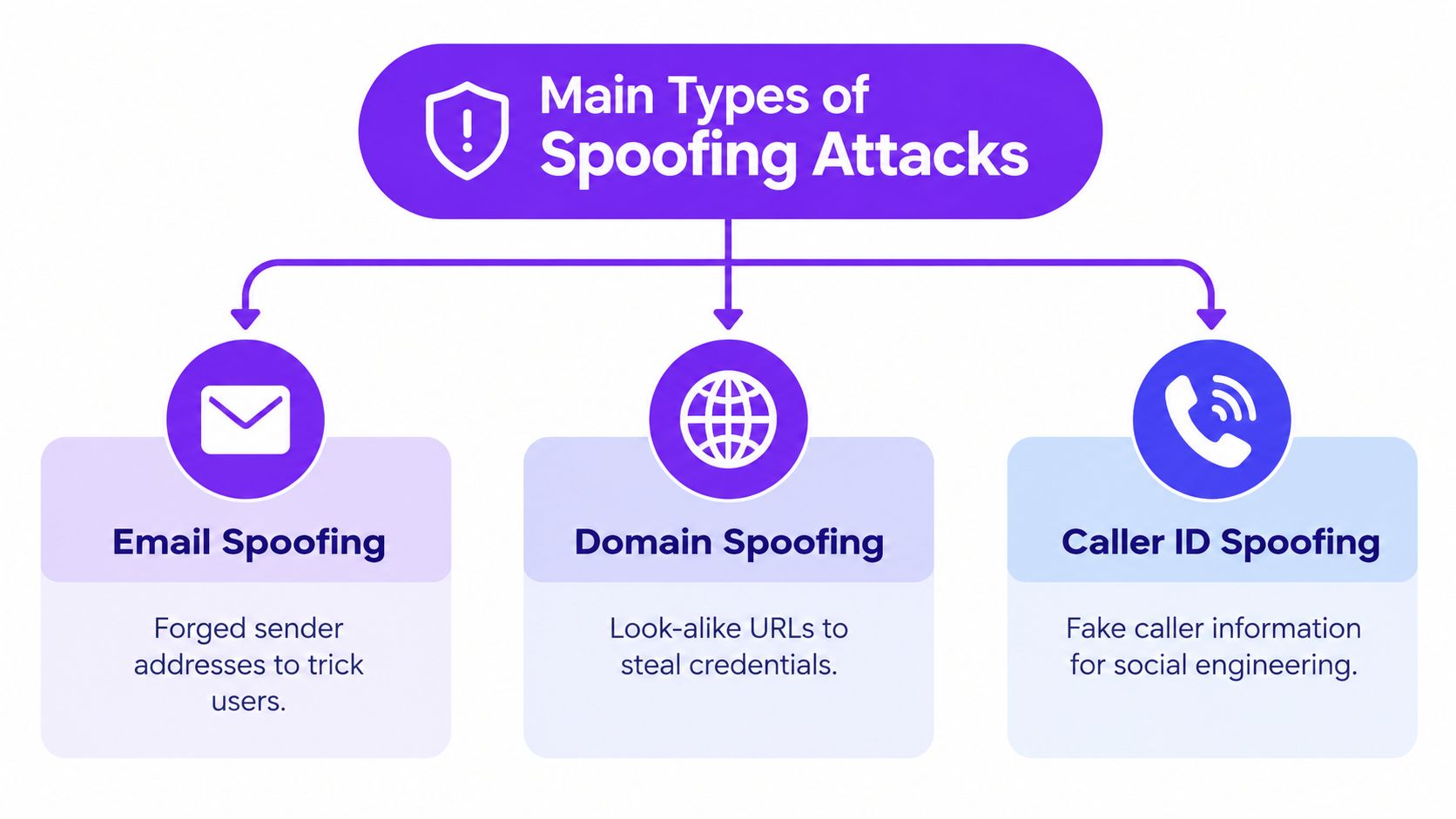
Understanding the Main Types of Spoofing Attacks
A spoofed message usually succeeds because it exploits a trusted path, not because the attacker has perfect technique. Mail, voice, web, API, and identity checks all fail in different ways, so teams that only harden one channel keep seeing incidents elsewhere.
Email and domain impersonation
Email domain spoofing changes who a recipient thinks sent the message. An attacker may forge the visible From field, copy an executive's display name, or register a lookalike domain that passes a quick glance. SPF, DKIM, and DMARC help with aligned mail from authorized systems, but they do not automatically stop a compromised supplier, a well-formed lookalike domain, or a message that is technically authenticated but still malicious.
That gap is why protocol settings alone do not stop fraud. Administrators in Microsoft 365 still need to account for sender inventory, forwarding rules, and exception handling, as covered in the Microsoft 365 email security guide. In practice, the bad messages usually arrive through a path the policy did not fully model.
Website spoofing relies on a cloned site with similar branding, URL structure, and login flow. HTTPS only confirms encryption to the domain that answered the request. It does not prove the domain belongs to the intended organization. The practical response is domain monitoring, registrar lock-down, browser and mail filtering, passwordless authentication where it fits, and workflows that avoid logging in through links from unexpected messages.
Voice, API, and synthetic identity attacks
Caller ID spoofing uses a false telephone number so a fraudster can present as a bank, coworker, or agency. Europol estimates losses of about EUR 850 million worldwide each year from caller ID spoofing (its position paper on caller ID spoofing). Verification schemes such as STIR/SHAKEN shift part of the burden from complaint handling to checking whether the caller can actually use the claimed identity.
API and token spoofing targets machine trust. An attacker may replay a token, forge a weakly validated signature, abuse a long-lived credential, or exploit a service that trusts a caller-supplied header. Strong signing, short token lifetimes, audience validation, mutual authentication, nonce handling, and centralized secrets management matter more here than email controls.
Synthetic voice, video, and profile images create another verification problem. A platform can authenticate an account through email and still host a fraudulent visual identity. Teams reviewing synthetic identity fraud risks should treat image and voice checks as extra signals, not substitutes for account, device, and transaction controls.
Layered Technical Controls for Spoofing Prevention
The right design has overlapping decisions. If one layer misses an attack, another should reduce delivery, limit trust, flag the anomaly, or require independent confirmation.

Build the email authentication foundation
Start with an inventory, not a policy change. List every legitimate sender, including Microsoft 365, customer relationship platforms, marketing services, ticketing systems, payroll providers, website forms, and legacy applications. For each source, identify the domain it uses in the envelope path, whether it signs with DKIM, and whether the visible From domain aligns.
Then implement the controls in an order that protects mail flow:
- Publish SPF for known senders. Keep the record governed and documented. Remove obsolete services and review every change through the sender inventory.
- Sign outbound messages with DKIM. Use organizationally controlled signing wherever possible, and confirm that forwarding and relaying behavior doesn't invalidate signatures unexpectedly.
- Set DMARC to monitoring first. Use aggregate reports to discover legitimate sources and alignment failures before enforcement affects business mail.
- Move to quarantine, then reject. Advance only after you can explain the remaining failures. A reject policy has value only when legitimate paths are covered and the receiving ecosystem can apply the policy.
- Require alignment. Passing SPF for an unrelated envelope domain isn't enough if the visible From domain remains unauthenticated under DMARC.
Enforcement is still uncommon. A large-scale domain-spoofing report found that only 12.8% of 5.5 million domains enforced a DMARC policy strong enough to reject forged mail, while 69.6% lacked DMARC entirely (the domain spoofing standards analysis). The figures point to a migration problem, not merely a knowledge problem. Organizations fear breaking mail because they haven't mapped their senders.
Close trusted ingress and exception paths
Authentication should be paired with restricted inbound connectors, anti-phishing policies, attachment and URL analysis, impersonation protection, and strong identity controls. Review every rule that bypasses filtering for executives, managers, vendors, or internal-looking messages. A trusted connector should identify a controlled path, not grant broad permission based on an envelope value that an attacker can forge.
The same principle applies to telecom and applications. Use carrier verification capabilities for caller ID where available, certificate transparency monitoring for unexpected certificates, and signed API requests with strict validation of issuer, audience, expiry, and replay resistance. For access governance and permission design, Ciphar's playbook for access security offers a useful complementary reference.
The controls below should be tested against observed attacks, not marked complete because a configuration exists.
A strong architecture also separates authentication from authorization. A valid sender doesn't authorize a payment, password reset, supplier change, or sensitive data release. Require independent verification for high-impact requests through a known telephone number, an approved workflow, or a second authenticated channel.
Monitoring and Detection Strategies That Work
A spoofing defense that isn't measured will drift. Sender inventories become outdated, SaaS providers change delivery paths, certificates expire, forwarding behavior changes, and administrators add exceptions during an incident. Monitoring turns those changes into evidence before an attacker turns them into an opportunity.
DMARC aggregate reports provide a practical starting point. They show which systems claim to send for your domain and whether messages pass or fail SPF, DKIM, and alignment checks. Route the reports into a parser or security information and event management platform, then retain enough context to connect a new source to a service owner.
Prioritize signals that lead to action
Don't alert on every authentication failure with equal urgency. A failed message from a known forwarding service needs different handling from a sudden stream of messages using your domain from an unfamiliar infrastructure provider. Combine authentication results with recipient sensitivity, message volume, domain age where available, URL reputation, display-name similarity, and the requested action.
| Metric | Alert Threshold | Action Required |
|---|---|---|
| New authorized sending source | Any unapproved source claiming your domain | Identify the owner, validate the service, and remove or contain unauthorized access |
| DMARC alignment failure | A new pattern or material increase from a known sender | Check forwarding, SaaS configuration, DKIM signing, and policy impact |
| Executive impersonation signal | Any high-risk message using a protected name or role | Quarantine, notify the security team, and verify the request out of band |
| Inbound connector exception | Any rule that bypasses normal filtering | Confirm business need, narrow the scope, and document an expiry or review owner |
| Suspicious URL or attachment | A message combines identity mismatch with a risky payload | Hold the message, inspect the destination or file, and search for related recipients |
The exact threshold should reflect your normal baseline. The important design choice is to make every alert map to an owner and a playbook. Otherwise, analysts learn to ignore the noise that attackers depend on.
Monitor identity beyond the mailbox
For platforms, marketplaces, and communities, email authentication won't validate profile images or synthetic personas. Image review can sit alongside account age, login behavior, device signals, payment risk, and moderator escalation. Fake profile detection guidance is relevant when a convincing image supports an impersonation attempt.
Treat visual analysis as triage. A suspicious result should trigger review or additional verification, not an automatic accusation. The same principle applies to physical security and sensitive facilities. A provider offering bug sweeps in London addresses a different threat surface, but the operational lesson is similar: detection works when teams define what constitutes an anomaly and what happens next.
Incident Response Playbook for Spoofing Breaches
A spoofing incident becomes expensive when the organization debates basic actions while the attacker continues sending messages. Prepare a short, role-based playbook that distinguishes message forgery from account compromise and treats financial or credential requests as high-risk events.
First response
Preserve the original message with full headers, message identifiers, URLs, attachments, delivery information, and relevant authentication results. Don't rely on screenshots. Security analysts need the technical evidence to determine whether the message failed authentication, passed through an allowed route, originated from a compromised account, or came from a look-alike domain.
Contain according to the evidence:
- Forged sender with no account compromise: Quarantine related messages, block malicious domains and URLs, search for other recipients, and notify affected users.
- Compromised mailbox or credential: Disable active sessions, rotate credentials and tokens, enforce strong multifactor authentication, inspect forwarding rules, and review outbound activity.
- Financial or supplier-change request: Contact the business owner through a known channel, pause the transaction, and involve finance, legal, and leadership according to policy.
- Executive impersonation: Apply protected-user impersonation controls, inspect exemptions, and communicate a clear verification requirement without naming unnecessary personal details.
Don't delete evidence while trying to clean the inbox. Use message tracing, identity-provider logs, endpoint telemetry, and mail-flow records to establish what happened and who interacted with the content.
A suspicious email is an event. A successful login, changed forwarding rule, or altered payment instruction is a potential breach.
Find the bypass, then harden it
After containment, reconstruct the attacker's path. Check whether the visible From address aligned, whether a connector treated the message as trusted, whether a spam override exempted a senior user, whether an external sender was incorrectly allowed, and whether a recipient clicked a link or supplied credentials. Review related messages across mailboxes rather than limiting analysis to the person who reported the incident.
Recovery should produce concrete changes. Tighten restricted inbound connectors, remove unnecessary executive exemptions, correct third-party DKIM and SPF alignment, shorten token exposure, and add independent approval for high-value actions. If an account was compromised, examine mailbox rules, delegated access, OAuth grants, recent authentication, and unusual outbound messages.
Communicate in plain language. Tell users what to look for, what not to click, how to report similar messages, and whether any action is required. Avoid declaring the incident resolved until monitoring confirms that the malicious path has stopped and the controls have been retested.
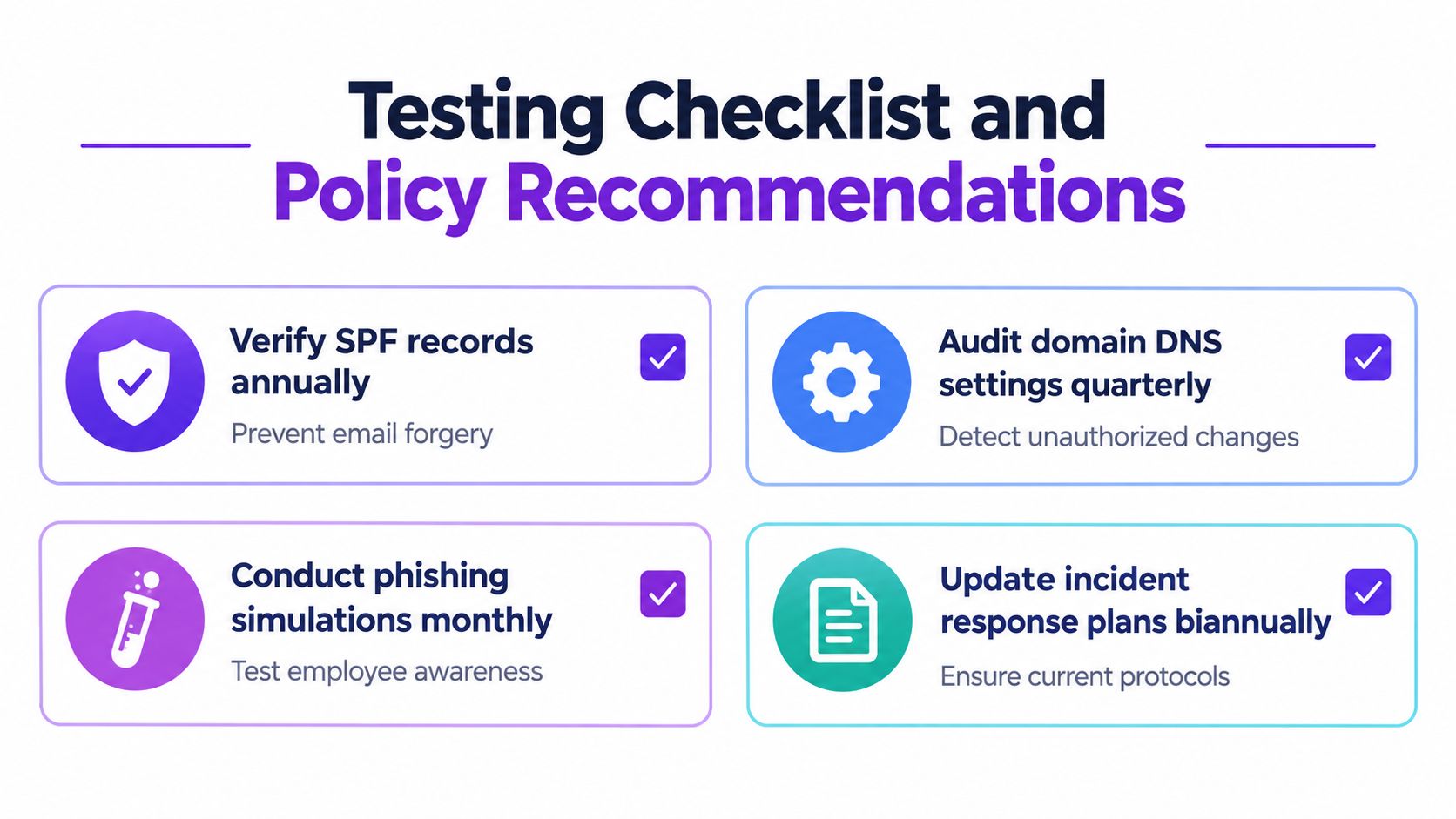
Testing Checklist and Policy Recommendations
Spoofing prevention improves when teams test the exact decisions an attacker will target. Annual compliance training and a one-time DNS review won't reveal forwarding failures, stale sender integrations, permissive connectors, or a finance workflow that still accepts an urgent email as authorization.
Test the controls in their operating environment
Begin with an inventory review. Ask service owners to confirm every approved sender, business purpose, domain relationship, signing method, and accountable owner. Remove abandoned integrations rather than leaving them authorized indefinitely.
Use a controlled test plan:
- Verify visible identity and alignment. Send authorized test messages through each business-critical path and confirm how receiving systems evaluate SPF, DKIM, and DMARC.
- Exercise forwarding and relaying. Test common forwarding routes, helpdesk workflows, mailing lists, and external collaboration channels. Record where signatures or alignment fail.
- Probe exception rules. Test executive names, internal-looking senders, trusted connectors, allowlists, and spam overrides. The expected result should be documented before the test begins.
- Run a payment-request scenario. Ask whether finance verifies a new bank instruction through a known channel. The test should measure behavior and escalation, not merely whether a user clicks.
- Simulate a compromised account. Validate session revocation, token rotation, mailbox-rule review, outbound search, and communication responsibilities.
- Review detection coverage. Confirm that new senders, policy violations, suspicious URLs, and impersonation attempts produce actionable alerts.
Tabletop exercises should include security, messaging, identity, finance, legal, communications, and executive representatives. Give them incomplete but realistic information, then record decisions, delays, and missing authority. A useful exercise ends with assigned remediation owners, not a general reminder to be careful.
Turn lessons into policy
Write policies around decisions rather than technologies. Require independent confirmation for payment changes, credential resets, sensitive data requests, and urgent executive instructions. Define approved reporting channels and make reporting safe for users who aren't certain a message is malicious.
Training should use realistic examples and reinforce a small number of habits: pause on urgency, inspect the actual sender and destination, avoid unexpected attachments, and verify high-impact requests outside the message thread. Measure whether users report suspicious content and whether responders can contain it, rather than treating course completion as proof of resilience.
Organizations handling user-generated content need a parallel visual-authenticity process. Email authentication won't determine whether a profile image is synthetic or manipulated. An AI image detector compliance risk assessment template can help teams document the use case, decision owner, retention rules, escalation path, and limitations of image analysis. Use API-based screening as one signal in moderation workflows, with human review for consequential decisions.
Review the program after material changes, including a new mail platform, major SaaS integration, identity-provider migration, acquisition, or incident. The standard should be simple: every trusted path has an owner, every exception has a reason, and every important control has evidence that it works.
AI Image Detector can add a visual verification layer to spoofing attack prevention by analyzing images for signs of AI generation or manipulation, including workflows that use its API for platform screening. Visit AI Image Detector to evaluate suspicious profile or media images alongside your email, identity, and trust-and-safety controls.