

Trust and Safety Content Moderation: A Practical Guide

More than 9 billion content-moderation decisions were reported by platforms in the first half of 2025 under the EU Digital Services Act, and 99% were taken proactively under platforms' own terms and conditions, according to the European Commission's DSA overview. That figure changes the operating question. Trust and safety content moderation isn't a small team deleting the worst posts after users complain. It's a production system that must classify, prioritize, explain, review, and learn from decisions at sustained volume.
The same design problem appears in a global platform and a small forum. The difference is the budget, not the fundamentals. Both need policies reviewers can apply, automated checks that fail safely, escalation paths for ambiguous cases, and an appeals process that exposes errors instead of hiding them.
Why Content Moderation Now Runs at Industrial Scale
The Digital Services Act has made moderation activity more visible and auditable. Intermediary services must publish content-moderation reports, and the largest platforms and search engines report more frequently. Those reports cover takedown orders, moderation measures, and automated-system error rates. The obligation changes how teams need to operate: moderation decisions must leave an evidence trail, not disappear into an admin panel.
That standard also helps smaller operators. A forum with a hundred people still needs to answer the same operational questions as a global platform, even if it uses fewer tools and reviewers. Which policy was applied? How quickly was the item reviewed? Was the action automated? Did the user appeal, and did a reviewer reverse it? A list of removed posts cannot answer those questions reliably.
Build for queues, not emergencies
Define the moderation item before choosing tools. It may be a user report, an automated classifier alert, a trusted-flagger notice, a legal request, or a sudden change in account behavior. Store structured metadata with each item, including policy category, potential severity, audience reach, confidence, and current status. This record gives reviewers context and gives operators a way to reconstruct decisions later.
Set priorities that hold under pressure:
- Severity first: Potentially irreversible or high-harm cases outrank ordinary disputes.
- Reach second: Fast-spreading content may need containment before a similar item with limited exposure.
- Confidence third: High-confidence cases can move through automation, while uncertain cases need review.
- Auditability always: Preserve the policy version, model version, action, reviewer identity, and appeal result.
A small operator may use a hosted queue and a modest reviewer rotation. A large platform may need specialist teams and regional coverage. The implementation differs, but the failure modes match: queues grow invisibly, reviewers lack context, models apply stale policy language, and nobody can explain why an action occurred.
A useful reference is this guide to content at scale, since moderation belongs in the same operational conversation as other high-volume content workflows. Treat it as an always-on service with capacity planning, incident procedures, service targets, and fallback behavior. That discipline matters whether the system protects a billion users or a hundred-person forum.
The Layered Moderation Pipeline
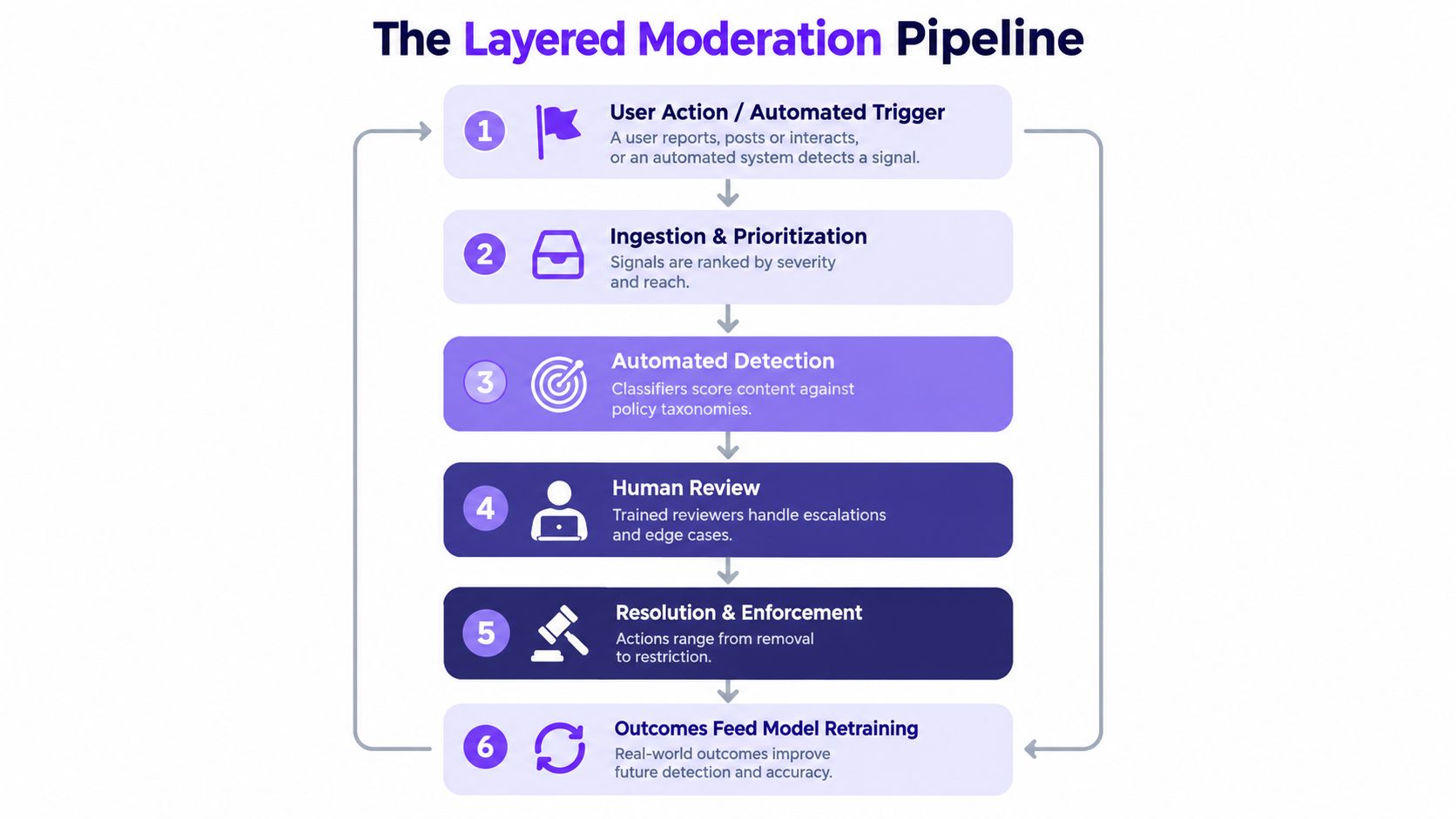
A reliable pipeline doesn't ask one model to make every decision. It moves content through progressively more expensive checks, reserving human attention for cases where context or potential harm makes automation unsafe.
Start with cheap, predictable signals
The first layer handles known material. Hash matching, blocklists, and keyword rules can identify previously confirmed content or obvious terms with very low latency. Their strength is precision on familiar patterns. Their weakness is recall and context. A keyword can appear in a threat, a quotation, a counter-speech post, or a harmless discussion.
The second layer uses a lightweight classifier for text, images, or multimodal content. It can recognize broader patterns than a blocklist, but it still produces a score rather than a complete judgment. Teams should validate performance by policy category, language, media type, and user context instead of relying on one aggregate score.
The third layer handles ambiguity. The layered moderation architecture described by Digital Applied places slower LLM-based judgment after fast filters and lightweight classifiers, with human escalation for the remainder. The useful lesson isn't a particular model or threshold. It's the routing logic. Most clear traffic should be handled cheaply, while complex or high-impact cases receive more attention.
Route by confidence and harm
A practical decision path looks like this:
- Known severe match: Contain or hold immediately, preserve evidence, and send for specialist review where policy requires it.
- High-confidence, low-context violation: Apply the configured action and sample decisions for quality checks.
- Medium-confidence item: Hold visibility when feasible and route it to a reviewer with the relevant policy context.
- Low-confidence, low-severity signal: Log it for sampling rather than forcing a binary enforcement decision.
- High-impact disagreement: Escalate regardless of model confidence if the action affects an account, livelihood, safety, or public visibility.
Practical rule: Optimize the handoff between layers. A very accurate model can still create a poor system if it sends the wrong cases to the wrong queue.
Attackers also adapt. Encoding, evasion, altered imagery, and coded language can defeat simple filters, so production systems need confidence thresholds, adversarial testing, and an escalation policy. The target isn't maximum automation. It's dependable containment with a clear path to human judgment.
Designing Policies That Actually Hold Up
A moderation policy is a decision document, not a legal disclaimer. Every rule should tell a reviewer what evidence matters, what action is available, and what happens when context is incomplete.
“Harmful content is not allowed” gives a reviewer almost no operational guidance. A more usable rule might prohibit content that depicts non-consensual sexual activity involving identifiable adults, define the evidence required to make that determination, and specify whether the item is removed, restricted, or escalated. The exact wording will vary by service, but the pattern is stable: observable conduct, defined context, and a linked action.
Vague policies create disagreement before automation enters the picture. Reviewers guess at intent, labels become inconsistent, appeals expose contradictory outcomes, and training data becomes noisy. Specific policies shorten decision paths because reviewers can compare the item against a shared test rather than debate the platform's values from scratch.
Use tiers instead of one universal rule
A useful policy hierarchy has three levels:
- Absolute prohibitions: Clear, high-severity categories with firm evidence standards and specialist escalation.
- Context-sensitive restrictions: Categories where intent, quotation, satire, consent, or public-interest context changes the outcome.
- Community norms: Lower-severity conduct rules that may justify reduced visibility, warnings, or local moderator action rather than removal.
Each tier can have its own review priority and appeal route. That prevents a minor etiquette dispute from competing with a serious safety report, while preserving room for local judgment in smaller communities.
Specificity has a limit. A rule that attempts to list every possible edge case will become brittle, while an overly broad rule will over-block legitimate speech. Write the main rule, add representative examples, document exceptions, and create a process for policy owners to update the text when appeals reveal a recurring gap. Teams building governance processes may also find this overview of regulatory compliance requirements useful when connecting policy language to accountability obligations.
| Policy Type | Example Rule | Reviewer Decision Time | Typical Appeal Rate |
|---|---|---|---|
| Vague | “Harmful content is not allowed.” | Inconsistent, because context and evidence requirements are unclear | Difficult to interpret and diagnose |
| Specific | Prohibits a defined form of non-consensual sexual depiction involving identifiable adults | More consistent, because evidence and action are specified | Easier to analyze by policy category |
| Context-sensitive | Allows discussion or quotation under defined public-interest or educational conditions | Requires contextual review | Higher risk of disagreement if examples are weak |
| Community norm | Prohibits repeated disruptive behavior under local forum rules | Usually suitable for local moderation | Depends on notice, explanation, and consistency |
Hybrid Human and Machine Decisions
Machines and human reviewers fail in different ways. Automated systems handle volume quickly and apply scoring rules consistently. Reviewers can interpret sarcasm, cultural references, coded language, reclaimed terms, and relationships between posts. They also face fatigue, inconsistent calibration, and queue pressure.
A 2026 comparative evaluation reported an overall F1-score of 0.98 for human moderators, while multimodal language models showed a noticeable gap across categories, according to the published evaluation. The authors recommended a hybrid system in which AI performs initial filtering and people handle precision-critical decisions.
The practical lesson is role definition. Automation should reduce the queue, identify recurring patterns, attach policy labels, and surface cases where a wrong action could cause greater harm. Reviewers should spend their limited time on context, exceptions, and decisions that require defensible judgment.
A large platform may apply this architecture across billions of interactions. A forum with a hundred people still benefits from the same separation of duties, even if one administrator handles several stages. Regulation and benchmark results may set expectations at platform scale, but small operators can adopt the underlying controls without building an industrial review department.
Confidence should route work, not determine punishment by itself. High-confidence signals may support automatic action when the category is clearly defined, the harm is understood, and sampling or reversal checks are operating. Medium-confidence cases can be held, have distribution limited, or go to a trained reviewer, with potential harm considered before arrival time. Low-confidence signals should support measurement and sampling rather than automatic penalties. High-impact actions require human oversight even when the model is confident.
These thresholds need calibration against labeled examples, policy severity, language, and the cost of false positives and false negatives. A setting that works for obvious spam may be unacceptable for political speech or account suspension. Recalibration is also needed when policy wording, user behavior, or model versions change.
The performance trade-off is clearest in the case mix. Clear, repetitive violations are suitable for fast first-pass screening. Context-heavy cases expose the gap between automated classification and human judgment. Ambiguous or adversarial content may require specialist review, while model confidence can be unreliable. Human review delivers more value in these cases, but queue capacity and response time still have to be managed.
Some borderline items will wait longer. That delay is preferable to applying the wrong action with high confidence. A small, well-trained review team can improve uncertain decisions more than a fully automated stack that hides errors behind throughput.
Appeals as a Quality Signal
An appeal tests whether a moderation decision can withstand scrutiny. It examines the policy, model signal, reviewer judgment, evidence, and explanation as one chain. A reversed decision may expose a policy gap, a mislabeled training example, reviewer drift, or an explanation that failed to make the rule understandable. Even an upheld decision can reveal confusing policy language or a weak user experience.
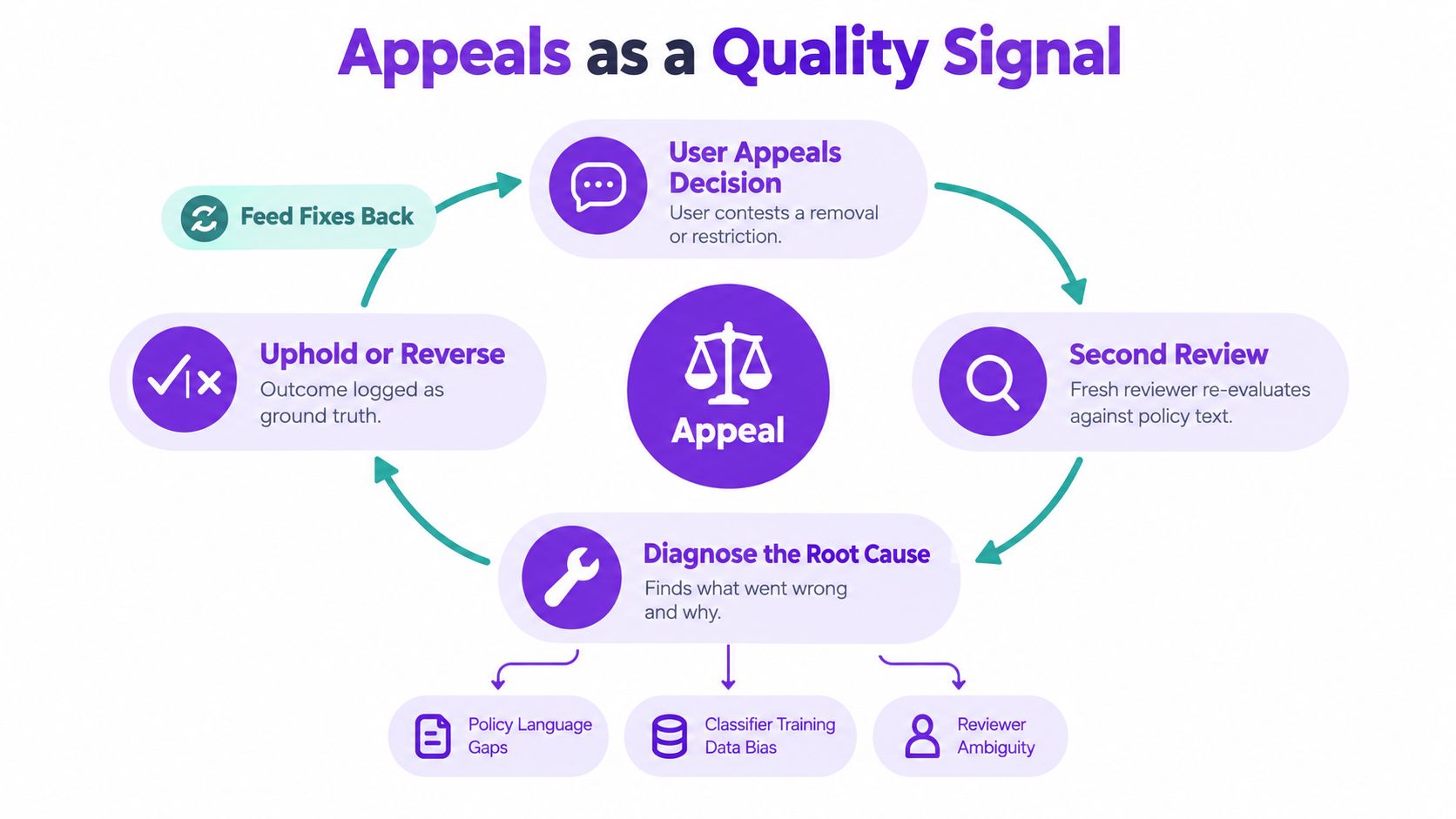
The second review needs genuine independence. A practical workflow acknowledges the appeal, states the applicable reason in plain language, and assigns the case to someone who did not make the initial decision. That reviewer should use the current policy while preserving the version applied to the original action. They examine the evidence and relevant context, not only the model score, then record whether the decision was upheld, reversed, or partially granted.
Each outcome also needs a structured reason code. Without one, teams cannot separate policy defects from reviewer mistakes, model errors, or poor explanations.
Safety-critical appeals should move faster than ordinary disputes. The target depends on staffing and risk, but publishing service expectations gives users a clear standard. Missing that target signals a queue or capacity problem, not merely a communication failure. A billion-user platform may need specialized appeal queues and regional coverage. A hundred-person forum can apply the same principle with a smaller trained rotation and clear escalation rules.
Appeals should change the system. If reversal data never reaches policy owners, model evaluators, and reviewer calibration sessions, the platform pays for quality control without using the result.
Review outcomes by policy, language, enforcement type, model version, reviewer group, and account segment. These cuts reveal patterns hidden by a single appeal total and connect appeals to precision, recall, agreement, and time-to-decision. Treating appeals as a cost preserves recurring errors. Treating them as labeled feedback improves the moderation pipeline.
When Reporting Surges Overnight
Bluesky recorded 6.48 million moderation reports in 2024, up from 358,000 in 2023, a roughly 17-fold increase, according to Bluesky's 2024 moderation report. 1.19 million users filed at least one report. Moderators removed 66,308 accounts, while automated tools removed another 35,842.
The operational lesson extends beyond account removal. A surge stresses intake, deduplication, prioritization, evidence retrieval, reviewer capacity, and escalation at the same time. Bluesky also submitted 1,154 confirmed CSAM reports to NCMEC in 2024, showing why severe categories require a specialist path rather than placement in a general queue.
Design for surge conditions
The earliest warning signs usually appear in operations before they appear in a polished dashboard: rapid growth around a hashtag or topic, clusters of reports from newly created accounts, repeated reports about identical content, or coordinated activity appearing across services.
A workable incident plan assigns three controls in advance. Reduce duplicate work by grouping reports about the same item and rate-limiting repetitive behavior without blocking good-faith reports. Increase review capacity through an on-call rotation, trained backup reviewers, and policy guidance prepared for the likely incident type. Create temporary clarity with an incident-specific interpretation, a named owner, and an expiry point. Temporary guidance should not become permanent by accident.
Surge response is a systems problem, not only a staffing problem. A large reviewer pool still fails when every report becomes a separate case, evidence takes too long to retrieve, or the queue cannot distinguish severe harm from ordinary disagreement.
A hundred-person forum can use the same architecture with simpler tools: deduplicated intake, a severity field, a named incident lead, and a documented escalation contact. A global platform may require specialized queues and regional coverage, but the design principle is the same. Reporting volume becomes manageable when the pipeline groups related work, routes risk clearly, and gives reviewers enough context to act consistently.
The Gap Most Coverage Leaves Out
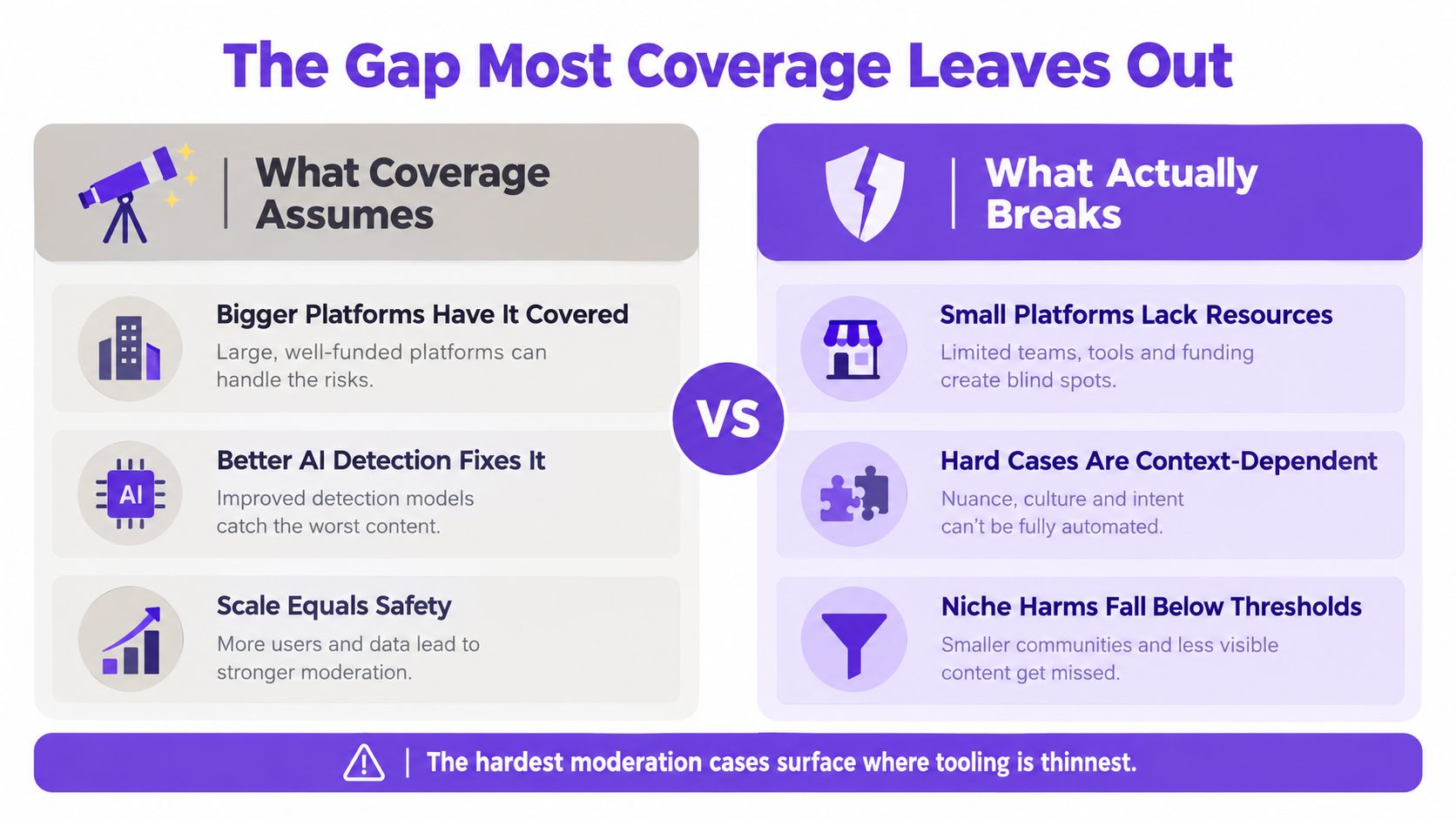
Large-platform systems dominate public discussion, but smaller communities often face the same categories of abuse with fewer tools and less specialist support. A 2025 needs assessment found that moderation products are still optimized for large flagship communities, leaving smaller operators with friction, inconsistent access to affordable tools, and workarounds such as manual denylists and informal group chats, as documented in the Social Web Trust and Safety Needs Assessment.
That gap changes the cost of a false positive. In a tight-knit forum, removing the wrong member or misclassifying a local norm can damage relationships that automated systems can't measure. A small operator may also lack a policy specialist, a data engineer, and counsel to interpret a complex vendor contract. Better detection alone won't solve those constraints.
Build for the long tail
Useful infrastructure for small operators should be modular rather than an imitation of a global platform. That means deployable moderation models, shared policy libraries that can be adapted locally, exportable decision logs, and dashboards that show queue health without requiring a dedicated analytics team.
The best tool isn't necessarily the most automated one. A small community may benefit more from a classifier that highlights likely duplicates and a clear second-review workflow than from an opaque system that removes content without explanation. Local moderators need control over thresholds, policy exceptions, evidence retention, and appeals.
The larger ecosystem has a responsibility here. Mature platforms and vendors can publish interoperable policy formats, support portable moderation records, document model limitations, and price basic review features for smaller operators. Communities with fewer users shouldn't have to choose between manual work and unaccountable automation.
A hundred-person forum still benefits from the same principles as a global network: use automation for triage, send uncertain decisions to people, preserve reasons, and make correction possible. Scale changes the implementation. It doesn't remove the need for accountability.
Privacy, Metrics, and the Road Ahead
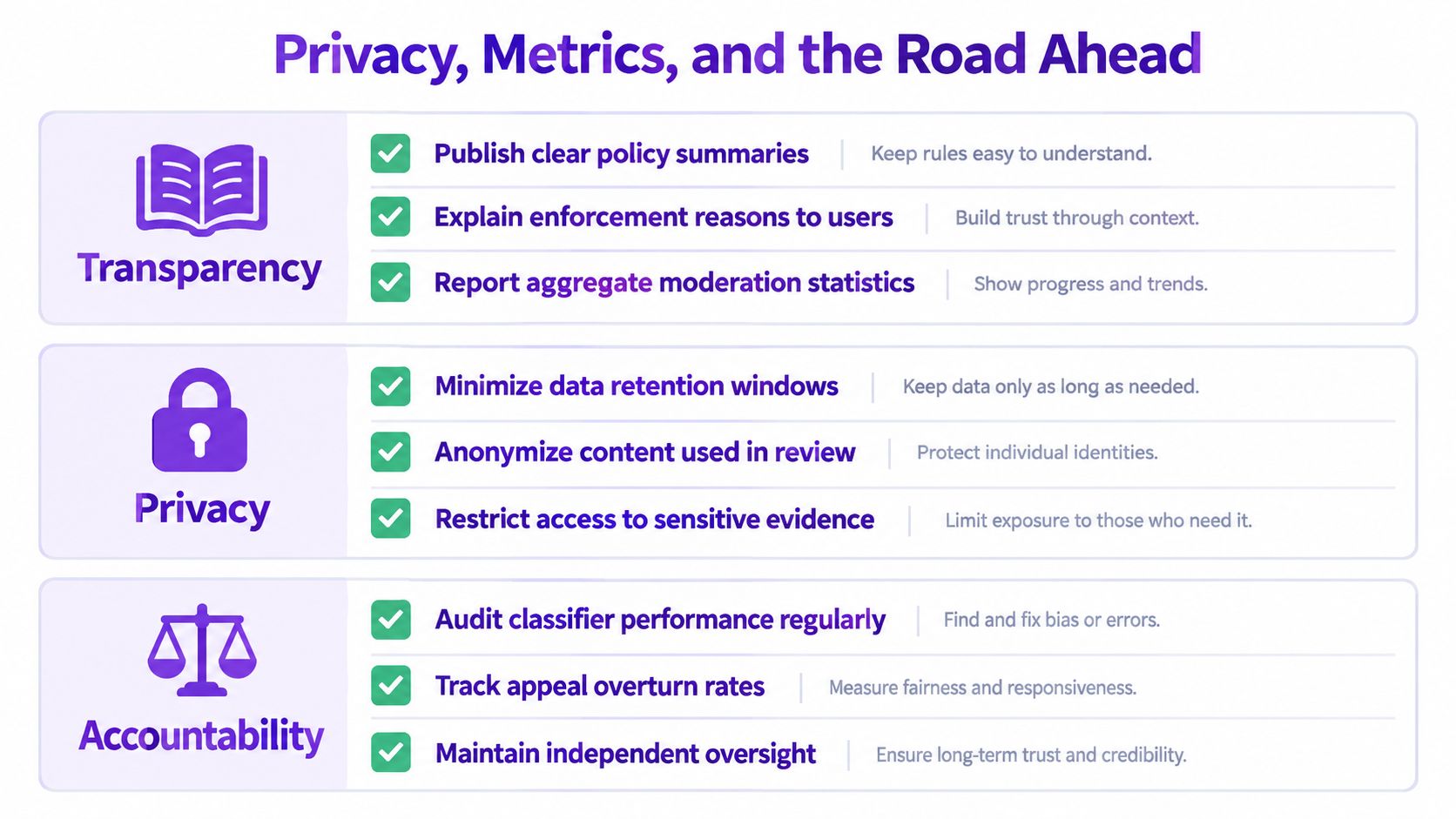
A mature moderation program distinguishes transparency, privacy, and accountability. None can substitute for the others. A transparent system that exposes sensitive evidence is unsafe. A private system that won't explain decisions is unaccountable. A measurable system that optimizes only removal volume can become more harmful while appearing more efficient.
Publish useful transparency
A report should explain the policy categories used, the types of actions available, the role of automation, the number of items reviewed, and how appeals affect outcomes. Small samples need special care. Publishing a tiny category count can reveal information about an individual or a vulnerable group, so aggregate or suppress data when disclosure would create a new risk.
Format matters as much as completeness. A readable category table, definitions, methodology note, and explanation of changes between reporting periods will help users understand the system. A long list of raw counts without definitions won't.
The recommendations for LLM-based moderation transparency call for reporting volumes reviewed, removals triggered, false positives, false negatives, audit methods, and dispute-resolution mechanisms. That approach shifts attention from takedown totals to decision quality and user recourse.
Minimize what the system retains
Privacy controls should be designed into intake and review, not added after a breach or complaint. Teams can start with a practical checklist:
- Retain less content: Keep only the evidence needed for review, appeals, legal obligations, and safety investigations.
- Separate identities: Use hashed or tokenized identifiers for repeat-offender logic where direct identity isn't required.
- Limit access: Give reviewers access to the evidence and metadata needed for their assignment, not the entire account history.
- Separate purposes: Don't repurpose moderation records for advertising or unrelated profiling.
- Document deletion: Set retention rules, exceptions, and deletion ownership so temporary evidence doesn't become permanent data.
A privacy workflow tool such as Privacy Policy Manager Copilot can help teams organize policy documentation and review obligations, but it shouldn't replace a data inventory, access controls, or a human privacy assessment.
Measure decisions, not just removals
Raw takedown counts are easy to display and difficult to interpret. They can rise because harmful content increased, because reporting improved, because a model became more aggressive, or because policy changed. Better operational measures include appeal reversal rate, time to decision by severity, reviewer agreement, automation coverage, escalation volume, and performance by language or content type.
Use performance metrics for content workflows as a starting point for designing a measurement layer, then connect every metric to a decision. If reversals rise, review the policy and model labels. If severe items wait too long, change queue priority. If reviewer agreement falls, run calibration sessions and update examples.
Over the next few years, teams will likely face more region-specific reporting expectations, stronger demands for explanations of automated decisions, and difficult privacy questions around detection in encrypted or user-controlled contexts. The durable answer won't be a single model. It will be a layered system that minimizes data, exposes uncertainty, gives users a meaningful appeal, and lets operators prove whether each component is working.
AI Image Detector offers a privacy-first image-authenticity signal that trust and safety teams can use when triaging possible synthetic media, impersonation, fraud, or visual misinformation. Visit AI Image Detector to test images directly or explore an API-based workflow for authenticity checks in moderation pipelines.