

What Is AI Monitoring and Why It Matters in 2026

AI monitoring is ongoing post-deployment oversight of performance, drift, safety, and outcomes, covering at least six dimensions of whether a system still works as intended. A detector that becomes unreliable after a new image generator launches illustrates why passing a pre-launch test isn't enough.
You might be the editor deciding whether to publish a suspicious photograph, the moderator reviewing disputed flags, or the compliance lead asked to explain an automated decision. You need more than a score on a screen. You need to know whether the system deserves your trust today, under the conditions you are facing.
Why AI Monitoring Has Become an Everyday Concern
Suppose your moderation team tested an image detector before launch and found it suitable for its intended workflow. Later, reviewers notice that legitimate artwork is being flagged while unfamiliar synthetic images pass through. Nobody changed the detector, but the content arriving at its door changed.
That's a hypothetical example, not a reported case study. It illustrates a practical distinction: validation checks readiness for deployment; monitoring checks continued suitability after deployment. The team needs evidence about current behavior, not reassurance from an old test report.
The scale of adoption makes this an everyday operational concern. McKinsey's global survey found that 72% of respondents reported organizational AI use in at least one business function in early 2024, compared with roughly 50% annually over the preceding six years; more than two-thirds of respondents in nearly every geographic region reported organizational use.
The problem belongs to the whole workflow
These scenarios show why oversight can't stop at the model's test results.
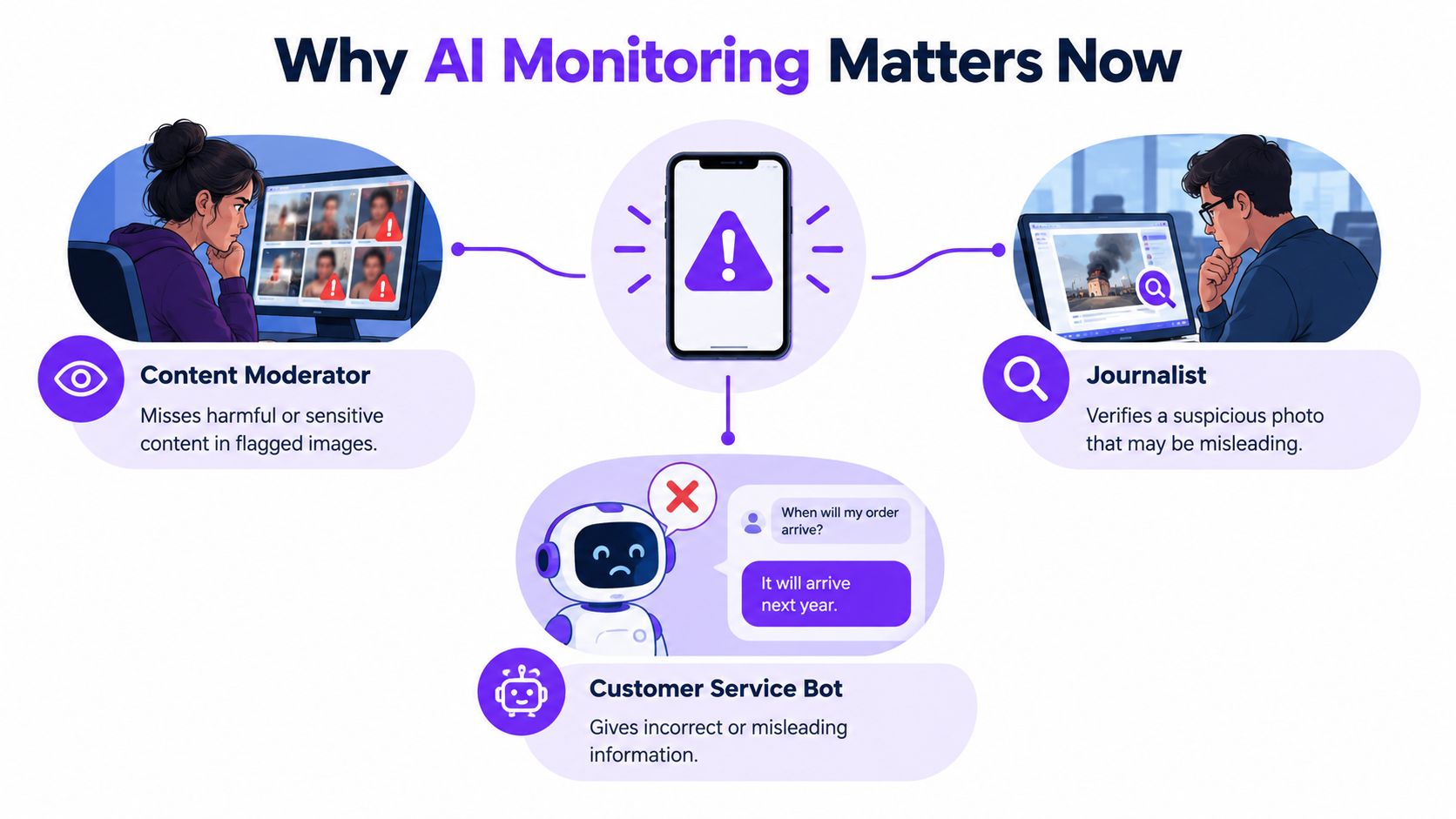
A journalist needs to recognize uncertainty before publication. A moderator needs to know when automated flags require reconsideration. A customer service manager needs a way to investigate wrong answers rather than confirming that the bot is online.
For each workflow, assign responsibility for distinct questions:
- Technical ownership: Who investigates a change in model behavior or service reliability?
- Decision ownership: Who can pause automation when the consequences become unacceptable?
- Review ownership: Who checks whether a proposed fix resolves the problem?
For colleagues in regulated industries, Visbanking's resource on how regulators watch AI in banking offers a sector-specific route into the oversight discussion.
The discipline didn't suddenly appear in 2026. What makes it relevant now is the need to manage AI as an operating service, with accountable people checking whether yesterday's deployment remains appropriate for today's work.
The Core Idea Behind AI Monitoring
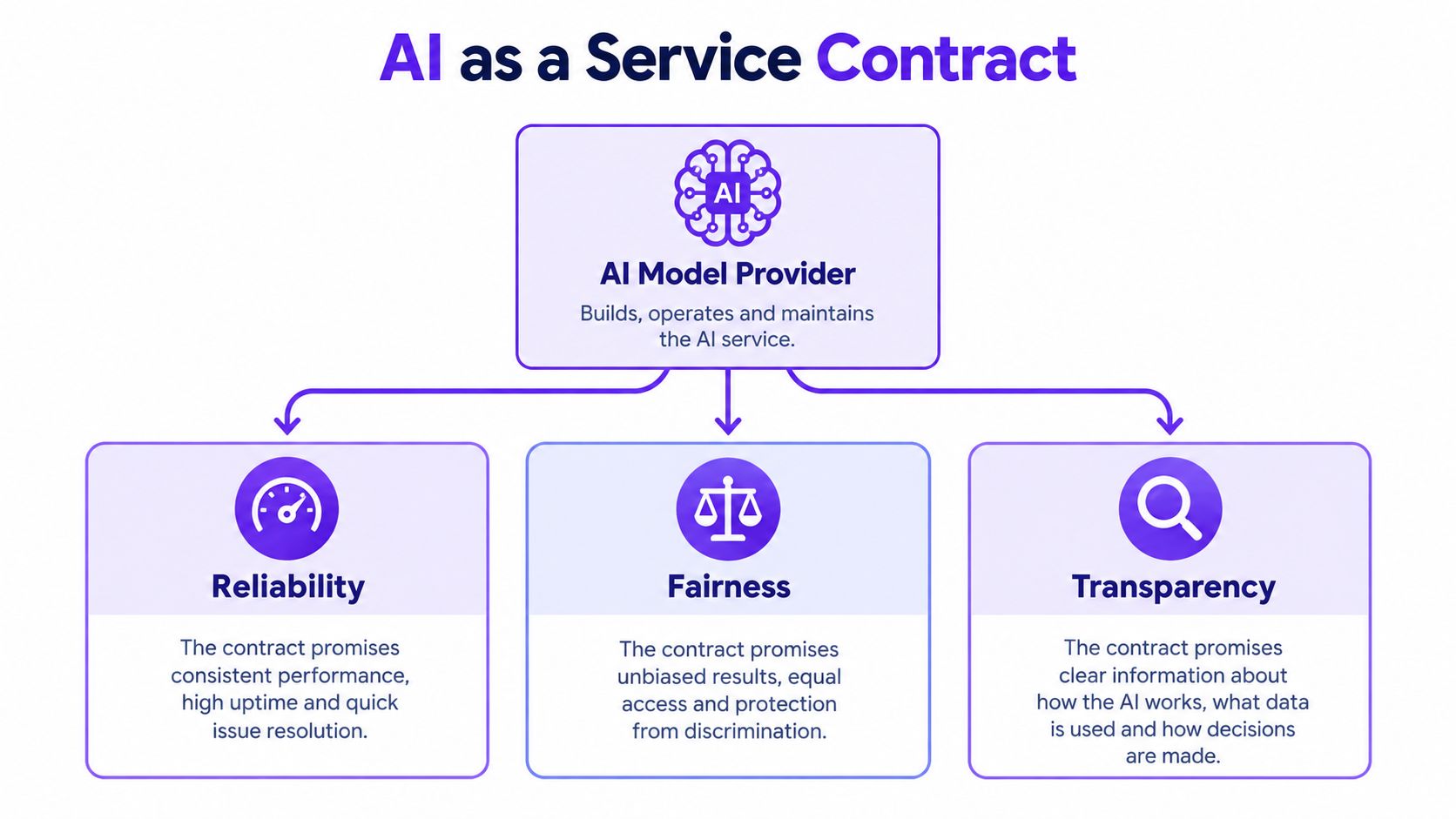
Think of an AI system as a continuous service contract between its operator and the people who rely on it. This isn't necessarily a legal contract. It's a practical statement of what users should be able to expect, where the system has limits, and what the operator will do when those expectations aren't met.
For an image detector, the promise shouldn't be perfect certainty. A more defensible promise is useful evidence within defined conditions, understandable uncertainty, and a review route when the evidence is insufficient.
This diagram summarizes the user-facing promises behind that contract.
Translate promises into questions
A technically complete program covers at least six dimensions: functionality, operational reliability, human factors, security, regulatory compliance, and large-scale societal impacts, reflecting the distinctions in NIST's monitoring framework.
| Dimension | The question an operator needs answered |
|---|---|
| Functionality | Does the system still perform its intended task? |
| Operational reliability | Can users obtain usable results without service failures? |
| Human factors | Can people understand, challenge, and override its recommendations? |
| Security | Are tampering and misuse being detected and addressed? |
| Regulatory compliance | Is the workflow meeting its applicable obligations? |
| Societal impacts | Could repeated decisions create harm beyond individual interactions? |
These aren't interchangeable checks. A detector can return accurate classifications while its interface encourages users to treat uncertainty as proof. Conversely, a carefully worded interface won't compensate for an unavailable service.
Practical rule: Define the promise, the evidence that tests it, and the person authorized to act when it isn't met.
Follow the complete service
The service contract covers more than an isolated model. File handling, preprocessing, model calls, review queues, and downstream decisions all deserve attention because users experience the combined workflow.
For a complementary explanation of how components are coordinated, consult Yalc's AI orchestration guide. Keep the distinction clear: orchestration concerns how components work together; monitoring concerns how operators evaluate their behavior and respond.
Use the accompanying video as another entry point into the discussion.
The reusable mental model is simple: a dashboard supplies evidence, but people maintain the contract.
The Four Main Types of Monitoring
For implementation, it's useful to organize monitoring into performance, drift, safety, and privacy. Treat these as working categories, not competing definitions or a requirement to buy separate products. Each addresses a different reason an AI-enabled workflow might become unfit for purpose.
A performance dashboard answers whether the service is producing useful results. It doesn't, by itself, establish whether the input population has changed, whether people are being harmed, or whether sensitive material has been retained.
Comparing the Four Main Types of AI Monitoring
| Monitoring Type | What It Tracks | Typical Alert | Blind Spot |
|---|---|---|---|
| Performance | Precision, recall, false positives, false negatives, calibration, and latency | Reviewed results exceed the workflow's error tolerance | An aggregate result can conceal failures in a particular image category |
| Drift | Changes in input features, outcome distributions, and confidence patterns | Screenshot uploads differ materially from the reference distribution | A detected shift doesn't establish that decisions are wrong |
| Safety | Harmful outcomes, biased treatment, adversarial testing results, and misuse reports | A tested manipulation bypasses a safeguard | Unreported harm may remain invisible |
| Privacy | Data handling, access, retention, and leakage checks | Uploaded content appears in a persistent debugging log | A clean accuracy report says nothing about data handling |
Performance monitoring requires knowing what each metric means. Precision asks how often flagged images are correctly flagged; recall asks how much of the relevant synthetic content the detector catches. False positives concern authentic images incorrectly flagged, while false negatives concern synthetic images missed. Calibration asks whether confidence levels match observed correctness in comparable labeled examples.
Drift monitoring asks whether yesterday's reference material still resembles today's inputs. Population-stability or divergence measures compare distributions, rather than issuing an authenticity verdict. A shift toward heavily compressed screenshots warrants investigation, but it isn't proof of model failure.
Choose checks by consequence
Safety monitoring should follow the decisions made with the output. For a moderation workflow, test borderline content and deliberate attempts to evade review; for a chatbot, include attempts to bypass safeguards. The alert needs to identify the unsafe behavior, not merely unusual traffic.
Privacy monitoring should examine what happens to data throughout processing. Useful review questions include whether debugging tools capture images, whether staff access is authorized, and whether technical testing should cover membership inference or re-identification concerns.
- Ask for coverage: Which categories does the vendor measure?
- Ask for evidence: Are outcome claims based on reviewed examples or proxy signals?
- Ask for response: What happens after an alert, and who can authorize intervention?
A vendor selling latency graphs isn't necessarily selling model-quality oversight. Match the tool to the question you need answered.
Why Counting Incidents Is Not the Same as Monitoring
An incident count tells you how many events were reported. It doesn't tell you how often harm occurred among everyone exposed to the system.
MIT FutureTech's public-health framing of AI incident monitoring explains that estimating risk requires information about deployment exposure and reporting frequency. Without those denominators, rising reports may indicate better detection or wider deployment rather than worsening safety.
Consider a hypothetical platform that introduces a clearer appeal button. More complaints afterward could reflect newly accessible reporting, a deteriorating detector, a change in users, or some combination. The count alone can't distinguish these explanations.
Think like a surveillance team

The public-health analogy helps because surveillance teams must interpret incomplete observations. For AI oversight, that means recording exposure estimates, acknowledging reporting assumptions, seeking expert review, and classifying trends with appropriate uncertainty.
It also changes how you interpret a detector's confidence score. Confidence is not a population-wide error rate. Its usefulness depends on calibration against the kinds of images and workflows being assessed, including compression, editing, source context, and relevant user populations.
A more visible problem isn't necessarily a more frequent problem. Investigate what changed in both the system and the reporting process.
For the measurement vocabulary behind these distinctions, use this explanation of image-detection performance metrics. The practical objective is to avoid treating different quantities as if they answer the same question.
Make uncertainty inspectable
A rigorous dashboard should make its limitations visible rather than hide them behind a headline result.
- Coverage limits: Identify image categories and workflows that haven't been adequately evaluated.
- Exposure context: Separate raw reports from estimates of how widely the system was used.
- Error context: Distinguish false positives from false negatives in relevant slices.
- Reporting changes: Record alterations to appeals, reviewer access, or incident intake.
- Uncertainty: Mark conclusions that lack enough reviewed evidence.
When evaluating a vendor, ask what could explain an apparent improvement besides a better model. A quieter incident queue might reflect fewer mistakes, but it might also reflect users abandoning the reporting process. Good monitoring supports investigation; it doesn't turn incomplete evidence into certainty.
How Monitoring Looks for Different Teams
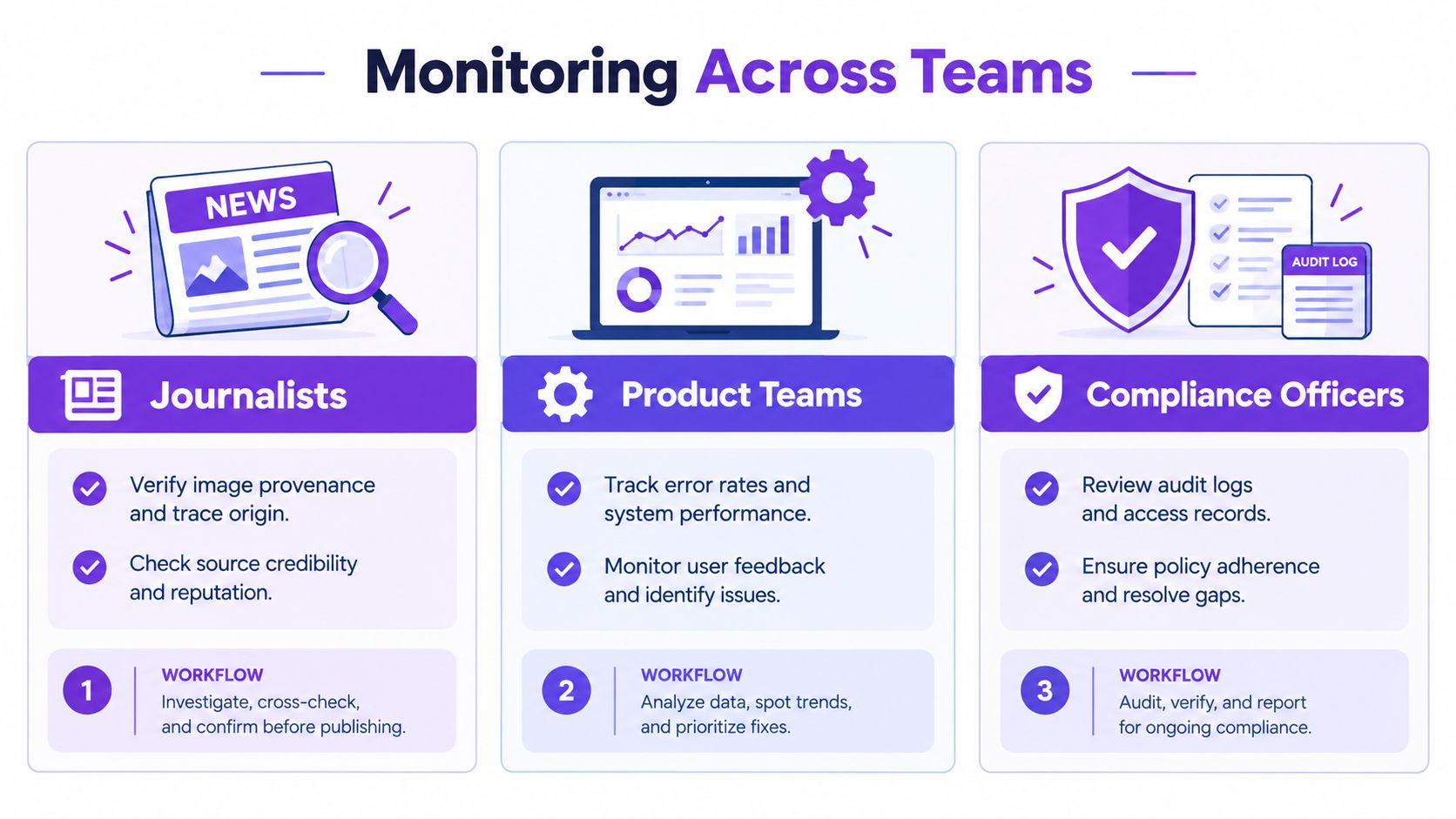
Different teams can use the same detector while needing different evidence. A newsroom's central concern is whether it can responsibly describe an image. A platform moderator must decide whether to impose an action. A compliance lead needs to reconstruct how the organization controlled risk.
The distinction matters because benchmark coverage isn't equally developed across all concerns. A systematic review of 232 studies found dense coverage of bias and toxicity but sparse evaluation of privacy, provenance, deepfakes, and system-level failures, identifying continuous multimodal evaluation and versioned artifacts among the priorities.
That finding supports a cautious approach: don't assume a strong benchmark result answers every team's operational question.
Journalists and fact-checkers
A verification editor should ask whether evidence remains applicable to unfamiliar generators and different source channels, such as wire-service files versus social uploads. Keep provenance separate from detection: an estimate of synthetic origin doesn't establish who captured an image, where it came from, or whether its caption is accurate.
In a proposed newsroom workflow, ambiguous results trigger source verification and specialist review before publication. The editorial record should distinguish what the detector suggested, what the journalist independently confirmed, and what remains unknown.
These team workflows show how the same technical evidence supports different responsibilities.
Trust-and-safety and product teams
Moderation teams should focus on the relationship between a classification and its consequences. A questionable label used to prioritize review is different from the same label used to remove content or restrict an account.
A practical workflow might route disputed artwork to qualified reviewers and temporarily suspend automatic enforcement for an affected category. The objective is to limit harm while investigating, rather than keep processing everything under a questionable rule.
For related workflow considerations, consult this guide to trust-and-safety content moderation.
Legal, compliance, and corporate risk teams
Compliance staff need evidence that decisions followed an approved process. Their questions concern authority, documentation, applicable obligations, and whether corrective action was completed.
| Team | Evidence to prioritize | Proposed action trigger |
|---|---|---|
| Editorial | Source checks, provenance notes, and unresolved uncertainty | Evidence conflicts with the proposed publication claim |
| Moderation | Reviewer disagreement, appeals, and affected content categories | An enforcement rule no longer has adequate support |
| Compliance | Approval records, incident decisions, and mitigation evidence | A required control is missing or an issue remains unresolved |
An educator faces a similar consequence-sensitive choice: a detector result can prompt a conversation, but shouldn't stand alone as proof of misconduct. Across teams, monitor the decision workflow, not just the prediction.
Building a Monitoring Loop You Can Actually Run
A workable loop needs evidence, decision rules, intervention, and follow-through. If an alert produces a notification but nobody has authority to respond, you've built visibility without control.
NIST's documentation recommendations and OECD's due-diligence guidance emphasize documenting evaluation material, metrics, performance changes, incidents, limitations, thresholds, deficiencies, and mitigation actions. Use those categories to make the loop auditable.
Establish the operating sequence
- Set a reference baseline. Maintain versioned, appropriately authorized test material and evaluation settings. This guide to how to test AI provides a starting point for planning checks.
- Define thresholds and responses. Decide in advance which conditions require review, quarantine, restricted automation, retraining, or rollback.
- Make alerts actionable. Record the model version, affected slice, breached threshold, severity, and decision owner.
- Verify the resolution. Use qualified review to confirm degradation, evaluate the intervention, and document whether the issue was resolved.
For conversational workflows, SupportGPT's guide for support teams offers an adjacent quality-assurance resource. Apply the operating discipline to your own context rather than copying another team's thresholds.
Preserve evidence without retaining images
A privacy-first image workflow creates a constraint: investigators may need to understand failures without storing user uploads. Design for that constraint before deployment, using aggregate statistics, consented benchmark hashes, ephemeral processing logs, and sampled review outcomes that exclude retained user images.
Wire in distribution comparisons, calibration curves, abstention rates, and per-slice dashboards as complementary checks. Record why the system declined to classify, not just the classifications it returned.
Privacy boundary: An audit trail should explain the decision and response without becoming a hidden archive of sensitive uploads.
Hashes aren't substitutes for labeled evaluation material, and they still require appropriate handling. Where necessary, evaluate with separately authorized benchmark images or conduct transient review under an approved process.
Keep the handoff concrete: threshold records, version tags, named owners, mitigation notes, and resolution evidence. Engineers need executable rules, while reviewers need enough context to act responsibly.
Where AI Monitoring Goes From Here
A deployed image detector needs an ongoing service commitment, much like equipment that requires regular inspection after installation. Article 72 of the EU AI Act requires providers of covered high-risk systems to establish and document a post-market monitoring system and plan. The framework was scheduled to apply to high-risk obligations from 2 August 2026.
Related high-risk duties include controlled logs retained for at least six months and serious-incident reporting, alongside the post-market monitoring framework described above. These duties do not mean every image detector must retain user uploads. Teams need to determine which obligations apply to their role, system, and use case, then design evidence collection around those requirements.
Treat monitoring as an operating commitment
A dashboard can show signals, but people still need to assess them and act. Providers need a process for collecting experience, checking whether a system remains suitable, and taking corrective or preventive action. A monitoring plan should assign that work and explain how decisions will be made, instead of merely naming metrics.
For a multinational organization, a shared control framework can provide a common starting point. Teams should review jurisdiction-specific requirements separately. Shared operational evidence can support governance across teams, but legal interpretation remains necessary.
A practical checklist includes:
- Calibrated evidence: Confidence scores make sense within the context in which the system was evaluated.
- Relevant drift checks: Alerts cover image categories that matter to the workflow.
- Scheduled safety and privacy review: Named owners examine risks that accuracy tests cannot resolve.
- Minimal-data auditability: Records support investigation without unnecessary retention of user images.
- Human escalation: Ambiguous or consequential decisions have a defined review route.
Keep the contract realistic
The durable answer to what is AI monitoring is a commitment to keep checking whether an AI-enabled service remains fit for its purpose, and to respond when it does not. Like a service agreement, that commitment needs clear responsibilities, evidence, and a route for addressing problems. It also needs technical measurement and judgment about consequences.
Responsible teams do not need to claim perfect foresight. They need defensible limits, inspectable evidence, and people authorized to intervene. That turns monitoring into active operational work, rather than passive reporting.
AI Image Detector offers privacy-first image analysis with a confidence score and explanatory verdict, without storing uploaded images on its servers. Visit AI Image Detector to assess an image, then use the result as one input to a verification workflow with documented uncertainty and human review.