

AI Fraud Detection Software: How to Choose the Right One

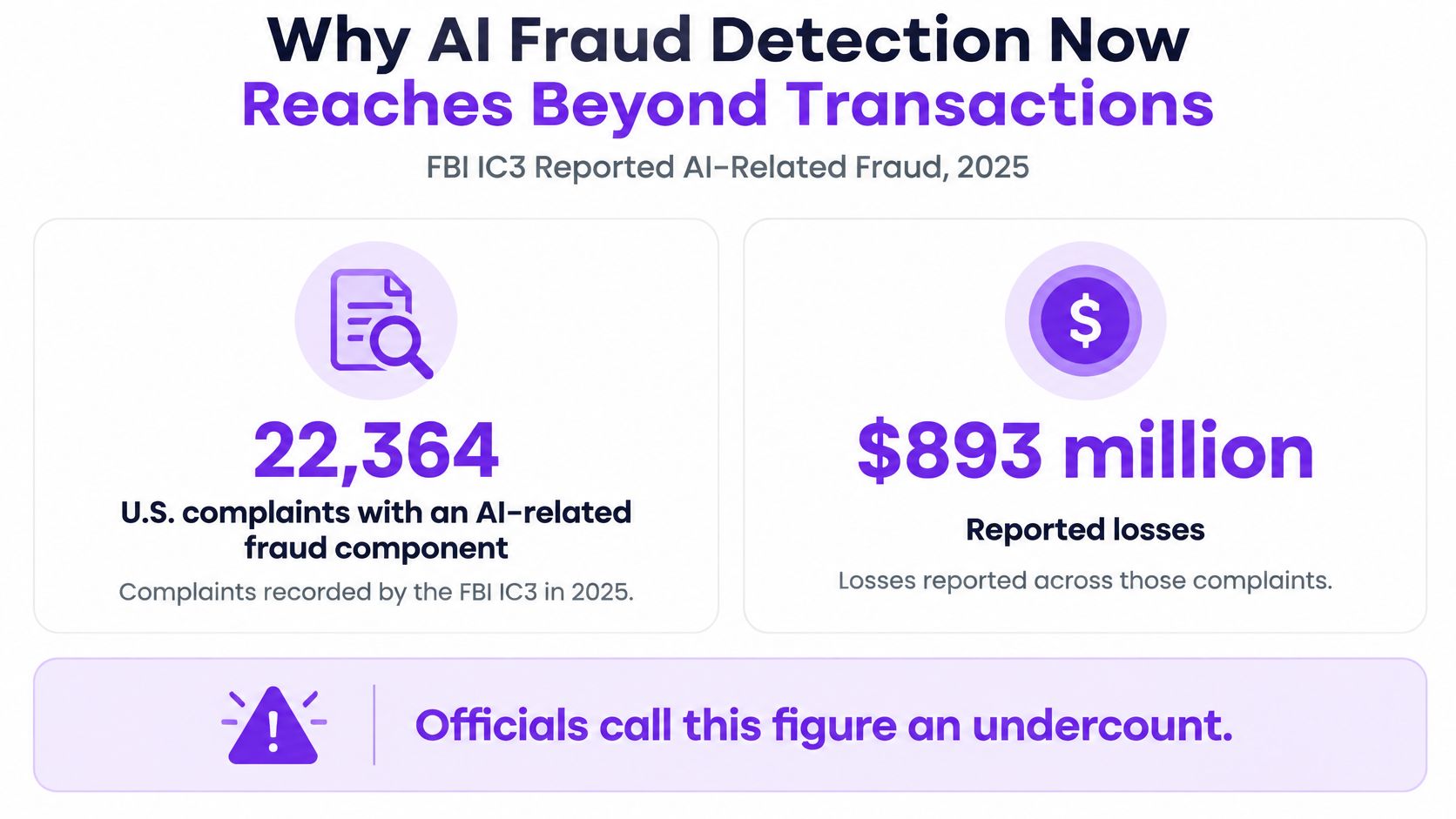
The FBI's Internet Crime Complaint Center recorded 22,364 U.S. complaints containing an AI-related fraud component in 2025, with approximately $893 million in reported losses, according to Keepnet's compilation of AI fraud statistics. Those figures are described as an undercount because victims and investigators don't always identify AI involvement. For buyers of AI fraud detection software, the implication is practical: detecting suspicious payments is no longer enough when the evidence used to authorize them can also be fabricated.
Why AI Fraud Detection Now Reaches Beyond Transactions
AI fraud detection software analyzes available signals and returns a risk or confidence score, ideally with reasons that an investigator can inspect. Treat that output as a recommendation about what to investigate or verify, not a verdict of guilt.
Earlier controls concentrated on transaction values, payment frequency and manually defined alerts. A broader assessment may also need document authenticity, facial imagery, voice evidence and account behavior. A payment can look ordinary while the identity behind it is fabricated, just as an authentic photograph can accompany a dishonest claim.
The reported scale helps explain why buyers need broader coverage.
Choose the evidence before the detector
Start with the decision your team must defend. An insurer reviewing submitted photographs needs different evidence from a payments analyst investigating account takeover. For visual evidence, this guide to claim fraud detection provides a useful workflow context.
Invoice controls illustrate another boundary. TaxID's guide to preventing VAT fraud through invoice checks is relevant when the question concerns invoice information and business verification, rather than whether an attached image looks synthetic.
Buying principle: Specify what the detector must establish before comparing how confidently it scores an input.
Don't assume a transaction model, identity platform and image detector cover the same risks. Require each candidate to identify its supported signals, unsupported attack types and expected review workflow. Then compare its detection approach, operational metrics, processing location and evidence trail against that defined task.
The useful distinction isn't merely rules versus AI. It's whether the software produces evidence your team can audit, reproduce and defend, without retaining more sensitive information than the decision requires.
Approaches Compared on Accuracy, Latency, Privacy and Deployment
Detection approaches compared on five criteria
| Approach | Detection quality | Latency | Privacy exposure | Deployment | API access |
|---|---|---|---|---|---|
| Rule-based controls | Catches defined patterns; misses undefined ones | Very low for simple checks | Can remain in-house | Quick initial configuration; ongoing rule maintenance | Internal service or rules-engine endpoint |
| Gradient-boosted trees, such as XGBoost | Strong candidate for tabular and behavioral signals | Test feature retrieval plus scoring | Hosting and feature collection determine exposure | Requires feature pipeline and retraining | Vendor endpoint or self-hosted service |
| Deep neural networks | Strong results in some benchmarks; explanations need scrutiny | Hardware and model size determine serving cost | Hosting and input retention determine exposure | May require GPU or specialized serving | Vendor-hosted or self-hosted endpoint |
| Graph neural networks | Suited to investigating linked entities and suspected rings | Include graph construction and retrieval | Requires linked account or relationship data | Substantial entity resolution and integration | Graph-backed service or custom endpoint |
| Cloud scoring API | Must be validated on the buyer's traffic | Includes network and vendor processing | Inputs leave the buyer's environment | Relatively light initial integration | Typically REST; confirm contract |
| On-device or no-storage image analysis | Media authenticity signal, not proof of fraud | Local processing or short-lived remote pipeline | Local execution and remote deletion offer different protections | Browser, app or short-lived API integration | Product-specific; verify endpoint availability |
Separate model choice from hosting choice
Rule-based controls remain useful when the organization can state the condition explicitly. A velocity rule is straightforward to inspect, but investigators must distinguish the rule's trigger from evidence that the activity was in fact fraudulent.
Gradient-boosted trees, including XGBoost, are a sensible candidate when inputs consist mainly of structured transaction, device and account features. Their deployment burden includes producing those features consistently, not merely loading a trained model.
Deep neural networks deserve consideration when the input requires more complex representations. Don't accept a stronger headline result without checking explanation quality, serving requirements and whether the comparison used equivalent data.
Graph neural networks address a different question: whether relationships between accounts, devices or payees reveal coordinated activity. Ask how the vendor resolves identities and handles incorrect links before treating a suspicious neighborhood as evidence against an individual account.
Inspect the service boundary
A cloud scoring API describes delivery, not a particular detection method. The provider may use trees, neural networks, rules or a combination, so evaluate the underlying coverage separately from the convenience of integration.
Likewise, on-device and no-storage aren't interchangeable. On-device analysis can keep the input local; a no-storage remote service still receives it and needs clear deletion and logging terms.
Use the table as a procurement framework, not a universal speed ranking. Ask vendors to replace qualitative descriptions with measured results under your workload and document any unpublished values rather than guessing them.
No approach wins across detection quality, latency, privacy, deployment effort and access, so design a hybrid stack around the gaps your team needs to close.
Evaluation Metrics That Hold Up Under Fraud's Rarity
A detector can achieve approximately 99.83% accuracy while catching no fraud: the widely used Kaggle credit-card dataset contains approximately 284,807 transactions, with only about 0.17% labeled fraudulent, as discussed in this fraud-detection survey. Labeling every transaction legitimate exploits the base rate rather than detecting anything.
That's why accuracy shouldn't determine your shortlist. The operational question is how much fraud the model identifies at a level of customer friction and investigation work your organization can sustain.
Read the benchmark at its operating threshold
On the IEEE-CIS fraud dataset, engineered temporal and behavioral features combined with XGBoost achieved 0.891 precision, 0.807 recall, 0.847 F1 and 0.863 PR-AUC, with a false-positive rate below 0.4% at the default threshold, according to the ACM benchmark paper.
That result makes a useful comparison point for structured signals. It doesn't establish how an implementation will perform on your customers, your fraud mix or uploaded identity images.
Precision asks how many flagged cases are genuinely fraudulent. Recall asks how much of the actual fraud the detector catches. Changing the decision threshold changes their operational balance, so ask for the threshold alongside every reported result.
A recall-focused configuration can create a queue your investigators can't clear. A precision-focused configuration may produce convincing alerts while leaving substantial fraud unflagged.
Evaluation metrics and what to request from a vendor
| Metric | What it reveals | What to request |
|---|---|---|
| Recall at fixed false-positive budget | Share of fraud caught at an acceptable legitimate-event flag rate | Recall at your approved false-positive ceiling, with the threshold disclosed |
| Precision at real fraud prevalence | Share of flags that are true fraud at the production base rate | Precision at your expected fraud rate, not a balanced test set |
| PR-AUC | Precision-recall ranking quality under heavy imbalance | Value with confidence interval on held-out, time-split data |
| False positives per 1,000 legitimate events | Customer friction and potential reviewer workload | Normalized count, broken down by customer segment |
| Performance by fraud subtype | Blind spots such as account takeover or synthetic identity | Recall for each subtype the vendor claims to cover |
| Accuracy | Overall correctness, which can obscure missed rare events | Report only as a secondary figure |
Keep evaluation separate from calibration
Use historical cases to choose an operating threshold, then evaluate it on a separate, later sample. Otherwise, your team risks measuring how well it tuned the detector to a familiar test set.
Preserve the actual fraud prevalence when estimating production precision. If you also build an attack-heavy challenge set, report it separately rather than mixing it into a supposedly representative result.
A benchmark describes a model on a dataset. A buying decision requires a model, a threshold, a workload and an action policy.
Require the same labeled evaluation sample and scoring rules for every candidate. If a vendor only offers aggregate accuracy on a balanced demonstration set, you don't yet have the evidence needed to approve production use.
Latency, Throughput and Where Your Data Gets Processed
The most accurate model isn't automatically the model you should deploy. In one reported real-time fraud evaluation, a deep neural network achieved 97.1% accuracy, while a Random Forest delivered the fastest processing profile at approximately 45 milliseconds per decision and 1,000 transactions per second, with a 2.3% false-positive rate.
These are results from that evaluation, not promises for another deployment. Hardware, concurrency, input preparation and the surrounding decision workflow belong in your acceptance test.
Measure the complete decision path
A scoring endpoint can respond quickly while the application waits for account history, document extraction or an overloaded review queue. Start the clock when the event enters your system and stop it when the application can act.
A staged architecture is worth testing. Let a lightweight model triage incoming events, then send ambiguous cases to more expensive analysis. Preserve a separate route for unavailable evidence, because a missing score shouldn't silently become a low-risk score.
For media workflows, real-time analysis is relevant to the entire upload-to-result experience, not just inference inside the model.
Ask engineering to record:
- Typical and tail latency: Measure p50 and p95 across the full request path, including feature retrieval.
- Sustained throughput: Maintain realistic concurrency long enough to expose queue growth and throttling.
- Failure behavior: Include timeouts, retries, unavailable dependencies and peak-load degradation.
- Detection under load: Check whether the system preserves recall and false-positive behavior when capacity is constrained.
Ask what remains after processing
Processing location and retention answer different privacy questions. Local execution can avoid transmitting raw media; short-lived remote processing can limit retention without eliminating transmission.
Ask where analysis runs, which subprocessors receive inputs, and whether the provider uses uploads for training. Then separate the retention terms for raw files, extracted features, request logs, support records and backups.
No-storage should describe an enforceable handling policy, not just the absence of a gallery in the user interface. Request a data-flow diagram and contract language that matches the operational architecture.
A privacy claim without a retention window gives a compliance team nothing concrete to audit.
There's also a real tension between minimization and reproducibility. Deleting the original input reduces retained sensitive material, but it may prevent an investigator from rerunning the exact case later.
Resolve that tension deliberately. Specify which evidence must remain, who can access it, how deletion works and whether a controlled customer-side copy is justified. The right answer is a documented evidence policy, not indefinite retention disguised as auditability.
Integrate Detection and Handle Uncertain Verdicts
A detector's score only becomes operationally useful when teams can trace how it became an action. Keep the model output, decision policy and human judgment distinct, then record enough context to audit the route from input to outcome.
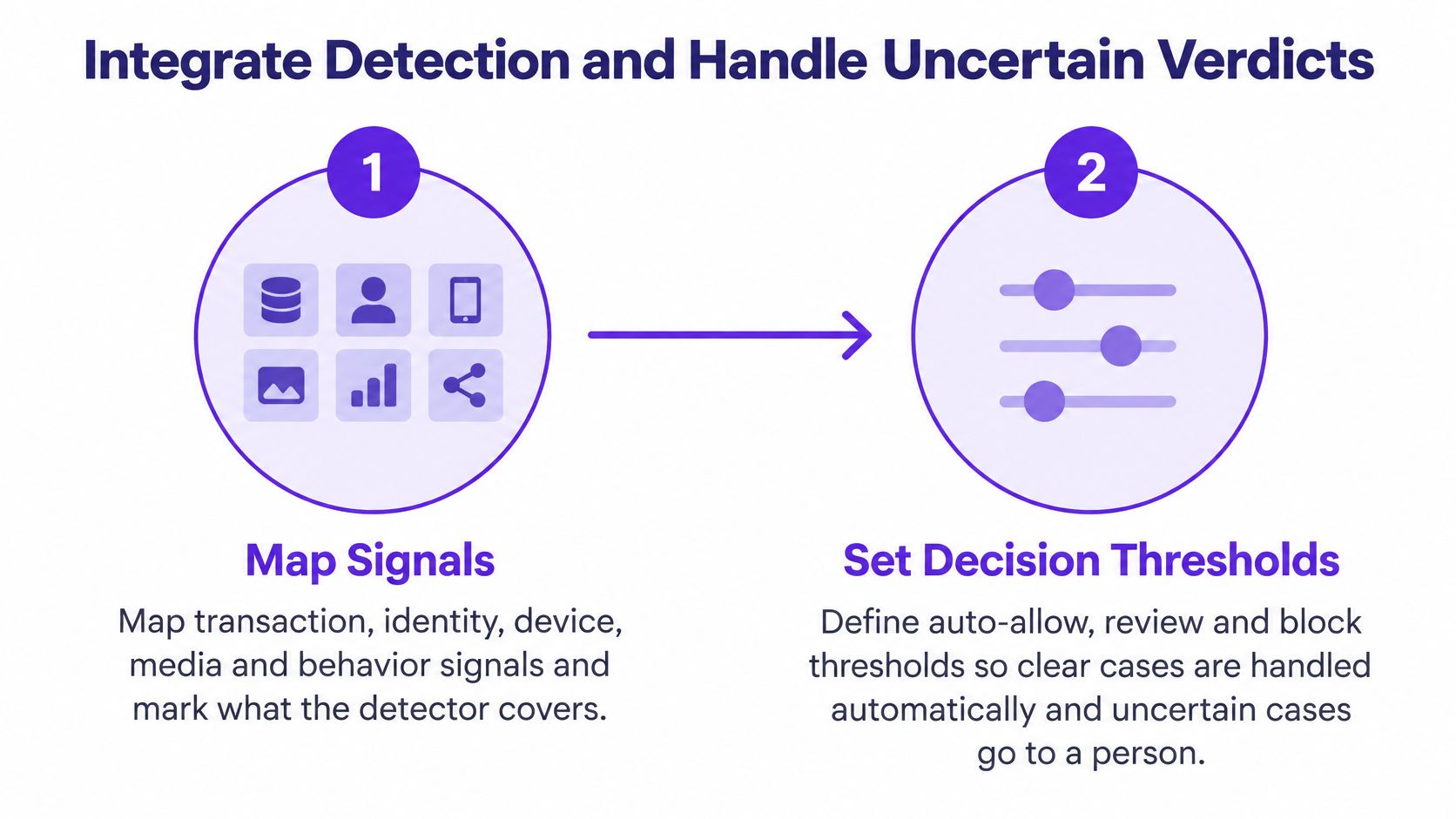
Map the signals and ownership. Inventory transaction, identity, device, media and behavior inputs, and identify which detector uses each. Assign an owner to missing or unreliable fields. Otherwise, a data gap can surface as a model failure with no clear explanation.
Set auto-allow, review and block bands for each use case. Keep the score separate from the action policy: a marketplace listing and an identity check can carry different consequences even when their scores are similar.
Calibrate on your own traffic. Measure the review workload each threshold creates, not just the alerts it produces. Include legitimate edge cases so the team can see where customers may face added friction.
Record the score, model version, reason codes, decision time and policy version. Use input hashes where appropriate to limit retained data, while recognizing that a hash identifies an input but can't reconstruct it.
Require human review and an appeal path before consequential account, payment or legal action. Reviewers need authority to overturn the recommendation and a clear way to document their reasons.
Test API timeouts, fallback behavior, rate limits and version pinning. If a detector is unavailable, the system should show that operational state rather than inventing a confidence score.
Schedule recurring monitoring for segment-level false positives, score drift and performance against emerging generators or attack methods. Feed adjudicated outcomes into evaluation, but do not treat every previous block as confirmed fraud.
Make routing decisions visible to engineering, compliance and reviewers. The record should show which policy applied and who made the final call.
Make explanations useful to an investigator
In a 2025 global survey of 562 fraud and financial-crime professionals, 87% of banks identified data management as their biggest obstacle, while 89% prioritized explainability and transparency, according to Feedzai's AI fraud trends release. Those priorities make a reason field insufficient on its own. Procurement should test whether investigators can interpret and challenge a result, and whether the explanation can be tied to the decision that followed.
A useful explanation identifies the evidence behind a score and its limits. A generic suspicious-image label does not show whether the concern is synthesis artifacts, missing evidence or an unsupported input type. These distinctions affect whether a reviewer can reproduce the assessment or defend it later.
Request a sample case export before signing. It should connect the original event, scoring configuration, explanation and final human decision. If an analyst must piece those together from unrelated dashboards, the audit trail is harder to reproduce.
Workflow guidance should also fit the sector and operating model. For casino payment controls, NexGrate on safer casino payment operations provides sector-specific context, rather than general evidence about detector performance.
Preserve uncertainty in the case record
A Springer study on fairness in fraud systems identifies recurring limits that matter to case handling: imbalanced classes, inaccurate labels, overlapping legitimate and fraudulent patterns, poor data quality and adaptive attackers. Review policies should allow for those limits instead of turning every score into an accusation.
For image workflows, use distinct descriptions:
- AI-generated: The detector found evidence consistent with synthetic creation; it has not established fraudulent intent.
- AI-assisted: The material may combine human-created content with generative processing.
- Heavily edited: Transformation makes the original provenance harder to assess.
- Inconclusive: The available input does not support a dependable classification.
Include compression, screenshots, and camera quality in testing. Reviewers should also be able to request an original file or corroborating evidence without assuming the submitter acted in bad faith.
What each detection result supports by use case
| Situation | What a result can support | Escalate to human review when |
|---|---|---|
| Newsroom photo verification | Likely AI-generated or likely human as one input to sourcing | The result is inconclusive or the image is heavily edited |
| Marketplace listing screening | Flag for a second look before publication | Removal is proposed or the seller disputes the flag |
| Identity document or selfie check | Risk signal combined with document and liveness checks | An adverse account action is considered or the customer appeals |
| Academic submission review | Prompt for an instructor conversation, not a finding of misconduct | The student contests the result or the work is marked AI-assisted |
| Social profile screening | Priority ranking for trust and safety queues | Account suspension or a public statement is being considered |
Inconclusive is a routing outcome, not a failed accusation. Send the case to a person with the evidence needed to assess it. An image score alone should not determine disciplinary or account action.
Confirm Your Requirements Before You Choose a Vendor
Choose by the decision your team needs to make, not by the broadest feature list. The right shortlist should be narrow enough that every candidate can be tested against the same operational requirements.
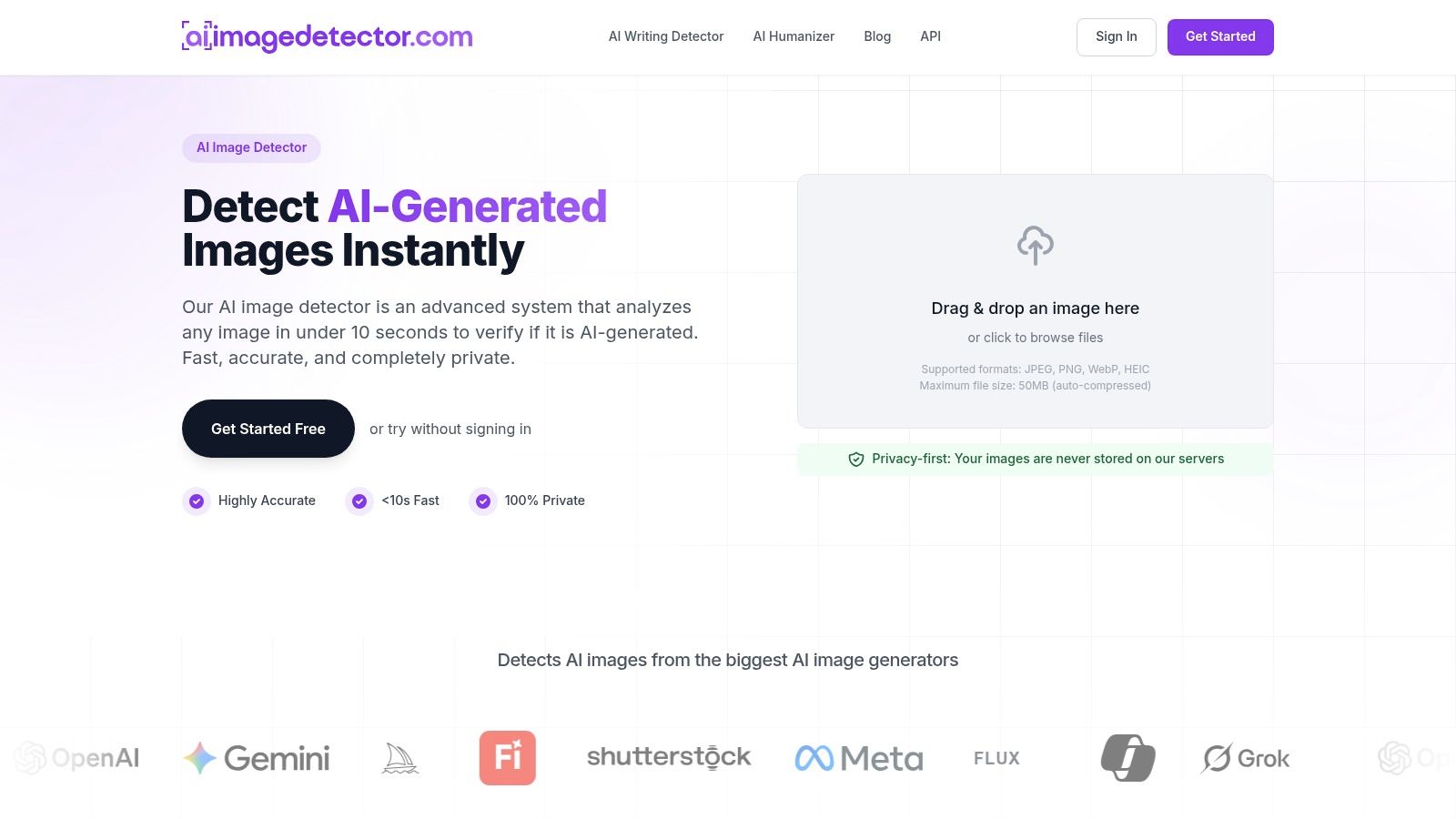
For an image-analysis option, inspect how the interface presents uncertainty and explanations.
Match the purchase to the operating team
Banks and payments teams should prioritize transaction coverage. Shortlist gradient-boosted or ensemble scoring services with published precision-recall evaluation, suitable private-hosting arrangements and investigator-facing explanations. Request evidence that the feature pipeline works with the fields your systems currently provide.
Marketplace and identity teams should prioritize media handling and escalation. Require documented upload processing, confidence outputs, useful reason codes and a route for disputed results. For commerce workflows, connect those requirements to the broader controls described in this guide to ecommerce fraud prevention.
Small teams should prioritize a reversible integration. A hosted API can be a practical starting point, but require a trial or sandbox before committing. Check whether your team can export case evidence and change providers without losing the ability to explain past decisions.
Treat media authenticity as a separate layer
The publisher's image-analysis tool is an option for checking uploaded media, not for scoring transactions or proving identity ownership. Its described workflow accepts common image formats, provides explanations across a likely-human to likely-AI-generated spectrum, offers developer API integration and states that uploaded images aren't stored on its servers.
Core detection is described as free without registration. Confirm current file limits, API access terms, account-history behavior and deletion arrangements directly before procurement rather than assuming the interactive workflow and developer service have identical conditions.
Use the demonstration to inspect the workflow, then validate the outputs independently.
Put acceptance criteria in writing
Build a labeled pilot set from real cases your team is authorized to process. Run every candidate on the same inputs, preserve the evaluation configuration and separate representative production traffic from deliberately difficult challenge cases.
Before signing, compare recall at your approved false-positive budget, normalized legitimate-event flags, tail latency and reviewer time per case. Add an evidence-export exercise and a deletion test: your team should be able to explain a disputed outcome and verify what information the provider retains.
Choose the candidate that meets those acceptance criteria with a defensible operating policy. A stronger score isn't a sufficient reason to accept evidence you can't inspect or retention you can't justify.
AI Image Detector offers image-authenticity analysis with confidence-based explanations and developer integration as a media-screening layer within a broader fraud workflow. Visit AI Image Detector to test authorized sample images, then assess whether its outputs give your reviewers useful evidence without turning uncertainty into an unsupported fraud allegation.