

What Is Real Time Analysis? a Practical Guide

Real time analysis is the continuous processing of data as it arrives, rather than waiting for a complete dataset and running a later batch job, with real time meaning the delay the application can tolerate rather than an absolute speed. That distinction matters because you don't need the fastest possible answer in the abstract. You need an answer that arrives while your decision is still open, and that's honest enough about uncertainty to act on.
You've probably felt that pressure already. An image lands in your inbox, your classroom queue, or your moderation dashboard, and someone's waiting for you to publish, approve, flag, or move on.
Why Real Time Analysis Matters Right Now
A journalist is minutes from filing. A striking photo has arrived from a source she doesn't know well, it fits the story perfectly, and her editor wants a yes or no now. If she publishes a synthetic image as news, the correction won't travel as far as the error. If she holds a genuine image for hours of checking, another outlet may publish first.
That squeeze is where what is real time analysis stops being a technical question and becomes a practical one. The challenge isn't just getting data processed quickly. It's getting a usable signal in time for the choice in front of you, whether you're a teacher screening a submission, a seller checking a product photo, or a moderator deciding whether content stays up. Waiting has costs too, and the business impact of stale data shows why delayed information can undermine decisions that look sound on paper.
The Misunderstanding to Drop First
People often hear real time and picture instant. That's the trap. Real time is operational, not absolute. It means the delay is short enough for the task at hand. A few seconds can be real time for verifying a photo before publication. It wouldn't be close to fast enough for systems that must react while an event is still unfolding.
A fast answer is only useful if it arrives before the decision closes and if you know how much weight it can carry.
This guide builds that idea in layers. You'll get a plain mental model of streaming, then see how engineers measure delay, then follow one image through a verification workflow. From there you'll compare real time analysis with slower alternatives, confront why instant confidence can mislead, and finish with criteria you can apply to any tool or pipeline you rely on.
The promise isn't speed for its own sake. It's knowing when a result in seconds is good enough for triage, and when you should slow down and corroborate before the consequences become hard to undo.
The Core Idea Behind Real Time Analysis
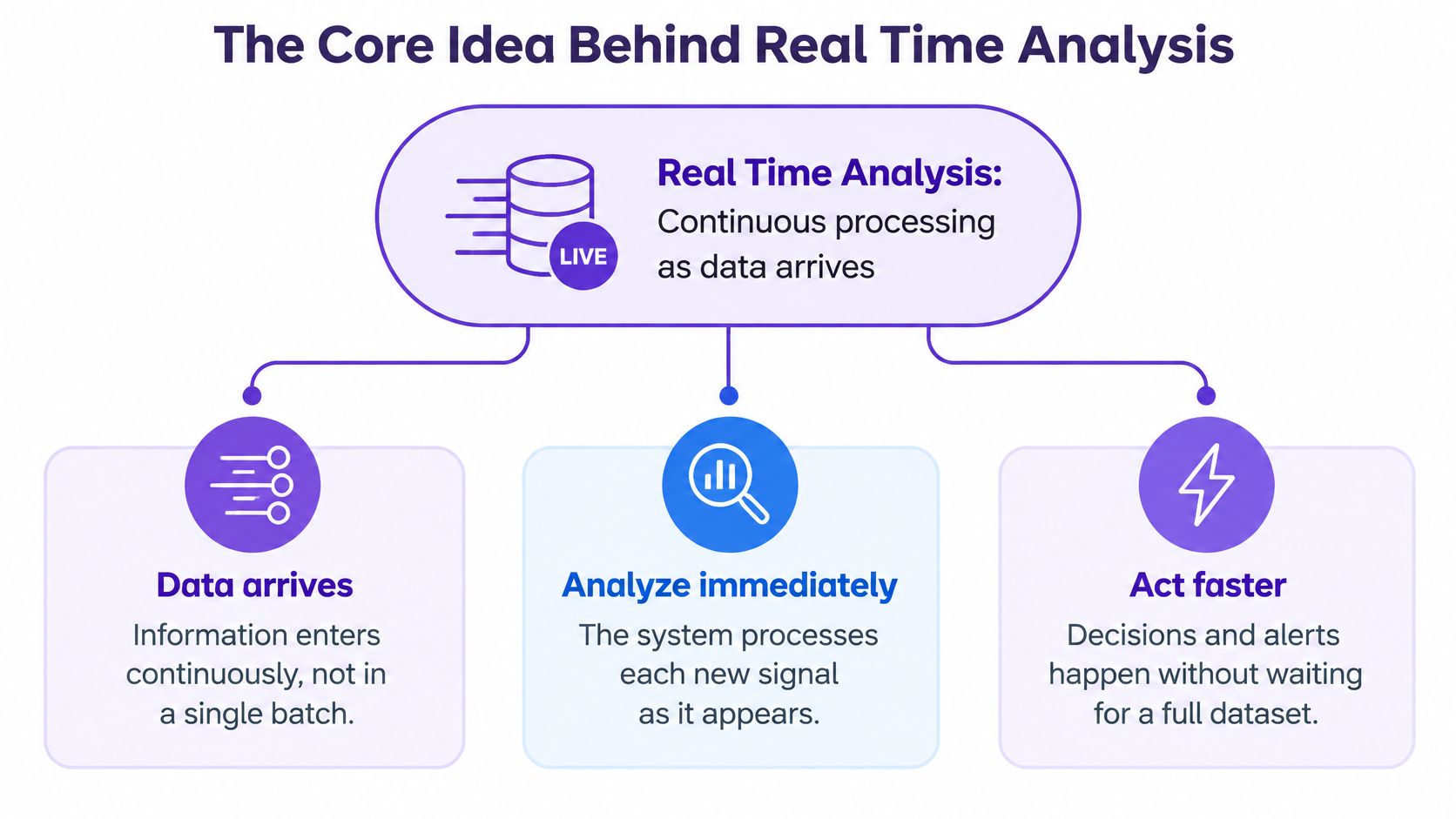
Start with the simplest version. Batch processing is like developing film after the day is over. You collect everything, wait, then look at it all at once. Real time analysis is like a security camera feed. You watch events as they happen and respond while they're still relevant.
That analogy captures the formal definition. Academic literature on data streams describes a data stream as data produced incrementally over time, often as an unbounded flow that can't be fully stored and whose arrival rate and order you can't control. You don't get to say, hold on, let me gather everything first. The data keeps coming, so the system has to evaluate it continuously.
Continuous Queries Instead of One Time Jobs
In conventional reporting, someone runs a question against stored data and gets an answer about the past. A real time system works differently. It runs processing operators and continuous queries that sit in the flow, evaluating each new event as it arrives instead of treating every analysis as a fresh, one time task.
The objective stays constant across fields. Turn incoming events into useful results immediately or with a very short delay. That's why the same principle shows up in such different places:
- Stock market monitoring: Prices move continuously, and a signal that arrives late describes a market that no longer exists.
- Patient monitoring: Clinicians need readings evaluated as they're generated, not summarized tomorrow.
- Traffic analysis and fraud detection: Patterns only matter if someone can intervene while they're forming.
- Content verification: A verdict on an image helps only if it returns before you publish, approve, or share it.
Why the Full Path Counts
Here's where readers often get confused. They assume the speed of the model is the speed of the system. It isn't. The measure that matters is end to end latency, the interval from when an event is generated at its source to when the output reaches its destination.
For image verification, that means the whole journey counts. Upload, ingestion, model inference, and delivery of the confidence score all take time. Quoting only the model's internal computation is like timing a flight by counting just the minutes at cruising altitude. It ignores everything the passenger experiences.
Practical rule: If a tool reports only model time, you're not seeing the latency your users feel.
Hold onto that framing. Everything about architecture, budgets, and trade offs builds on measuring the complete path.
Streaming Architecture and the Latency Trade-Off
A photo can reach a verification service while many other uploads are arriving. The system must decide whether to begin work on each image immediately or briefly group incoming tasks to use its computing capacity more efficiently. That choice affects two measures: latency, the time one event takes to produce an output, and throughput, the volume the system can process over time. The placement of work also matters, as these server-side processing choices affect both response time and capacity.
Record at a Time Versus Micro Batch
Record-at-a-time systems start on each event as it arrives, which can reduce waiting. Micro-batch systems collect events for a short interval before processing them together. Grouping can use resources more efficiently and simplify retries, but each event waits for its group to form.
| Design | Latency Behavior | Throughput Behavior | Fault Tolerance |
|---|---|---|---|
| Record at a time | Processing starts on arrival | Less work can be shared across events | Recovery may require handling partially processed events |
| Micro batch | Includes time spent waiting for a group | Work can be shared across events | A failed group can be retried together |
Neither design is automatically better. Marketing teams deciding how to personalize ads in real time face a similar trade-off: a recommendation can lose its value if it arrives after the customer has moved on. For image verification, the better fit depends on the deadline, upload volume, and consequences of a delayed or mistaken result.
What the Benchmarks Actually Show
Millisecond-scale benchmark results describe particular systems and test conditions, not a general promise of real-time performance. Without a clearly identified system, workload, and test setup, a precise figure cannot tell you what response time to expect from an image verification workflow.
The useful comparison is between processing speed and the quality of the decision it supports. A rapid score can help prioritize an image for review, but it does not establish where the image came from or whether its history is trustworthy. Treat an instant verdict as triage, not proof. When the stakes call for confidence in origin and handling, a slower workflow backed by provenance may be the more reliable choice.
Message brokers such as Kafka separate systems that produce events from those that process them. Partitioning lets work run in parallel, while incremental processing avoids rescanning all prior data. For an image detector, this architecture can help deliver a result quickly during upload surges. Speed alone is not enough: the result must arrive in time to guide a decision and be reliable enough for that decision.
How Real Time Analysis Works in an Image Verification Workflow
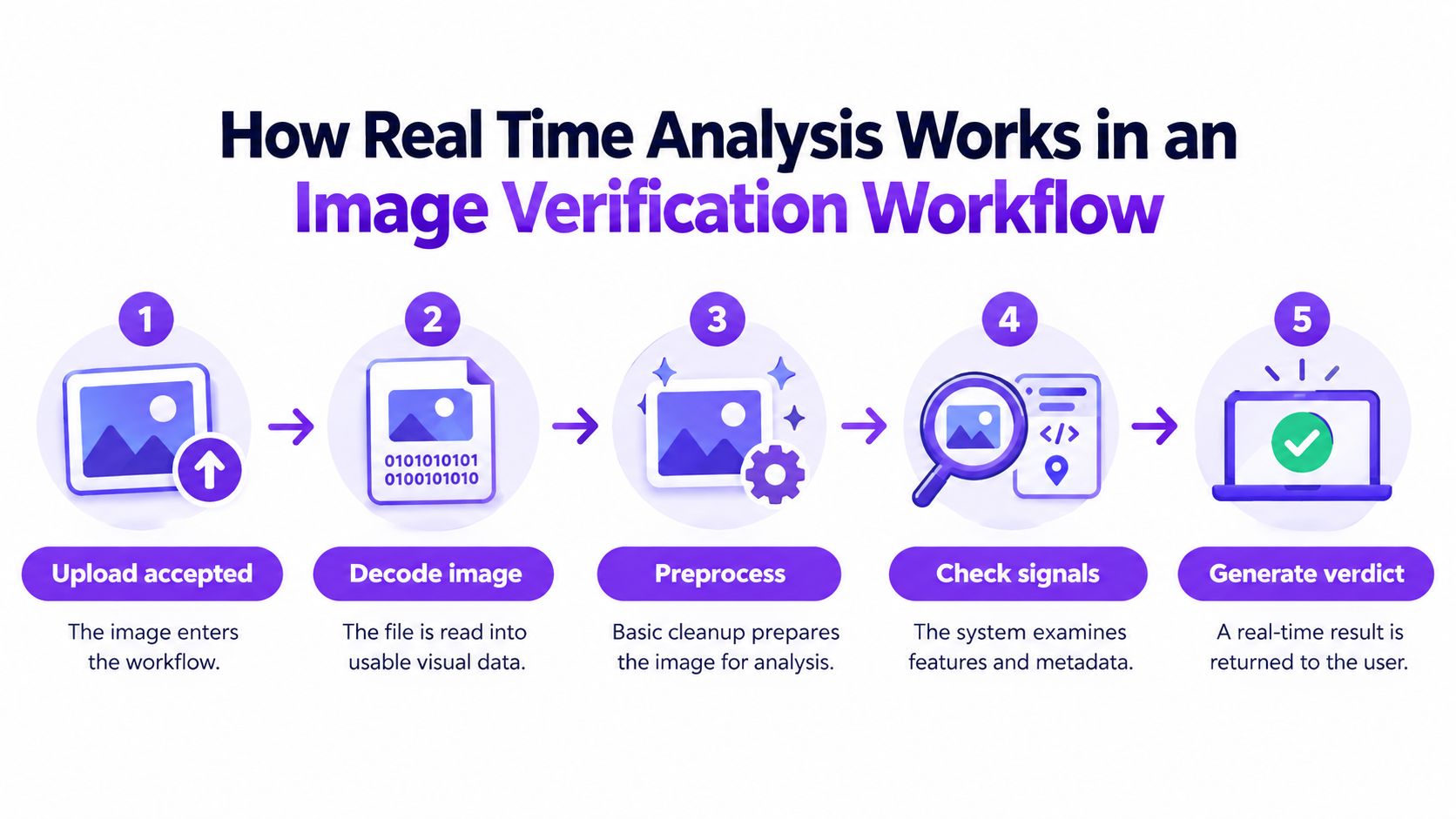
Follow one photo from the moment you drop it into a verification tool. What feels like a single action is a chain of stages, and each one spends part of your time budget.
The Stages Your Image Passes Through
- Upload acceptance: The system receives the file and confirms it can be handled.
- Decoding: The compressed file is read into usable visual data.
- Preprocessing: The image is prepared for analysis, which may include resizing or normalization.
- Model inference: The detector evaluates visual signals and patterns.
- Post processing and delivery: Raw output becomes a verdict, a confidence score, and an explanation you can read.
An old engineering distinction earns its keep here. NIST guidance on real time communication emphasizes that guaranteed latency, rather than efficiency alone, is the decisive measure of a real time system. A pipeline that's cheap to run but unpredictable in timing hasn't met the requirement. The deadline is the requirement.
Budgets, Percentiles, and Honest Targets
Smart teams assign a latency budget to each stage rather than hoping the total works out. They also measure performance with percentiles, tracking median, p95, and p99 response latency instead of relying on averages. Averages hide the painful cases. The oversized file, the cold start, the moment fifty people upload at once. Those slow outliers are exactly what your users remember.
Your average response time describes a user who may not exist. Your p99 describes the one who's about to complain.
Budgets force practical decisions. Teams enforce file size and format limits so decoding stays predictable. They use asynchronous queues only where waiting won't break the user facing deadline. They return confidence plus uncertainty indicators in the same transaction, so you don't get a verdict now and its caveats later.
Context also changes what real time means here. Images increasingly arrive after rounds of enhancement through tools like those covered in AI-assisted photo editing for Mac, so preprocessing has to handle files that have already been transformed before analysis begins. A journalist checking a photo before publication can treat a few seconds as functional real time. An automated moderation pipeline making decisions at platform scale may need millisecond responses. Same workflow shape, very different budgets.
Real Time Analysis Compared with Batch and Provenance Approaches
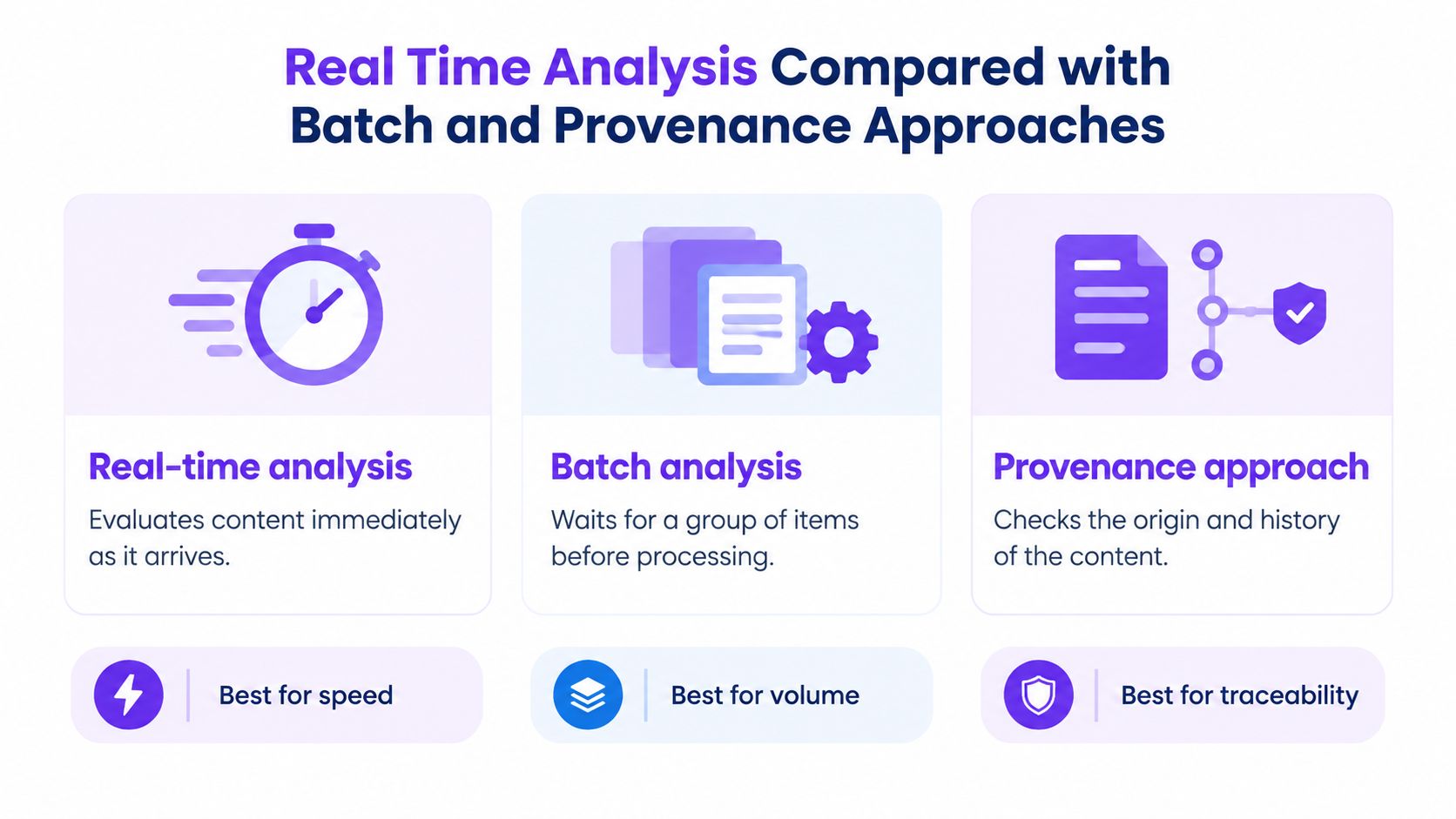
There are three ways to get an answer about a piece of content, and they don't answer the same question. Confusing them is the most expensive mistake you can make with a fast tool.
Three Approaches, Three Different Questions
Real time analysis evaluates content as it arrives and answers what the model currently infers. Batch processing accumulates items and analyzes them together later, which suits volume and retrospective review, and teams handling archives often rely on batch image processing workflows for exactly that reason. Provenance systems such as C2PA record tamper evident creation and editing history, answering what the verified chain of custody is.
That distinction is the heart of the matter. Coverage of the rise of real time analytics makes the point that faster isn't always better, because cutting latency demands more compute, networking, storage, and operational complexity, while distributed systems may sacrifice consistency or tolerate events arriving out of order. Speed is a purchase, not a free upgrade.
There's a deeper fragility too. Forensic detection reads visual signals in the file in front of it. Those signals can weaken or disappear after resizing, compression, screenshots, or human editing. Provenance metadata, when it exists and survives, carries history that pixels alone can't reconstruct.
Choosing Based on Stakes, Not Speed
Ask these questions before you pick an approach:
- What happens if you're wrong: A mislabeled classroom exercise and a mislabeled news photo carry very different costs.
- How reversible is the decision: Flagging content for review is reversible. Publishing or accusing someone often isn't.
- Is corroboration available: If provenance records, originals, or witnesses exist, a fast score shouldn't be your only evidence.
A result delivered in seconds is useful for newsroom triage, classroom screening, or marketplace moderation. It tells you where to look first. It doesn't constitute definitive proof of origin, and treating it as proof is where good tools get blamed for bad process. When consequences are high, a slower provenance backed workflow can be the more reliable choice, even though it feels like a step backward in speed.
The Limits of Instant Answers and the Problem of Concept Drift
Here's an assumption worth challenging directly. If a system answers in seconds and sounds confident, the answer must be current and trustworthy. Often, it isn't.
When the World Changes Faster Than the Model
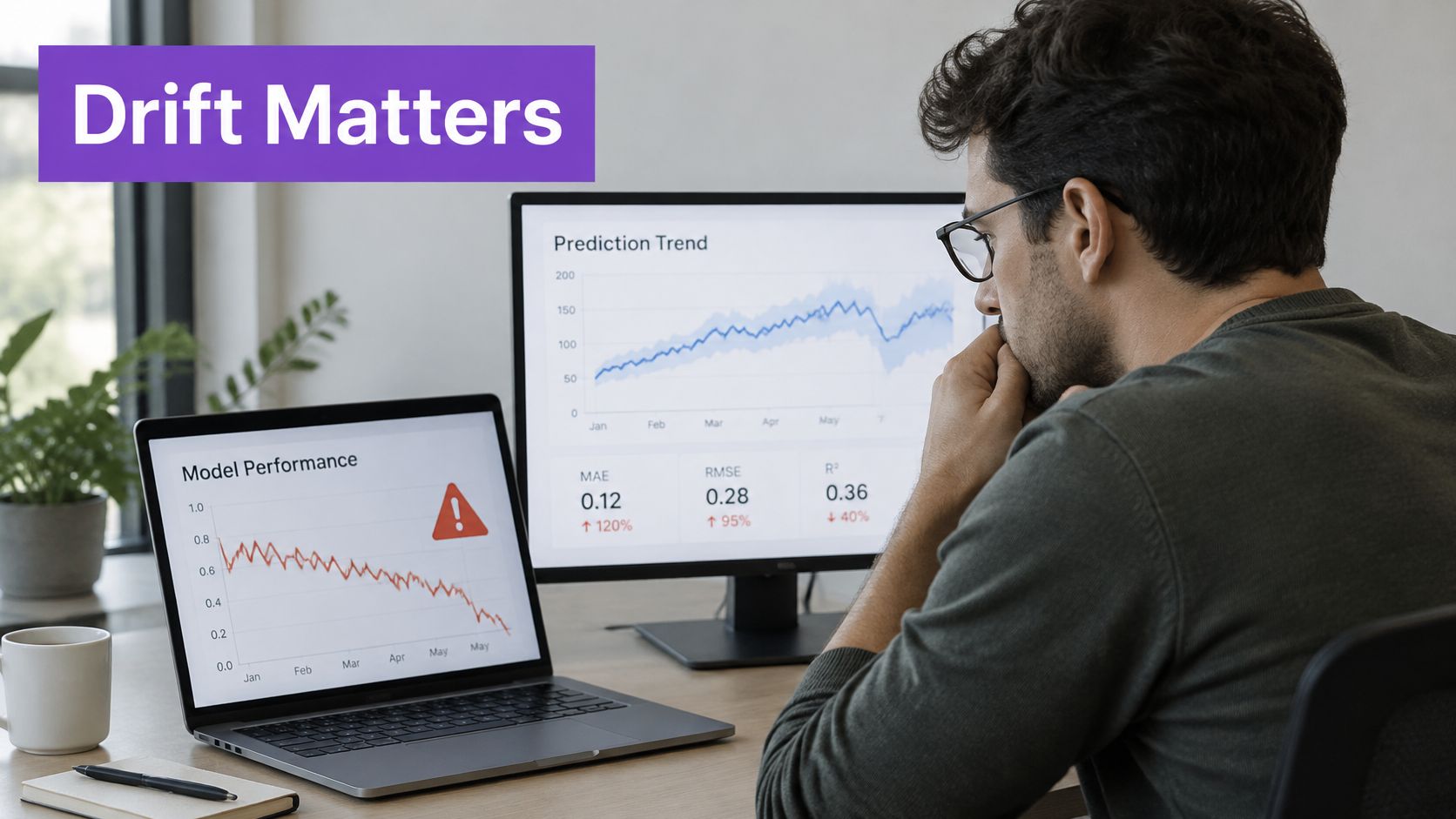
Concept drift means the underlying phenomenon shifts while the model stays still. AI image detection is unusually exposed to this. New generators appear, editing tools evolve, compression patterns change, and hybrid human AI workflows blur the categories entirely. The evidence available to a detector changes under its feet.
Human judgment shows the same strain. Research on identifying AI generated images found that people correctly identified AI generated images in 63.7% of cases overall, but only 29% for images produced by FLUX.1-dev, with below chance discrimination reported for that model. Confidence, in other words, can point in exactly the wrong direction. That's why ongoing AI monitoring practices matter as much as the detector itself, since performance has to be watched continuously rather than assumed.
Detectors aren't immune either. Benchmark results in that same research area show advanced detectors with high controlled test accuracy experiencing significant performance drops on real world data. The gap between the lab and your inbox is where drift lives.
Immediate processing doesn't mean real time adaptation. A system can answer in seconds using stale knowledge.
The practical responses are unglamorous but effective. Present a confidence range and explanatory signals instead of a single bold number. Distinguish likely AI from verified provenance in plain language. Monitor performance separately by generator and edit type, so weakness in one category doesn't hide inside a healthy average. Route ambiguous cases to human review instead of forcing a verdict.
The video below walks through how detection reasoning works in practice, which is worth watching before you decide how much weight a single score should carry in your workflow.
The direction of travel is clear. One shot detector claims are giving way to layered verification that combines forensic signals, provenance metadata, and calibrated human judgment. Each layer covers a failure mode the others miss.
Putting Real Time Analysis to Work in Your Workflow
You now have the pieces. Real time means continuous processing within a delay your task can tolerate. Latency is measured end to end, budgeted stage by stage, and reported in percentiles. Speed trades against decision quality, and drift means today's confident model can become tomorrow's liability.
A Checklist for Any Tool You Evaluate
- End to end honesty: Does it report full time to verdict, or only model computation time?
- Uncertainty on display: Does the result include confidence and failure conditions, or just a label?
- Performance by category: Is accuracy tracked across generators, formats, and edit types, or only as one blended score?
- Escalation path: Are ambiguous cases routed to human review, or forced into a yes or no?
- Behavior under load: What happens during bursts, and does the system degrade gracefully instead of guessing?
Apply those questions to your own setting. In a newsroom, that might mean using a fast score to prioritize which images get full verification before deadline. In a classroom, it might mean screening submissions quickly, then talking with students rather than treating a score as an accusation. In a marketplace, it might mean auto flagging suspicious listings for a moderator instead of auto removing sellers.
Working principle: Use real time analysis to decide where your attention goes first. Use corroboration to decide what you conclude.
That's the honest summary of what is real time analysis in practice. It's a powerful triage instrument that buys you time and focus when both are scarce. It isn't a verdict machine, and the workflows that hold up under scrutiny are the ones that pair a fast first pass with slower evidence whenever the stakes justify the wait.
When you need that fast first pass on an image, AI Image Detector analyzes uploads in real time and returns a confidence score with explanatory reasoning in seconds, without storing your images. Use it to triage what deserves deeper verification, then escalate the high stakes cases for corroboration. Visit the site, drop in an image you're unsure about, and see how a seconds level verdict fits into your own decision process.
