

Artist Copyright Protection: A Practical Playbook

You post a finished illustration online, wake up to a promising number of shares, and then find the same image on an unrelated merchandise store. The seller has removed your name, cropped your signature, and may be using the artwork to train or promote an AI system. You know the work is yours, but knowing that and proving it are different problems.
Artist copyright protection works best as an operating system for your creative business, not as a notice you add after something goes wrong. You need a record of creation, a registration strategy, sensible contracts, monitoring habits, and an escalation plan that matches the value and visibility of each infringement.
Understanding the Foundations of Artist Copyright Protection
You sell a painting, post an illustration, or deliver a design file, and two different things may change hands: the physical object and the rights to reproduce the work. Artist copyright protection starts with identifying what you retained. Copyright protects original creative expression fixed in tangible or digital form, including an illustration, painting, photograph, sculpture, design file, animation, or other completed work. It does not protect a general idea, subject, artistic concept, or broad style by itself.
That distinction controls your next business decision. If you sell a physical painting, the buyer may own that particular canvas while you retain copyright in the image. You may still control reproductions, print licenses, merchandise, digital publication, and adaptations. The sale of an object does not automatically transfer reproduction rights. Your contract must state the transfer if that is what you intend.
Practical rule: Treat every original file, working sketch, final export, and commissioned deliverable as both a creative asset and a business asset. Keep the files, versions, delivery records, and agreed usage terms together.
The United States generally recognizes copyright automatically when an eligible work is fixed. You do not wait for a certificate for the copyright to exist. Automatic protection still leaves operational gaps. It does not identify the final version, document every permission, find unauthorized copies, or guarantee access to the remedies you may want in court. Platform terms of service can also grant platforms specific licenses or set the process for reporting disputed uses, so read those terms before posting valuable work. For a deeper explanation of ownership records and enforcement, see this guide to protecting intellectual property rights.
What your rights cover
Economic rights usually drive daily decisions. They cover important uses such as copying, distribution, public display, public performance where relevant, and adaptations. A client who buys a logo file has not automatically bought unlimited permission to reproduce it on products, sublicense it to partners, or alter it beyond the agreed brief. Define the permitted channels, duration, territory, and modifications in writing.
Moral rights address attribution and the integrity of certain works, but their scope varies by jurisdiction and type of work. A copyright assignment does not answer every question about credit, alteration, or removal of your name. Put those expectations into the agreement before delivery, then keep the signed version with the project archive.
Copyright rules have developed alongside the ways art is copied and distributed. The U.S. Copyright Office copyright timeline identifies the U.S. Copyright Act of 1976 as a major revision signed on October 19, 1976, effective January 1, 1978, and the first major revision since 1909. The WIPO Copyright Treaty and WIPO Performances and Phonograms Treaty were agreed in 1996 and entered into force in 2002, giving creators stronger tools against unauthorized use on digital networks.
What automatic protection leaves exposed
Automatic copyright does not tell you which file was final, when you created it, what rights a client received, or whether an online copy has been altered. It also does not resolve every AI-related dispute. AI scraping may feed training systems, while a generated image may imitate elements of your work or a recognizable visual identity without copying one identifiable file. Treat those cases as evidence and legal analysis problems, not automatic infringement claims. Save prompts, outputs, platform notices, and terms of service when they are relevant.
The problem supports a regular monitoring routine. In a Pew survey of 2,793 musicians, songwriters, and music publishers, 61% said current copyright laws did a good job protecting artists' rights, while 59% said those laws did more to protect people who sell art than artists themselves. The same survey found that 50% would be bothered if someone put a digital copy of their music online without permission. See the Pew survey of musicians and music publishers for the underlying findings.
Your work may be protected automatically. Enforceable ownership in practice requires clear rights, reliable records, platform-aware terms, and a process for finding and challenging unauthorized use.
Securing Your Work Through Registration and Preventative Measures
Registration is the step that converts a vague ownership claim into stronger litigation strength in the United States. Copyright exists at fixation, but timely registration is required to sue over U.S. works in federal court and to preserve access to statutory damages and attorney's fees. Registration completed within three months of first publication or before infringement provides the strongest position described by the Copyright Office guidance.
Registration within five years of publication can also create prima facie evidence of validity, which improves your position when the other side disputes authorship or ownership. These rules make timing operationally important. Waiting until a stolen work attracts attention can leave you with a valid copyright but weaker access to remedies.
Use a repeatable filing workflow
Create a fixed copy first. Preserve the final file, a representative deposit copy, and the records that show how the work developed. Then file the application, pay the required fee, submit the deposit, and retain the application and registration records in an organized archive.
The U.S. Copyright Office guide for musicians describes the same practical sequence and explains that copyright is automatic at fixation, while registration serves as the gatekeeper for important U.S. court remedies. Registration isn't required for every enforcement step, including some takedown notices, but a notice alone won't replace the legal advantages of registration.
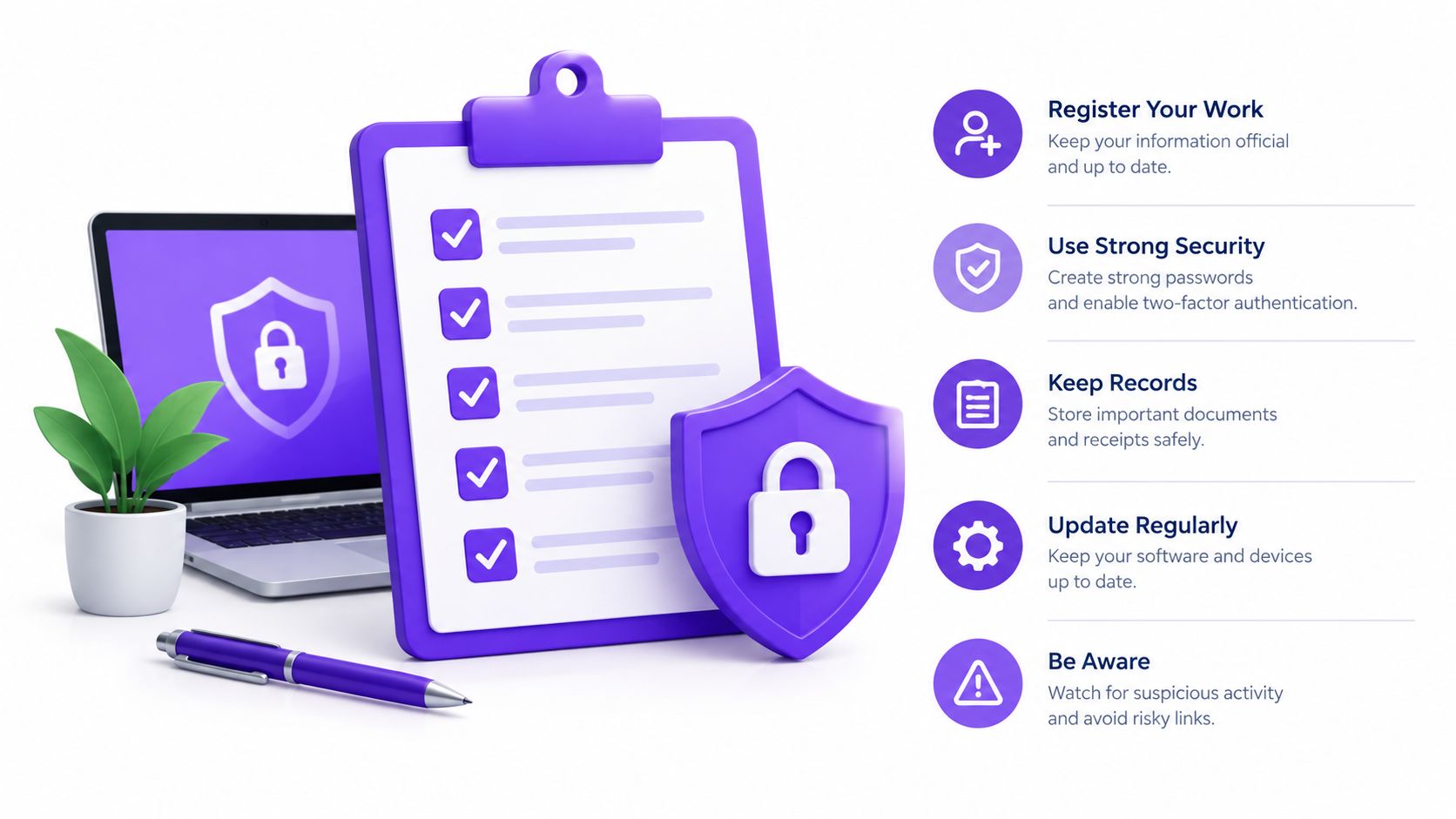
Don't register blindly. Group works in a way that matches the applicable registration rules, keep the title and creation information consistent, and ask an attorney about complex collections, commissioned work, collaborations, or works with unclear ownership.
Build evidence before publishing
Your archive should answer five questions without requiring you to reconstruct your process under pressure:
- Who created it: Keep sketches, source files, drafts, project notes, and correspondence that identify your role.
- When it existed: Preserve dated exports, file history, invoices, and delivery records.
- What was delivered: Store the exact version sent to a client, gallery, publisher, or platform.
- What rights were granted: Keep signed contracts, licenses, invoices, and email changes together.
- Where it appeared: Record your original URLs, publication dates, and authorized outlets.
Metadata helps, but it isn't a substitute for registration or a signed agreement. Add your name, copyright notice, creation year, and usage restrictions where appropriate. Use a visible watermark for public previews, and consider invisible watermarking or other provenance methods for files that need to remain visually clean. The guide to how watermarks are made can help you choose a method that fits your publishing workflow.
Your contract should state whether the client receives a license or an assignment, which media and territories are covered, whether sublicensing is allowed, and whether you can display the work in your portfolio. It should also address modifications, credit, exclusivity, payment milestones, and what happens when the client asks for uses outside the original scope.
For a practical overview of registration, ownership, licensing, and enforcement issues in a business setting, review Coto & Waddington startup IP and adapt the principles with advice for your jurisdiction and type of work.
Use the video below as a supplementary visual explanation, not as a replacement for reviewing the applicable registration rules or your contract.
The central decision is straightforward. Register commercially important work early, preserve the creation trail, and make every client relationship produce a clear rights record.
Monitoring the Web for Unauthorized Use and AI Generation
You can't enforce a right you haven't detected being violated. Monitoring doesn't require constant searching, but it does require a defined routine that looks for direct copies, altered versions, merchandise listings, reposts, and suspicious synthetic images.
A useful workflow starts with a controlled reference library. Keep the original high-resolution file, a public preview, distinctive crops, the title, your name, and the URLs where you authorized publication. Those references make searches faster and help you distinguish a genuine match from a merely similar image.
Search for copies and altered versions
Run reverse-image searches against your most commercially valuable work. Search both the full image and unusual crops, because infringers often remove signatures, change the background, mirror the image, or place it on a product. The reverse image search SEO guide provides useful background on how image matching can support discovery and indexing analysis.
Set alerts for your artist name, studio name, collection names, and distinctive titles. Search marketplaces where your work could be printed or resold, social platforms where reposting is common, and image results that omit your attribution. Ask trusted followers to report suspicious uses, but route every report into one evidence folder rather than handling it informally in scattered messages.
When you find a match, capture the full page, seller identity, product description, displayed image, URL, date, and any evidence of commercial use. Save the page as a PDF or screenshot and download a copy where lawful. Record whether the use is exact, modified, licensed, attributed, or merely similar.
Treat AI detection as evidence, not a verdict
AI detection tools can help assess whether an image presented as your work is likely synthetic, especially when someone claims to have created it manually. A confidence score is an investigative signal. It isn't, by itself, proof that a particular person copied your work, trained a model on your files, or violated a specific copyright.
Use detection alongside reverse-image matching, file history, platform records, and your own creation archive. A suspected AI-generated image that resembles your visual identity may raise a serious business or impersonation concern, but copyright analysis still depends on the image, the conduct, the jurisdiction, the contract, and the available evidence.
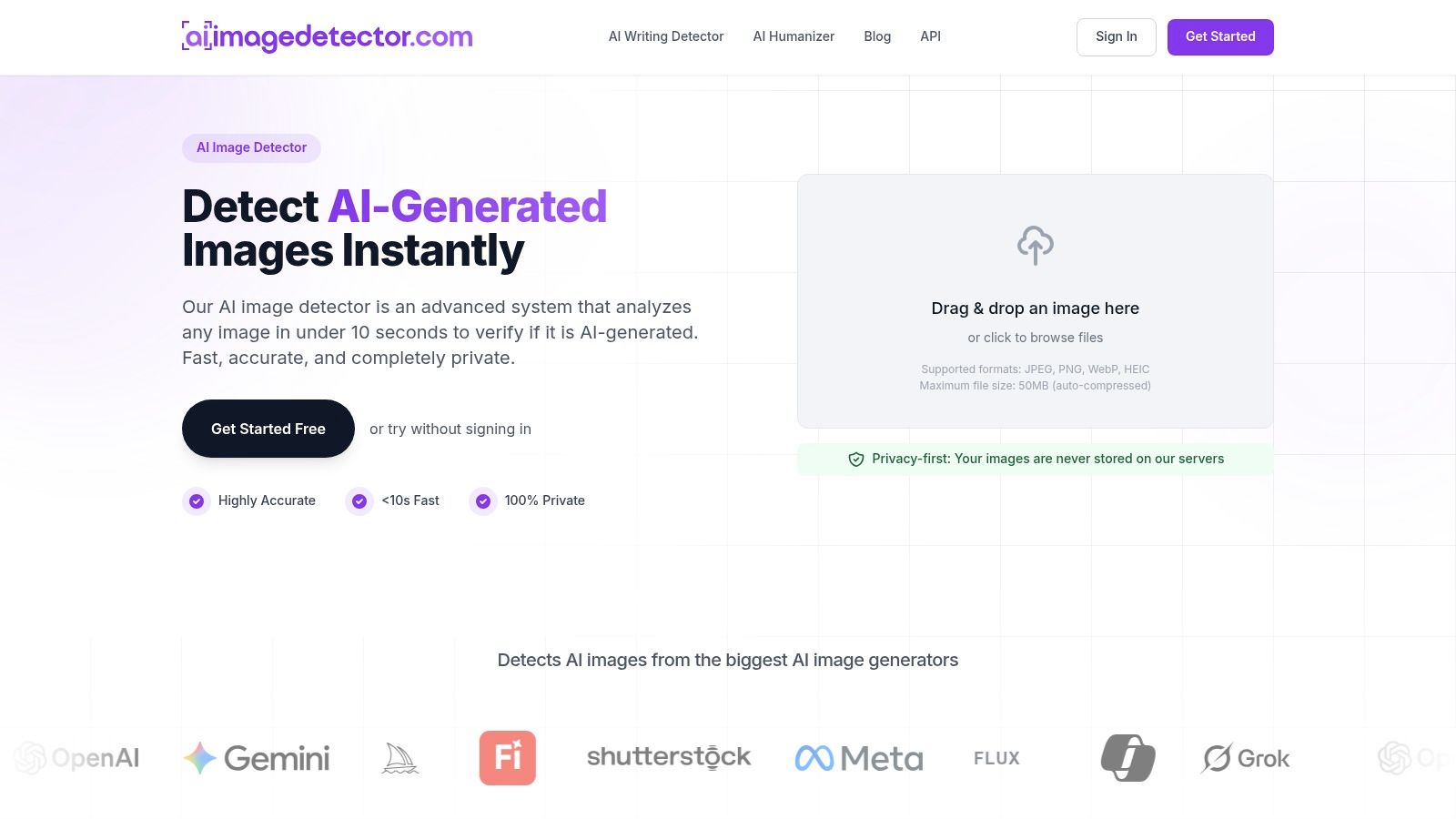
Prioritize cases instead of reacting to every repost. Start with paid products, advertising, impersonation, high-visibility accounts, repeated commercial use, and copies that could confuse customers. For broader brand monitoring, guidance on how to track citations in AI answers is relevant because creators increasingly need to understand how their names and work appear in machine-generated results as well as ordinary search.
The goal isn't to prove every suspicious image immediately. The goal is to create a defensible record, identify the highest-impact violations, and move quickly while the relevant page and account evidence remains available.
Enforcing Your Rights and Handling Infringement
Finding infringement is the beginning of a decision, not the end of one. Preserve evidence before contacting the other party. A seller may remove the page after receiving your message, and a platform may change the listing or account details. Capture the original state first.
Choose the response based on the use, the evidence, the location of the service provider, and the remedy you want. A polite request can resolve an accidental repost. It isn't the right tool for a business selling unauthorized prints after being told to stop.
Compare the escalation options
| Action Type | Estimated Cost | Time to Resolution | Best Used For |
|---|---|---|---|
| Direct permission request or licensing proposal | Low, mostly your time | Often short if the user cooperates | Accidental reposts, attribution errors, and potentially licensable uses |
| Platform or host takedown notice | Low to moderate, depending on preparation | Variable and controlled by the platform or host | Clear online copies where removal matters more than compensation |
| Cease-and-desist letter | Moderate, especially with counsel | Variable | Repeated use, commercial exploitation, or a party ignoring informal contact |
| Negotiated settlement or license | Variable | Variable | Uses where payment, continued licensing, or a written release is commercially sensible |
| Copyright Claims Board or comparable lower-value process | Variable | Variable | Eligible disputes where a formal claim is justified but full federal litigation is disproportionate |
| Federal litigation | High and highly case-specific | Potentially lengthy | Serious commercial harm, strategic precedent, or claims requiring court remedies |
A direct message should identify the work, show your original publication or registration record, identify the unauthorized use, state what you want, and set a clear response date. Don't make unsupported accusations about criminal conduct, demand facts you can't prove, or grant a retroactive license accidentally through careless wording.
Use takedowns carefully
A DMCA notice generally works best when the copied material is hosted by a service that accepts valid copyright complaints. Identify the protected work, provide the infringing location, explain your good-faith belief that the use isn't authorized, provide accurate contact information, and complete the required declarations. The platform may remove the material, seek more information, or notify the uploader.
A counter-notice can return the material to the platform under the applicable process. If that happens, don't treat the counter-notice as proof that the other party is right. Review the evidence and decide whether a negotiated resolution, counsel letter, or court action is justified.
Reverse-image evidence helps you locate and compare copies. The practical overview on using reverse image search for IP is a useful reference for organizing that discovery stage.
Escalation rule: Send a takedown when removal is the priority. Consult counsel when the use is commercial, repeated, strategically important, or likely to produce a counterclaim.
Jurisdiction matters. The platform, host, uploader, client, and artist may all be in different countries, and a notice that works against one service may not resolve the underlying commercial activity elsewhere. If the work is registered, the infringer is identifiable, and the use has meaningful commercial consequences, an intellectual property attorney can assess remedies before you make an avoidable concession.
Navigating AI Tools and Proactive Portfolio Management
The common advice that “AI-generated images aren't copyrightable” is incomplete. The better question is which parts of the final work reflect human authorship and which parts came from the system without sufficient human creative control.
The U.S. Copyright Office guidance says copyright may cover human-authored elements of a mixed work, including creative selection, arrangement, or substantial modification, while excluding the AI-generated material itself. That creates a boundary problem for artists who use generative tools for ideation, texture, cleanup, compositing, or editing. Your protection may attach to your human decisions and modifications, not automatically to every pixel in the final output.
Document the human contribution
Keep prompts, source images, layered files, masks, sketches, edits, compositing stages, and notes explaining your creative decisions. Preserve the version before AI assistance, the generated material used, and the final human-edited composition. Your records should show what you selected, changed, arranged, rejected, and authored.
Don't describe a mixed work as entirely hand-created if that isn't accurate. A precise creation record is more credible than an exaggerated claim, especially when a client, platform, registry, or court asks how the image was made.
Read the tool's contract before uploading
Platform terms may affect your rights even when copyright law doesn't. Harvard Law's comparative analysis notes that many AI image tools require users to grant irrevocable copyright licenses covering inputs and outputs, while congressional research recognizes that there is still no clear rule identifying who the author or authors of AI-created works may be. Review the comparative analysis of copyright registration for AI-generated works before placing confidential commissions, unreleased collections, or client-owned assets into a tool.
Look for rights to train on uploads, reuse outputs, sublicense content, retain files, and use material for marketing. Check whether the tool promises exclusivity, restricts commercial use, or shifts responsibility for third-party claims to you. If the terms are unacceptable, don't upload the work merely because the tool is convenient.
Your public portfolio also deserves a risk review. Publish web-sized previews, keep original files offline or in controlled storage, add provenance information where useful, and avoid uploading unreleased client material to services with unclear retention policies. A documented chain of creation won't solve every AI dispute, but it gives you a stronger factual position than automatic protection alone.
Building a Sustainable Copyright Strategy
Copyright management becomes sustainable when you attach it to the same moments you already use to run your studio. Finish a work, archive it. Prepare a public release, create the approved preview. Sign a client agreement, define the rights. Discover unauthorized use, preserve evidence before responding.
The system should be simple enough to use during a busy launch. Create one record for every important work with the title, creator, collaborators, creation history, final file, approved preview, publication locations, contract, license terms, registration status, and known enforcement events.
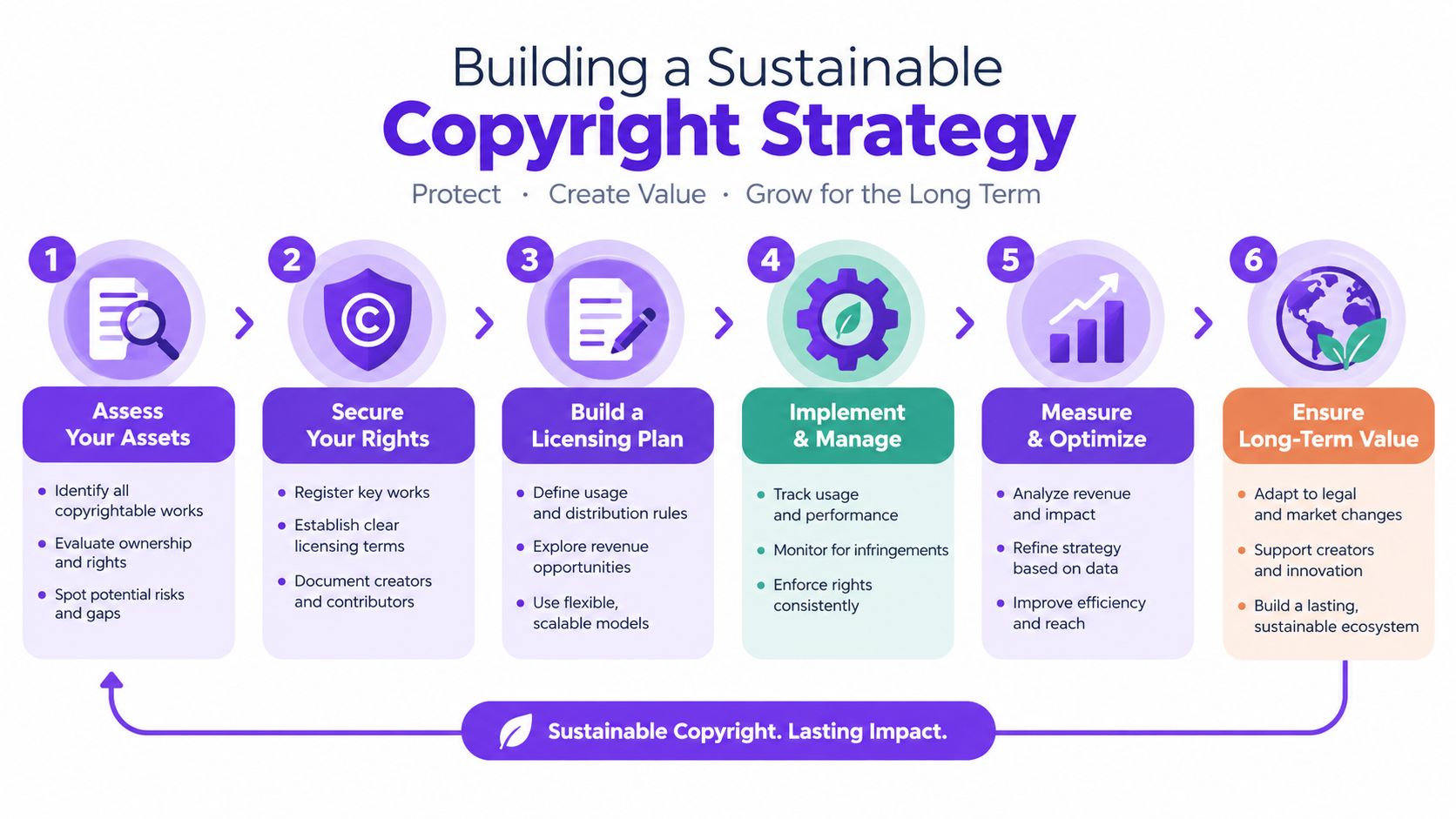
Apply the same six-part routine
- Create and preserve: Save the source files, drafts, exports, and notes that show how the work developed.
- Define ownership: Confirm whether you, a client, a collaborator, or an employer owns the work and what the contract grants.
- Prepare the release: Choose the resolution, watermark approach, metadata, attribution, and approved channels.
- Register strategically: Prioritize commercially important collections and works whose unauthorized use would cause serious harm.
- Monitor deliberately: Search valuable works, artist names, distinctive titles, marketplaces, and suspicious synthetic images.
- Enforce proportionately: Use a request, takedown, license negotiation, counsel letter, or formal claim according to the evidence and commercial stakes.
Batch administrative work instead of letting it accumulate. Set a recurring portfolio review for new work, a regular search session for high-risk pieces, and an annual contract audit for platforms, clients, galleries, and AI tools. The exact schedule should reflect how often you publish and how exposed your work is, but it must be scheduled rather than left to memory.
Your strategy should also change as your business changes. A personal portfolio may need clear attribution and evidence preservation. A licensing business needs stronger contract controls. A studio working with assistants needs written assignments and contribution records. An artist selling digital products needs a monitoring process that includes marketplaces and reseller pages.
The purpose isn't to make sharing impossible. Strong artist copyright protection lets you publish with clearer boundaries, negotiate licenses confidently, and decide when a use deserves payment rather than panic. Your records turn creative work into an asset you can manage, license, and defend.
AI Image Detector offers image analysis that helps assess whether suspicious artwork is likely AI-generated or human-created, with a confidence score and explanatory verdict. Use it as one evidence-gathering step alongside source files, reverse-image searches, contracts, and registration records, then visit AI Image Detector to support your copyright monitoring workflow.
