

Protecting Intellectual Property Rights Your Guide to Securing Creative Assets

Protecting your intellectual property is all about legally safeguarding your creations—the things that make your work unique. Think about your inventions, brand name, artistic works, or even your secret recipes. It’s the process that transforms those brilliant ideas into exclusive, defensible assets, giving you the power to control how they're used and who profits from them.
Why Protecting Intellectual Property Is a Smart Business Move
Imagine spending years developing a groundbreaking product, building a brand people love, or writing a novel, only to watch someone else swoop in and cash in on your hard work. It’s not just frustrating; it’s a direct hit to your bottom line and competitive standing.
This is where intellectual property rights come in. It’s not about building a legal fortress just for the sake of it. It’s about laying a solid foundation that lets your business grow and innovate without fear of your best ideas being stolen.
Think of it this way: an unprotected idea is like a treasure chest left wide open. Anyone can walk by and take what’s inside. When you secure the right IP protections, you’re essentially putting a lock on that chest and holding the only key.
Securing Your Competitive Edge
Getting your IP protection right is one of the smartest things you can do to carve out your space in the market. It gives you the ability to:
- Prevent Imitation: You can legally stop competitors from ripping off your products, services, or branding. This keeps your market share safe.
- Drive Innovation: When you have exclusive rights to an invention, it creates a powerful incentive to keep investing in research and development.
- Build Brand Value: A registered trademark is more than just a logo. It becomes a symbol of trust and quality, making your brand instantly recognizable and far more valuable.
This isn’t just a nice-to-have; it’s becoming essential. In recent years, global IP filings have skyrocketed, with patent applications jumping 4.9% and industrial design filings rising 2.2%. This surge shows just how seriously businesses worldwide are taking IP to fuel their growth and creativity. You can learn more about these global IP filing trends.
The Four Main Types of Intellectual Property
Navigating the world of IP can feel a bit confusing at first because different types of creations require different kinds of protection. The four main categories you’ll encounter are copyrights, patents, trademarks, and trade secrets.
Here's a quick breakdown to help you tell them apart.
Quick Guide to Intellectual Property Types
| IP Type | What It Protects | Real-World Example |
|---|---|---|
| Copyright | Original creative works like books, music, art, and software code. | The manuscript of a novel, the lyrics to a song, or the photos on your website. |
| Patent | New inventions and unique processes. | A new type of solar panel, a pharmaceutical drug, or the mechanism inside a smartphone. |
| Trademark | Names, logos, and slogans that identify a brand or product. | The Nike "swoosh" logo, the name "Coca-Cola," or the tagline "Just Do It." |
| Trade Secret | Confidential business information that gives you a competitive edge. | The secret recipe for Coca-Cola, Google's search algorithm, or a client list. |
Understanding which category your work falls into is the first step toward securing the right protection. For example, if you're an author, copyright is your best friend.
For writers, getting a handle on these rights is absolutely critical. If you're looking to protect your written work, this comprehensive guide to copyrighting a book is an excellent resource to start with.
Ultimately, this guide will be your playbook for turning creative work into protected, revenue-generating assets.
Understanding the Four Pillars of Intellectual Property
When you hear “intellectual property,” it’s easy to get lost in legal jargon. So let’s cut through the noise and break it down into four distinct pillars, each designed to protect a different kind of creative or business asset. Getting a handle on these is the first real step in safeguarding your work.
Think of your intellectual property like different kinds of treasure. You wouldn't store gold coins, a secret map, a royal flag, and a machine blueprint in the same type of chest, would you? Each one needs a unique form of protection to keep its value intact.
This simple diagram lays out the four main IP types, each with its own purpose.
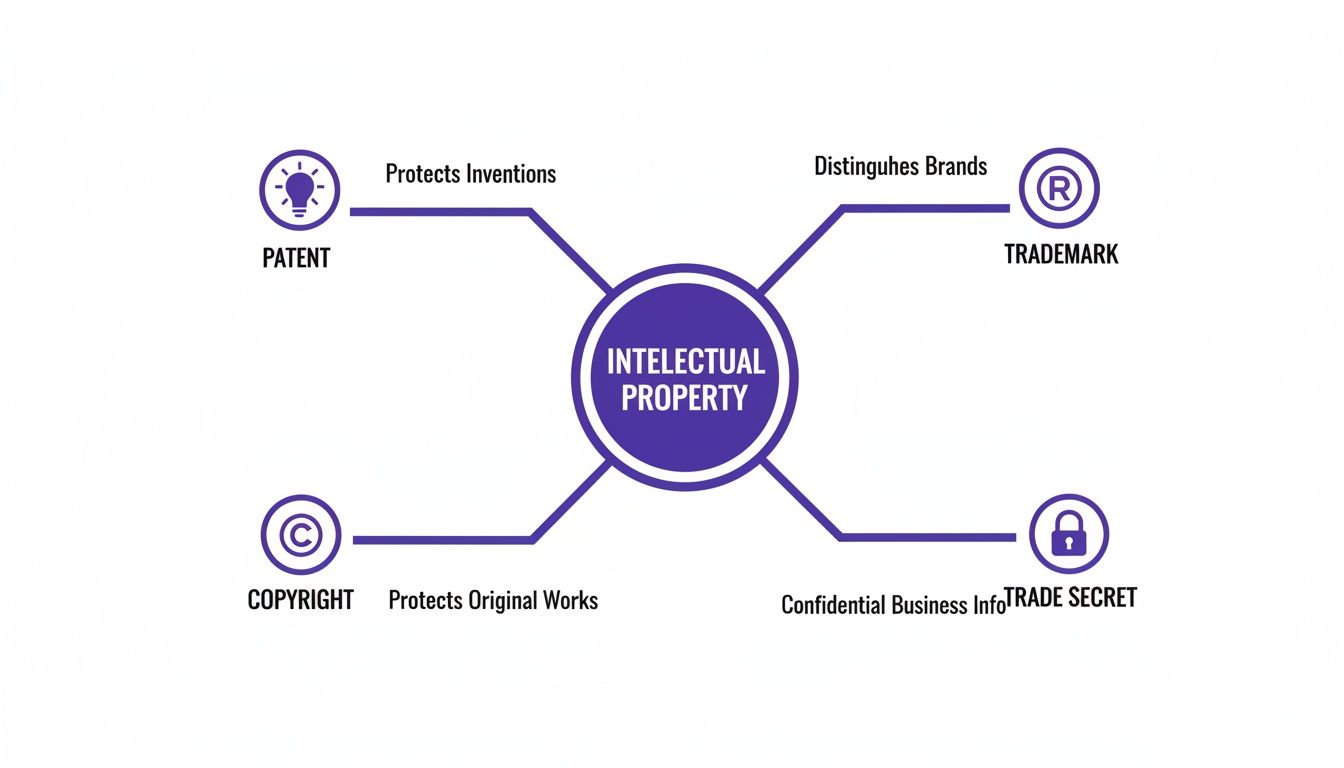
As you can see, patents, trademarks, copyrights, and trade secrets are all branches of the same tree, but each one shields a unique form of creativity or innovation.
The Blueprint: Patents
A patent is basically an exclusive blueprint for an invention. It gives the inventor the sole right to make, use, and sell their creation for a set period—usually 20 years from the day they file. This protection is for tangible inventions, new processes, or unique designs.
Take a smartphone, for example. The complex guts inside, from the user interface to the processing chips, are covered by thousands of individual patents. This stops competitors from just copying the tech and passing it off as their own. It ensures that real innovation gets rewarded, which fuels more research and development down the line.
The real power of a patent is that it protects the functional idea itself, not just how it looks or is described.
The Brand Flag: Trademarks
A trademark is your brand’s unique flag, helping it stand out in a crowded marketplace. It protects the symbols, names, and slogans that tell customers where a product or service comes from, which prevents confusion. This covers everything from brand names like Apple and logos like the Nike "swoosh" to distinctive sounds or colors.
Trademarks are all about building an association. When you see those golden arches, you instantly think of McDonald's. That immediate recognition is the power of a strong trademark. It’s a promise of quality and consistency that people learn to trust.
Unlike a patent, a trademark can last forever as long as you're actively using it and keeping up with renewal filings. For businesses operating globally, it's crucial to understand how to legally protect these brand elements in different regions. For instance, registering a trademark in the UAE involves its own specific process.
Key Takeaway: A trademark protects your brand's identity, while a patent protects your invention. It’s common to have both—a patented product sold under a trademarked name.
The Official Seal: Copyrights
A copyright acts as the official seal on your original creative works. The moment you fix a creative idea in a tangible form—like writing it down or recording it—it's automatically protected. This applies to a huge range of creations: books, music, paintings, software code, and photographs.
Copyright gives the creator exclusive rights to reproduce, distribute, perform, and display their work. It protects the specific expression of an idea, not the idea itself. For example, copyright protects the exact words and story of Harry Potter, but not the general concept of a boy wizard attending a magical school.
This protection is built to last, typically covering the creator's entire life plus another 70 years. The instant you write a blog post or snap a photo, you own the copyright. That said, formally registering it provides a public record of your ownership, which makes it much easier to defend your rights if you have to. And when working with written content, it's always smart to ensure originality; learning how to check for plagiarism in Google Docs is a great way to respect the copyrights of others.
The Secret Recipe: Trade Secrets
Finally, a trade secret is the confidential recipe locked away in a company’s vault. It's any private information that gives a business a competitive edge because it isn't publicly known. The most famous example, of course, is the formula for Coca-Cola.
A trade secret can be a recipe, a process, a customer list, or any compilation of information. Unlike the other IP types, you don't register it with a government office. Its protection lasts for as long as you can keep the information under wraps.
To be considered a trade secret, a company has to take reasonable and active steps to keep it confidential. This usually means:
- Using non-disclosure agreements (NDAs) with employees and partners.
- Implementing strong cybersecurity to prevent digital theft.
- Limiting who has access to the information internally.
If the secret gets out—whether it’s leaked or someone else figures it out independently—the protection vanishes. It’s a high-risk, high-reward way to protect what makes your business special.
Your Proactive IP Protection Playbook
Knowing the different types of intellectual property is a great start, but real security comes from taking action. The key is to shift from a reactive "what do I do now?" mindset to a proactive one. This means building a strong defense before anyone even thinks about infringing on your work, turning your IP into a well-guarded asset right from the get-go.
This proactive approach isn't just one big action; it's a series of deliberate, strategic steps. Think of it as creating a documented paper trail of ownership and putting legal safeguards in place that make potential infringers think twice. By getting ahead of the game, you establish a clear, public claim to your work that’s much easier to defend if you ever need to.
Laying the Groundwork with Due Diligence
Before you pour time and money into a new brand name, logo, or invention, you have to be sure it’s actually yours to claim. Just jumping into the market without checking first could land you in an expensive and damaging infringement battle—where you're the one on the wrong side. This is where thorough due diligence becomes your most valuable tool.
You need to conduct comprehensive searches to see if your idea is already out there. For brand names and logos, that means searching national trademark databases, like the one managed by the U.S. Patent and Trademark Office (USPTO). For inventions, it involves a deep dive into existing patent records to confirm your concept is truly new and not just an obvious next step.
This initial legwork isn't just about dodging lawsuits; it's about making sure your own IP is strong enough to stand on its own.
Implement Ironclad Confidentiality Agreements
So many brilliant ideas are born from collaboration—working with partners, contractors, and employees. But without the right protections, those crucial conversations can become a huge vulnerability. This is precisely why non-disclosure agreements (NDAs) are a cornerstone of any proactive IP defense.
An NDA is a straightforward, legally binding contract. It establishes a confidential relationship between you and anyone you share sensitive information with, explicitly stopping them from blabbing your trade secrets, business plans, or new concepts to the world.
A well-drafted NDA should clearly define what counts as "confidential information," spell out the responsibilities of the person receiving it, and state how long the confidentiality lasts. This simple document is one of the most effective tools for protecting trade secrets and unpatented ideas.
Make it a standard operating procedure to get NDAs signed before any sensitive discussions take place. It’s a simple habit that builds a culture of security and gives you crucial legal options if that trust is ever broken.
Document Everything and Assert Your Ownership
In the IP world, proof of creation is king. Keeping meticulous records of your entire creative process can be your single best piece of evidence in a dispute. Good documentation creates a verifiable timeline that proves exactly when and how your idea came to life.
Here are a few practical ways to build this evidence trail:
- Keep Dated Records: Hold onto detailed notes, sketches, and drafts, all with clear dates. Digital files are great for this, as their metadata automatically timestamps your work.
- Use Copyright Notices: While copyright protection kicks in the moment you create something, adding a formal notice (like © 2024 Your Name) to your work acts as a public "hands-off" sign. It reminds people that the work is protected and not up for grabs. To dive deeper, our guide on how to check if an image is copyrighted offers more context for visual creators.
- Formal Registration: The ultimate proactive step is to formally register your IP. For creative works, this means registering with the U.S. Copyright Office. For brands, it means filing for trademark protection. This official registration creates a public record of your claim and is a must-have if you ever need to file an infringement lawsuit in federal court.
Taking these steps transforms your intangible ideas into documented, defensible assets. Protecting your intellectual property isn't just a legal formality—it's a fundamental business strategy for securing your innovation and your place in the market. By adopting this proactive playbook, you build a fortress around your most valuable creations.
The High Cost of Unprotected Ideas
What really happens when a good idea is left out in the open? It’s not just a missed opportunity. It's a genuine threat to your business's stability, your reputation, and whatever you're planning for the future. Leaving your intellectual property unprotected is like leaving your shop unlocked overnight. Eventually, someone is going to walk away with your most valuable inventory.
The fallout isn't just some abstract legal concept; it leads to real-world business disasters. A competitor could reverse-engineer the product you spent years developing, or counterfeit goods could flood the market and poison your brand's name. The damage is often fast and brutal. This isn't about losing one sale—it’s about losing market share, customer trust, and the very competitive edge you worked so hard to create.
The financial numbers are shocking. IP theft gouges major economies, with the United States alone facing annual losses estimated between $225 billion and $600 billion. And it’s not getting better. Global losses are projected to climb toward $750 billion, partly because AI is making these attacks easier to pull off. You can dig deeper into these intellectual property theft statistics to see the full picture.
From Lost Revenue to Brand Collapse
When someone steals your intellectual property, the first place you'll feel it is your bank account. Piracy, counterfeiting, and patent infringement mean that revenue that should be yours is ending up in a thief's pocket. For a small business or a solo creator, that lost income can be devastating, forcing you to shelve new projects or even shut down entirely.
But the damage goes far beyond the balance sheet. A brand without protection is a target for dilution and reputational ruin.
Think about a small artisan known for high-quality, handcrafted leather bags. If counterfeiters start churning out cheap knockoffs with the same logo, customers who buy the shoddy version will blame the original creator. Just like that, a reputation for excellence is trashed.
Once that trust is gone, it's incredibly hard to get back. Rebuilding a brand’s good name costs far more time and money than protecting it from the start.
The Ripple Effect of IP Infringement
IP theft sets off a domino effect that can cripple a business from the inside. After the initial financial hit and brand damage, a wave of secondary problems follows that can be just as destructive. Getting a handle on these risks is the first step to understanding why protecting intellectual property rights is such a critical part of managing your business.
To make this more concrete, let's look at some common IP risks and what you can actually do about them.
Common IP Risks and Mitigation Strategies
This table breaks down some of the most frequent threats businesses face and outlines practical ways to defend against them.
| Risk Category | Example Scenario | Mitigation Strategy |
|---|---|---|
| Counterfeiting | An unauthorized factory produces and sells fake versions of your popular product online. | Register your trademark and use anti-counterfeiting tech like holograms or serial numbers. |
| Patent Infringement | A competitor launches a product using the core technology you invented and patented. | Secure a strong patent and actively monitor the market for infringing products. |
| Trade Secret Theft | A former employee leaves to start a competing business using your confidential client list and pricing strategies. | Implement strict NDAs, control access to sensitive data, and conduct exit interviews. |
| Copyright Piracy | Your digital course, e-book, or software is illegally copied and distributed on file-sharing websites for free. | Use digital rights management (DRM), register your copyright, and issue DMCA takedown notices. |
At the end of the day, leaving your ideas unprotected is a massive gamble. This isn’t just about stopping thieves; it’s about securing your ability to innovate, grow, and keep the trust you’ve earned from your customers. Investing in IP protection is one of the smartest business decisions you’ll ever make.
What to Do When Your IP Rights Are Violated
Finding out someone has stolen your work is a punch to the gut. Whether it’s a pirated e-book, a knockoff of your product, or a straight-up copy of your design, the violation feels personal. But channeling that frustration into a calm, methodical plan is your best move.
A structured response is your most powerful tool for enforcing your rights and taking back control. It all starts with gathering solid proof and ends with a clear resolution, letting you handle the situation effectively and protect the assets you worked so hard to create.

Your First Step: Gather and Document Everything
Before you fire off an angry email or call someone out publicly, stop. Your first and most critical job is to gather undeniable evidence. In any IP dispute, the person with the most thorough documentation almost always comes out on top. You need to build a case so clear it can't be argued.
Think of yourself as a detective. Your goal is to create a detailed record that leaves zero room for doubt.
- Take Dated Screenshots: Capture every single instance of the infringement you can find—product pages, social media posts, website content, you name it. Use a tool that adds a timestamp to the image to make your evidence even stronger.
- Save Web Pages: Don't just rely on screenshots. Save the entire web page as a PDF or HTML file. This simple step preserves crucial metadata and links that could be vital later on.
- Record Purchase Details: If you can, buy the infringing product. Keep everything: the receipt, the packaging, and the item itself. This is tangible, physical evidence. Make sure to document its quality, especially if it's inferior to your original.
Properly documenting infringement is the bedrock of your case. To get a better sense of just how tricky this can be, understanding the challenges in digital forensics offers great insight into how digital evidence is tracked and verified.
The World Intellectual Property Organization (WIPO) is an incredible resource hub for creators and businesses, offering tools and guidance for managing and enforcing rights on a global scale. This portal connects you to international IP systems and legal frameworks, showing just how important a centralized approach is for protecting your work.
Send a Formal Cease and Desist Letter
Once your evidence is neatly organized, the next logical step is sending a Cease and Desist letter. Think of this as a formal, legal warning shot. It officially informs the other party that you know what they're doing, details the specific violation, and demands they stop immediately. More often than not, this serious warning is enough to resolve the issue without ever stepping into a courtroom.
A powerful Cease and Desist letter must include:
- Your Identity: Clearly state who you are and that you are the rightful IP owner.
- Proof of Ownership: Include your copyright registration or trademark serial numbers.
- The Infringement: Describe exactly what they're doing wrong, and include links to the evidence you gathered.
- The Demand: State in no uncertain terms that they must stop all infringing activity by a specific date.
- Consequences: Mention that you are fully prepared to take further legal action if they don't comply.
You can find templates for these online, but having an IP attorney draft or at least review the letter gives it serious teeth. That small investment often leads to a much faster and better outcome.
Use Platform-Specific Takedown Tools
If the infringement is happening on a social media site, an e-commerce platform like Amazon or Etsy, or a content-sharing site, your most direct path is often the platform’s own reporting system. Most major online services have dedicated processes for IP violations, especially for copyright issues under the Digital Millennium Copyright Act (DMCA).
Look for a "Report Infringement" or "IP Policy" link, which is usually tucked away in the website's footer. Filing a DMCA takedown notice is generally a straightforward form where you provide proof of your original work and a link to the stolen content. These platforms have a legal obligation to act quickly, and they’ll often remove the offending material within a few days.
When to Escalate to an IP Attorney
So, what if your Cease and Desist letter gets ignored? Or what if the infringement is so widespread it’s causing you real financial harm? That’s your cue to call an IP attorney.
An attorney can evaluate the strength of your case, walk you through options like suing for damages, and take over all legal communications. Bringing in a professional sends a clear signal: you are serious about protecting your intellectual property rights and you won't back down.
Navigating the Global IP Landscape
Think of your intellectual property rights like a local business license, not a universal passport. A trademark you register in the United States, for example, has zero legal standing in Japan. This core concept is called territoriality, and it’s the first thing you need to grasp about global IP strategy.
Essentially, you have to secure protection in every single country where you intend to operate.
This might sound like a bureaucratic nightmare, but thankfully, there are international treaties designed to simplify things. They act as streamlined systems for creators and companies to extend their IP rights across multiple nations without drowning in separate, country-specific applications.
For anyone with global ambitions, getting familiar with these frameworks is non-negotiable for protecting intellectual property rights on a bigger stage.
Key International IP Treaties
Two of the most important agreements that can make your life easier are the Berne Convention for copyrights and the Madrid Protocol for trademarks. Each one offers a much more efficient path to multinational protection.
The Berne Convention: This treaty is a game-changer for creators. It ensures that if your work is created in a member country, it gets the same copyright protection in all other signatory countries. It also establishes automatic protection—meaning your work is legally protected the moment you create it, no formal registration required.
The Madrid Protocol: This system is for brand owners. It lets you file a single application and pay one set of fees to seek trademark protection in up to 130 countries. It drastically simplifies what used to be a complex and expensive process, making global brand protection far more accessible.
Using these treaties to your advantage is a smart move, helping you build a solid, enforceable IP shield for your brand and creative works around the world.
Why Global IP Protection Matters
You can tell a lot about a country's economic health and its capacity for innovation by how seriously it takes intellectual property rights. When creators and businesses know their ideas are safe from theft, they're more willing to invest time and money into developing them.
This isn't just a theory; it's backed by solid data. The International Property Rights Index (IPRI) shows a direct and powerful link between strong IP rights and economic prosperity.
The United States, for instance, leads with an IPRI score of 8.01, reflecting an environment that actively encourages innovation. The index also reveals a staggering 21-fold per capita income gap between countries with the strongest IP protections and those with the weakest. You can dive deeper into how IP rights fuel economic growth to see the full picture.
For any business planning to expand, prioritizing markets with robust IP enforcement isn't just a legal step—it's a critical strategic decision.
Common Questions About Protecting Intellectual Property
Let's be honest, figuring out how to protect your creative work can feel overwhelming. You're probably wondering about the cost, how long it takes, and whether you really need a lawyer. These are the practical questions everyone asks, and getting clear answers is the first step toward protecting your assets with confidence.
Think of this as your no-nonsense guide to the most common IP questions we hear.
How Much Does It Cost to Protect My IP?
The cost really depends on what you're trying to protect.
A U.S. copyright registration is your most affordable option, usually costing less than $100 to file yourself. For any creator, this is a simple, high-value move that gives you a ton of legal leverage for very little investment.
Trademark applications are the next tier up. Government filing fees might only be a few hundred dollars, but if you bring in a lawyer to help (which is often a good idea), the total cost can range from several hundred to a few thousand dollars.
Patents are the most significant financial commitment by a long shot. The whole nine yards—from searching existing patents and drafting the application to filing and maintenance fees—can easily run into the thousands, or even tens of thousands, of dollars. It helps to think of this not as a cost, but as a critical investment in a core business asset.
Do I Need a Lawyer to Secure My IP Rights?
Technically, you can file for copyrights and straightforward trademarks on your own. But should you? That's a different question. For something as complex as a patent or a tricky trademark case, hiring an experienced IP attorney isn't just a good idea—it's essential.
The application processes are notoriously picky. One small mistake on a form can weaken your rights or get your application flat-out rejected. A good lawyer knows the system, helps you avoid those pitfalls, and makes sure your protection is strong enough to hold up if it's ever challenged down the road.
How Long Does Intellectual Property Protection Last?
This is a great question, because each type of IP has its own shelf life. Knowing the timelines is crucial.
Copyright: In the U.S., copyright protection for an individual's work typically lasts for the author's entire life plus another 70 years.
Trademark: A trademark can last forever. As long as you keep using the mark in your business and file the necessary paperwork to maintain it, your protection doesn't expire.
Patent: Utility patents—the kind that protect new inventions and processes—are generally good for 20 years from the day you first file the application.
Trade Secret: Like a trademark, a trade secret can also last indefinitely. Its protection holds as long as you can keep the information under wraps and it continues to give you a competitive edge.
Ready to verify the authenticity of your visual content? AI Image Detector offers a fast, free, and privacy-focused solution to determine if an image is human-created or AI-generated. Protect your work and combat misinformation by visiting https://aiimagedetector.com to get started.