Best AI Generated Photos: 10 Cases to Verify

The popular advice about the best AI-generated photos usually ends with visual polish: choose the most realistic model, write a detailed prompt, and publish the result. That advice misses the harder question. A convincing image may be excellent creative work, yet still have no evidentiary value.
This roundup examines ten high-impact categories, from executive portraits and social avatars to breaking-news scenes, medical scans, and historical images. Each case separates visual appeal from authenticity, explains why the image persuades viewers, identifies artifacts worth inspecting, and sets a clear boundary for journalists, educators, brands, and everyday users.
AI image production has become a mainstream content stream at remarkable speed. Since consumer image generators launched in mid-2022, more than 30 billion AI images have reportedly been created worldwide, while one industry estimate puts daily creation at about 34 million images. The reported scale of AI image generation helps explain why surface realism is no longer a sufficient test.
For a quick first check, AI Image Detector accepts JPEG, PNG, WebP, and HEIC files up to 10MB. It returns a confidence score and explanatory verdict, but that result should sit alongside provenance, reverse-image research, metadata, and human expertise. Readers comparing creation tools can also compare AI image generators, then apply the same verification discipline to anything they make.
1. Hyperrealistic Portrait by DALL-E 3
A corporate headshot can establish a professional identity before anyone checks whether the person exists. DALL-E 3 can generate a convincing portrait of a middle-aged executive in business attire, with studio lighting and a neutral office background. Its visual polish makes the image useful for creative work, while offering no proof of employment, expertise, or identity.
Familiar conventions do much of the persuading. A suit, controlled lighting, and a confident expression resemble legitimate business photography, so viewers may supply the missing context themselves. For executives seeking professional results, compare options like AiHeadshots best AI headshots before deploying a synthetic portrait in a professional context.
What makes the portrait persuasive
The face may look balanced, well lit, and emotionally credible. Mathematical perfection in facial symmetry can nevertheless feel slightly unnatural. Enlarge the image and inspect jewelry, glasses, buttons, and textile patterns, where small inconsistencies often become easier to see.
Check the relationships across the whole frame:
- Hair distribution: Look for strands that merge, repeat, or end without a believable connection to the scalp.
- Accessories and fabric: Examine earrings, watch bands, lapels, stitching, and tie patterns for malformed details.
- Light and shadow: Confirm that the face, clothing, and background appear lit from compatible directions.
- Identity evidence: Search the name, company, and image separately. A portrait establishes appearance, not existence.
Practical rule: Treat a profile image as an identity claim, not identity proof.
Recruiters, social platforms, and compliance teams can consult fake profile detection guidance as one part of a wider review. Automated analysis can produce useful signals, but it cannot settle authenticity alone. Seek corroborating professional records, examine account history, and refer identity-sensitive decisions to an appropriate reviewer. Visual suspicion is a reason to verify, not to accuse.
2. Social Media Profile Picture by Midjourney
The attractive avatar is one of the most socially effective forms of synthetic imagery because it asks for very little. A warm smile, soft-focus background, casual clothing, and flattering light can make a generated face feel more authentic than a formal portrait.
That same accessibility creates risk. A fabricated avatar may support catfishing, social engineering, reputation fraud, or a relationship scam. The image doesn't need to be perfect. It only needs to lower a viewer's suspicion long enough for conversation, payment, or access to follow.
Read the account, not only the face
Midjourney portraits often reward close inspection. Skin may look unnaturally uniform, hair may contain repeated structures, and ears or eyes may sit within plausible but unusual anatomical relationships. Those signs are clues, not verdicts. Real photographs can also be heavily retouched, compressed, or edited.
A stronger review combines image analysis with account behavior:
- Reverse-image search: Check whether the face or a similar portrait appears elsewhere under another name.
- Photo consistency: Compare lighting, facial proportions, age, and background conditions across the account's other images.
- Activity history: Look for a credible timeline, ordinary interactions, and specific social context rather than a sudden collection of polished portraits.
- Conversation behavior: Be cautious when the person avoids live verification, creates urgency, or requests money or credentials.
The Midjourney AI image examples and detection guidance can help reviewers recognize common visual patterns, but no detector can establish a person's identity on its own. Don't publish an allegation or restrict an account solely because a face appears synthetic. Combine technical signals with platform records, consent-aware investigation, and human judgment.
3. Celebrity Deepfake by Stable Diffusion XL
A fabricated paparazzi image gains force from its setting. A public figure walking through a crowd, photographed from a distance with telephoto compression and harsh sunlight, appears incidental rather than staged. Stable Diffusion XL, particularly when adapted with additional fine-tuning, can imitate that visual language convincingly.
The danger is not limited to embarrassment. A false image can imply criminal conduct, create a defamatory narrative, or place a recognizable person in non-consensual imagery. Public familiarity makes the image more persuasive, but it also gives investigators more reference material.
Test the story around the subject
Start with identity, then test the scene. Compare the person's face, posture, hairline, clothing, and distinctive features against official or independently verified photographs. Don't rely on a single celebrity image because lighting, makeup, and camera angles can change appearance.
Look for evidence that the environment behaves like a real photograph:
- Anatomy: Inspect hands, fingers, ears, teeth, and the connection between limbs and clothing.
- Physics: Check whether shadows, reflections, crowd spacing, and object placement make physical sense.
- Metadata: Examine capture-device information, timestamps, editing history, and file provenance, while remembering that metadata can be removed or rewritten.
- Independent reporting: Search for contemporaneous photographs, video, official statements, and reputable coverage.
A useful explanation of deepfake image examples can sharpen visual inspection, but a detector's confidence is only one signal. Editors should preserve the original file, record where it came from, and seek comment before publication. Artists and marketers should also obtain consent and avoid using a real person's likeness in a misleading or commercial context.
4. Breaking News Scene by Stable Diffusion 3
A synthetic disaster image works because urgency suppresses skepticism. Smoke, damaged buildings, crowded streets, emergency responders, and dramatic lighting tell viewers that something important has just happened. Stable Diffusion 3 can produce a scene that resembles professional photojournalism even when no camera recorded it.
For journalists, the evidentiary standard must be higher than visual plausibility. A fabricated image can influence public understanding before a newsroom has time to correct it. Research on synthetic media has also identified its growing use across creative industries, social media, and misinformation campaigns, as described in recent MediaEval-related research.
Slow the publication decision
Inspect the whole frame at high resolution. AI systems may create anatomically inconsistent figures, impossible hand positions, incoherent fingers, or objects that appear to float. Read every sign, uniform patch, vehicle marking, and building label. Generated text often remains unreliable, even when the surrounding scene looks documentary.
Use a newsroom sequence that preserves uncertainty:
- Archive the original: Save the received file, URL, message, and timestamp before editing or recompressing it.
- Search the image: Run reverse-image research and crop distinctive sections for separate searches.
- Verify the location: Compare landmarks, weather, shadows, road layouts, and architecture with independent records.
- Contact witnesses: Seek original photographers, local authorities, wire services, or geolocated video.
- Use analysis tools: Upload a supported copy for an explanatory confidence signal, but don't treat the score as confirmation.
A breaking-news image remains unverified until its source and context are established. Labeling a reconstruction or illustration is responsible. Presenting it as a real event is not.
5. Architectural Visualization by Midjourney
Luxury interiors are a legitimate and often impressive use of image generation. Midjourney can combine marble, glass, warm sunset light, expansive windows, and carefully arranged furniture into an image that helps a resort, architect, or designer communicate an atmosphere before construction.
The visual composition may be excellent while the building itself is impossible. A staircase can meet a wall at the wrong angle, a reflection can show a room that isn't present, or a window can cast light inconsistent with the apparent sunset. These flaws matter when a viewer mistakes mood imagery for a specification.
Separate concept from representation
Review architectural images as proposals, not measurements. Perspective line convergence should remain coherent, repeated materials should retain consistent scale, and furniture should relate plausibly to doors, ceilings, and human movement. Reflections deserve special attention because generated surfaces often reproduce an attractive pattern without accurately mirroring the room.
For commercial work, label the image according to its purpose:
- Concept art: Use it to communicate mood, palette, or spatial ambition.
- Client presentation: Identify generated elements so stakeholders don't infer construction-ready detail.
- Property marketing: Don't depict amenities, views, finishes, or room dimensions that don't exist.
- Planning documentation: Replace synthetic visuals with verified drawings, photographs, surveys, or renderings tied to actual plans.
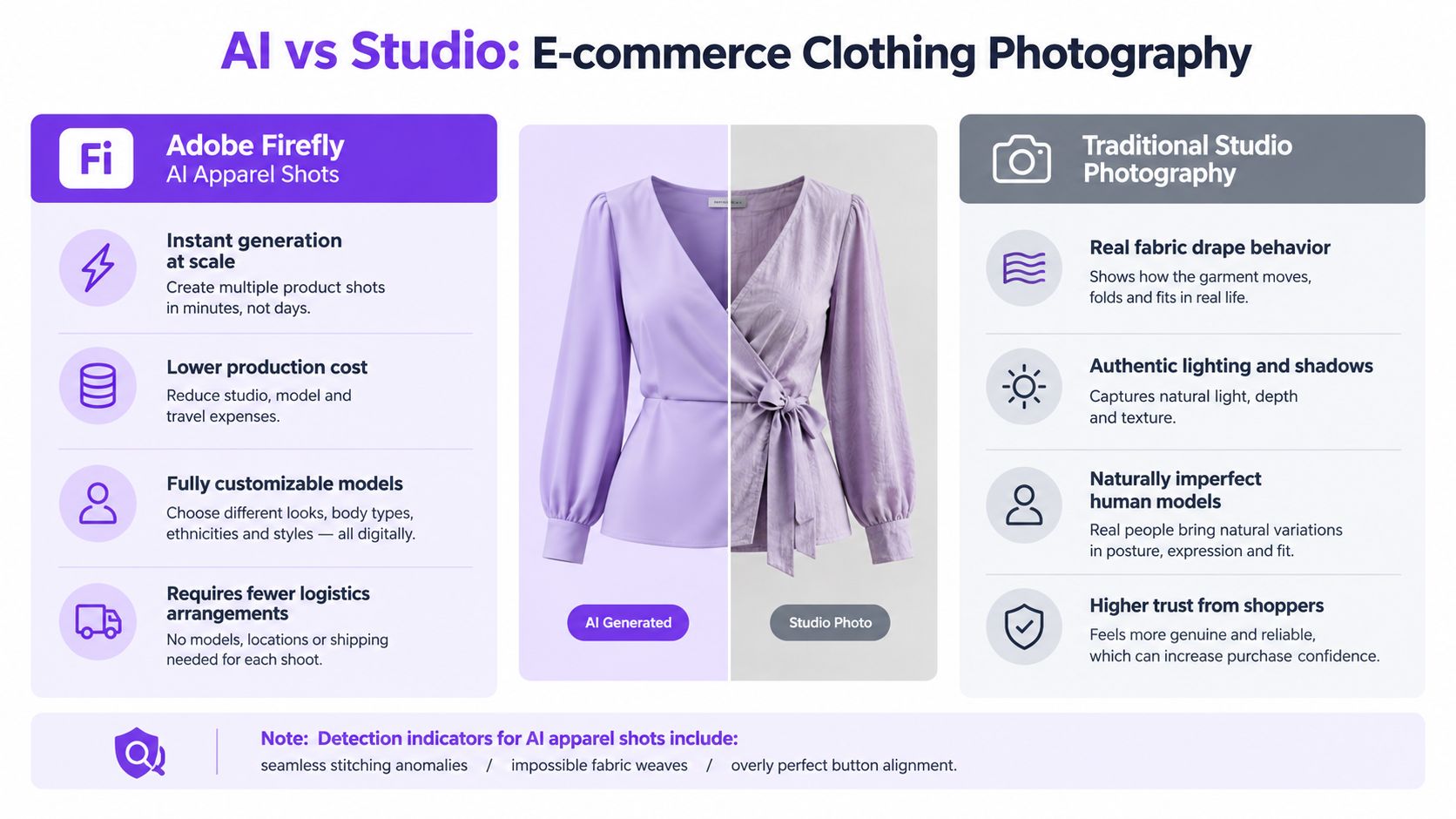
The accompanying comparison of AI-generated and traditional clothing photography illustrates a related distinction. A polished visual can sell an idea, but it doesn't automatically document a real object. Developers and designers should preserve source prompts and project references, then have a qualified professional verify any image used to support a technical or contractual claim.
6. E-Commerce Clothing by Adobe Firefly
Synthetic apparel photography can solve a practical creative problem. A brand may want a silk blouse in a particular navy tone, shown on a clean background and then in a lifestyle setting, without arranging a complete studio shoot for every variation. Adobe Firefly can produce useful commercial concepts and image assets, especially when teams need rapid exploration.
The commercial benefit doesn't remove the authenticity question. A generated garment may drape beautifully while failing to represent the actual product. Customers care about fabric weight, sheen, stitching, fit, color, and how the material behaves on a body. A visual that exaggerates those properties can become misleading product information.
Verify what the buyer is being shown
Inspect the fabric weave, pattern continuity, seams, hems, buttons, and transitions around collars and cuffs. Light should interact with the material consistently. Silk, denim, wool, and synthetic blends each behave differently, and a generated image may make every surface look equally flawless.
A product image can be creative advertising, but it shouldn't quietly become a substitute for product evidence.
Use real photography or clearly labeled composites for claims about fit, construction, and color. Compare generated assets with approved product samples, official packaging, and production photography. Keep the distinction visible in the workflow, especially when a marketplace, retailer, or affiliate publisher receives images from multiple sources.
Adobe's tools can support ideation and presentation, but the merchant remains responsible for accurate representation. Don't use a generated model wearing a garment that has not been photographed or validated if the image suggests the exact item is available. A transparent label such as “visualization” can protect trust while preserving the creative value of the asset.
7. Beverage Advertisement by Stable Diffusion XL
Beverage advertising depends on a polished visual grammar. Condensation, ice, saturated color, a clean label, and a controlled splash can suggest refreshment in one frame. Stable Diffusion XL, guided by composition controls, can produce that atmosphere quickly for mood boards, campaign concepts, and selected finished assets. Its visual appeal, however, does not establish that the pictured product or physical behavior is real.
The verification problem begins when the image changes the claim. A can may contain inaccurate text, a bottle may have an impossible form, or liquid may interact with ice in ways that imply qualities the actual beverage lacks. Brand owners also need approval for trademarks, packaging designs, recognizable settings, and other protected material.
Inspect the product before admiring the scene
Start with the label. Enlarge every word, logo, color block, and regulatory mark, then compare them with approved brand materials. A striking bottle that does not exist must not be presented as an official product photograph.
Physical behavior offers further clues:
- Condensation: Droplets should respond to gravity and surface curvature, rather than appearing as decorative dots.
- Ice and liquid: Cubes, bubbles, splashes, and reflections should interact in a physically plausible way.
- Color standards: Lighting can alter brand colors, but it should not create an unapproved identity.
- Rights and approvals: Confirm permission for trademarks, people, locations, and source material used in the composition.
A responsible campaign can disclose that the scene is synthetic while identifying which product elements are real. Hybrid production often provides a clearer boundary: photograph verified packaging separately, then treat generated surroundings as an explicitly fictional setting. This preserves creative flexibility and gives viewers a way to distinguish visual persuasion from product evidence. A product image can be creative advertising, but it must not become a substitute for product evidence.
8. Exotic Wilderness by Midjourney V6
Visual appeal can create geographic confidence without proving a place exists. Midjourney V6 can combine recognizable rock formations, turquoise water, aurora, storm clouds, and golden-hour light into a convincing travel-style photograph.
Familiar elements do much of the persuasive work. A viewer may identify a mountain range or glacial lake, then accept the entire composition as authentic. The model may have combined seasons, weather systems, astronomical conditions, and terrain that never occur together.
Test the location claim
If an image is presented as a real destination, verify it independently. Compare the mountain profile, shoreline, vegetation, rock layers, access roads, and visible structures with maps, park records, and trusted local imagery. Check the season, the sun's position, twilight timing, and whether an aurora could be visible under the stated conditions.
Water and atmosphere can expose inconsistencies. Reflections may not match the terrain above them, waves may ignore the shoreline, and cloud shadows may point in conflicting directions. A highly polished composition is not proof of generation, but it justifies closer examination.
Use the mountain scene image as concept art or a clearly labeled illustration. It should not represent a destination photograph, current safety conditions, or evidence that a particular view exists. Its visual appeal is real, while its geography, timing, and environmental conditions still require independent verification.
9. Fabricated X-Ray Scan by Stable Diffusion
Medical imagery is where the phrase “best AI-generated photos” becomes dangerously inadequate. A fabricated X-ray, CT image, or MRI-style scan can look technical and authoritative, especially when it uses grayscale contrast, clinical framing, and interface-like labels.
A generated scan isn't a diagnosis, a medical record, or evidence of disease. It can confuse patients, support insurance fraud, mislead students, or encourage someone to challenge professional care based on a false image. Even an apparently anatomically accurate image may contain subtle errors that require specialist knowledge to identify.
Stop at the boundary of visual inspection
Inspecting an image can reveal suspicious noise, repeated structures, impossible anatomy, or inconsistent markers. It can't establish that the scan came from a real patient or that a finding has clinical meaning. Metadata claims also require caution. DICOM fields, timestamps, patient identifiers, and PACS references can be missing, altered, or fabricated.
A responsible workflow requires:
- Original records: Request the authenticated clinical file through the appropriate healthcare process.
- Qualified interpretation: Ask a radiologist or relevant clinician to review medical content.
- Privacy protection: Don't upload identifiable patient material to an unapproved service.
- Clear labeling: Mark educational demonstrations and synthetic training images as generated.
Never use an image detector as a replacement for medical expertise. Escalate suspected fraud, disputed records, or urgent health concerns to qualified professionals and the relevant institution. For educators, synthetic scans can support teaching only when their fictional status is unmistakable and the lesson doesn't imply that the image documents a real case.
10. Historical Archive Image by DALL-E 3
A black-and-white photograph with film grain, period clothing, old vehicles, and a documentary composition can feel like recovered history. DALL-E 3 can generate that visual language for classroom materials, fiction, exhibitions, or creative reinterpretations.
The problem begins when a recreated image enters a caption, archive, textbook, or social post without disclosure. Historical photographs carry authority because viewers treat them as records of what people saw. A fabricated scene can therefore alter the perceived details of an event even when the accompanying narrative is broadly true.
Verify the period and the provenance
Look closely at clothing cuts, uniforms, vehicle models, architecture, signage, technology, and photographic artifacts. Group scenes deserve special attention because faces, hands, and repeated body shapes may reveal generation errors. Metadata should also be compared with the standards and records expected from the supposed archive.
Cross-reference the scene with established historical records and archival databases. Search for original photographs, event documentation, newspaper collections, and museum catalogues. If no original exists, describe the image as a reconstruction or artistic interpretation, not an archival photograph.
Teachers and publishers should preserve the prompt, generation date, editing history, and reference material. That record helps future readers distinguish the creative object from the historical evidence. The ethical line is simple. Synthetic imagery can help people visualize an era, but it shouldn't impersonate a document from that era.
Top 10 AI-Generated Photos Comparison
| Item | Implementation Complexity | Resource Requirements | Expected Outcomes | Ideal Use Cases | Key Advantages |
|---|---|---|---|---|---|
| Hyperrealistic Portrait by DALL‑E 3, "CEO Headshot" | High, advanced prompting/fine‑tuning for true photorealism | High, large model, strong GPU/cloud iterations | Near‑photoreal headshot capable of deceiving human and automated checks | Legitimate headshot services and marketing; high fraud risk for identity deception | Extremely realistic facial detail and corporate presentation |
| Social Media Profile Picture by Midjourney, "Attractive Avatar" | Moderate, style tuning and prompt engineering | Moderate, consumer model credits or moderate GPU | Believable, attractive avatars optimized for social platforms | Social media content, placeholders; vulnerable to catfishing and social engineering | Warm, platform‑optimized aesthetic with high shareability |
| Celebrity Deep Fake by Stable Diffusion XL, "Paparazzi Photo" | Very high, LoRA/fine‑tuning and precise conditioning for likeness | Very high, fine‑tuning data, compute, advanced toolchains | Convincing candid likenesses of public figures; high legal and reputational risk | Deepfake research and detection testing; otherwise high misuse potential | Can recreate specific likenesses in realistic scenarios (highly convincing) |
| Breaking News Scene by Stable Diffusion 3 | High, complex multi‑figure composition and environmental realism | High, advanced prompts, larger models, iterative refinement | Documentary‑style scenes that can fabricate events and misinform | Editorial mockups, verification training; major misinformation risk | Realistic chaotic scenes with strong narrative and emotional impact |
| Architectural Visualization by Midjourney, "Luxury Resort Interior" | Moderate to high, control over perspective, materials, lighting | Moderate, Midjourney or similar, sometimes extra refinement tools | Photoreal interiors with convincing materials but subtle physical inconsistencies | Design mockups, marketing visuals; risk of misrepresenting real properties | Rapid cinematic concept visualization with professional material rendering |
| E‑Commerce Clothing by Adobe Firefly | Low to moderate, standardized product templates and prompts | Low, consumer toolset, minimal compute or credits | Studio‑quality product shots suitable for listings and catalogs | Product catalogs, quick ad creatives; raises authenticity concerns | Consistent lighting and multiple angles at low production cost |
| Beverage Advertisement by Stable Diffusion XL | Moderate, precise art direction, optional ControlNet for layout | Moderate, SD XL + ControlNet, compute for high‑res outputs | Professional ad imagery aligned to brand aesthetics; IP risks exist | Ad creative, campaign prototyping; verify packaging and labeling accuracy | High‑quality product focus with advanced color grading and mood |
| Exotic Wilderness by Midjourney V6 | Moderate, combining multiple ideal conditions and effects | Moderate, Midjourney V6, iterative prompt refinement | Dramatic landscapes that may combine impossible natural elements | Travel marketing, social media visuals; risk of misleading location facts | Cinematic, highly shareable scenic compositions and atmospheric effects |
| Fabricated X‑Ray Scan by Stable Diffusion, "Medical Imaging" | High, requires anatomical and imaging realism knowledge | High, medical image datasets, specialized tuning and validation | Plausible diagnostic images that could mislead clinical or insurance processes | Research into detection, fraud prevention; dangerous if misused in healthcare | Can convincingly mimic diagnostic imaging formats and presentation |
| Historical Archive Image by DALL‑E 3 | Moderate, emulation of period photographic style and degradation | Moderate, model capable of vintage styling and careful prompts | Convincing archival‑style photos that threaten historical accuracy | Educational illustrations, film previsualization; high risk for false history | Authentic vintage aesthetic and period detail when accurately rendered |
Verify Before You Publish, Teach, or Trust
The best AI-generated photos aren't necessarily the most useful images. For creative work, a synthetic portrait, resort interior, beverage scene, or historical reconstruction may be exactly right. For journalism, medicine, identity verification, public safety, and education, the central question is different: what does this file prove, and what does it not prove?
Use a decision workflow that starts before detection. Preserve the original file, its source URL or message, and any available chain of custody. Check provenance and metadata, then inspect anatomy, text, reflections, shadows, object placement, material behavior, and the wider context. Reverse-image research can reveal earlier versions or unrelated source images, while location, time, and independent reporting can test the story attached to the picture.
Next, upload a supported copy to AI Image Detector for a fast confidence score and explanatory verdict. The service analyzes images in real time, doesn't store uploaded images on its servers, and provides a spectrum from Likely Human to Likely AI-Generated. Its core detection is free without registration, accounts can save history, and an API supports scaled workflows for platforms and communities.
Treat the result as a signal, not standalone proof. Edited, recompressed, mixed-content, or partially synthetic images can complicate interpretation, and a detector may not identify the tool that produced an image. A “Likely Human” result doesn't prove that a scene occurred, while a “Likely AI-Generated” result doesn't by itself establish intent, fraud, or misconduct.
Different professionals should apply different escalation thresholds:
- Journalists and editors: Don't publish an unverified image as news. Seek the original source, corroborate the event, and disclose reconstructions.
- Educators and researchers: Label generated examples, protect student and patient privacy, and cite authentic records separately from illustrations.
- Artists and designers: Track source material, obtain consent where people or protected likenesses are involved, and disclose synthetic work when audiences could reasonably be misled.
- Trust and safety teams: Combine detection with account behavior, provenance, moderation history, and human review.
- Legal and compliance teams: Escalate medical, identity, defamation, copyright, publicity, and public-safety matters to qualified professionals.
Ethical safeguards should be explicit. Don't present fabricated people, products, locations, events, or records as real. Respect copyright, publicity rights, consent, privacy, and applicable disclosure requirements. A label won't solve every risk, but concealment makes informed judgment impossible.
Synthetic imagery now occupies both creative and information environments. Research into election-related images found deepfakes represented a measurable share of the images examined in a Canadian election study, with variation across platforms, as reported in the study's published analysis. That finding reinforces the practical lesson behind every category here: the more consequential the claim, the less acceptable it is to rely on appearance alone.
If you review portraits, news scenes, product assets, or educational images, AI Image Detector can provide a fast confidence score and explanatory verdict without storing uploaded files. Upload a supported image for an initial signal, then combine the result with provenance checks, reverse-image research, metadata, and qualified human review before you publish, teach, or act.