

Fake News Detection API Guide for 2026

A fake news detection API takes articles, captions, or images and returns signals that help determine whether content is misleading, manipulated, or likely AI-generated. Think of it as a triage layer: it screens massive volumes so journalists, moderators, and investigators spend their time where it matters most.
Why Manual Checking Can't Keep Up
People are genuinely uneasy about online information. The Reuters Institute Digital News Report 2024 found that 59% of respondents across 47 countries worry about distinguishing true from false content online, and in some election-heavy markets that figure climbs to 81%.
Manual verification will always matter, but no team can inspect every post, image, and headline at the speed publishers operate. An API doesn't pretend to deliver a definitive true-or-false verdict on every claim. Instead, it ranks items so human reviewers can focus on the ones that need them most.
Detection should prioritize human attention, not replace editorial judgment.
Most services accept a mix of inputs:
- Article text, extracting claims, entities, sources, and confidence signals.
- Social captions, flagging emotional framing, unsupported assertions, and suspicious repetition.
- Images, checking visual artifacts, provenance indicators, and likely synthetic generation.
Here's how that looks in practice. A newsroom uploads a photograph to an image endpoint while sending its caption to a text-analysis endpoint separately. If both come back with elevated risk scores, the system routes the item to a fact-checker, attaching the original file, the model's reasoning, and the review history.
This approach pays off especially fast for teams handling international or multilingual content. Rather than asking editors to scrutinize every submission, developers set thresholds:
- Low risk, publish or continue normal moderation.
- Uncertain, request source confirmation or specialist review.
- High risk, hold distribution while preserving evidence.
For image-focused workflows, learn how AI Image Detector supports fake news verification with confidence-based results, rapid analysis, and no server-side image storage.
How to Use This Reference
The rest of this guide is built for quick lookup. Developers can compare solution categories, endpoint patterns, and integration approaches side by side. Product and trust-and-safety teams can focus on accuracy, latency, privacy, provenance, and testing criteria. Editors and compliance staff can jump straight to workflow design, human escalation, and interpretation guidance.
The core principle is straightforward: pick an API that gives you reviewable evidence and calibrated confidence, then layer it with source checks, provenance signals, and accountable human decisions.
Global Misinformation Concern by Region
Misinformation concern isn't evenly distributed. Markets with recent elections or active disinformation campaigns tend to report higher anxiety about online content.
| Region/Country | Concern Level | Platform Difficulty Rate |
|---|---|---|
| United States | 78% | 64% |
| Brazil | 81% | 71% |
| India | 72% | 58% |
| United Kingdom | 61% | 49% |
| Germany | 54% | 42% |
| Japan | 38% | 31% |
| South Africa | 76% | 67% |
These numbers reflect general patterns from recent surveys, and exact figures shift year to year. Still, they give teams a useful starting point for prioritizing where automated detection infrastructure will have the greatest impact.
A fake news detection API generally falls into one of four categories. Which one makes sense for you depends on whether you need claim evidence, image analysis, combined context, or full control over deployment.
This infographic visualizes reported misinformation concern across regions, including the 59% global average, 81% concern in election-heavy markets, and survey coverage across 47 countries.
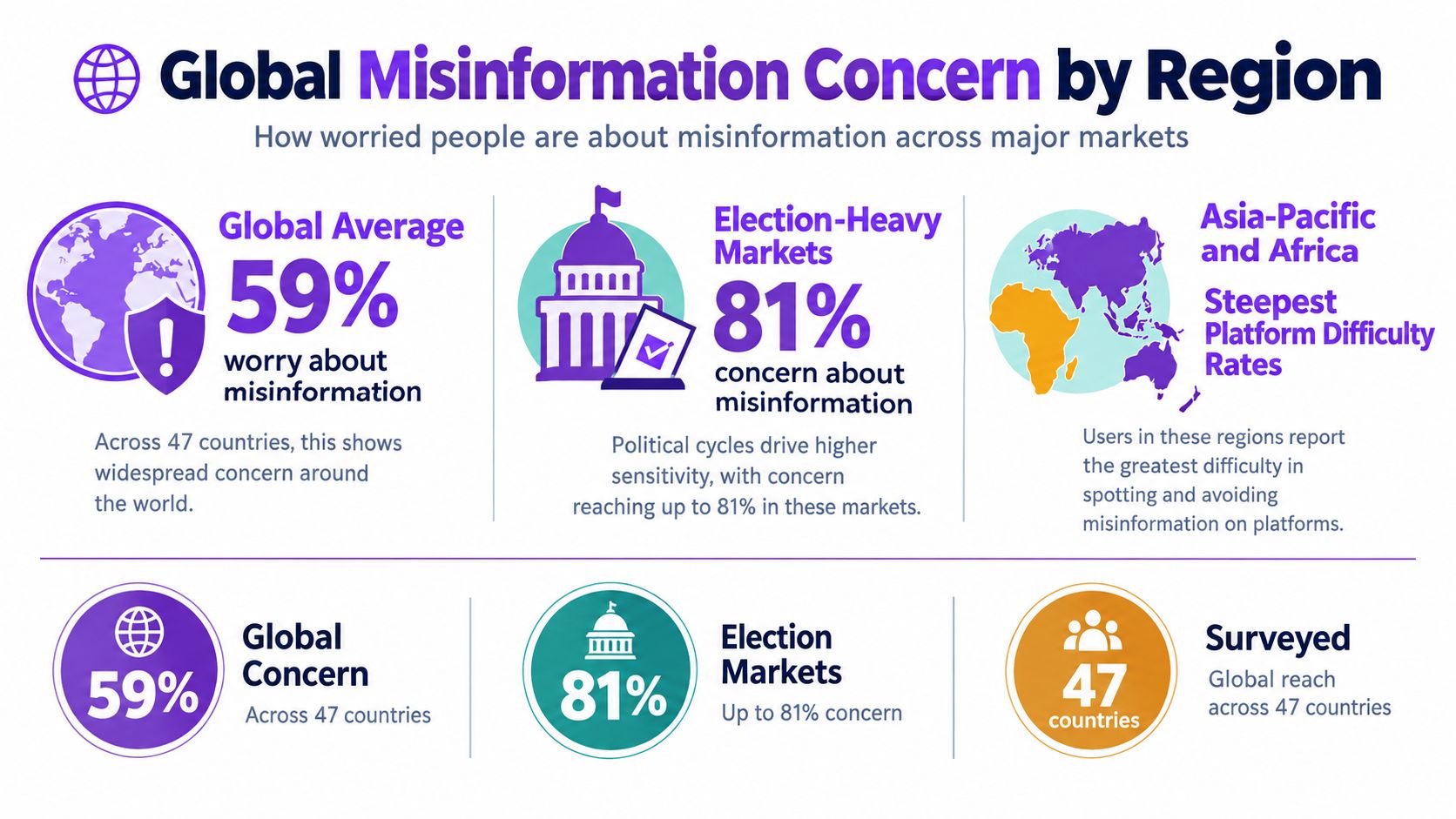
The takeaway is straightforward: high-concern markets benefit from layered checks, but regional language, platform, and topic differences still demand local testing. A model that performs well on English-language political content may stumble on regional dialects or niche subject matter.
Compare the Four Main Categories
Text-based claim verification APIs extract claims, identify entities, retrieve supporting sources, and return evidence or confidence scores. Typical endpoints include /claims/analyze, /sources/search, and /batch/verify. They suit newsrooms checking articles, academic institutions screening submissions, and trust-and-safety teams reviewing captions. Latency is often seconds for single claims, though source retrieval can stretch longer depending on the breadth of the search.
Image authenticity detectors inspect pixels, compression patterns, lighting, metadata, and generator-specific artifacts. Common endpoints include /images/analyze and /images/batch. AI Image Detector accepts JPEG, PNG, WebP, and HEIC files up to 10MB, returns results in seconds, and does not store uploaded images. Its verdict ranges from Likely Human to Likely AI-Generated, making it practical for newsroom photographs, marketplace listings, and social profile reviews.
Cross-modal verification platforms combine captions, images, URLs, and source relationships. They can flag contradictions, such as an authentic photograph paired with a false event description. Social platforms and moderation teams often use this category for triage, although response time and vendor cost may increase as complexity grows.
Open-source detection models run inside your own infrastructure, letting researchers inspect weights, adapt datasets, and limit data transfer. They require machine-learning expertise, ongoing monitoring, and careful calibration. Accuracy varies sharply by language, manipulation type, and model age, so avoid treating published benchmark results as production guarantees.
API Solution Categories Comparison
The table below summarizes how the four categories compare across input types, accuracy, latency, and typical use cases. Use it as a quick reference when narrowing down options.
| Category | Input Types | Accuracy Range | Latency | Best Use Case |
|---|---|---|---|---|
| Claim verification | Text and URLs | 70–95% depending on source coverage | Seconds to minutes | Newsrooms and fact-checking teams |
| Image detection | Image files (JPEG, PNG, WebP, HEIC) | 85–98% for known generators | Seconds | Marketplaces and profile moderation |
| Cross-modal platforms | Text, images, URLs, source graphs | 75–90% across modalities | Seconds to minutes | Social platforms and moderation triage |
| Open-source models | Local datasets and custom pipelines | Highly variable by language and task | Depends on hardware | Research teams and controlled environments |
No single category dominates across all dimensions. Claim verification leads on evidence depth, image detection on speed, cross-modal platforms on context, and open-source models on data control. Your workflow should dictate the priority.
Match Architecture to Workflow
When comparing categories, adjacent AI-driven content analysis workflows built on large-scale web data can also inform source collection and preprocessing. The Agenty web scraping tool offers relevant background for that neighboring workflow, particularly when you need to gather candidate sources before verification.
For endpoint formats, authentication, and sample requests, see the integration section. For accuracy, latency, and privacy selection criteria, consult the trade-offs section before shortlisting vendors.
False information rarely stays within one category. According to Statista's 2024 data, respondents encountered political misinformation most often at 36%, followed by health at 30%, economics at 28%, conflict at 27%, and and climate at 23%. For developers, this spread means a fake news detection API must classify subject matter before judging risk.

A binary true-or-false response is too blunt for these domains. A political claim may need source comparison, while a health statement may require medical review. An effective API should therefore return topic labels, claim types, evidence signals, and calibrated confidence scores, allowing teams to set different escalation thresholds.
| Topic | Respondents Exposed | Useful API Signal |
|---|---|---|
| Politics | 36% | Claim and source verification |
| Health | 30% | Medical evidence review |
| Economics | 28% | Date and data checks |
| Conflict | 27% | Location and media context |
| Climate | 23% | Scientific source comparison |
Add Emotional And Evidence Signals
Topic classification is only the first filter. False narratives often use anger, fear, urgency, or outrage to encourage rapid sharing, so detection systems should flag emotional triggers, repeated slogans, unsupported certainty, and calls for immediate action. These signals do not prove deception, but they help reviewers prioritize content likely to spread quickly.
Evidence preservation is equally important for journalists and compliance teams. Store the submitted text or file reference, timestamp, response identifier, confidence score, extracted claims, and model version. This creates an audit trail without treating an automated result as a final editorial verdict.
A confidence score should guide investigation, not replace it.
For example, a newsroom could route a high-confidence health claim with alarming language to a specialist editor, while sending a low-confidence climate claim for source checking. A platform might quarantine conflict imagery only when visual risk, caption risk, and provenance gaps appear together.
Include Images In Every Domain
AI-generated images can accompany fabricated political, health, economic, conflict, or climate narratives. Consequently, text analysis alone may miss the strongest deceptive element, especially when a genuine caption is paired with synthetic or misrepresented media.
Combine claim analysis with image inspection, then cross-reference the provenance section for credential and metadata checks. AI Image Detector analyzes JPEG, PNG, WebP, and HEIC files in seconds, provides a verdict from Likely Human to Likely AI-Generated, and does not store uploaded images. Use its result as one explainable signal within a review workflow, not as standalone proof.
Start with a stable contract before writing any application logic. Confirm the provider's base URL, authentication method, accepted media types, size limits, rate limits, and response fields upfront. Treat these details as vendor-specific, since endpoint names and retention policies differ from one service to the next.
A typical workflow breaks across separate routes:
POST /v1/text/analyzeaccepts JSON claims or article text.POST /v1/images/analyzeaccepts multipart uploads or a secure file reference.POST /v1/batch/analyzeprocesses multiple items in one call.POST /v1/webhooksregisters asynchronous result notifications.
Common API Endpoint Structures
Most fake news detection services follow a recognizable pattern, even when the exact paths differ. Here is what you will encounter in practice:
| Endpoint Type | HTTP Method | Request Format | Response Schema |
|---|---|---|---|
| Text analysis | POST | JSON | Risk score, labels, evidence |
| Image analysis | POST | Multipart | Verdict, confidence, reasons |
| Batch processing | POST | JSON array | Job ID and item results |
| Webhook registration | POST | JSON | Subscription ID |
Use bearer tokens in server-side requests, never in browser code. A straightforward curl example for image analysis:
curl -X POST "$BASE_URL/v1/images/analyze"
-H "Authorization: Bearer $API_KEY"
-F "file=@photo.webp"
Python clients should set explicit timeouts and preserve the request identifier for debugging:
import requests
response = requests.post(
f"{base_url}/v1/text/analyze",
headers={"Authorization": f"Bearer {api_key}"},
json={"text": caption},
timeout=15,
)
result = response.json()
In JavaScript, send structured JSON and handle non-success responses before reading any fields:
const response = await fetch(${baseUrl}/v1/text/analyze, {
method: "POST",
headers: {
Authorization: Bearer ${apiKey},
"Content-Type": "application/json"
},
body: JSON.stringify({ text: caption })
});
if (!response.ok) throw new Error(HTTP ${response.status});
const result = await response.json();
Handle Errors and Asynchronous Jobs
Expect 400 for invalid input, 401 or 403 for authentication problems, 413 for oversized files, 429 for throttling, and 5xx for temporary service failures. Retry only 429 and transient 5xx responses, using exponential backoff with jitter and an idempotency key to prevent duplicate analysis.
For batch requests, expect a job identifier, a status endpoint, and an optional webhook callback. Verify webhook signatures, reject replayed events, and make handlers idempotent. See this practical guide to AI content detector API integration for related implementation considerations, and review system integration for 2026 when coordinating broader platform dependencies.
Apply a Privacy-First Image Workflow
AI Image Detector provides a useful reference pattern. A user drags and drops a JPEG, PNG, WebP, or HEIC file up to 10MB; analysis completes in seconds, images are not stored on servers, and the response communicates a confidence result from Likely Human to Likely AI-Generated.
Keep the returned verdict, confidence, timestamp, and model version, but avoid storing the original image unless policy requires it. Before launch, cross-reference the testing section to validate malformed files, concurrency, retries, webhook delivery, and threshold behavior against representative samples.
Choosing a fake news detection API means weighing three things against each other: how confident you are in the result, how fast you get it, and how well you protect the data you send through. The models that dig into source reputation, cross-reference claims, and analyze embedded media take longer to run. The ones that respond in under a second usually rely on narrower signals, which limits what they can actually tell you.
Compare Deployment Approaches
| Approach | Accuracy and Speed | Privacy Profile | Best Fit |
|---|---|---|---|
| Cloud processing | Stronger models, seconds to minutes of latency | Depends on vendor retention and training terms | High-volume editorial review pipelines |
| On-device inference | Fast after initial setup, accuracy varies by hardware | No data leaves the device | Sensitive offline or air-gapped workflows |
| Hybrid processing | Balanced trade-off | Local preprocessing reduces what gets transmitted | Regulated platforms with compliance obligations |
Cloud processing gives you frequent model updates and the ability to pull in broader evidence networks. Before committing, though, check whether uploaded text or images are retained, reused for training, or automatically purged after analysis. On-device inference puts control firmly in your hands, but detection quality can degrade when hardware is limited or when the local model falls too far behind current techniques.
A hybrid setup strikes a middle ground by stripping metadata, resizing images, and extracting text locally before sending only the essential features to a hosted model. You keep most of the analysis on-premises while still benefiting from the full power of a regularly updated backend.
Optimize for the cost of a wrong decision, not accuracy in isolation.
Apply Privacy and Regulatory Controls
What you owe your users depends on who they are, where they are, and what kind of content you are processing. Under GDPR, you need a documented lawful basis, a clear justification for every piece of data you collect, defined retention windows, and a working process for data-subject requests. CCPA adds its own requirements: notice at the point of collection, access and deletion mechanisms, and transparent handling of personal information.
Healthcare and financial platforms should be especially careful. Images, claims, and account context can expose sensitive details you would not expect. Encrypt everything in transit, scope API credentials tightly, separate personal identifiers from the analysis payload, and log access events without keeping unnecessary copies of the originals.
Before signing up with any vendor, run through these questions:
- Where is the processing performed, geographically?
- How long are requests and results retained on their side?
- Are customer inputs fed back into model training?
- Can deletion and regional processing be confirmed contractually?
- What audit evidence or certifications back up their compliance claims?
See the API Selection Trade-off Matrix below for a quick decision framework tied to these trade-offs.
Match Models to Media Types
Detecting AI-generated media is its own discipline, separate from general image classification. A standard classifier might recognize faces, vehicles, or scenes, but it was not trained to spot synthetic fingerprints, inconsistent lighting, warped details, compression artifacts, or the quirks of a specific generator.
AI Image Detector handles JPEG, PNG, WebP, and HEIC files up to 10MB, returns results within seconds, and does not retain uploaded images after scoring. Its spectrum-based output, ranging from Likely Human to Likely AI-Generated, gives you more actionable information than a bare yes-or-no label.
Calibrate thresholds to the stakes involved. Auto-approve low-risk submissions, route uncertain results to a human reviewer, and preserve full evidence for high-risk cases. Then test your pipeline against edited, compressed, multilingual, and out-of-distribution samples, because privacy exposure, latency, and accuracy can all shift well beyond what vendor benchmarks suggest.
API Selection Trade-off Matrix
This matrix gives you a structured way to prioritize accuracy, speed, and privacy when narrowing down candidate APIs.
| Priority Factor | Recommended Approach | Performance Impact | Privacy Benefit |
|---|---|---|---|
| Maximum detection accuracy | Cloud-based ensemble models | Higher latency (seconds to minutes) | Requires careful data-retention review |
| Low-latency real-time response | On-device or edge inference | Sub-second response, limited model complexity | No external data transfer |
| Regulatory compliance with strong privacy | Hybrid with local preprocessing | Moderate latency from preprocessing step | Minimizes data sent to third parties |
| Full transparency and auditability | Vendors with published audit evidence and regional processing guarantees | Varies by deployment model | Contractually enforceable data handling |
If your primary concern is catching as many manipulated sources as possible and you can tolerate a processing delay, lean toward a cloud ensemble and negotiate strict data-handling terms. When response time matters more than detection depth, on-device inference keeps everything local at the cost of model sophistication. Regulated environments often benefit from a hybrid design that preprocesses content locally before handing off only anonymized features.

A fake news detection API works best alongside provenance checks, not instead of them. Provenance records where a file came from and how it changed, while detection models inspect the content itself when that record is missing or incomplete.
OpenAI adopted C2PA credentials for DALL-E 3 images in February 2024, embedding metadata that can identify AI generation and timestamps. C2PA credentials are useful evidence when they survive editing, downloads, screenshots, and redistribution. However, their absence does not prove human authorship, because metadata can be stripped or never added.
Combine Provenance With Visual Analysis
When credentials are unavailable, an image detector examines signals within the file. These may include synthetic texture patterns, inconsistent lighting, unnatural edges, repeated details, compression behavior, and generator-specific artifacts. AI Image Detector analyzes JPEG, PNG, WebP, and HEIC files up to 10MB, returns a verdict within seconds, and does not store uploaded images.
A practical workflow should preserve both evidence types:
- Read available C2PA credentials and record the claimed origin, timestamp, and edit history.
- Send files without useful credentials to a visual detection endpoint.
- Compare provenance claims with visual findings and contextual source information.
- Route uncertain or conflicting results to an editor, investigator, or legal reviewer.
- Store the score, explanation, timestamp, and model version for later auditing.
Provenance vs Detection Methods
| Method | Reliability | Coverage Gap | Best Application |
|---|---|---|---|
| C2PA credentials | Strong when intact and cryptographically valid | Missing or stripped metadata | Origin and edit-history checks |
| Visual detection | Useful for files without credentials | Performance varies by edits and generators | Triage and forensic review |
| Human assessment | Adds context and accountability | Slower and resource-intensive | Legal or editorial decisions |
No single method covers every scenario. Provenance gives you a verifiable chain of custody, but only when the metadata survives. Visual detection fills in the gaps but can struggle with heavily edited or recompressed files. Human judgment remains essential for high-stakes decisions where context matters more than a score.
A missing credential is an unknown, not proof that an image is human-made.
For example, a newsroom may receive a photograph with valid credentials identifying AI generation. That result can support transparent labeling. A screenshot without metadata should instead receive visual analysis and source review, rather than an automatic authenticity verdict.
Teams comparing broader enterprise safeguards can also review how enterprises stop deepfake scams. The strongest process is layered: provenance supplies traceable history, visual analysis covers gaps, and human reviewers interpret the combined confidence in context.
Before you deploy a fake news detection API in production, set up a test program that mirrors your actual traffic instead of leaning on vendor demos. A well-rounded dataset covers verified authentic content, known false claims, AI-generated images, edited photographs, screenshots, multiple languages, and varied compression levels.
Add demographic and regional diversity too. Performance often shifts across dialects, topics, and user groups. Keep separate development, validation, and locked test sets so repeated tuning doesn't inflate reported accuracy.
Build a Representative Benchmark
Label every item with source, creation method, manipulation type, language, topic, and review confidence. For images, record resolution, format, cropping, recompression, filters, screenshots, and metadata removal.
Track more than accuracy alone. False positives can wrongly suppress legitimate reporting, while false negatives let deceptive content slip through.
| Metric | What It Reveals |
|---|---|
| Precision | How often flagged items are genuinely suspicious |
| Recall | How many suspicious items the API catches |
| F1 Score | Balance between precision and recall |
| Calibration | Whether confidence scores reflect actual risk |
| Latency | Time from request to usable result |
Run each candidate API against identical samples, thresholds, and hardware conditions. Test both single requests and batches, and document model version, timestamp, response code, and request identifier so results stay reproducible.
A high benchmark score doesn't guarantee production performance.
Stress Test Failure Conditions
Push concurrency steadily higher until latency shifts, throttling kicks in, or error rates climb. Confirm documented rate limits, retry behavior, timeout handling, and idempotency before you expose the API to users.
Include difficult cases like:
- Low-resolution images, where forensic signals often disappear.
- Heavily edited files, covering crops, filters, overlays, and screenshots.
- Unsupported formats, empty payloads, oversized uploads, and corrupted files.
- Duplicate submissions and traffic bursts during breaking news events.
For AI Image Detector, test JPEG, PNG, WebP, and HEIC files up to 10MB, mixing authentic and synthetic examples. Verify results return within the expected seconds-scale window and check that uploaded images aren't stored—this is outlined in the AI Image Detector documentation.
Monitor Drift and Bias
After launch, keep an eye on precision, recall, abstention rates, latency, provider errors, and manual-review outcomes broken down by language, region, topic, device, and image type. Compare false-positive rates across user segments, investigate any gaps, and pause automated enforcement when a monitored group shows unexplained degradation.
Store model versions alongside every decision. When a provider updates its model, replay the locked benchmark, compare threshold behavior at each confidence level, and roll out the change gradually. Keep the previous version available for rollback, document any shifted scores, and alert reviewers before automatic decisions resume.
API Testing Checklist
Use the following criteria to evaluate vendor capabilities before committing to a specific fake news detection API:
| Test Category | Validation Method | Success Criteria | Frequency |
|---|---|---|---|
| Accuracy | Run labeled benchmark dataset | F1 score above agreed threshold | Every model update |
| Precision | Measure false-positive rate on verified authentic content | False positives stay below 2% | Weekly |
| Recall | Measure false-negative rate on known deceptive content | Miss rate stays below 5% | Weekly |
| Latency | Time requests under normal and peak load | P95 under 300ms for single requests | Daily |
| Rate Limiting | Push concurrency to documented limits | Graceful throttling with clear headers | Monthly |
| Error Handling | Submit malformed and edge-case inputs | Meaningful error codes and retry guidance | Monthly |
| Language Coverage | Test representative samples per supported language | No language drops more than 5% in accuracy | Quarterly |
| Image Format Support | Submit JPEG, PNG, WebP, HEIC at various sizes | Correct handling up to 10MB without data retention | Quarterly |
| Bias Audit | Compare outcomes across demographic segments | No segment degrades more than 3% vs. baseline | Quarterly |
| Model Drift | Replay locked benchmark after each update | Threshold behavior stays within documented bounds | Every update |
Cross-reference these checks against the benchmark approach and stress testing procedures above to build a complete picture of how the API behaves under real conditions.
A production fake news detection API needs orchestration around the model. Start with a queue that separates ingestion from analysis, allowing newsrooms, marketplaces, and social platforms to absorb traffic spikes without blocking uploads or publication workflows.
For example, a newsroom can place incoming articles and images in a durable queue, assign priority by topic, then send jobs to text and image endpoints independently. Store the request identifier, source, timestamp, model version, and confidence result so editors can reconstruct every decision.
Route Results by Confidence
Use thresholds as workflow gates, not as declarations of truth. A practical routing policy looks like this:
- High-confidence authentic content continues to normal publishing or listing checks.
- Uncertain content enters a human-review queue with evidence and source context.
- Suspected manipulation is quarantined, preserving the original submission and audit record.
- Appealed decisions return to reviewers without silently overwriting the initial result.
Caching reduces cost when identical files, claims, or captions are submitted repeatedly. Hash normalized inputs, define a short retention period for results, and avoid caching sensitive content unless your privacy policy permits it.
Batch processing can further lower request volume during scheduled imports or marketplace catalog updates. Add request deduplication before the queue, and reserve real-time calls for breaking news, live moderation, or urgent verification.
Pipeline Architecture Components
Every scalable verification system breaks down into a handful of modules. Here is how they fit together, what each one does, what can go wrong, and what stack choices teams tend to use:
| Component | Function | Technology Options | Failure Mode |
|---|---|---|---|
| Queue | Absorbs traffic bursts | RabbitMQ, SQS, Kafka | Delayed processing |
| Cache | Reuses recent results | Redis, in-memory TTL store | Stale verdicts |
| Router | Applies confidence thresholds | Custom rules engine, OPA | Misclassification |
| Dashboard | Supports review and appeals | CMS plugin, custom UI | Reviewer overload |
| Fallback | Maintains service continuity | Secondary detector, manual queue | Reduced detection depth |
In practice, these components form a pipeline: ingestion hits the queue, the cache intercepts repeats, the router splits results into buckets, the dashboard handles the exceptions, and the fallback keeps the line moving when the primary detector falters. Design each layer to fail gracefully rather than cascade.
Connect Review Systems
Integrate results into the content management system, moderation dashboard, and appeal workflow rather than creating another isolated interface. Editors should see the flagged asset, explanation, confidence, provenance findings, reviewer notes, and final disposition together.
If the provider becomes unavailable, use exponential backoff for transient errors, then switch to a secondary detector or hold content for manual review. Never auto-approve merely because a dependency timed out.
Read the AI Image Detector API integration guide for a privacy-first image workflow. It supports JPEG, PNG, WebP, and HEIC uploads up to 10MB, analyzes files in seconds, and does not store images on servers.
Design outages as review states, not invisible failures.
For cost control, combine tiered service plans with deduplication, batching, selective image analysis, and topic-based escalation. A marketplace might scan every new image, while sending only suspicious listings for deeper text and provenance checks. This keeps expensive review capacity focused where the risk is highest.
What Is a Fake News Detection API?
A fake news detection API takes text, images, or both and returns risk signals, confidence scores, and supporting evidence. It's built to help teams prioritize human review rather than deliver a final verdict on truth. Before you start wiring anything up, review the endpoint patterns and routing guidance above.
How Accurate Are AI Image Detectors?
Accuracy shifts depending on the generator, the amount of editing or compression, the language involved, and the overall image quality. Screenshots and heavily altered files are especially tricky. Treat every result as probabilistic. Labels like Likely Human and Likely AI-Generated should point you toward further investigation, not replace provenance checks or editorial judgment.
What Privacy Questions Should I Ask?
Find out whether uploaded files are stored, used for training, transferred across borders, or deleted automatically. Look into encryption standards, where processing happens, how long data is retained, who has access, and whether you can contractually enforce deletion. If privacy is a priority, AI Image Detector analyzes supported files without keeping images on its servers.
How Do I Add Detection to a Workflow?
Send content asynchronously, log the request ID and model version, then route results based on confidence. Auto-approve low-risk items, flag uncertain cases for human reviewers, and keep evidence intact for high-stakes decisions. Before going live, test file formats, rate limits, retry behavior, and model drift, as covered in the testing section.
AI Image Detector can help protect your platform with fast, privacy-first image verification. Try AI Image Detector today.
