

How Does AI Recognize Images and What It Means

What does it mean when an AI “recognizes” a photo? If it labels a dog correctly, finds the same image on the web, and says the picture was generated by AI, are those three examples of the same ability? They aren't. Each requires a different question, model behavior, and standard of evidence.
Understanding how AI recognizes images starts with separating those tasks. Once you know whether a system is classifying, retrieving, or checking authenticity, its output becomes much easier to interpret.
What It Really Means for AI to Recognize an Image
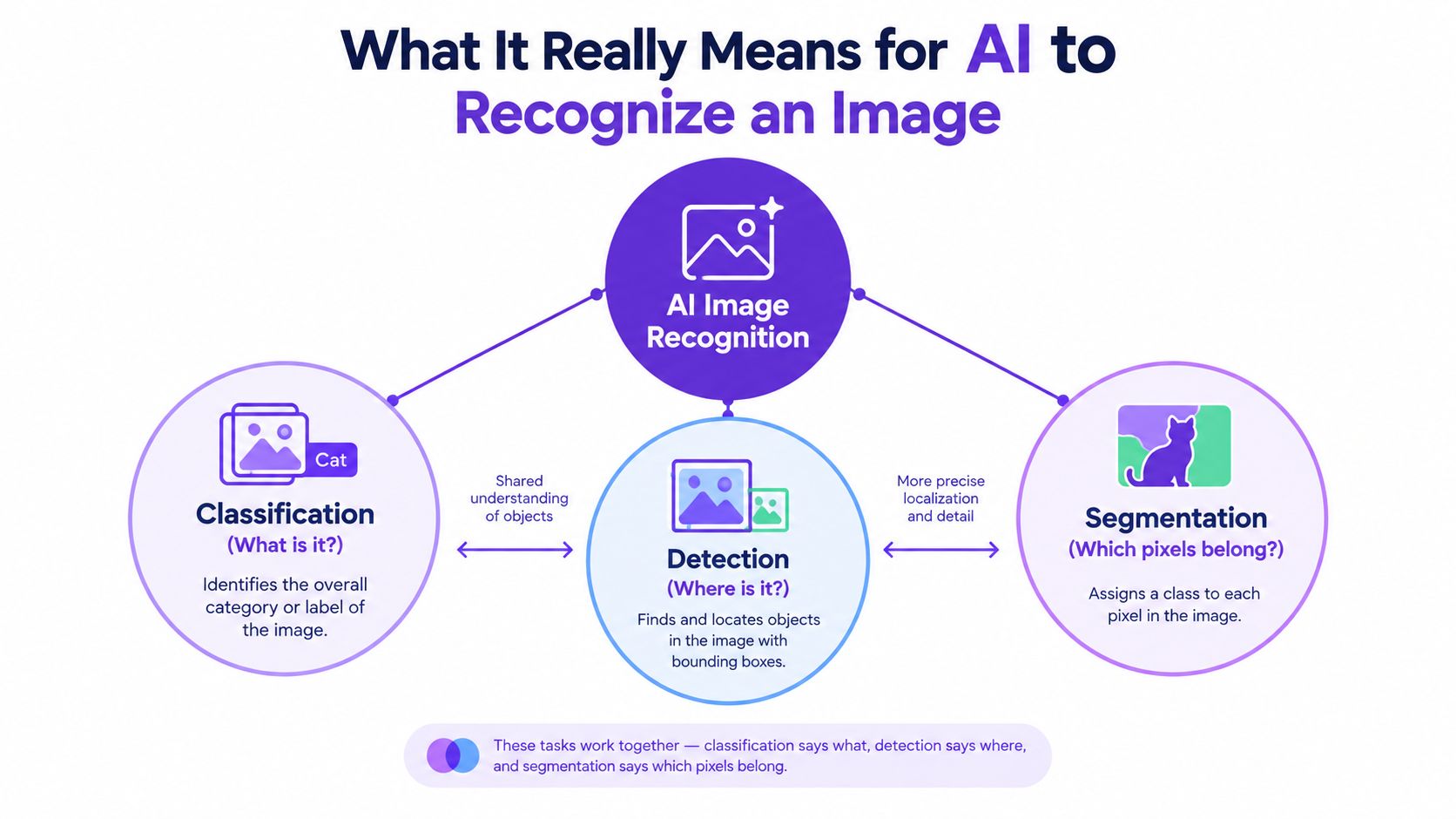
AI image recognition isn't a single skill. It's a family of related operations that turn visual input into a useful result.
Classification asks, “What is in this image?” A model might assign labels such as cat, bicycle, or melanoma to the whole image. Some systems classify scenes, while others identify multiple objects or estimate attributes such as pose or emotion.
Retrieval asks, “Where have I seen this image, or something visually similar, before?” A search system converts the image into a numerical representation called an embedding, then compares that representation with entries in a database. This can locate duplicates, related products, or visually similar photographs.
Authenticity recognition asks, “Was this image captured, edited, or generated, and does it support the claim attached to it?” That question is harder because visual content can be plausible while its origin or context is false.
Suppose you upload a photograph of a crowded street. If you want to know whether it contains a bicycle, classification is the right task. If you want to find earlier copies, use retrieval. If the image is being presented as an unedited camera photograph, you need authenticity analysis. A detector that answers one question shouldn't be treated as if it answered all three.
The technical ingredients
Most modern systems combine several ideas:
- Pixels: The original image becomes numerical values representing brightness and color.
- Learned features: A neural network transforms those values into patterns that are useful for the task.
- Embeddings: The system compresses visual information into a vector that supports comparison and search.
- Prediction heads: A final layer converts features into labels, similarity scores, or authenticity estimates.
- Training data: Examples teach the model which visual patterns tend to correspond to each outcome.
Convolutional neural networks learn visual features through local filters, while Vision Transformers divide images into patches and compare them with self-attention. An accessible AI and image processing guide offers further background on how these components fit into broader image workflows. You can also explore what image analysis means in practice when the goal involves more than assigning a simple label.
The practical lesson is simple: choose the task before choosing the model. A classification score can't prove provenance, and a retrieval match can't establish that an image is authentic.
How Convolutional Neural Networks Learn to See
A convolutional neural network, or CNN, reads an image as a structured grid rather than as a sentence. Each pixel supplies numerical information, and the network learns which local arrangements of those values matter.
At the beginning, the image might look like nothing more than rows of color measurements. A convolutional layer slides small filters across that grid. Each filter responds strongly when it encounters a particular pattern, such as a horizontal edge, a diagonal boundary, or a change from dark to light.
Those first responses aren't “eyes” or “wheels.” They're basic signals. A later layer combines them into corners, curves, textures, and repeated arrangements. Another layer can combine those shapes into parts, such as an eye, wheel, handle, or fold of fabric. Deeper layers assemble parts into object-level evidence.
From edges to objects
This hierarchy explains why a CNN can recognize an object even when the photograph varies.
- Early layers respond to edges, gradients, and simple color contrasts.
- Middle layers combine those responses into textures, contours, and parts.
- Deep layers connect parts with broader arrangements that support a category.
- Output layers translate the learned representation into labels or scores.
The network doesn't receive a hand-written rule saying that a bicycle has two wheels. It adjusts internal weights until combinations of visual features consistently help it distinguish bicycles from other objects. A sketch may emphasize clean edges, while a photograph may offer texture and lighting. The same hierarchy can use both, but it can also be misled if a background happens to correlate with a label.
AlexNet made this approach a defining milestone. In the 2012 ImageNet challenge, it achieved a 15.3% top-5 error rate, compared with 26.2% for the runner-up, according to this history of the ImageNet breakthrough. In top-five evaluation, the correct label appeared among the model's five most likely guesses for about 84.7% of test images. The result showed that deep convolutional layers could learn useful visual features directly from pixels instead of depending mainly on manually designed rules.
The architecture itself isn't a miniature human visual system. Its “understanding” is statistical. A texture that often appears on synthetic skin may influence a detector, but that clue alone doesn't establish how the image was made.
Practical rule: Treat a CNN's confidence as evidence about learned visual patterns, not as a guarantee that the model understands the scene.
Why deeper networks helped
ImageNet results continued to improve. By 2014, GoogLeNet had reduced top-five error to 6.7%, and later research surveys reported ResNet reaching about 3% error in 2015, below the 5.1% human error rate cited for that contest. These figures are summarized in Google's account of progress in neural image recognition.
ResNet introduced skip connections that let information move across layers more directly. That design helped engineers train substantially deeper networks without losing useful signals as they passed through the architecture. In practical detection, depth can help the system combine fine details with object-level structure, but it doesn't remove the need for representative data or careful evaluation.
For a broader view of tools built around visual classification, photo recognition software provides useful context. The important distinction remains the output. A classifier may tell you what an image resembles, while an authenticity system must assess whether its visual evidence is consistent with its claimed origin.
How Vision Transformers Read an Image
Vision Transformers, usually called ViTs, approach images in a different way. Instead of applying local filters that gradually expand their view, a ViT divides an image into fixed-size, non-overlapping patches and treats those patches like tokens in a sequence.
Each patch is converted into a vector. The model then uses self-attention to compare every patch with other patches and assign different levels of importance to those relationships. A region containing a wheel can be connected directly to a region containing a vehicle body. A face can be evaluated alongside the surrounding background without waiting for many convolutional stages to transmit that information.
This global view helps with scenes where distant regions affect one another. It can also help when an object is partly hidden, because visible patches may still form a meaningful relationship with one another. The tradeoff is substantial: Vision Transformers typically need large pretraining datasets and significant computation. On smaller datasets, a carefully designed CNN may generalize more reliably.
Google reported ViT results in which a large model achieved 88.55% top-1 accuracy on ImageNet, 99.50% on CIFAR-10, and 90.72% on ImageNet-Real. The results are described in Google's research on transformers for image recognition. These benchmarks show the potential of global attention when the model has enough data and training capacity, not a guarantee for every image task.
| Dimension | CNN, such as ResNet | Vision Transformer, or ViT |
|---|---|---|
| Basic operation | Applies learned filters across local regions | Compares image patches through self-attention |
| First useful view | Nearby edges and textures | Patch relationships across the image |
| Main strength | Efficient local structure and strong performance with limited data | Long-range relationships and global scene context |
| Main requirement | Convolutional inductive bias and suitable training examples | Extensive pretraining data and compute |
| Common weakness | May need depth to connect distant regions | Can overfit when data is limited |
| Detection implication | Strong for local texture and object features | Useful when spatial relationships span the image |
A ViT still doesn't “look” in the human sense. Its attention weights describe computational relationships, not conscious focus. For readers interested in the broader role of learned visual patterns, AI pattern recognition explains why a model's output depends so heavily on the patterns represented in its training examples.
Training Data and How a Model Actually Learns
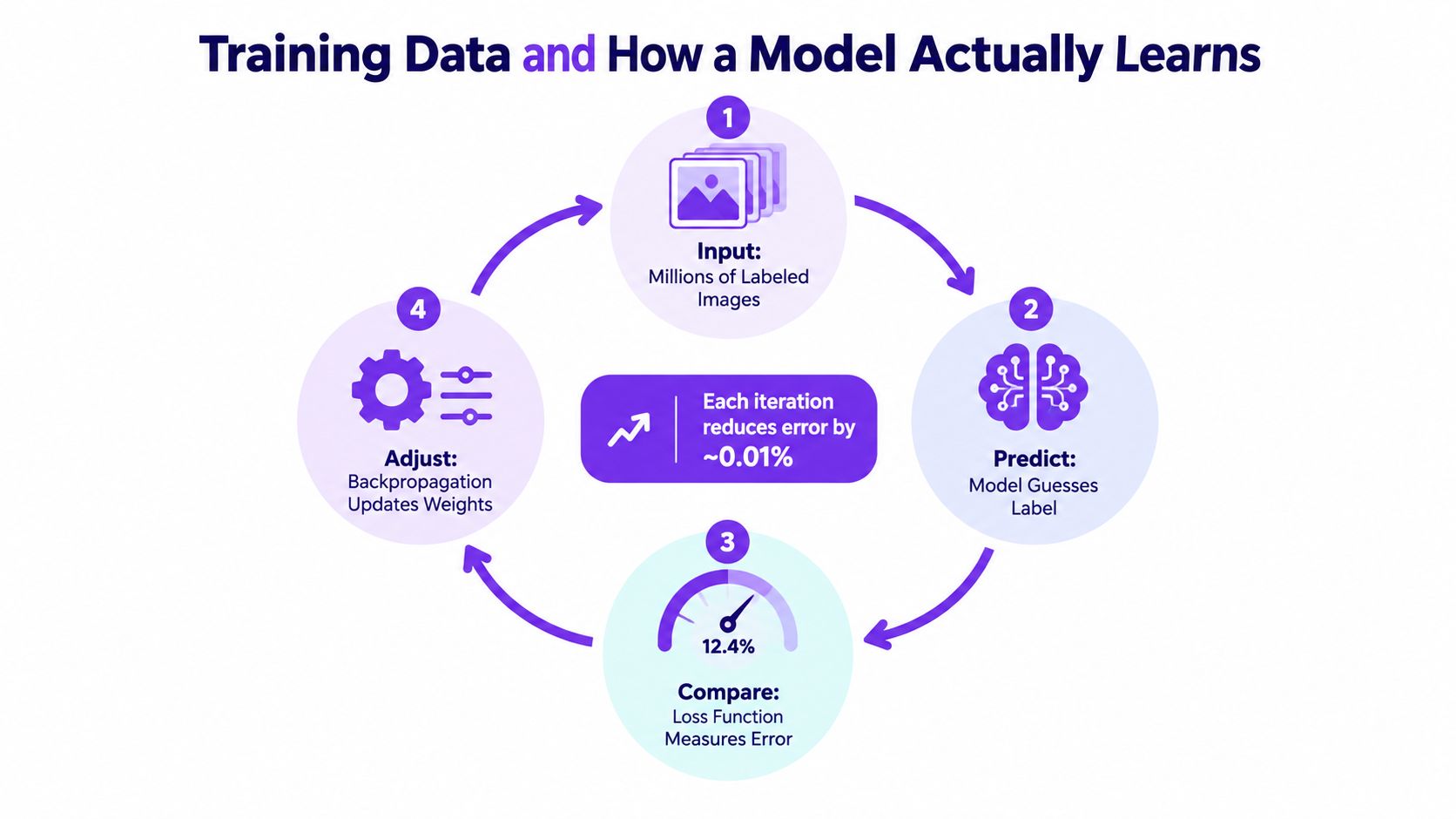
Training begins with examples, not understanding. A model receives an image, produces a prediction, compares that prediction with a supplied answer, and adjusts its internal weights to reduce the error.
Consider a system trained to distinguish cats from dogs. At first, its weights may be poorly calibrated, so it assigns unreliable scores. A loss function measures how far those predictions are from the labels. Backpropagation then calculates how each weight contributed to the error and nudges the weights in directions that should improve later predictions.
That loop repeats across many examples. A held-out validation set provides a separate test of whether the model has learned transferable patterns rather than memorized training images.
What the labels teach, and what they hide
Labels carry assumptions. If every dog photograph in a dataset was taken outdoors and every cat photograph indoors, the model may use the background as a shortcut. It can then appear accurate during testing while failing on a cat photographed outside.
Other problems include:
- Label noise: Human annotators may disagree or make mistakes.
- Imbalance: Some people, environments, or image styles may appear far less often than others.
- Watermarks and compression: Repeated publishing artifacts can become accidental category clues.
- Memorization: A model may recognize familiar examples without learning the underlying concept.
The quality of the output therefore depends on more than architecture. A large dataset can still teach the wrong lesson if its labels are inconsistent or its visual variety is narrow.
A confidence number describes the model's internal preference among learned possibilities. It doesn't document where the image came from or prove that the model's shortcut is valid.
For authenticity work, provenance context matters. A detector should expose what kind of evidence influenced its result, because a single score can't reveal whether the model noticed a meaningful artifact, a benign editing trace, or a misleading correlation.
The Gap Between Classifying Images and Verifying Them
A classifier answers a content question. Verification answers an origin and truth question.
A model can identify a face, a building, or a landscape without knowing whether the image was generated, altered, miscaptioned, or taken at the claimed time. Conversely, a reverse-image system can find an earlier copy without proving that the earlier copy was genuine. These capabilities overlap in a workflow, but they shouldn't be collapsed into one verdict.
| Task | Core question | Typical model | Failure mode |
|---|---|---|---|
| Classification | What appears in the image? | CNN or ViT classifier | Label bias or misplaced confidence |
| Retrieval | Where is this image, or a similar one, indexed? | Embedding search system | Near-duplicate confusion or no database match |
| Authenticity | Does the image's origin and presentation appear credible? | Forensic and multimodal detector | Blindness to new generation methods or subtle edits |
Reverse-image retrieval generally relies on visual fingerprints. It may compare colors, shapes, textures, and patterns to identify copies or related images. Cropping, recoloring, heavy compression, or a newly generated image can weaken that match, and a database can only return evidence it contains.
Multimodal description models follow another route. They interpret visual regions through language, generate descriptions, and may refine searches based on those descriptions. This can expose an impossible object or an implausible scene, but a plausible caption doesn't establish provenance. Recent coverage of why AI models struggle to verify photographs highlights this difference between visual matching and language-based interpretation.
A sound authenticity workflow combines signals rather than asking one model to do everything. Retrieval can reveal prior publication, visual analysis can inspect artifacts, and metadata or provenance records can add context. None of these signals should be treated as conclusive in isolation.
Where Image Recognition Fails on Edited and Synthetic Content
Recognition systems fail when the visual problem requires more than matching familiar patterns. Synthetic and edited images expose that boundary because they can preserve a convincing overall appearance while violating details that a person might inspect deliberately.
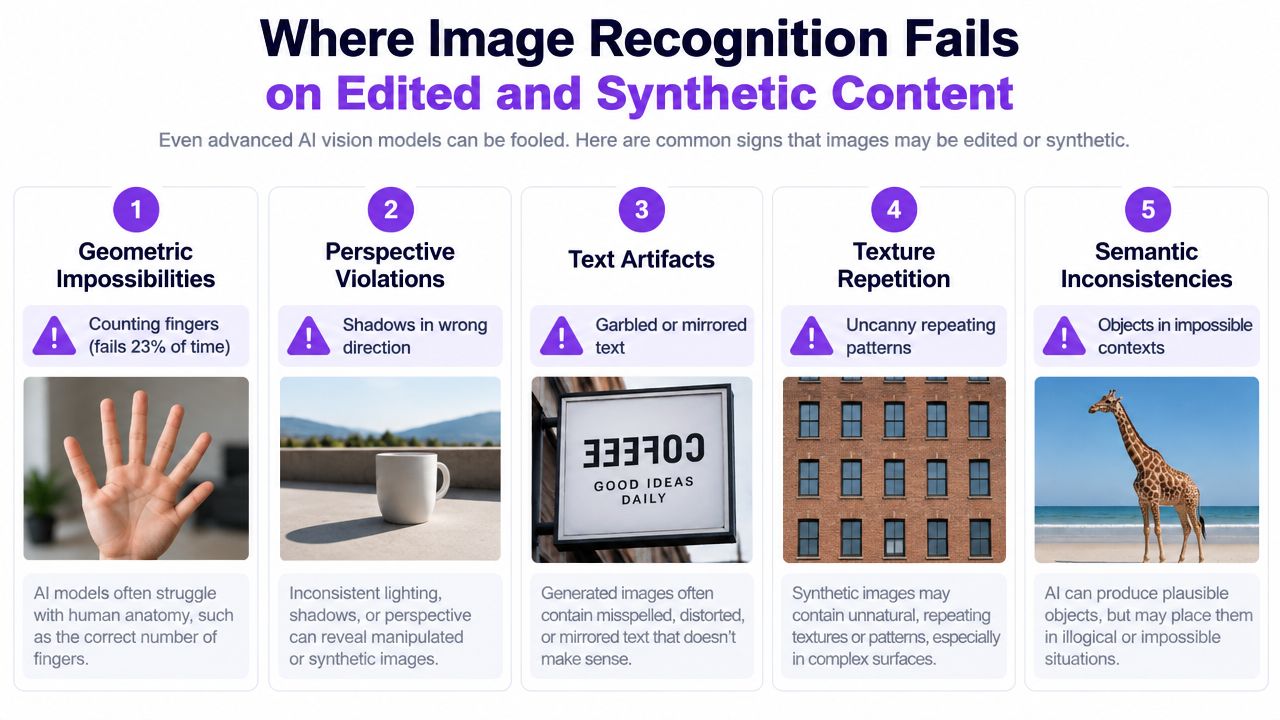
Geometry is a common weakness. A model may struggle with the number of fingers, the relationship between an occluded object and its surroundings, or the arrangement of objects on a table. Spatial language creates another trap. Systems can confuse whether one object is to the left or right of another, even when both objects are individually recognized.
Lighting produces a different class of error. A composite may contain locally realistic shadows while using inconsistent directions across the scene. A relit subject can look natural at a glance, yet the apparent light source and reflected brightness may not agree.
The visible symptoms are task-specific
- Geometry: Counting, occlusion, and perspective checks test whether objects occupy physically coherent positions.
- Lighting: Shadow direction and reflections can reveal compositing or inconsistent rendering.
- Text: Stylized fonts, partial occlusion, and small lettering remain difficult for vision systems.
- Texture: Repeated skin, hair, fabric, or background patterns can indicate synthesis or aggressive processing.
- Semantics: An image may contain individually plausible objects arranged in an impossible context.
These clues aren't automatic proof. Real cameras produce blur, lens distortion, compression, and unusual lighting. Editors also introduce seams, resampling traces, and color changes without using generative AI.
Recent reporting describes cases in which AI tools wrongly identify generated images as real, including images made with related generative systems. It also discusses failures involving geometry, physical-law violations, text rendering, and spatial relationships in coverage of AI tools and synthetic-image detection. For organizations assessing deepfake business risks, that uncertainty matters because a detector can support review without replacing source verification.
The right response depends on the suspected problem. Use OCR for scene text, geometric checks for object relationships, lighting analysis for composites, and residual or artifact analysis for synthetic content. Human review remains essential when the image affects safety, reputation, legal decisions, or public reporting.
How AI Image Detector Puts Recognition Into Practice
A practical authenticity tool can combine the recognition mechanisms described above into a focused pipeline.
First, the uploaded image is normalized and divided into visual regions. A vision model transforms those regions into learned features, often using a patch-based architecture. Those features represent signals such as texture consistency, lighting behavior, edge structure, and relationships between parts of the image.
A classification layer then produces an authenticity estimate. The output isn't just “cat” or “car.” It might place the image on a spectrum from likely human-created to likely AI-generated, while a calibrated threshold determines how strongly the system should state that result.
Why explanations and privacy affect trust
A useful result includes more than a number. A reasoning layer can point to visible or statistical evidence such as unusual chromatic noise, geometry drift, inconsistent seams, or texture repetition. That explanation gives a reviewer something to inspect and makes uncertainty easier to communicate.
The processing design matters too. A privacy-first workflow can analyze an image in memory, discard hashes, avoid using uploads for training, and avoid retaining the original file. Those choices reduce the risk that verification itself creates a new data exposure.
AI Image Detector is one example of this focused category. It analyzes uploaded images for signs associated with AI generation, provides a confidence score and explanatory reasoning, accepts common image formats within its stated file limit, and presents results ranging from Likely Human to Likely AI-Generated. Its role is authenticity analysis, not a replacement for a general image search index or a universal classifier.
That distinction connects the tool to the three questions introduced earlier. Classification identifies content. Retrieval looks for known visual matches. An authenticity detector evaluates whether the image's visual evidence is consistent with human or synthetic creation. A result becomes more useful when the interface makes that scope explicit.
A Simple Mental Model for Trusting Image AI Results
Before trusting an image AI result, ask three separate questions.
What is in the image? Use a classifier when you need object or scene labels. A CNN or ViT can provide a useful prediction, but label bias and unusual examples can distort the result.
Where did this exact image come from? Use retrieval when you need earlier copies, related versions, or visually similar material. An embedding index can find strong matches, but it can't find an image that isn't represented in the database, and near-duplicates can create ambiguity.
Is the image what it claims to be? Use authenticity analysis when origin, editing, or generation matters. Generative artifacts, compression, relighting, and unfamiliar production methods can still defeat a detector, so a score should support investigation rather than end it.
Four checks before you act
- Task match: Does the tool answer the question you have?
- Confidence threshold: Is the result strong enough for the consequence involved, or should you request another signal?
- Reasoning present: Does the system identify evidence that a person can inspect?
- Provenance handled: Have you checked source history, metadata where available, publication context, and independent corroboration?
The safest interpretation is not “the AI knows.” It is “the AI found patterns that may answer this specific question.”
This mental model keeps classification, retrieval, and authenticity in their proper roles. It also explains why two systems can disagree without one necessarily being broken. They may be examining different evidence, optimizing for different outputs, or operating against different databases and training distributions.
Use image AI as structured evidence. Match the tool to the task, inspect the basis for its result, and escalate important decisions to human review and source verification.
AI Image Detector analyzes images for signs of AI generation and returns a confidence score with explanatory reasoning, helping you evaluate authenticity without confusing it with classification or reverse-image search. Upload a file and review the result at AI Image Detector when you need a fast, privacy-focused first check.

