

How to Tell If Art Is AI A Practical Guide for Modern Observers

Figuring out if a piece of art was made by AI isn't about one single trick. It's a process that blends a good eye for detail, a bit of technical sleuthing, and some old-fashioned source-checking. By combining these approaches, you can look past the glossy surface, spot the digital tells, and get to the real story behind the artwork.
The AI Art Explosion and Why We Need to Look Closer
The world of digital art is in the middle of a massive shake-up, all thanks to the incredible speed at which AI can churn out images. This flood of synthetic content is making it harder to tell the difference between human creativity and a machine's output, which is why learning to spot AI work is becoming a crucial skill for just about everyone.
The numbers are pretty staggering. It's estimated that 34 million AI images are created every single day. Since 2022, AI has generated over 15 billion images—a number that took photographers nearly 150 years to reach. If you're interested in the data behind this surge, the full report from Digital Silk is worth a read.
This new reality brings both challenges and opportunities. Artists are grappling with what authenticity and ownership mean now. Galleries and collectors have to do more homework to confirm where a piece actually came from. And in the classroom, educators have the new job of teaching students how to think critically about the art and images they see everywhere.
A Practical Workflow for Detection
When you're trying to determine if art is AI-generated, it’s best to have a system. I find it most effective to start with simple visual checks and then move on to the more technical stuff if needed. This way, you build your case step by step.
This flowchart lays out the core stages of the detection process, from the initial visual inspection to using specialized tools and, finally, verifying the source.
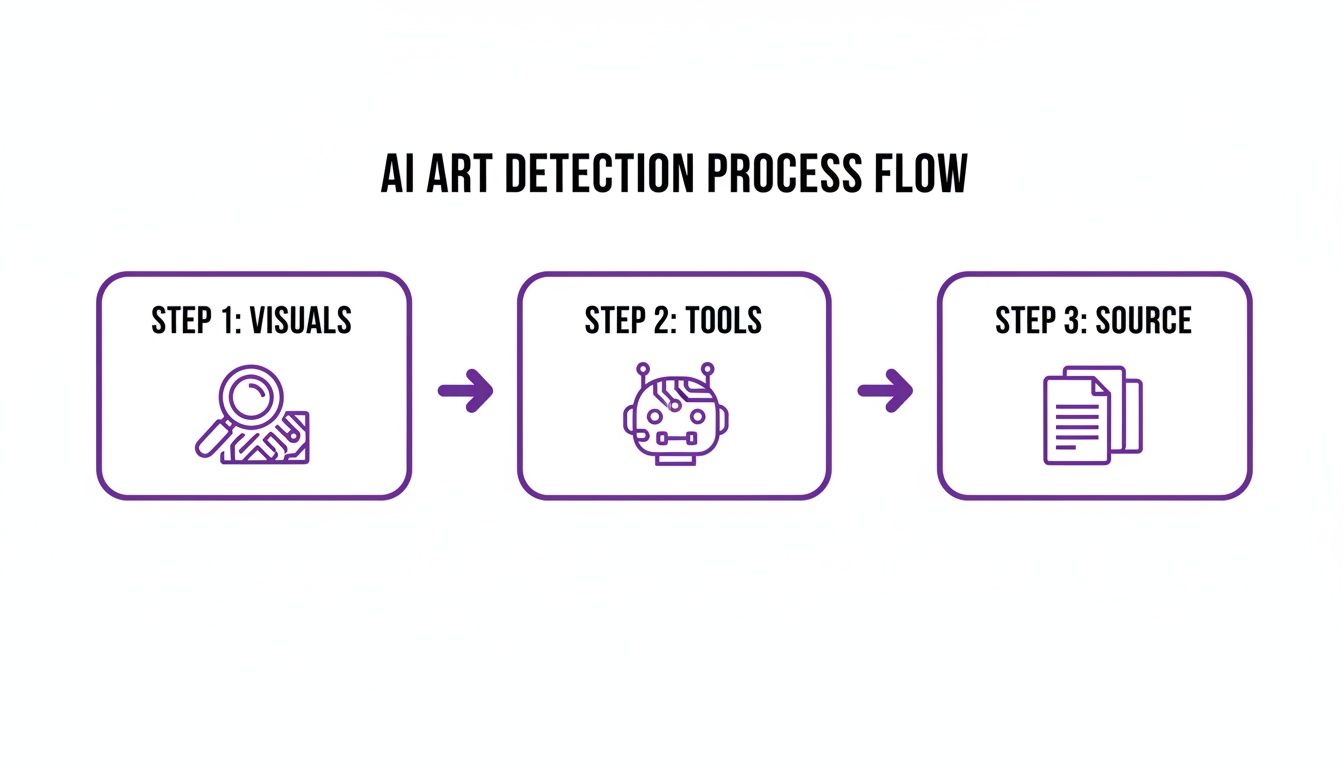
As you can see, it’s not about finding a single "gotcha" clue. Instead, it’s about collecting evidence from different angles to form a confident conclusion.
At its core, telling the difference between human and AI art is about looking for a story. Human art has a history, a process, and imperfections tied to its creator. AI art, for now, often lacks that coherent narrative.
To get started, it helps to have a mental checklist of what to look for. The table below gives you a quick side-by-side comparison of common traits you'll find in both human and AI art.
Human Art vs. AI Art Key Distinctions at a Glance
| Characteristic | Human-Created Art | AI-Generated Art |
|---|---|---|
| Imperfections | Contains natural flaws, brushstrokes, and asymmetries. The "human touch." | Often looks overly perfect, smooth, or has strange, illogical errors (e.g., extra fingers). |
| Consistency | Style is generally consistent, reflecting the artist's unique hand and vision. | Can have jarring inconsistencies in style, lighting, or texture within a single image. |
| Story & Context | Usually has a backstory, artist's statement, or portfolio of related work. | Lacks a verifiable creation process or a human artist's background. |
| Fine Details | Complex details like hands, text, and intricate patterns are rendered logically. | Struggles with complex details. Hands are notoriously malformed, and text is often gibberish. |
| Emotional Depth | Conveys specific, nuanced emotions rooted in human experience. | Can feel emotionally flat or generic, mimicking emotional cues without genuine depth. |
Think of this table as a quick field guide. As you spend more time analyzing different images, these distinctions will become second nature.
How to Spot the Telltale Signs of AI Art
Learning to spot AI-generated art is a bit like becoming a detective. At first glance, everything might seem perfectly normal, but once you know what to look for, the tiny, tell-tale clues start to jump out. AI models are getting scarily good, but they aren't perfect. They still make mistakes—subtle and sometimes not-so-subtle errors that betray their non-human origin.
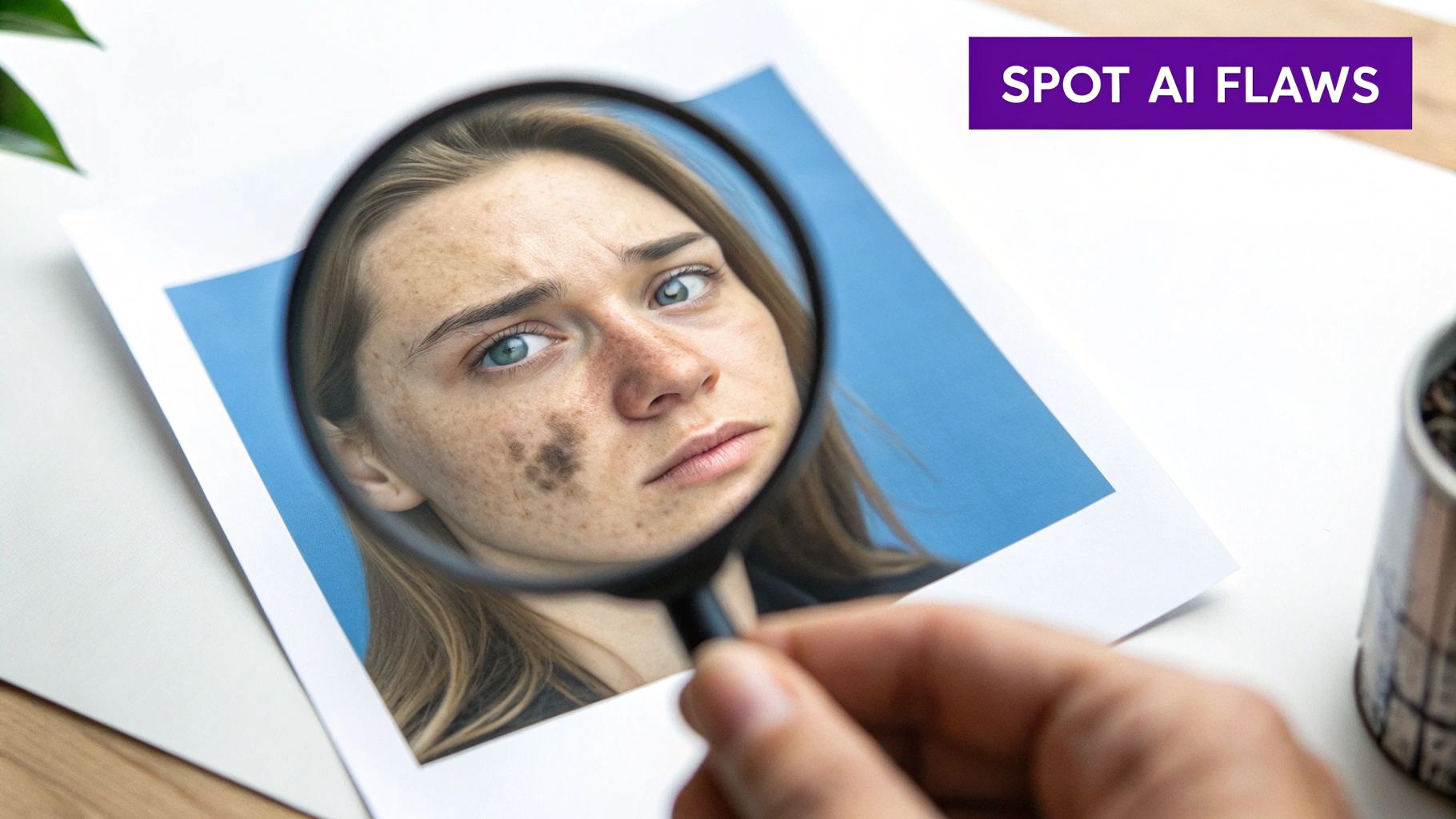
Don't feel bad if you get it wrong, though. It's a real challenge, and research shows that 38% of people can't reliably pick out AI-made pieces. The most common giveaways, like weird textures or wonky proportions, are becoming rarer as the tech improves. That's precisely why honing your own observational skills is so critical.
The Classic AI Flaws
Even the most advanced AI models still get tripped up by certain things, especially when it comes to the complex details of human anatomy and the laws of physics. If you know where to focus your attention, you can often find a giveaway pretty quickly.
- Hands and Fingers: This is the big one. AI has a notoriously difficult time with hands. Look closely for people with six fingers, missing digits, or hands that bend in impossible ways. Sometimes, you'll see a hand just sort of... melt into whatever it's holding.
- Eyes and Teeth: Zoom in on the face. Are the pupils perfectly round and do the reflections in them match? AI often messes this up, creating oddly shaped pupils or reflections that don’t make sense with the surrounding light. Teeth are another trouble spot—they might be freakishly uniform, oddly spaced, or look like one continuous strip of white.
- Hair and Ears: Hair often gives the game away. Individual strands might look like they're painted on, blending into a solid, plastic-like helmet. Ears are another complex feature AI struggles with, often producing bizarre cartilage shapes or lobes that connect to the head in unnatural ways.
Understanding a little about what prompt engineering entails can also give you an edge, as the instructions given to the AI directly influence the kinds of mistakes it might make.
Look Beyond the Subject
The main focus of an image—a person or an object—might be flawless. But often, the AI's mask slips when you look at the background details. This is where the machine's lack of real-world context and understanding really shows.
Keep an eye out for text on signs, books, or posters. AI is great at mimicking the look of writing, but it usually devolves into a nonsensical scramble of letters that don't form real words. You might also spot bizarre architectural choices, like a window that opens onto a brick wall or a staircase that leads to nowhere.
The uncanny valley isn't just about faces anymore. It’s in the way a shadow falls incorrectly, the texture of a brick wall looks too repetitive, or how a piece of jewelry seems to melt into the skin. AI mimics reality, but it doesn't understand it.
The "Too Perfect" Problem
Sometimes, the giveaway isn't a mistake but an impossible level of perfection. Real art, made by human hands, has flaws. It has texture, slight asymmetries, and happy accidents. AI-generated images can sometimes feel sterile and soulless because they lack these imperfections.
Be suspicious of skin that has no pores or blemishes, fabric with a perfectly repeating digital pattern, or a field where every single blade of grass is identical. This unnatural flawlessness is often a dead giveaway. Trust your gut—if an image just feels a little "off" or too good to be true, it probably is.
Turn to Technology: Using AI Art Detectors
Training your eye to spot the weird, uncanny details in AI art is a fantastic skill, but let's be honest—sometimes you need a more technical second opinion. This is exactly where AI art detection tools come into play. These services are designed to analyze an image for the subtle digital fingerprints and algorithmic patterns that our human eyes almost always miss.
Think of these tools as a digital forensics lab for images. They've been trained on millions of examples of both human-made and AI-generated art. When you upload a picture, the system compares it against all those known patterns and calculates the statistical likelihood that it came from an AI model.
How These Detectors Actually Work
AI detectors aren't just looking for six-fingered hands or garbled text. They go much deeper, analyzing the very fabric of the image file for artifacts left behind by the generative process.
- Unnatural Consistency: They're great at spotting unnaturally perfect textures or repeating patterns that just don't feel random enough for a human artist. It's a sort of digital tidiness that can be a dead giveaway.
- Frequency Analysis: Some detectors analyze an image's frequency domain—a concept from signal processing—to find patterns more common in synthetic media than in photos or digital paintings.
- Model-Specific Signatures: Different AI models like Midjourney or DALL-E 3 often leave their own unique, subtle traces. Think of it like a painter's brushstroke; some advanced tools can recognize these digital signatures.
A crucial thing to remember is that these tools provide a probability, not a definitive verdict. A high "AI-generated" score is a very strong clue, but it’s rarely the smoking gun all by itself.
Running a Detection: A Quick Walkthrough
Using a tool like our own AI Image Detector is designed to be simple. You just upload the image file you're curious about, and the analysis runs in real time.
Here's what the interface looks like once you kick off the process.
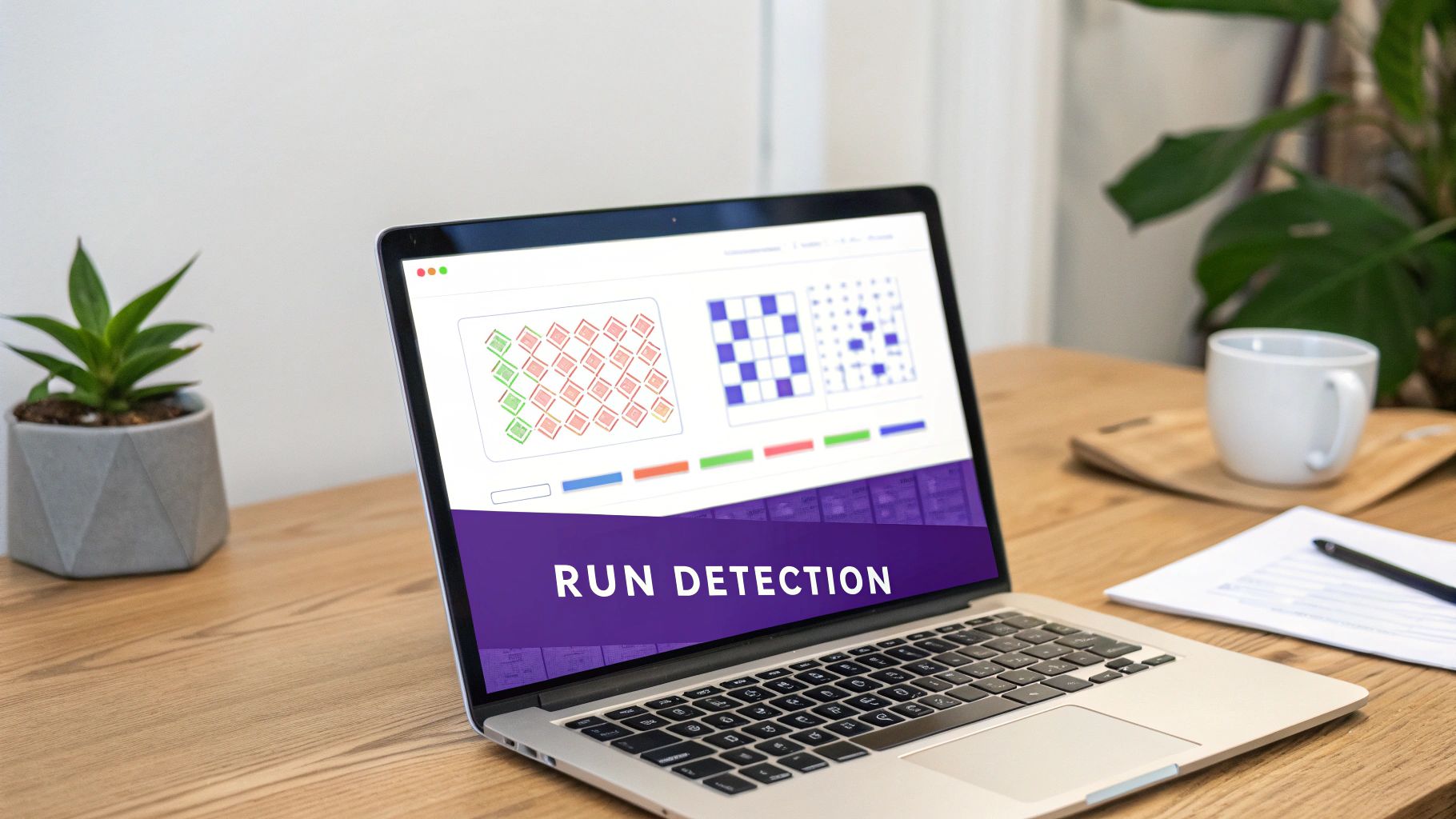
The result isn't a simple "yes" or "no." Instead, you get a confidence score, often on a scale from "Likely Human" to "Likely AI-Generated," which gives you a much better sense of the nuance involved.
I like to think of an AI detection tool as an expert consultant. It provides a highly educated opinion based on technical evidence. But you, the investigator, have to weigh that opinion alongside all the other clues before making a final call.
How to Interpret the Results Wisely
The score you get back from a detector is just one piece of the puzzle. It’s absolutely vital to use this data as part of a broader investigation, not as the final word.
The truth is, no detector is 100% accurate. Results can be thrown off by heavy image compression, extensive digital editing, or even hybrid workflows where a human artist incorporates AI-generated elements into their work.
For a deeper dive into how these tools work and the best ways to interpret their findings, check out our guide on how to use an image AI detector. Always combine a tool's output with your own visual inspection and research into the artwork's origin. That’s how you build the strongest possible case.
Investigating an Artwork's Origin and Provenance
Sometimes, the visual tells aren't enough. An image can look flawless, and the detection tools might be on the fence. When that happens, the most definitive clues often come from the story behind the artwork. This is where you put on your detective hat.
Tracing an image's origin, or its provenance, is just as critical as analyzing its pixels. A little bit of digging into the image's history and the supposed creator can often give you the answer when visual analysis alone falls short.
Your first move should be a simple reverse image search. Tools like Google Images or TinEye are perfect for this. You're looking for the earliest instance of the artwork online. Did it pop up first on a professional artist's portfolio, or did it make its debut on a Reddit forum dedicated to AI art experiments? Where it came from tells you a lot.

This kind of authentication isn't unique to the digital world. The same principles apply elsewhere. For instance, a good guide on how to spot fake antiques emphasizes verifying an item's history and origin—a mindset that's directly transferable to investigating digital art.
Examine the Artist's Digital Footprint
If there's an artist's name attached to the work, their online presence becomes your primary source. A real artist leaves a trail. You'll find a body of work, a history, and usually a clear progression of their style and skill over time.
Here's what to look for to verify a human creator:
- A Consistent Portfolio: Does this new piece fit in with the rest of their work? Be wary if an artist who has worked in one distinct style for years suddenly drops a flawless, photorealistic piece in a completely different genre. That's a potential red flag.
- Evidence of Process: Artists love to show their work. Look for sketches, time-lapse videos, or behind-the-scenes posts. This is the stuff that proves a human was involved, and it’s almost always missing with AI-generated images.
- Engagement and Discussion: See if you can find interviews, social media posts, or blog articles where the artist talks about their inspiration, their tools, and their techniques.
An artwork with a clear and verifiable history—an artist who talks about their methods, a portfolio that shows growth, and a consistent online presence—is far more likely to be human-made. AI art often appears suddenly, without a story or a creator willing to explain their process.
Digging into the Digital Details
Beyond the artist's profile, the image file itself can hold some surprising clues. I’m talking about metadata, which is the data embedded right into the file.
This data, often called EXIF data, can include hidden comments or tags from the software used to create it. It’s not uncommon to find a direct mention of "Midjourney" or "Stable Diffusion" tucked away in the file's information. Of course, this data can be easily removed, but when it’s there, it’s a smoking gun. To get deeper into this, we have a whole guide on how to check image metadata.
In the end, checking the provenance is all about finding the human story. Does this piece of art have a history? Is there a creator with a believable process and a digital trail that adds up? If you can't find these things, there’s a very good chance you're looking at something made by an algorithm.
Navigating the New Realities of AI in Art
The whole conversation around telling AI art from human art is getting tricky. The obvious tells we used to rely on? They're disappearing. Nowadays, many artists aren't just typing a prompt and calling it a day. They’re using AI as just one tool in a much bigger, more complex creative workflow.
We're seeing the rise of hybrid art forms, where the lines get really blurry. An artist might generate a rough composition with an AI, then pull that into a program like Procreate or Photoshop to spend hours digitally painting, editing, and refining it. They could even print it out, add physical paint, and then scan it back into the digital realm. The final piece isn't AI-generated or human-made—it's both.
The Creator and the Tool Are Merging
This new dynamic really messes with our old-school ideas of authorship and what makes art authentic. When AI is just one part of the process, the artist’s skill and vision are what truly matter. The question isn't a simple "Was AI used?" anymore. It’s become, "How was AI used, and what was the artist trying to achieve?"
For anyone in the art world—collectors, galleries, museums—this means you have to dig deeper. Provenance checks and detailed artist statements are no longer just formalities; they're essential. Understanding an artist's entire creative process is now the only way to grasp the work's context, originality, and, ultimately, its value. There's a huge difference between a one-click text-to-image output and a heavily manipulated hybrid piece, and learning to see that is a new kind of art literacy. To go deeper on this topic, check out our article comparing AI art vs. real art.
How the Market is Adapting
Despite all the hand-wringing and ethical debates, the art market is starting to embrace art that involves AI. When major auction houses like Christie's and Sotheby's start selling these pieces, you know a shift is happening. Serious collectors are showing interest, and that commercial validation is changing how people see this work—it's moving from a weird tech curiosity into a legitimate medium.
The real challenge ahead is not just detection, but interpretation. As AI becomes more integrated into the creative process, our ability to understand an artist's unique vision and how they use these new tools will define the next chapter in art history.
This isn't just talk; there's real money behind it. Projections show that AI-generated art could make up about 5% of the contemporary art market by 2025. Remember when that AI-generated portrait sold for $432,500 at a Christie's auction? That single sale showed a serious appetite from collectors. You can learn more about the stats behind AI's impact on the art market and see where things are headed. As the tech gets better, the ability to recognize the artist’s hand—whether it’s holding a physical brush or a digital stylus—will be what truly matters.
Common Questions About Spotting AI Art
Even with a solid workflow, it's natural to have questions. The tech and the conversations around it are moving incredibly fast. Here are some quick, straightforward answers to the questions we get asked most often.
How Accurate Are AI Detection Tools, Really?
This is the big one. The honest answer? No AI art detector is 100% accurate, and you should be skeptical of any tool that claims otherwise. How well they work really depends on a few things: the specific AI model that made the art, how much the image has been tweaked or compressed, and the quality of the detector's own training.
A good tool won't give you a simple "yes" or "no." Instead, it provides a probability score—think of it as a highly educated guess backed by technical evidence.
- High Confidence: A score showing 95% "Likely AI" is a very strong signal.
- Mixed Results: A score floating around 50-60% could mean a few things. It might be a hybrid piece where a human artist used AI as a starting point, or it could just mean the detector itself is on the fence.
Always treat a detector's result as one clue among many. It's a powerful data point, but it's rarely the whole story. You still need to combine it with your own visual inspection and provenance checks.
Is It Legal for Artists to Use or Sell AI Art?
This is where things get complicated, as copyright law is still catching up. Right now, the stance from the U.S. Copyright Office is that work generated entirely by an AI system from a text prompt cannot be copyrighted. The core reason is that copyright law is built around human authorship.
But, an artist can often claim copyright if they can show they've put significant human creativity into the final piece. For instance, if an artist generates an image but then heavily modifies it, paints over it, and combines it with their own original elements, that resulting artwork may be eligible for copyright.
The Bottom Line: The more human creativity and transformation that happens after the initial AI generation, the stronger the artist's claim to copyright. Just typing a prompt and selling the output as-is offers very little, if any, legal protection.
How Should I Approach an Artist I Suspect Is Using AI?
This is a delicate situation that calls for a bit of tact. Your goal should be to start a conversation, not to throw down an accusation. It's always best to lead with curiosity instead of suspicion.
A good approach:
- Ask about their creative process. Something like, "I love this piece! Could you tell me more about your technique or the tools you used?"
- Zero in on a specific detail. "The texture in the background is amazing. How did you achieve that effect?"
- Keep your tone positive and focused on your appreciation for the work.
What to avoid:
- Bluntly asking, "Did you use AI for this?"
- Calling them out publicly on social media without definitive proof.
- Demanding they show you their work-in-progress files.
Remember, many artists are integrating AI into their workflows in fascinating ways. An open and respectful question about their process is the best way to understand the full story behind the art you're admiring.
Ready to put your own detection skills to the test? With AI Image Detector, you can get a fast, reliable, and private analysis in just a few seconds. Upload an image now and see how it works.

