

AI Art vs Real Art A Complete Guide

The whole AI art vs real art discussion really boils down to one thing: authorship. Real art is a direct extension of a human’s skill, vision, and intent. AI art, on the other hand, is what happens when an algorithm translates a human's words into a picture. One comes from lived experience and emotion; the other is built from data patterns and pure logic.
Defining the Modern Canvas: AI vs Human Creation
Art has always been tied to technology. Think about the jump from charcoal to oil paints, or from canvas to the digital tablet. Today, the conversation is all about artificial intelligence—a tool that doesn't just help create, but actually does the creating. This forces us to ask some big questions about what "art," "artist," and even "creativity" really mean now.
What Makes Real Art, Real?
Real art—the kind made by human hands—is steeped in the creator's personal world. It’s the result of years of practice, physical dexterity, emotional vulnerability, and countless conscious choices. Every single brushstroke or pixel is placed with intent, even the "happy accidents." This process is deeply personal and one-of-a-kind.
How Is AI Art Different?
AI art is more like a collaboration. A person acts as the creative director, feeding the machine text prompts and setting certain rules. The AI model, which has been trained on a massive library of existing images, then generates the artwork based on those instructions. The skill isn't in the brushwork anymore; it's in prompt engineering and curation—knowing how to talk to the algorithm to get what you want. Tools like AuralumeAI for Modern Creation are great examples of how this new creative process works in practice.
This simple visual helps map out the core differences at a glance.
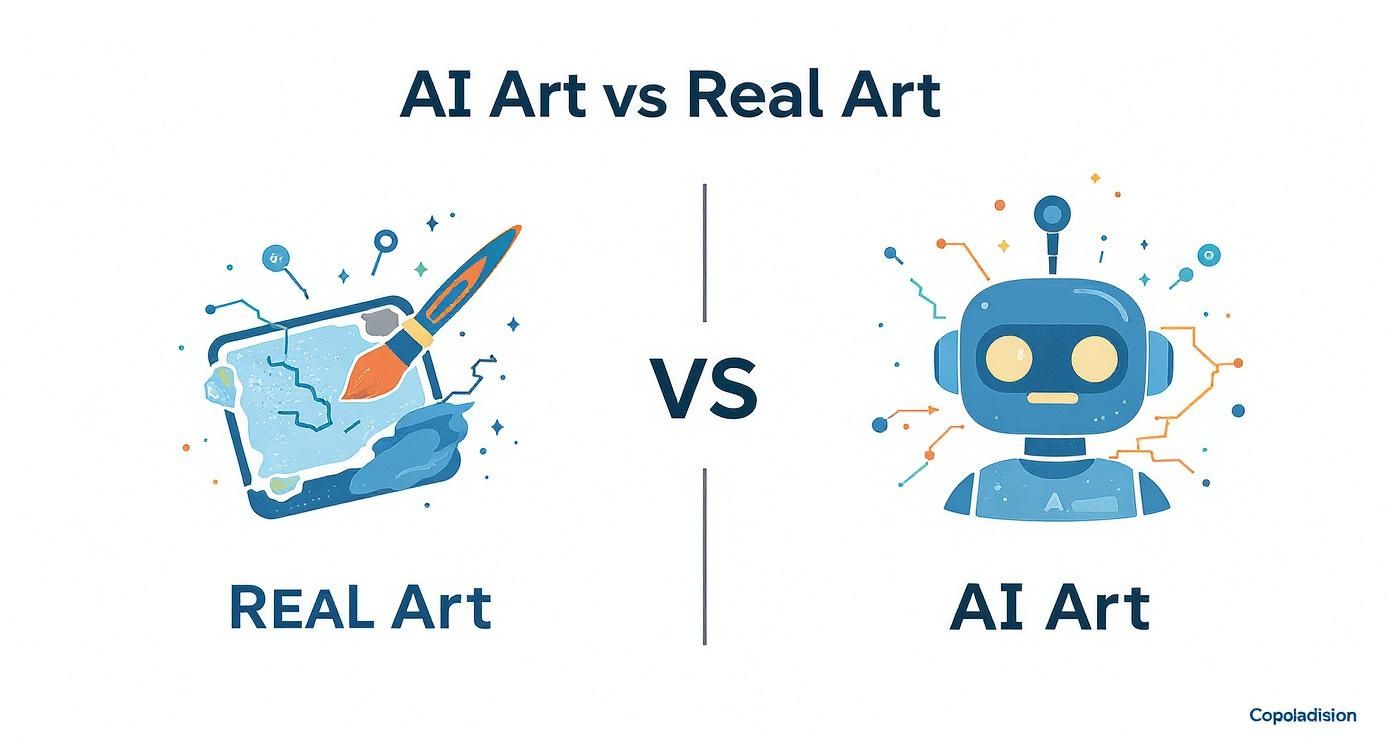
As you can see, the real split is the origin point: human feeling versus algorithmic interpretation. The rise of AI has kicked off a major debate, especially as AI pieces start fetching serious money, like the $1.08 million sale of 'AI God. Portrait of Alan Turing' at Sotheby’s. Critics worry that we're replacing a uniquely human creative process with something more like mechanical reproduction, which calls the very soul of art into question.
Core Differences AI Art vs Real Art
To really get to the heart of the AI art vs real art debate, we need to look at what sets them apart on a fundamental level.
The central question isn't whether machines can create, but whether their creations carry the same weight, intent, and story as something born from human hands and a human heart.
The table below breaks down these foundational differences, highlighting where each type of art gets its spark, how it's made, and who truly gets the credit.
| Attribute | Real Art (Human-Created) | AI Art (Machine-Generated) |
|---|---|---|
| Creative Source | Subjective experience, emotion, and personal history. | Data patterns from training sets and algorithms. |
| The Process | Direct, hands-on execution requiring learned technical skill. | Indirect guidance via prompts and parameter tuning. |
| Authorship | Clear and direct; the artist is the creator. | Ambiguous; a collaboration between the user and the algorithm. |
| Originality | Stems from a unique human perspective and interpretation. | A new combination of patterns learned from existing data. |
Ultimately, while both paths can lead to a stunning final image, their journeys from concept to creation couldn't be more different. One is a reflection of the inner world of a person, and the other is a reflection of the vast digital world it was trained on.
The Creative Spark: A Tale of Two Processes
The journey from a blank canvas to a finished work is where human and AI art diverge most profoundly. While both can end up with a stunning image, how they get there is fundamentally different. One path is a direct, hands-on conversation between the creator and their medium; the other is a guided, almost curated, collaboration with an algorithm.
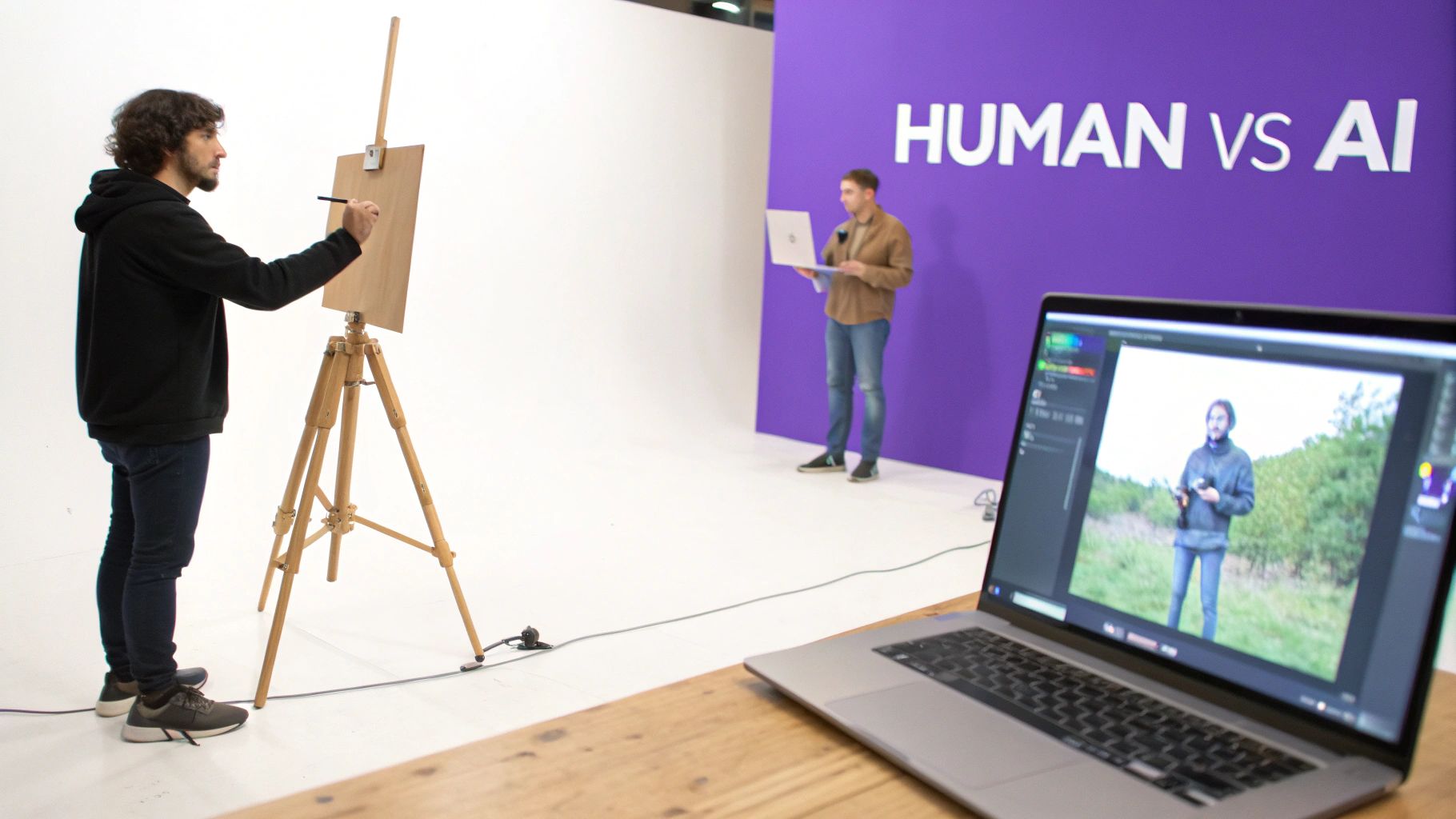
For a human artist, the workflow is an intensely personal and often messy affair. It all starts with an internal spark—an idea, a feeling, a fleeting memory—that they feel compelled to bring into the world. This isn't just about talent; it's about years of practice, learning the nuances of oil paint, mastering digital brushes, or understanding how clay behaves.
The Human Touch: A Journey of Intent and Happy Accidents
The human creative process is anything but linear. It’s an iterative dance of conceptualizing, sketching, composing, and finally, executing. Every step is a deliberate choice, but it’s also influenced by the artist’s mood, their personal history, and even the light in their studio. These elements leave an undeniable fingerprint on the final piece.
Sometimes, the best moments are unplanned. We call them "happy accidents"—a drip of ink, an unexpected color blend, or a slip of the hand that opens up a whole new direction for the artwork. This interplay between intention and pure chance is really the soul of human creativity.
The heart of human art is turning a subjective experience into a visual language others can feel. It’s a process built on direct touch, emotional investment, and the beauty found in imperfection.
This hands-on approach forges a deep, personal link between the artist and their creation. The final piece isn't just a picture; it's an artifact holding the artist's time, skill, and story.
The AI Method: Prompt Engineering and Curation
Creating with AI, on the other hand, is less about physical skill and more about strategic direction. The core competency shifts from hand-eye coordination to prompt engineering. This is the art of crafting detailed text descriptions to guide the algorithm, a creative skill that demands a rich vocabulary and a keen sense of how the AI model thinks.
The user really acts more like a creative director or a curator. They generate a batch of options and then select the one that best captures their vision. The typical workflow looks something like this:
- Writing an initial prompt: Detailing the subject, style, lighting, and mood.
- Choosing the right model: Picking an AI trained for a specific look, like photorealism or anime.
- Tweaking the parameters: Adjusting settings like aspect ratio or adding negative prompts to exclude unwanted elements.
- Iterating and refining: Rewording the prompt based on what the AI produces to get closer to the goal.
To really get a feel for this, playing around with different AI image generation tools is the best way to see this human-machine dialogue in action.
The table below really highlights how different these two worlds are.
| Workflow Stage | Human Artist (Direct Creation) | AI User (Guided Curation) |
|---|---|---|
| Concept Origin | An internal idea, emotion, or memory. | An external idea described in text. |
| Execution | Physical or digital manipulation of tools. | Writing prompts and adjusting software settings. |
| Refinement | Directly adjusting the work on the canvas. | Generating new images by changing the prompt. |
| Skill Set | Technical mastery, anatomy, color theory. | Language precision, conceptual vocabulary, curation. |
In the end, the distinction is crystal clear. A human artist is a builder, meticulously constructing an image from scratch with total control. The AI user is a collaborator, steering a powerful tool to assemble an image from a vast library of learned patterns. One is direct creation; the other is guided curation.
How to Spot AI-Generated Images
Telling the difference between human-made art and something an AI dreamed up is getting tougher by the day. But even the best algorithms leave clues—subtle fingerprints that give them away if you know where to look.
The trick is to hunt for details that just feel… wrong. Things that defy common sense, physics, or basic anatomy. AI models are masters of mimicry, but they often stumble when it comes to creating a cohesive, logical scene.
Identifying Anatomical and Physical Flaws
One of the classic AI giveaways has always been hands and teeth. For a long time, algorithms just couldn't get the complex geometry of fingers right, leading to images with six-fingered hands, digits that twist unnaturally, or a jumble of too many teeth in a smile.
While models are getting better, these types of errors still pop up. You'll also see other physical inconsistencies if you look closely:
- Impossible Lighting: Are the shadows pointing in the wrong direction? Does an object cast multiple shadows from a single light source? AI often messes this up.
- Unnatural Physics: Look for objects that seem to blend into each other, float without reason, or defy gravity. A common one is jewelry or clothing that appears to pass right through skin.
- Nonsensical Text: AI generators are famously bad at writing. Any text you see on signs, books, or clothing in the background is often a garbled mess of unreadable characters that just looks like language.
The most reliable signs of AI generation are often found in the details the human eye might initially gloss over. An algorithm can create a stunning portrait but fail to render a simple earring or a coherent background sign correctly.
These flaws shatter the illusion of a real moment captured in time. A human artist, even one with a wild, abstract style, usually works with an internal logic that AI still struggles to replicate.
Analyzing Textures and Digital Artifacts
Beyond outright errors, many AI images have a unique textural feel. Sometimes, it’s a kind of algorithmic perfection that feels too clean. Surfaces might appear overly smooth and waxy, lacking the tiny imperfections you'd expect from a real-world material or a painter's brushstroke. Skin, for example, can look unnaturally airbrushed, missing the pores and fine lines that make us human.
You should also be on the lookout for bizarre patterns and digital artifacts. You might spot repetitive textures that an algorithm has copy-pasted across a scene, or strange, blurry patches where the model struggled to blend two different ideas. These are the digital seams of the image, showing how the algorithmic patchwork was stitched together.
For a deeper dive into these visual cues, our guide on how to tell if art is AI-generated provides more examples and tips for manual checking. At the end of the day, spotting an AI image is about looking for what’s obviously wrong while also noticing what’s just a little too perfect.
Understanding the Market Impact of AI Art
The debate over AI art versus real art isn't just a philosophical one; it’s spilling over into the commercial art world, shaking the very foundations of how we define value, ownership, and an artist's livelihood. AI-generated works have moved from a niche tech curiosity to a disruptive market force, forcing artists, collectors, and galleries to rethink everything they thought they knew.
Make no mistake, the commercial power of AI art is here and now. We saw a major turning point back in 2018 when the AI-generated portrait 'Edmond de Belamy' fetched an astonishing $432,500 at a Christie’s auction. That sale sent a clear signal: the market was ready to put serious money behind algorithmically created pieces. It wasn't a fluke; it was the start of a trend.
This growing acceptance is carving out a brand new segment in the art market. Some projections even suggest that by 2025, AI-generated art could make up 5% of the total contemporary art market. That’s a significant slice of the pie, reflecting a real shift in what collectors and institutions are willing to buy. You can dig deeper into these market statistics and their implications to see the numbers behind the shift.
The Economic Ripple Effect on Artists
For working artists, the rise of commercial AI is a double-edged sword. On one hand, these tools open up new creative pathways. An artist can quickly mock up ideas, generate background assets, or experiment with styles in ways that were previously impossible. In commercial fields like marketing and design, that speed is a game-changer.
But on the other hand, that same efficiency creates a massive threat. Why would a business pay an illustrator for a week's worth of work when an AI can churn out dozens of polished options in minutes, for next to nothing? This is the tough economic question artists are facing, pushing many to reconsider their business models and double down on the value of genuine human creativity.
The core challenge for human artists is not to compete with AI on speed or volume, but to highlight the irreplaceable value of authenticity, emotional depth, and a unique personal vision—qualities an algorithm cannot replicate.
How AI Changes Market Dynamics
The flood of AI art into the marketplace is fundamentally altering how art is bought, sold, and appraised. The sheer volume alone can make it incredibly difficult for unique, human-made works to get noticed. Beyond that, fundamental concepts like provenance and authorship are becoming murkier than ever.
Here’s a quick look at the key market shifts:
- Valuation Models: Traditionally, a piece's value is tied to the artist's reputation, their skill, and the work's physical uniqueness. For AI art, value might come from the novelty of the technology, the intricacy of the prompt, or its viral cultural moment.
- Accessibility and Democratization: AI tools have dramatically lowered the barrier to entry, letting anyone create compelling images. While this is exciting, it also floods the market with content that can be generated almost effortlessly.
- Fraud and Authenticity: The ability to create convincing fakes is a huge risk. For buyers and collectors, figuring out if a piece is a genuine work by a human or an AI imitation is becoming a critical and often difficult task.
Ultimately, the market is in a state of flux. AI is opening up exciting new possibilities, but it's also creating real economic and ethical challenges. Whether you're a creator or a collector, understanding this new terrain is the only way to navigate the art world of tomorrow.
Tools for Verifying Digital Artwork
While a keen eye can still catch some of the more clumsy AI fakes, the models are getting smarter and better at hiding their tells. The line between AI-generated and human-made art has become incredibly blurry, and relying on manual inspection just doesn't cut it anymore. A sophisticated fake can sail right past even a seasoned expert, which is why we're seeing a growing need for specialized tools.
This is where algorithmic tools, or AI image detectors, come into play. They've become essential for anyone needing reliable verification. These platforms don't just look at the surface; they dig into the very structure of an image file. They're trained on massive datasets of both human and AI art, learning to spot the subtle statistical fingerprints that generative models leave behind.
How Algorithmic Detectors Work
An AI image detector doesn't "see" an image the way we do. Instead, it breaks it down, hunting for patterns that are invisible to the naked eye. The whole process is about analyzing key differences between how a camera sensor captures light, how a digital artist lays down pixels, and how a generative model "imagines" an image.
The analysis typically zeroes in on a few things:
- Digital Artifacts: AI models often introduce unique, nearly imperceptible artifacts. This could be a strange noise pattern or an unnatural smoothness in textures that shouldn't be smooth.
- Pixel-Level Analysis: Detectors look at the statistical relationships between pixels. AI-generated images sometimes have patterns that are a little too perfect or mathematically uniform compared to the beautiful, organic randomness you’d find in a real photo or a digital painting.
- Metadata Clues: While this data can be easily removed, some AI tools embed metadata signaling an image's origin. On the flip side, the complete absence of expected camera data (like EXIF info) can also be a red flag.
By weighing all these signals together, the detector spits out a probability score. This shifts the verification process from a gut feeling to a more data-driven conclusion.
A Practical Guide to Using an AI Detector
Using one of these tools is refreshingly simple. They're built for speed and clarity. Whether you’re a journalist fact-checking a source, an artist protecting your portfolio, or just a curious netizen, you can check an image’s authenticity in just a few seconds.
Here’s what the workflow usually looks like:
- Select Your Image: Grab the file you want to check. Most detectors handle common formats like JPEG, PNG, or WebP.
- Upload the File: Just drag and drop the image into the tool’s interface or browse for it on your device.
- Analyze the Results: The platform gets to work, processing the image and delivering a verdict, usually almost instantly.
The screenshot below gives you a good idea of what a typical results page looks like. It’s all about providing a clear, immediate probability score.
This kind of interface gets straight to the point. It gives you an immediate verdict—in this case, "Highly Likely AI-Generated"—backed by a confidence percentage, which helps remove the guesswork.
One of the biggest misconceptions is that AI detectors are infallible. It's better to think of them as powerful investigative tools. They provide a strong piece of evidence, but for the most accurate conclusion, you should always combine their findings with your own manual inspection and contextual analysis.
This technology is a crucial tool in the fight against misinformation, in spotting fraudulent listings on online marketplaces, and in upholding academic integrity. If you're looking to build this skill, you can learn more about how to detect AI images and the specific techniques involved. Ultimately, these detectors offer a vital layer of defense, making sure that in the ongoing AI art vs real art debate, we have what we need to tell human expression apart from algorithmic creation.
Navigating Copyright and Ethical Issues
AI art has exploded so quickly that our laws and ethical guidelines are struggling to keep up. This has thrown us into a messy gray area, sparking heated debates about who owns what, what's considered fair use, and how to prevent misuse. Much of the conflict in the AI art vs real art debate really boils down to these thorny questions.

Copyright law is right in the middle of this storm, mainly because it was written for human creators. The current stance from bodies like the U.S. Copyright Office is pretty clear: a work needs significant human authorship to get protection. Since AI-generated images are made by an algorithm following a text prompt, they often don't clear that bar.
What does that mean in practice? Many images made purely with AI might technically be in the public domain from the moment they're created. The person who wrote the prompt can't claim copyright. This creates a huge risk for anyone—businesses, artists, marketers—wanting to use AI art commercially. If you can't own it, you have no legal way to stop someone else from taking and using it. For a deeper dive, our guide on how to check if an image is copyrighted is a great resource.
The Training Data Dilemma
The single most divisive issue is how AI models are trained. These systems are fed billions of images scraped from across the internet, a dataset that inevitably includes countless copyrighted works from human artists. The problem is, this is usually done without the permission, knowledge, or payment of the original creators.
The central ethical conflict is this: AI art is built on the creative labor of human artists, yet the resulting technology often directly competes with them, creating a system many feel is fundamentally parasitic.
Artists and advocates for creators' rights see this as mass copyright infringement on a scale we've never seen before. On the other side, some AI developers argue it's similar to how a human artist learns—by studying the work of others to find their own style. This fundamental clash is at the heart of several major lawsuits that could completely redefine the future of creative AI.
Broader Societal and Marketplace Risks
Looking beyond copyright, AI art also introduces serious risks of misinformation and fraud. The technology makes it shockingly simple to create convincing deepfakes or photorealistic images of events that never actually happened. These fakes can be weaponized to spread disinformation, smear individuals, or build fraudulent online personas from scratch.
This threat bleeds directly into the art market. A scammer could use AI to generate art that perfectly mimics the style of a famous artist, then try to pass it off as an authentic piece. This not only cheats buyers out of their money but also damages the reputation and value of the real artist’s life’s work.
Key areas of concern include:
- Misinformation Campaigns: Using fake images to sway public opinion or stir up social unrest.
- Marketplace Fraud: Selling AI-generated works disguised as human-made art or forging the style of known artists.
- Identity Theft: Creating fake social media profiles with AI-generated headshots for scams or catfishing.
In the end, working with AI art means you have to be acutely aware of these legal and ethical minefields. The technology is incredibly powerful and holds immense creative potential, but using it comes with a responsibility to think about its impact on artists, authenticity, and the very idea of truth in our visual world.
Frequently Asked Questions
As AI-generated images become more common, it's natural to have questions about where this technology fits into the creative world. Let's tackle some of the most common queries that come up in the AI art vs. real art conversation.
Can AI Art Be Genuinely Creative?
This question really gets to the heart of the matter. An AI model doesn't have a consciousness, memories, or feelings, so it can't be "creative" in the way a person can. What it does do, and does incredibly well, is synthesize patterns from the vast amount of data it was trained on to create something new that looks creative to our eyes.
The real creative spark, however, comes from the person behind the keyboard. The act of crafting an imaginative prompt, refining the output, and curating the final image is a creative process in itself. In this sense, the creativity is a product of human-machine collaboration, not something born from the algorithm alone.
Will AI Replace Human Artists?
It's a valid concern. AI will absolutely change the game for commercial art, especially in fields like graphic design, advertising, or concept art where certain tasks can be automated. But it's highly unlikely to replace artists whose work is built on a unique perspective, emotional resonance, and the story of their own life.
The value of real art is often tied to the artist's unique vision and the human story embedded in the creation process—qualities that AI cannot replicate. It will likely become a tool that artists use, not a replacement for them.
How Is the Value of Art Determined Now?
The arrival of AI art has definitely stirred the pot. For traditional, human-made art, the fundamentals of value haven't changed much. An artist's reputation, technical skill, the piece's history (provenance), and its cultural weight are still the primary drivers of its worth.
For AI-generated images, the concept of value is much more experimental. It could be based on how novel the image is, the cleverness of the prompt that created it, how viral it becomes online, or if it captures a specific cultural moment. The market for AI art is still finding its feet, and what gives these pieces long-term value is a hot topic for collectors and critics alike.
Ready to verify your images with confidence? AI Image Detector provides fast, accurate analysis to help you distinguish between human creation and AI generation. Get your free analysis and check your images now.


