

AI Image Detection: What a Score Can Prove

AI image detection gives journalists and platform teams a probability, not a verdict on authorship. Human viewers can also be unreliable at spotting generated images, and their accuracy may fall sharply for images from some newer generators.
A high score is evidence, not a certificate. It is strongest when the file is intact; resizing, compression, or rebuilding an image on screen can weaken the signals a detector reads. Treat the score like a clue, preserve the file being assessed, and avoid claiming more than the evidence supports.
What AI Image Detection Can and Cannot Say
In a large benchmark, people identified real images and AI-generated images correctly 61.3% of the time, while the strongest model in that framework still failed about 13% of the time, according to the benchmark write-up on arXiv. Human accuracy varies across studies, and neither a viewer's judgment nor a detector's score settles who made an image.
AI image detection estimates whether a whole frame or a particular region shows signs of synthetic generation or editing. It cannot identify the product, prompt, or person behind the file. A detector's score is more like a metal detector's beep: it points to a signal, not ownership or authorship.
Use four bands, and record the result before a platform re-encodes the file.
| Verdict | What it suggests | What it does not prove | Next step |
|---|---|---|---|
| Likely human | Consistent with a camera capture or ordinary human editing | Legal authorship or that no tool touched the file | Keep the original and note the source |
| Likely fully synthetic | Generator-like artifacts across most of the frame | Which model, prompt, or person produced it | Corroborate with the publisher or creator |
| Likely AI-assisted edit | Local signs such as fill, sky swap, face retouch, or upscale | That the entire photograph is fake | Review the suspect region, not only the score |
| Indeterminate | Signals weakened by compression, crop, screenshot, or conflict | A clean bill of health or a fake label | Escalate to human review and provenance |
How to read each band
Likely human means the frame-wide texture and noise are consistent with a camera capture or ordinary editing. It does not establish who owns the image, and a screenshot may obscure the traces a detector relies on.
Likely fully synthetic means generator-like clues appear across most of the frame. That pattern does not identify a specific tool or author.
Likely AI-assisted edit points to local changes, such as a replaced sky, generative fill, face retouching, or upscaling. The untouched parts may still come from a photograph.
Indeterminate is a useful outcome when compression, cropping, or conflicting signals make a firm label unreliable. The file may not support a clear conclusion.
Practical rule: Record the band and keep the earliest available original. A later social-media download is a different piece of evidence.
How Models Spot Synthetic Image Artifacts
A score only means something if you know which layer produced it. Detectors do not “see a fake.” They compare the file with traces learned from paired training: real photos set against synthetic outputs from several generators.
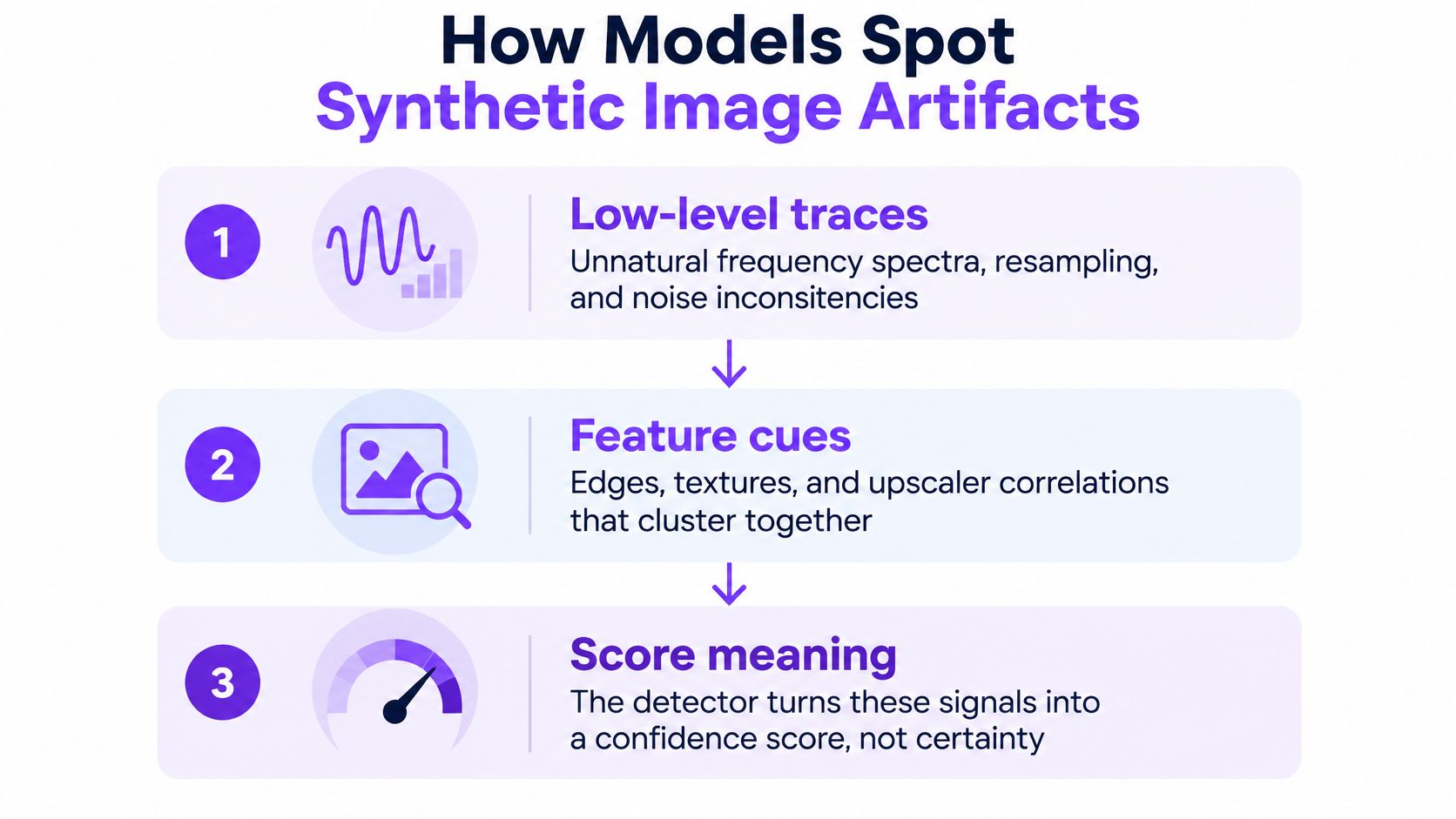
Three layers, from quiet to obvious
Low-level traces are the ones people miss. Diffusion models often leave a frequency spectrum that is too smooth, noise that is oddly even, resampling correlations from an upscaler, and texture statistics that lack the grit of a sensor. A CNN such as ResNet-50, or a ConvNeXt backbone, can lock onto those patterns without ever “understanding” the scene.
Mid-level inconsistencies are geometric. Light on a cheek may disagree with the shadow on the collar. A reflection may miss the object that should cast it. Hair, fabric, or skin can repeat a micro-pattern. Straight edges, window frames, or a curb can fail perspective by a few pixels. A documents examiner checks paper fibers and ink before judging the signature. This layer is the fibers.
Semantic oddities are what a glance catches first: warped lettering, extra fingers, melted stairs, nonsense text on a receipt or a settings screen. Modern generators hide those mistakes. A clean glance is weak evidence, not a pass.
What the number actually is
Families you will see in papers mix those checks. Some stay with a CNN classifier. Others add a higher-level semantic pass so a pretty frequency match cannot ignore a broken scene. The reported confidence is similarity to the learned traces, placed on a spectrum from likely human to likely AI-generated.
It is not the probability that someone committed fraud, and it is not a warrant.
A 90 on an untouched PNG can describe traces that a new generator never learned to leave.
That is the failure the next test exposes: a fingerprint memorized on one family of models can vanish on another.
Why Same Generator Tests Mislead
A near-perfect lab score often means the detector and the test set share a family. GenImage, introduced in 2023, holds more than one million paired real and AI images across eight generator subsets, as described in the GenImage benchmark paper. When training and testing stayed on one generator distribution, accuracy consistently exceeded 98.5%, reaching 99.9% for Stable Diffusion 1.4 and Stable Diffusion 1.5.
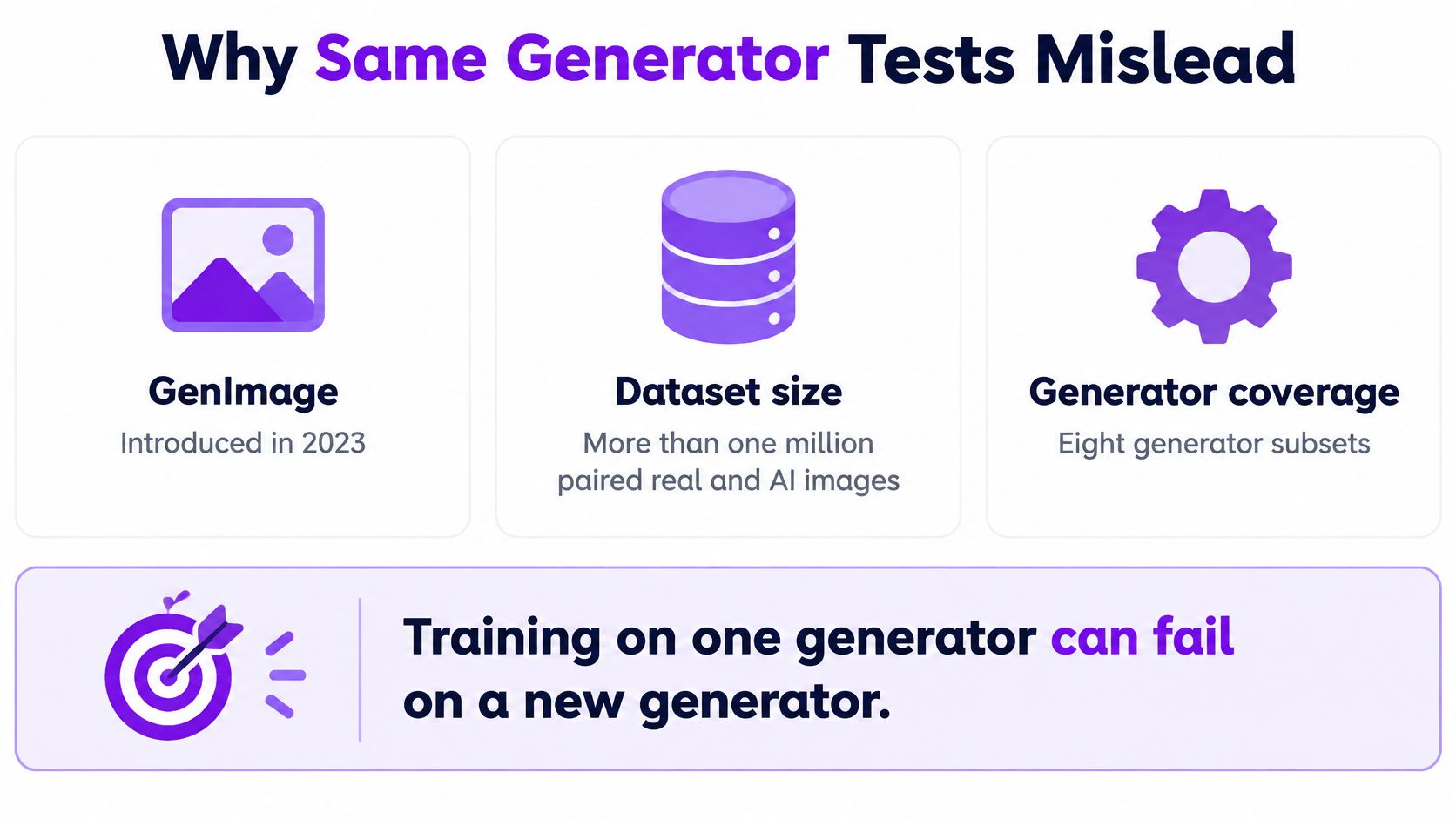
The same approach does not travel. A ResNet-50 trained on Stable Diffusion 1.4 and tested on Midjourney fell to 54.9%, only modestly above a coin flip. The model had memorized one family's frequency habit and texture tic. It had not learned a universal mark of synthetic origin. That gap has a name: generator shift.
| Test | Detector or setting | Accuracy | What changed |
|---|---|---|---|
| GenImage, same generator | Trained detectors | Above 98.5%; 99.9% on SD 1.4 and 1.5 | Train and test on one family |
| ResNet-50 cross-generator | Trained on SD 1.4 | 54.9% on Midjourney | Unseen generator |
| ConvNeXt, four dataset conditions | Benchmark system | 98.5%, 95.8%, 77.1%, 99.1% | Data distribution shifted |
| 17 leading detectors, 2025 benchmark | Leading systems | About 58% | Two sets with unseen or shifted data |
What to demand before you trust a headline
The bottom rows exist because the test left the training family. A ConvNeXt system can sit near the ceiling on one set and drop to 77.1% when the data changes. A 2025 check of 17 leading detectors, on about 166,000 images, reached only about 58% on two evaluated sets. More pictures from generators you already know do not buy skill on a generator you have never seen.
Ask for splits by generator, by content type, and by transform. Treat uncertain as a real output. Forcing yes or no on an unseen model turns a coin flip into a published claim.
How Compression and Edits Break Signals
Those traces are fragile. A score on a social download is not the score on the file someone uploaded. The benchmark note on text-rich synthetic images is blunt about why: GenImage already tests low resolution, blur, and JPEG, and later work finds severe JPEG sensitivity on posters, receipts, tables, and interface shots.
What each ordinary step erases
JPEG recompression quantizes high-frequency coefficients. That is exactly where many generator fingerprints live. A second save at a lower quality throws more of them away.
Resize or downscale rewrites pixel neighborhoods and adds aliasing. An upscaler clue can look like a camera, or a camera can look resampled. Do not line that file up against a full-size benchmark score.
A screenshot runs the picture through a new renderer. The display pipeline can drown the original fingerprint. Prefer indeterminate unless other evidence agrees.
A crop drops neighboring texture and context. You can judge only what remains.
Light sharpening or a filter pushes edge statistics. A human photo can look processed. A synthetic one can look crisp. Treat it as processed, not as a clean original.
| Handling | Signal it changes | How to treat the score |
|---|---|---|
| JPEG recompression | High-frequency coefficients | Weaker; note the quality if known |
| Resize or downscale | Pixel correlation and aliasing | Do not compare with a full-size benchmark |
| Screenshot | A new rendering pipeline | Prefer indeterminate unless other evidence agrees |
| Crop | Context and neighboring texture | Judge only the remaining region |
| Light sharpening or filters | Edge statistics | Treat as processed, not as a clean original |
Testing has to include several JPEG qualities, resize ratios, screenshot crops, recompression, and light sharpening, not only clean PNGs. Put those conditions beside the score, with a calibrated range. A high mark on an untouched benchmark image does not travel through a marketplace pipeline. How those losses show up in the pixels is covered in this guide to image compression artifacts.
Once a platform recompresses the file, indeterminate is often the honest band. Scaling the training set does not put discarded frequencies back.
Keep the earliest file and its metadata. That copy is the one worth scoring.
Reading Accuracy, Precision and False Alarms
A single percentage hides three different questions. Accuracy is the share of all calls that were correct. Recall is the share of synthetic images the detector catches. Precision is the share of flagged images that really are synthetic.
The number that hurts people is the false positive rate: real photos wrongly flagged as AI. That is the student accused, or the photographer discredited, on a balanced test that still looks excellent in a slide.
Say a detector catches 490 of 500 synthetic images and wrongly flags 20 of 500 real photos. On that balanced set, accuracy is 97%. Precision is about 96%. Twenty real photographs are still accused. The headline did not mention them.
Threshold and calibration
The threshold is the cutoff that turns a score into a verdict. Move it up and you miss more synthetics. Move it down and you accuse more real files. A claim is meaningless until you know the cutoff used.
Calibration asks a plainer question. When the tool says 90%, is it right about 90% of the time on held-out images from the kind of files you receive? If the 90s are right only half the time, the number is a rank, not a probability.
Before you quote a vendor or a paper, ask for three things:
- Per-class results: Separate numbers for real photos, fully synthetic frames, and edits, not one blended score.
- The threshold: The cutoff behind any yes or no, plus what happens if you move it.
- A confidence interval: The range on the test that matches your generators and your JPEG pipeline.
A short walk-through of how those terms fit together sits in this explainer on performance metrics. If a study will not show the threshold, do not publish its percentage as if it were yours.
Mixed Images Editors Actually Receive
Desks rarely get a pristine generator PNG. They get a wire photo, a listing, a scan, or a screenshot, and the score still cannot settle authorship.
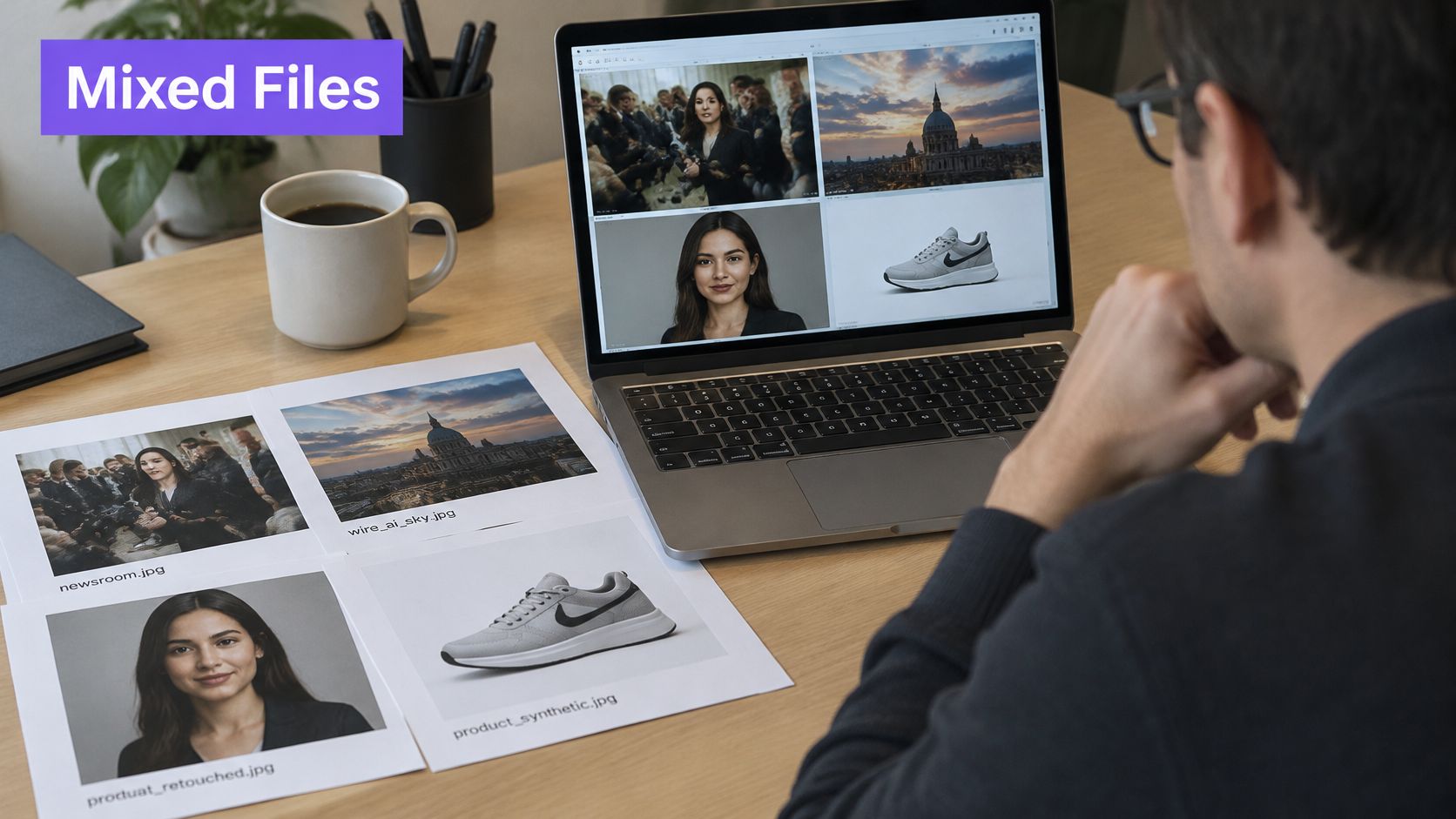
Say a photographer files a street scene and an editor swaps the gray sky for a blue one. The people and the pavement can be a real capture. The honest band is likely AI-assisted edit, not fully fake. If you confirm the swap, the caption should say the sky was altered. The score does not prove the street never existed.
Generative fill that extends a wall, a beauty retouch on a portrait, and an upscaler on an old scan share that class. Synthetic involvement sits in part of the pipeline. Teams making an ai fashion photoshoot hit the same split: a real model, a generated backdrop, or both. Name the region. Do not let one number condemn the whole frame.
A marketplace thumbnail built entirely by diffusion, including invented product text, fits likely fully synthetic. You still cannot name the seller's tool, the prompt, or who clicked generate.
The trap is a screenshot of a poster, a receipt, or a chat window. Text-heavy content plus a second render makes localization unreliable, and a model may react to the subject rather than the origin. The 2025 AIGIBench benchmark reports significant performance drops on real-world data after degradation and preprocessing, even when controlled tests look strong. A separate 2025 benchmark of 166,000 images found that 17 leading detectors reached only about 58% on two evaluated sets, largely because systems overfit known generators. More training data does not reliably fix a file whose pipeline you cannot see.
What you still cannot claim
Detection estimates synthetic involvement. It does not prove copyright ownership, and it does not prove a student wrote nothing themselves. When the method cannot point at a region, say so, and send the file to a person.
Where Newsrooms and Platforms Use Detection
The band is allowed to trigger a pause. It is not allowed to finish the decision.
A journalist sees a viral hospital photo that arrived as a screenshot. The score can hold publication while someone calls the photographer or the wire. It cannot treat that screenshot as the camera original. Label an illustration when the band is fully synthetic and a creator confirms it. A practical set of fact-checking tools for journalists belongs next to the detector, not instead of the phone call.
An instructor gets a poster flagged likely synthetic. That flag starts a conversation: ask for the working file, the drafts, or the prompt history. A flag on a class poster does not, by itself, prove misconduct.
Trust-and-safety and marketplace reviewers queue listings, profile photos, and product shots. Fully synthetic product imagery can break a listing rule even when nobody's face was faked. An indeterminate result goes to a reviewer, not an automatic ban. Brands already mix generated scenes into campaigns, which is why it helps to see how brands use AI in advertising before you write a policy that treats every synthetic pixel as fraud.
Legal, compliance, and ID-check workflows carry the highest bar. A detector can support suspicion that a document photo is synthetic. Acceptance or rejection still needs the capture process and the issuer. Artists use the same tool defensively, checking a client file or a scraped image for generative traces before they license it.
High-stakes cases get a human. Fast triage is the job of the score. The ban, the grade, and the front page are not.
How to Choose a Detector and Check a File
Buy against the limits you already know, then verify every claim with the vendor. Do not assume a marketing page matches the build you will upload to.
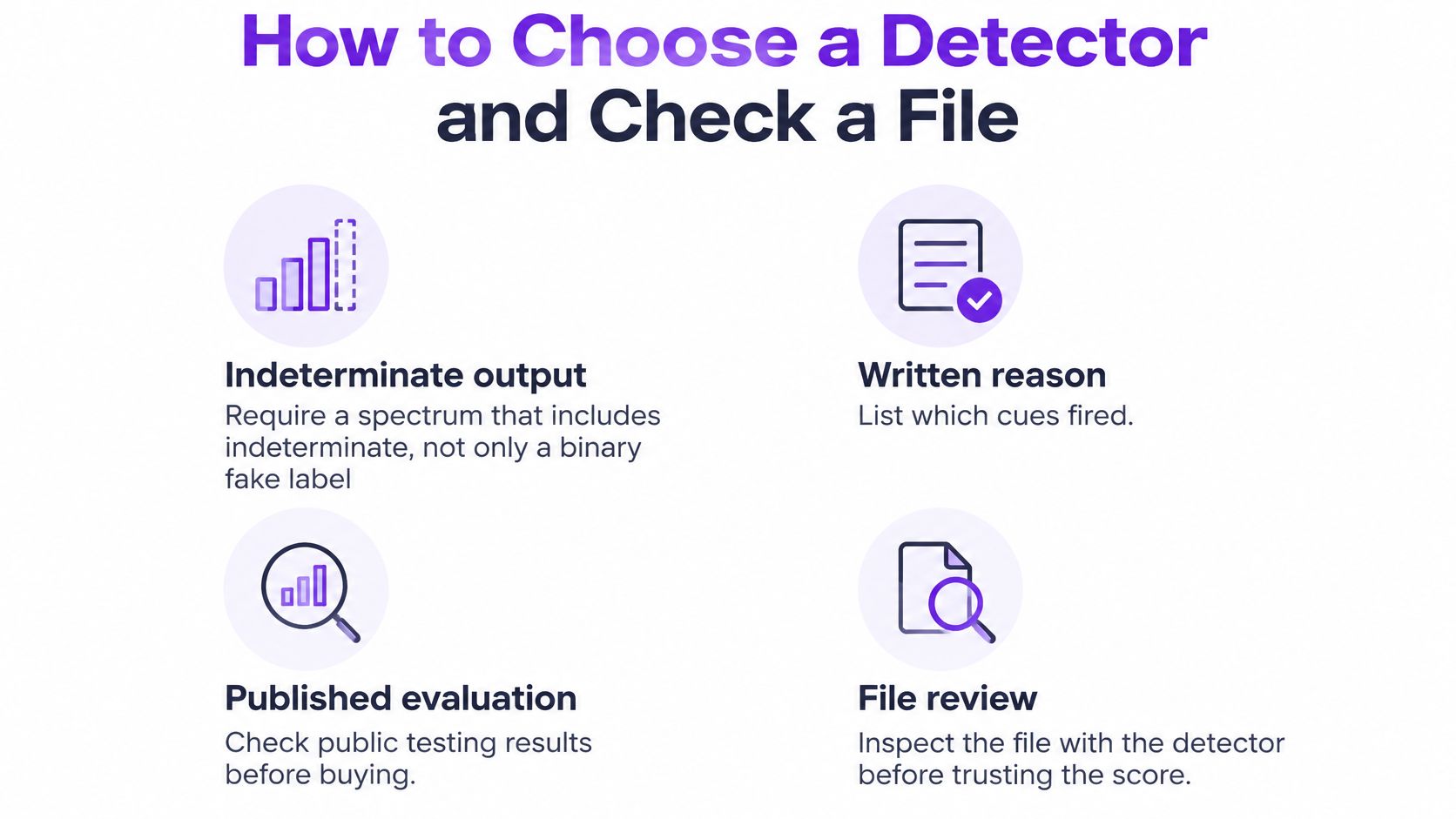
Indeterminate has to be an output. A tool that only prints “fake” or “real” will invent certainty on screenshots.
A written reason has to list which cues fired. A naked percentage cannot be challenged in an editorial meeting.
Published tests have to include unseen generators plus JPEG, resize, and screenshot inputs. In-family accuracy is not that test.
The privacy policy has to fit confidential news or student work: what is stored, and for how long.
AI Image Detector is one candidate to run against that list for a first pass. Check its current formats, file-size limits, storage practices, and pricing on its own site before you rely on them. A plain visual guide to how to spot AI-generated images is a useful companion for the cues a model may mention and a person should still look for.
A five-step first check
- Save the earliest file. Do not recompress it “to make it smaller” before the test.
- Upload that copy. Read the band and the written reasons, not the headline number alone.
- If the file is a crop, a screenshot, or a heavy JPEG, downgrade confidence one band.
- If the stake is publication, a grade, a ban, or an ID decision, add a person and a source check.
- Log the verdict, the handling history, and what remains unknown. The log is the decision. The raw percentage is not.
AI Image Detector gives journalists, editors, and platform teams a confidence score and a written verdict on whether an image looks human-made or synthetic, so you can treat the result as evidence rather than a certificate. Use it to triage a file, then keep the original and add a person whenever the stake is high. Try a file at AI Image Detector.


