

AI vs Real Life: Spotting Fake Images Today

People correctly identify AI-generated images in only about 63% of cases, and the bigger practical problem is that professionals can overestimate how reliable their own judgment is. In other words, the central challenge in AI vs real life isn't merely seeing a strange hand or an artificial face. It's knowing when human confidence deserves verification.
That conclusion runs against the popular image of the expert fact-checker who can expose a synthetic picture at a glance. A large-scale study collected 749,828 observations and 34,675 comments from 50,444 participants. Participants identified AI-generated images correctly in 76% of observations and authentic photographs in 74%, but performance varied dramatically by image. AI-image accuracy ranged from 32% to 99%, while real-photo accuracy ranged from 28% to 92% (large-scale human perception study).
The operational lesson is uncomfortable: a confident decision can still be a weak decision. For journalism, education, commerce, and moderation, image verification needs a repeatable process that combines visual examination, technical evidence, automated analysis, and documented human review.
The Human Perception Gap in AI Detection
Human observers aren't consistently poor at recognizing synthetic images because they lack intelligence or experience. They fail because image authentication is a judgment task under uncertainty, and modern generators can produce photographs that don't offer one obvious giveaway. A second global-scale analysis of more than 287,000 image evaluations by over 12,500 participants found an overall success rate of 62%, meaning participants misidentified roughly 110,000 images (global image evaluation analysis).
The result matters more than any individual visual trick. A person may correctly identify a distorted reflection in one image and confidently misclassify a convincing portrait in the next. The task changes with subject matter, compression, viewing conditions, and the observer's expectations.
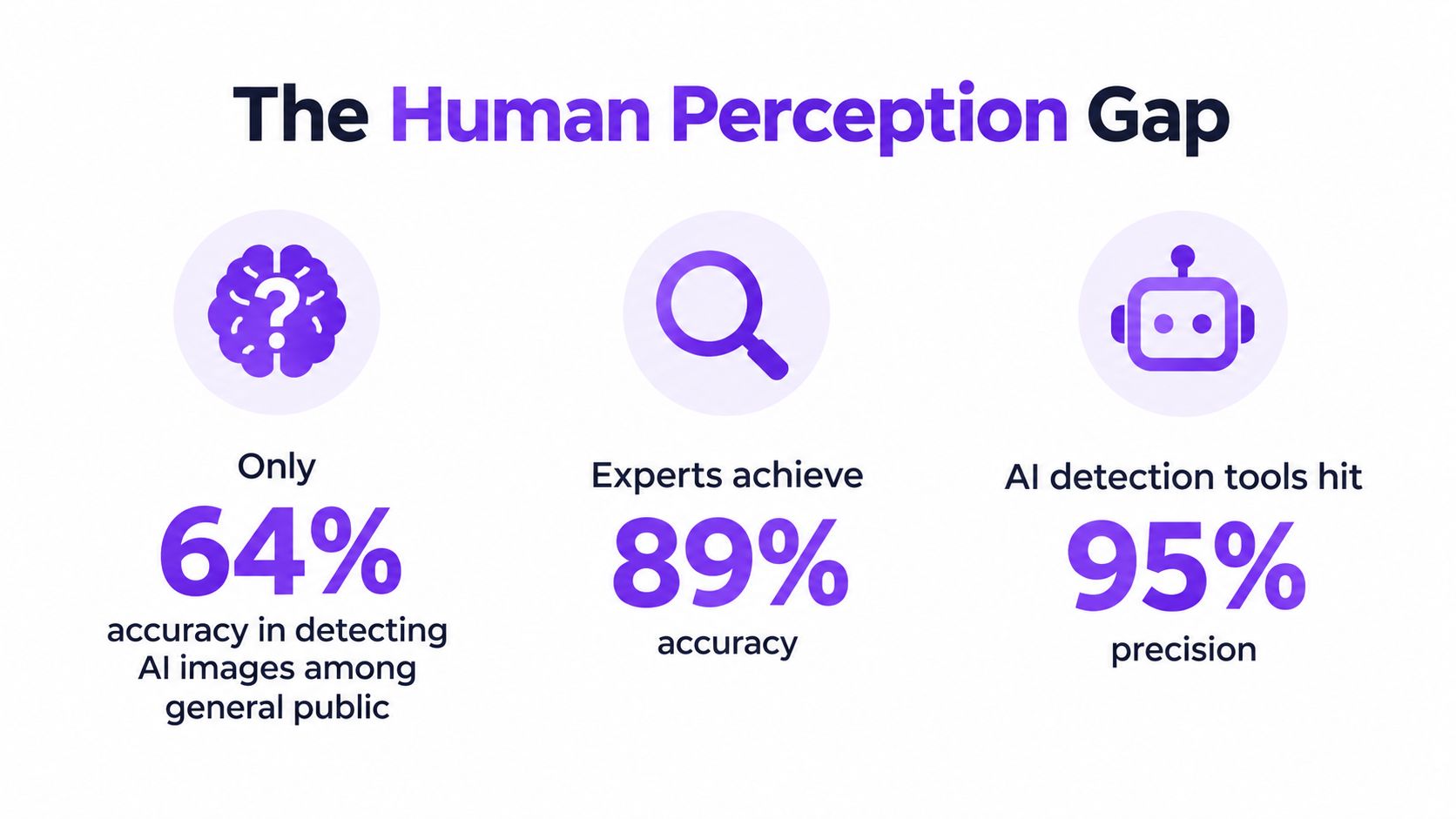
Accuracy is not the same as certainty
The most important gap is psychological. A mixed-methods study involving 746 participants found image-authentication accuracy between 47.0% and 55.5%, close to chance even among experienced viewers (study of human image authentication). That means expertise may improve attention without guaranteeing a dependable verdict.
A separate 2026 U.S. survey found an average detection score of 0.07 on a scale from -1 to 1, effectively random guessing, while nearly half of respondents believed they would pass the test (confidence and deepfake detection survey). The practical risk is overconfidence. A newsroom editor, admissions officer, or marketplace reviewer may not merely make an incorrect call. They may make it quickly, document it as fact, and act against the person represented in the image.
Practical rule: Treat confidence as a reason to check the evidence, not as evidence itself.
The research also shows why speed changes outcomes. In the large perception study, only 17% of diffusion-model images were misclassified as real at rates consistent with random guessing, but that misclassification rose to 43% when viewing time was limited to one second (large-scale human perception study). A thumbnail in a fast-moving feed creates a different verification environment from a high-resolution image reviewed at a workstation.
| Study scope | AI image accuracy | Real photo accuracy | Participants |
|---|---|---|---|
| Large-scale perception study | 76% | 74% | 50,444 |
| Global image evaluation analysis | 63% | Not specified | Over 12,500 |
| Mixed-methods authentication study | 47.0% to 55.5% overall | Not separated | 746 |
The distinction between probability and certainty is therefore central to responsible review. A useful explanation of that distinction appears in probability versus certainty in image detection, where a detector result is treated as an assessment rather than an unquestionable fact. In high-stakes work, the right question isn't “Does this look fake?” It is “What evidence supports this classification, and what would change my mind?”
Visual and Technical Differences Between AI and Real Photos
Visual inspection still has value, but it works best as triage rather than proof. Analysts should look for clusters of inconsistencies across lighting, texture, geometry, and image structure. One suspicious detail can result from editing, resizing, or a camera limitation. Several unrelated inconsistencies deserve a technical check.
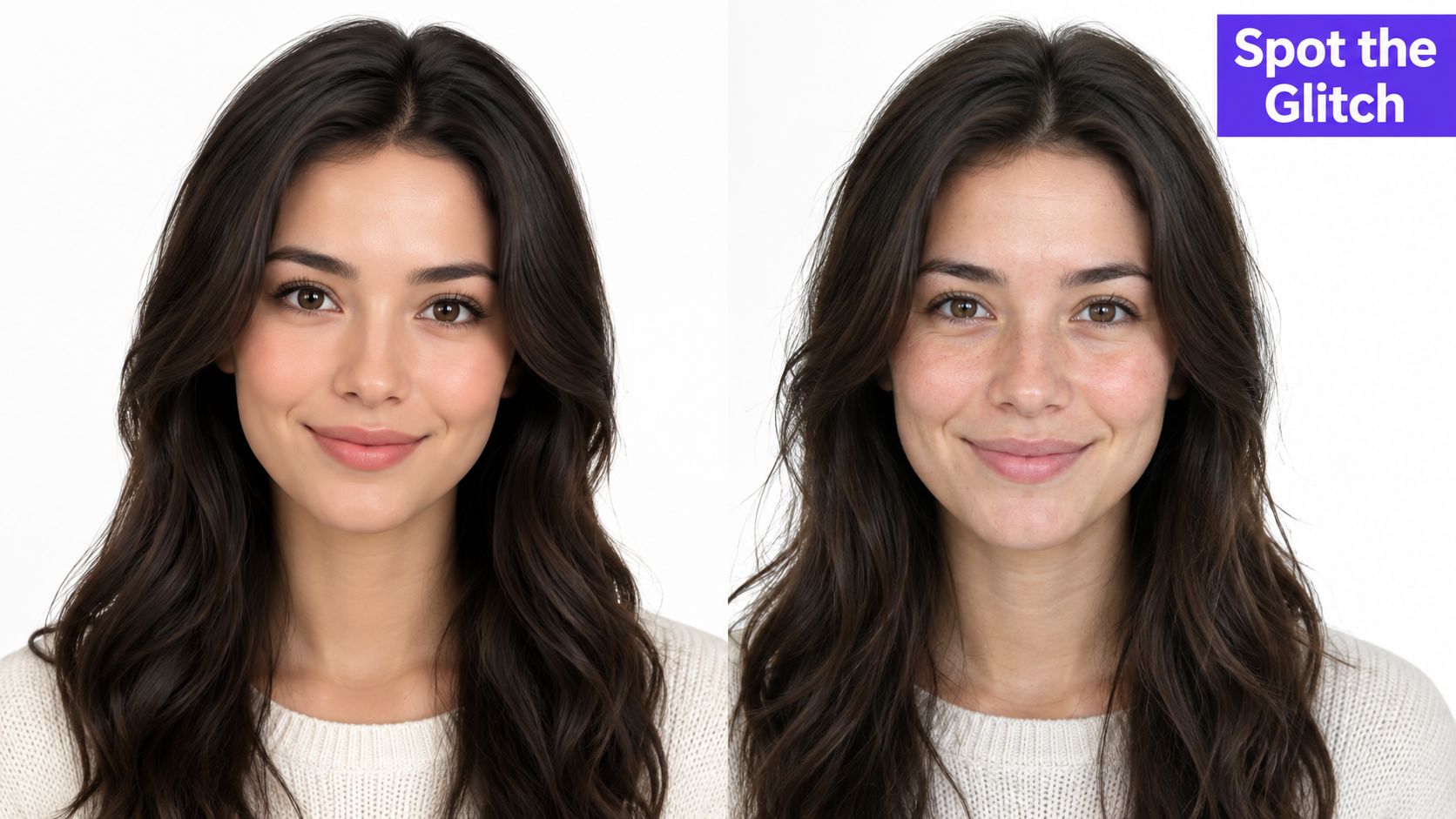
Compare the physical story inside the frame
A real photograph records a scene through a lens and sensor. Every visible object participates in the same physical environment, even when the camera or editing process introduces imperfections. Synthetic images often approximate that relationship convincingly, but local elements may not agree with one another.
| Artifact category | Real-life photography tends to show | Synthetic imagery may reveal |
|---|---|---|
| Lighting | Shadows, highlights, and reflected light follow a shared direction | A face, object, or background may appear lit from incompatible sources |
| Texture | Skin, fabric, hair, and surfaces carry irregular detail linked to focus and exposure | Texture may repeat, melt, become overly smooth, or change without a physical reason |
| Geometry | Objects preserve coherent perspective and attachment points | Jewelry, glasses, fingers, teeth, or architectural lines may merge or bend |
| Reflections | Mirrors, windows, and polished surfaces reflect the scene consistently | Reflections may omit, duplicate, or distort objects that should be visible |
| Edges | Focus and depth of field create gradual, optical transitions | Hair, clothing, and background boundaries may show unnatural blending |
| Backgrounds | Distant objects remain recognizable even when blurred or partially hidden | Text, crowds, signs, and repeated structures may lose logical continuity |
Lighting deserves special attention because it connects several clues at once. Check the direction of the main shadow, the brightness on the subject's face, the color cast on nearby surfaces, and the apparent source of highlights. If a person stands under a strong overhead light but their nose, cheek, clothing, and cast shadow imply different directions, the image deserves further review.
Texture can be more revealing than a dramatic anatomical error. Look closely at hair strands, skin pores, woven fabric, foliage, and small repeating surfaces. Generators may create a convincing impression at normal viewing size while producing local repetition, unstable detail, or a surface that shifts from sharp to liquid without a camera-based explanation.
Use technical clues without treating them as verdicts
Sensor noise and compression patterns can help analysts understand an image's history, but they don't automatically establish authenticity. A screenshot, social-media upload, export, or editing pass can remove or alter useful information. Analysts should preserve the original file when possible and distinguish between the image's visual content and the way it was delivered.
Metadata and EXIF information can provide context about a camera, timestamp, software, or editing history. Missing metadata isn't proof of generation, since many platforms strip it. Present metadata isn't proof of authenticity either, since it can be changed or copied.
A visual artifact is a lead. A consistent chain of evidence is a conclusion.
Compression deserves its own caution. Resizing and repeated encoding can create halos, block boundaries, ringing, and softened details that resemble generator artifacts. A practical guide to image compression artifacts helps separate delivery damage from evidence about how the image was created.
The strongest manual review asks whether the entire image tells one coherent physical story. It doesn't hunt for a single famous flaw. It compares the subject, environment, illumination, perspective, texture, and file history before assigning confidence.
Systematic Verification Workflows for Professionals
A professional workflow should reduce two errors at once: accepting synthetic content as authentic and accusing authentic content of being fabricated. The process below deliberately moves from inexpensive observation to tool-assisted analysis and then to accountable human review.
Start with preservation and inspection
First, preserve the submitted file and record where it came from. Don't overwrite the original by opening, editing, or exporting it through another application. Create a working copy for enlargement and inspection, then note the source, claimed context, and any accompanying text.
Second, inspect the image without deciding too early. Look at faces, hands, text, reflections, shadows, repeated textures, and background geometry. The purpose isn't to declare the result human or synthetic. It's to identify questions that an automated tool or source check should address.
Third, examine available metadata and the file's delivery history. Metadata may be absent or incomplete, but it can still reveal whether the file passed through editing software or whether the claimed camera context is plausible. Keep negative findings in the record as well.
Add automated analysis
At this stage, upload the preserved working copy to a detector that provides a confidence range and explanatory indicators rather than a bare binary label. AI Image Detector is one option. It analyzes uploaded JPEG, PNG, WebP, and HEIC images up to 10MB, returns a verdict across a Likely Human to Likely AI-Generated spectrum, and states that analysis occurs in real time without storing images on its servers. Its core detection is available without registration, while an API supports platform-scale workflows.
Don't use one output as a substitute for judgment. Compare the tool's explanation with the visual observations. If the detector identifies synthetic texture but the image has undergone heavy compression, record compression as a competing explanation and seek the original before escalating.
| Step | Action | Tool required | Time estimate |
|---|---|---|---|
| 1 | Preserve the original and inspect visual artifacts | Image viewer and case record | Brief |
| 2 | Review metadata and file history | Metadata viewer, when available | Brief |
| 3 | Run automated detection and save the result | Detector or internal API | Usually seconds |
| 4 | Reconcile evidence and document the decision | Human reviewer and evidence log | Depends on risk |
The exact time will vary with image quality, file access, and the consequences of a wrong decision. A low-risk social post may need a light review. A disputed image in a publication, investigation, or account-fraud case needs source corroboration and a second reviewer.
Record uncertainty instead of forcing a binary answer
A useful case record contains the file identifier, source, claimed context, observed anomalies, metadata findings, detector result, reviewer, and final rationale. Use categories such as likely human, likely synthetic, and inconclusive when the evidence doesn't justify certainty.
Teams handling recurring reviews should standardize this record and refine it through workflow optimization for image verification. The goal isn't to make every case identical. It's to make the reasoning visible, comparable, and reviewable when a decision is challenged.
Use Cases Across Journalism Education and Commerce
The same image can require different verification thresholds depending on what someone will do with the result. A casual viewer deciding whether to share a humorous post has limited exposure. An editor publishing an alleged eyewitness image, an instructor evaluating evidence, or a marketplace approving a seller profile faces consequences that justify deeper review.
Journalism
Journalists should separate three questions: Is the file synthetic, does the image depict what the caption claims, and is the underlying event real? A human-authored photograph can still be miscaptioned, staged, old, or taken from another location. Detection addresses only part of that chain.
Editors can use visual inspection to flag inconsistencies, automated analysis to prioritize review, and source verification to test provenance. A detector's “likely AI” result should lead to requests for the original file, photographer contact, contemporaneous material, and independent corroboration. A “likely human” result shouldn't remove the need to verify date, location, and context.
The editorial record should preserve both the evidence and the uncertainty. If a newsroom labels an image as synthetic, the wording should reflect what was established, what remains unknown, and whether the conclusion concerns the whole image or only an edited portion.
Education
Teachers and academic researchers face a different problem. An AI-generated image in an assignment may indicate unauthorized assistance, but it may also be a permitted illustration, a student experiment, or an image that was altered after creation. A detector can identify a signal in the file, but it can't determine intent or whether an institution's policy was violated.
A fair process gives the student an opportunity to provide drafts, source files, prompts where relevant, or an explanation of the work. Instructors should compare the image with the assignment requirements and the student's broader submission rather than treating a single automated score as disciplinary proof.
This approach protects academic integrity while avoiding a false accusation based on an uncertain classification. It also teaches a valuable skill: students need to understand that digital evidence requires provenance and interpretation, not just visual confidence.
Commerce and trust and safety
Marketplaces and social platforms encounter volume, repetition, and adversarial behavior. Synthetic profile images can support impersonation, fake listings, romance scams, counterfeit branding, or coordinated account networks. Here, detection works best as one signal in a broader risk system.
Platforms can combine image analysis with account history, listing consistency, identity checks, user reports, and manual escalation. A suspicious profile picture shouldn't automatically trigger an irreversible penalty. It can instead prompt an additional verification step, limit reach while a review is pending, or request an original image captured through a controlled flow.
For high-volume operations, API integration can place image checks near upload or account-creation events. The model's role is triage and prioritization. Human reviewers should handle contested cases, high-value accounts, and decisions that affect access to income or reputation.
Ethical and Legal Considerations in Image Verification
Calling an image fake can harm a real person. A false positive may damage a journalist's source, a student's standing, an artist's reputation, or a seller's access to a platform. That risk makes a hybrid standard more defensible than either manual inspection or blind automation.
Evidence must match the consequence
A low-confidence signal may justify further questions, but it shouldn't automatically justify public labeling or account removal. The more serious the consequence, the more independent evidence the reviewer should require. That may include original files, provenance records, witness confirmation, reverse-image research, or review by someone who wasn't involved in the first decision.
Detection systems can also behave differently across image types, generators, edits, and delivery formats. Benchmarking therefore needs more than a single headline accuracy figure. Modern evaluation emphasizes cross-generator generalization, resilience to degraded data, and metrics such as accuracy, precision, recall, F1, ROC-AUC, and equal error rate, with suites such as GenImage using paired real and synthetic images across 1,000 ImageNet-aligned classes (survey and benchmark discussion).
Privacy and transparency matter
Organizations should minimize collection, restrict access, and explain how uploaded images are analyzed. People should know whether an image is retained, whether results affect automated decisions, and how they can challenge an outcome. Privacy protection isn't an optional feature when images may contain faces, homes, identification documents, or sensitive events.
Legal obligations vary by jurisdiction and use case, so teams should obtain qualified advice before using detection results in employment, education discipline, identity decisions, or litigation. The safe operational assumption is that a detector supplies probabilistic evidence. It doesn't establish authorship, intent, consent, copyright ownership, or the truth of a caption by itself.
Documentation standard: Write down what the tool found, what the reviewer observed, what alternative explanations were considered, and why the final action was proportionate.
The practical objection is that trained reviewers can spot obvious fakes without tools. They sometimes can. But the evidence on human authentication shows that even experienced viewers can perform near chance, while rapid viewing increases error. A tool won't eliminate judgment failures, but a documented tool-assisted process makes them easier to detect, contest, and correct.
Making the Right Verification Decision
Verification intensity should follow risk, not curiosity. For low-stakes content, inspect the image, question the context, and avoid sharing it as fact when uncertainty remains. For journalism, education, and disputed commercial content, preserve the file, inspect it systematically, review metadata where available, run automated analysis, and document the decision.
A practical decision ladder looks like this:
- Low consequence: Perform a visual and contextual check before sharing or reposting.
- Moderate consequence: Add metadata review, automated analysis, and a written rationale.
- High consequence: Seek original files and independent corroboration, use a second reviewer, and keep an auditable evidence record.
- Platform scale: Integrate detection into intake or moderation systems, but route ambiguous and contested cases to trained people.
Avoid two symmetrical mistakes. Don't assume that a strange detail proves generation, and don't assume that a clean-looking face proves authenticity. Don't treat a detector score as a final verdict, but don't reject systematic tools just because manual inspection feels faster.
The decisive recommendation is simple: use human judgment to frame the question, automated analysis to surface evidence, and documented review to make the final decision. That standard fits the reality of AI vs real life, where visual quality changes quickly and confidence often outruns accuracy.
AI Image Detector analyzes images for signals associated with AI generation, provides a confidence-based verdict, and supports formats including JPEG, PNG, WebP, and HEIC without storing uploaded images on its servers. Visit AI Image Detector to test a file, establish a repeatable review process, or explore API-based verification for higher-volume workflows.


