

Anti AI Art: The Growing Movement Defending Digital Artists

The anti-AI art movement isn't about Luddites smashing the machines. It's a direct response from artists and their supporters who are pushing back against the unethical way many commercial AI models are built—by scraping copyrighted images without asking for permission, giving credit, or offering any payment.
This is a movement focused squarely on creative rights in a world that's automating faster than our laws can keep up. The core issue isn't technology itself, but how it's being used. It's about preserving the value of human skill, hard work, and intellectual property.
Why Artists Are Taking a Stand
At its core, the anti-AI art movement is a fight for fairness. Artists aren't afraid of new tools; they're demanding accountability from the tech companies building these powerful generative AI systems. The central argument is simple: you can't just build a multi-billion dollar product on the back of billions of scraped images without the consent of the people who made them. Doing so completely guts the creative economy.
Think of it this way: imagine a famous author finds out her entire library of novels was fed into an algorithm to create a "story generator." That generator can now churn out books in her exact style, for free, and she never sees a dime or even gets a mention. That's precisely what's happening to visual artists right now. Their unique styles, their years of practice, and their copyrighted portfolios have become free fuel for commercial algorithms.
To better understand the movement's foundation, it helps to look at its core pillars. These are the central issues that unite artists, advocates, and consumers who are concerned about the future of creative work.
Core Pillars of the Anti AI Art Movement
| Core Issue | Who Is Affected | Desired Outcome |
|---|---|---|
| Data Scraping & Consent | Every artist with work online | Artists must give explicit permission (opt-in) for their work to be used in AI training datasets. |
| Lack of Compensation | Professional artists and illustrators | Fair payment or royalties for creators whose work contributes to a profitable commercial AI model. |
| Copyright & Style Mimicry | Creators with unique, recognizable styles | Stronger copyright protections to prevent AI from perfectly replicating an artist's style without permission. |
These three pillars—consent, compensation, and copyright—form the bedrock of the protest. They're not radical demands; they're a call to apply longstanding principles of creative ownership to a new technological context.
This isn't just some niche debate happening in online art forums. It's a critical conversation about the future of all creative professions. Data has become the new oil, and our collective digital footprint is being mined for corporate profit. The outcome here will set a huge precedent for how we value human creativity for generations.
As this debate heats up, being able to distinguish between what a machine generates and what a person creates is more important than ever. The lines can get blurry, which is why digging into the nuances of AI art vs real art provides crucial context. This is ultimately a fight for a future where technology empowers human artists, instead of unethically replacing them.
The Protests That Ignited the Movement
Every movement has its flashpoint. For the anti-AI art community, it wasn’t a meeting or a manifesto, but a simple, powerful graphic that went viral. This single image became a digital rallying cry, uniting thousands of artists and turning scattered frustrations into a coordinated global campaign.
What began as online chatter quickly snowballed into a full-blown protest. The movement’s strength wasn't in its complexity but its clarity: a demand for consent, credit, and compensation from tech companies harvesting art without permission. That core message struck a nerve, setting the stage for major showdowns with the very platforms artists had long called home.
ArtStation and the Digital Picket Line
The real momentum kicked off when Bulgarian illustrator Alexander Nanitchkov posted the first ‘No To AI-Generated Images’ graphic on December 5, 2022. Spreading with the hashtag #notoaiart, this grassroots action quickly jumped to major creative hubs like DeviantArt and ArtStation. Within weeks, artists were flooding these sites with protest images, a clear show of solidarity against what they saw as unethical AI development. You can get an in-depth overview of the anti-AI movement and its evolution here.
One of the most visible battlegrounds was ArtStation, a top-tier portfolio site for professionals in the gaming and entertainment industries. In a unified move, users started replacing their portfolio pieces with Nanitchkov's now-iconic "NO TO AI GENERATED IMAGES" graphic. The platform's homepage, usually a curated gallery of stunning human talent, was suddenly a sea of red "NO" symbols.
This digital picket line sent an unmistakable message. When ArtStation responded by removing the protest images and citing terms of service violations, it only threw fuel on the fire. Artists saw it as censorship—an attempt to silence a legitimate grievance—which only intensified the protest.
DeviantArt and the DreamUp Controversy
Another critical moment unfolded on DeviantArt, one of the web's oldest and largest artist communities. The platform’s decision to launch its own AI image generator, DreamUp, triggered immediate and widespread outrage from its user base.
The heart of the problem was the revelation that DreamUp was trained on users' own artwork without their explicit consent. Artists felt betrayed; their life's work had been used to build a commercial tool that threatened to devalue their skills.
The backlash was swift and decisive. Users organized, spoke out, and threatened a mass exodus from the platform. In what was seen as a major victory for the movement, DeviantArt walked back its policy, making all user artwork opted-out of AI training datasets by default.
This timeline highlights the key events that have shaped the anti-AI art movement, from the initial online protests to the landmark legal challenges that followed.
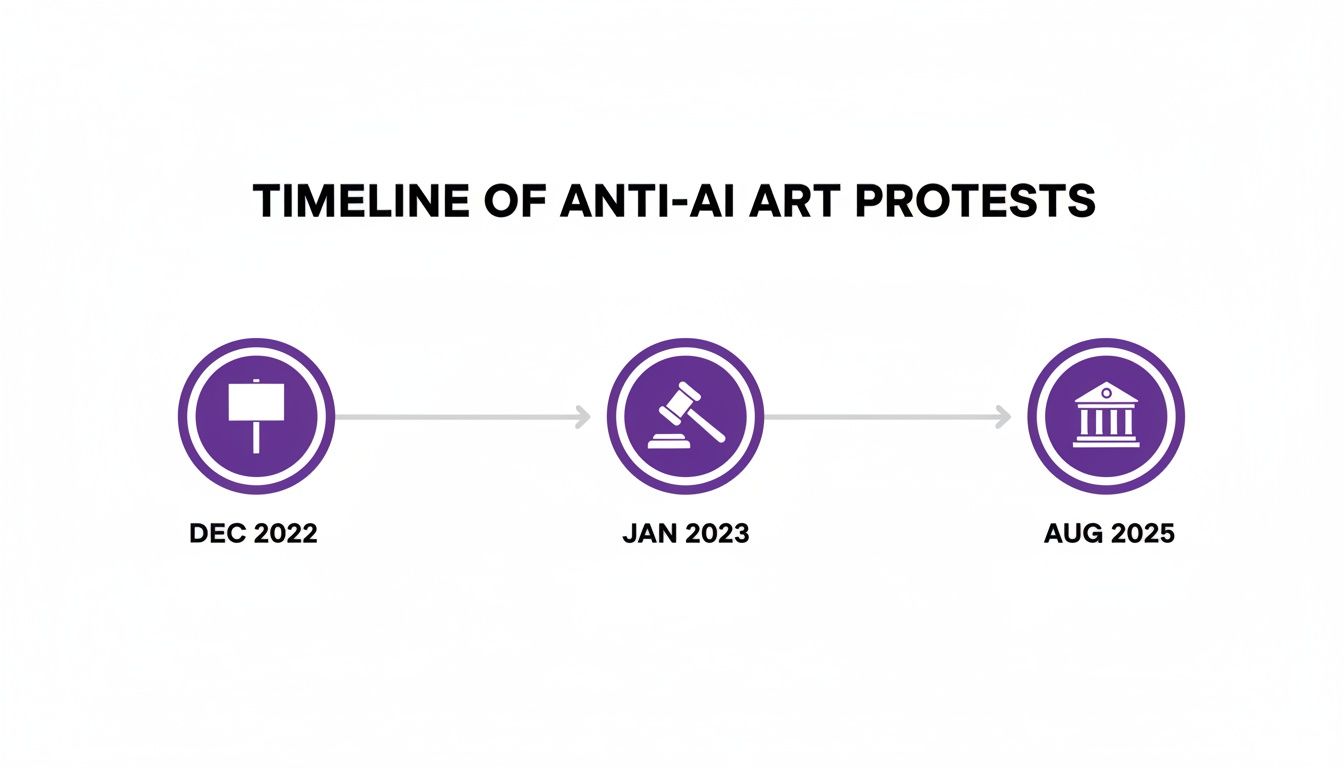
The visual shows a clear escalation, tracing how grassroots activism in late 2022 paved the way for the high-stakes legal battles that stretched into 2025.
From Hashtags to Lawsuits
As the movement grew, its focus shifted from platform protests to the legal system. By 2023, the fight had officially moved to the courtroom, marking a new, more serious phase where major legal precedents were on the line.
Two landmark cases are now at the center of this fight:
- Class-Action Lawsuit: In January 2023, three artists filed a class-action lawsuit against Stability AI, Midjourney, and DeviantArt. Their argument is that these companies infringed on the rights of millions of artists by using their work to train AI models without any permission.
- Getty Images vs. Stability AI: In a separate but related case, stock photography giant Getty Images sued Stability AI. The lawsuit alleges that the company illegally copied more than 12 million of its licensed photos to train the Stable Diffusion model—a staggering case of alleged copyright infringement.
As of August 2025, both of these pivotal cases are still ongoing. They represent a sustained and serious legal challenge to the practices of AI developers, and their outcomes will undoubtedly shape the future of copyright law and the creative economy for years to come.
The Fight for Copyright, Consent, and Compensation
At the very center of the anti-AI art movement are three core principles that artists feel have been completely steamrolled by tech companies: copyright, consent, and compensation. These aren’t just abstract legal concepts; they’re the foundation of a creative professional’s career. The debate isn't really about stopping technology in its tracks, but about making sure innovation doesn't happen by trampling over established ethical and legal rights.
Think of it this way: imagine someone broke into a library, scanned every single book, and used that data to train an AI that could instantly write new novels in the style of any author. Now, imagine they did this without asking a single author for permission or paying them a dime, all while selling access to their "novel generator." That’s a pretty direct analogy for how many of the big AI image generators were built.
The Problem with Scraping the Entire Internet
The real fire started with how these AI models were trained. Developers fed them absolutely massive datasets, like the infamous LAION-5B, which contains over five billion image-and-text pairs scraped from all corners of the web. The scraping was totally indiscriminate. It vacuumed up everything from family photos and private medical images to—and this is the crucial part—millions upon millions of copyrighted artworks.
Artists suddenly found their entire life’s work had been swallowed by these commercial systems, all without their knowledge or approval. We're not talking about a student using a few images for a mood board; this was an industrial-scale harvesting of intellectual property to build profitable products. The sheer scale of it is hard to wrap your head around.
The central legal and ethical complaint driving the anti-AI art movement is copyright infringement. When models like DALL-E 2, Stable Diffusion, and Midjourney were trained, they ingested millions of images scraped from the web, completely ignoring artists' rights. You can learn more about the pushback from digital artists and see how they are fighting for fair compensation.
The lawsuit filed by Getty Images against Stability AI is a perfect case study. Getty claims that Stability AI scraped more than 12 million of its copyrighted photos to train the Stable Diffusion model. This single case shows the staggering volume of protected work that was taken, teeing up a legal showdown that could set a major precedent for digital ownership. And through it all, the artists whose work fueled these systems received nothing.
When AI Steals a Signature Style
Beyond the initial data grab, an even trickier issue has surfaced: style mimicry. AI models have become frighteningly good at replicating an artist's unique, recognizable style. A user can just type a prompt like, "in the style of [artist's name]," and get a flood of images that look convincingly like that artist's work.
This is a nightmare for working artists for a few key reasons:
- It Saturates Their Market: The market gets flooded with cheap imitations, making it incredibly difficult for the original artist to find clients or sell their real work. Why pay for a commission when you can generate a knockoff instantly?
- It Devalues Their Brand: An artist’s style is their signature. It’s a brand they’ve spent years, sometimes decades, building. When an AI can replicate it on command, that unique value is severely diluted.
- It Risks Their Reputation: Artists lose all control over what’s created in their name. An AI could be prompted to generate offensive, low-quality, or controversial images in their style, falsely tying them to content they would never dream of creating.
To fight back, artists and researchers are getting creative. A team at the University of Chicago, for example, built a tool called Glaze. It "cloaks" an artist's work before it's uploaded online by adding tiny, almost invisible pixel-level changes. To a human, the image looks the same, but to an AI model trying to learn from it, the data is scrambled, effectively shielding the artist's style from being copied. This is just one of many new strategies for protecting intellectual property rights in a world of generative AI.
When you boil it all down, the anti-AI art argument is a fight to protect the value of human creativity. It's a declaration that an artist's work, their unique style, and their right to consent still matter, and that building new technology doesn't give anyone a free pass to ignore the rights of others.
The Impact on Artists and the Creative Industry

The rise of generative AI isn't some far-off, abstract issue. It’s here, now, and it's hitting individual artists, online platforms, and the entire creative industry with real, tangible consequences. For many professionals, the impact is intensely personal, shaking the very foundations of their careers and finances.
The most immediate blow has been the crushing economic pressure. When a client can get a high-quality image from an AI in seconds for pocket change, it creates a race to the bottom that human artists simply can't win. This isn't just about competition; it devalues the years of skill, time, and dedication that go into creating a single piece of art.
Beyond the financial squeeze, there's the problem of style mimicry—a core complaint of the anti AI art movement. An artist’s unique style is their signature, developed over a lifetime. An AI can now replicate that signature, flooding the market with look-alikes and diluting the artist's brand until it's barely recognizable.
Artists Are Adapting to Survive
Artists aren't just sitting back and watching this happen. They're fighting back, developing new strategies and adopting clever tools to protect their work. It's a powerful testament to the community's resilience in the face of such a massive technological shift.
Here are a few of the key ways they’re adapting:
- Adopting Protective Tools: Many are turning to software like Glaze and Nightshade. These tools make tiny, almost invisible changes to a digital image that effectively "cloak" or "poison" it, scrambling the data so AI models can't learn from the artist's style.
- Shifting Business Models: Artists are doubling down on building direct, authentic relationships with their followers. Think exclusive content for patrons, limited-edition physical prints, and behind-the-scenes access for fans who value the human touch.
- Legal and Contractual Defenses: Creatives are getting smarter with their paperwork. They're adding clauses to contracts and terms of service that explicitly forbid clients or users from feeding their work into AI training datasets.
This forces artists to wear multiple hats. They're no longer just creators; they're brand managers, tech specialists, and legal advocates for their own work. The job description for a digital artist has fundamentally changed, demanding a whole new level of diligence just to stay afloat.
The Platform Predicament
Creative hubs like ArtStation and DeviantArt have been caught in the crossfire. They're stuck between appeasing their artist communities—the very people who built their platforms—and the corporate push to integrate the latest AI tech.
Their initial attempts to roll out AI tools without getting clear consent from artists blew up in their faces, leading to massive user protests. Now, they're left with a huge challenge: how do you moderate a tidal wave of AI-generated content while keeping your platform a place that celebrates and rewards human skill? Rebuilding trust with their core users is the make-or-break task they face today. The integration of AI is happening across all forms of content creation, even with tools like AI press release generators.
Broader Shifts Across the Creative Economy
The ripple effects are spreading far beyond individual portfolios. Entire sectors of the creative economy are being reshaped. The stock photography market, for example, is now flooded with AI-generated images, completely upending the business model for photographers. In the film and video game industries, roles like concept artist are being re-evaluated as studios look to AI for lightning-fast ideation.
But it’s not all doom and gloom. This disruption is also carving out new niches. We're seeing a rising demand for jobs in AI ethics, prompt engineering, and consulting on how to use these tools responsibly. The anti-AI art movement has successfully dragged ethical questions into the spotlight, forcing companies to pair their conversations about innovation with crucial discussions about consent, credit, and fair pay for human artists.
Practical Ways to Identify AI-Generated Images
With the anti-AI art debate heating up, being able to tell the difference between human and machine-made visuals has become a crucial skill. Early AI models often gave themselves away with obvious glitches—think six-fingered hands or limbs twisted at impossible angles. But today's generators are much more sophisticated, which means just trusting your eyes isn't enough anymore.
A sharp eye can still spot subtle flaws, but the truly reliable methods now rely on tools designed to see what we can't. These systems dig deeper into an image, analyzing hidden digital fingerprints and statistical patterns that reveal its synthetic origins. This gives creators, journalists, and everyday users the power to verify sources with far greater confidence.
Telltale Signs an Image Might Be AI
Even the most advanced AI can slip up, especially when it comes to rendering fine details. While these clues aren't definitive proof on their own, they are strong indicators that something isn’t quite right.
- Unnatural Textures: Be on the lookout for surfaces that look too perfect, waxy, or plasticky. This is common on skin, wood grain, or fabric, where AI struggles to mimic the tiny, random imperfections of real life.
- Logical Inconsistencies: Check for things that just break the laws of physics. Are shadows falling in the wrong direction? Do reflections in a mirror or water look off? Does a necklace seem to melt into the skin?
- Asymmetrical Details: Pay close attention to features that should be symmetrical, like eyes, earrings, or patterns. AI might render one side perfectly while the other is a distorted, blurry mess.
- Weird Backgrounds and Blending: Background elements often get less of the AI's attention. You might see warped objects, strange shapes, or things nonsensically blended together just beyond the main subject.
These visual checks are a great first step, but they're becoming less reliable by the day. As AI models get smarter, they make fewer of these obvious mistakes. For a more certain answer, you need a tool built for the job.
If you want to get better at manual spotting, our detailed guide on how to detect AI generated images is a great resource. Understanding the specific AI image generation features behind these visuals also helps you know what to look for.
Using an AI Image Detector for Certainty
When a visual check leaves you guessing, a dedicated AI Image Detector is your best bet. Think of it as a digital forensics tool. It scans the image file's underlying data for the telltale signs of machine generation—patterns that are completely invisible to the human eye.
The process is incredibly simple and quick. You just upload the image you're curious about, and the tool does the heavy lifting.
The detector gives you a straightforward confidence score, usually a percentage, that shows the likelihood the image was made by AI. This isn't just a guess; it's based on a deep analysis of everything from pixel patterns and color frequencies to hidden digital artifacts left behind by generative models.
Using a tool like this is a practical move for anyone who cares about the anti-AI art movement. It gives you the solid evidence you might need to call out uncredited AI content, confirm an artist's portfolio is authentic, or just ensure the images you see online are genuine. Ultimately, this technology helps restore a bit of power to human creators and consumers, keeping the line between human artistry and machine output from blurring completely.
Building an Ethical AI Future for Creators
Beyond the protests and court cases, the anti-AI art movement is fundamentally about forging a better, more ethical path forward. This isn't just about fighting against something; it's about building something new.
The goal is to create practical tools and clear policies that protect artists while still leaving room for responsible innovation. We're seeing a shift from simply reacting to problems to proactively designing a system where technology supports human creativity, not the other way around.
For individual artists, this has sparked the development of some powerful defensive tools. You can almost think of them as digital vaccines for your art. These solutions give creators a way to take back control, disrupting unethical data scraping right at the source—before their work ever ends up in a training set.
Proactive Tools for Artist Protection
Artists now have specialized software they can use to shield their work from being mimicked or outright stolen by AI. A team at the University of Chicago is behind two of the most well-known examples:
- Glaze: This tool makes tiny, almost invisible changes to an image's pixels. To a person, the art looks identical. But to an AI trying to learn from it, these alterations "cloak" the artist's unique style, making it incredibly difficult for the model to copy it accurately.
- Nightshade: This one is a bit more aggressive. Nightshade acts like a "poison pill" for data scrapers. It manipulates image data in a way that fundamentally corrupts an AI model's understanding of what it's seeing, causing it to spit out weird, useless results if it trains on the poisoned art.
These tools represent a major step forward, giving artists a tangible way to fight back and protect their intellectual property on their own terms.
A Roadmap for Platforms and Developers
Of course, the burden shouldn't fall entirely on artists. Platforms and AI developers are feeling the heat to adopt ethical frameworks that can start to rebuild trust. A sustainable path forward really comes down to three core principles: transparency, choice, and fair compensation.
An ethical AI ecosystem is one where consent isn't an afterthought—it's the foundation. True partnership between tech and art can only happen when creators are treated as stakeholders, not just as a free source of raw data for commercial products.
For platforms like ArtStation, this means rolling out clear policies and user-friendly features. Things like robust, default opt-out systems for AI training, prominent labels to distinguish human-made art from AI generations, and integrating verification tools are becoming essential for maintaining community integrity.
For the AI developers themselves, the change has to be more fundamental, starting with how they source their data. The call for ethically sourced datasets—built from public domain works, properly licensed art, and explicit opt-in contributions—is getting louder every day. When you combine that with transparent training logs and fair compensation models for artists who choose to participate, you start to see an AI landscape that actually respects and rewards human creativity. That’s how we get to a truly collaborative future.
Your Questions, Answered
The debate around AI art is full of nuance, raising tough questions about technology, ethics, and what it means to be a creator today. Let's break down some of the most common questions to get a clearer picture of the anti-AI art movement and the challenges artists are up against.
We'll tackle everything from the movement's actual goals to what artists can do right now to safeguard their work.
Is the Anti-AI Art Movement Against All AI Technology?
Not at all. The movement isn't a blanket rejection of artificial intelligence. The real fight is against the unethical behavior of certain generative AI companies. Specifically, the issue is with models being trained on a massive scale by scraping copyrighted images from the web—all without the artist's permission, credit, or any form of payment.
Think of it as a call for responsible innovation. Artists are pushing for ethical AI development that respects their rights, not trying to halt technological progress itself. It’s about accountability, not Luddism.
Can I Always Spot an AI-Generated Image by Myself?
It used to be easier. Early AI images often had tell-tale signs, like bizarrely rendered hands or distorted backgrounds. But today's models are so sophisticated that they can create images that are virtually indistinguishable from photographs or human-made art.
Simply relying on your eyes isn't a reliable strategy anymore. For anyone who needs certainty—journalists, researchers, moderators, or even just a curious user—the only real way to know is to use a specialized tool. An AI Image Detector can see what we can't by analyzing the hidden data patterns left behind during the generation process.
Relying on visual inspection alone is becoming a losing game. The technology is advancing so quickly that even experts can be fooled. For true verification, you need to look beneath the surface at the digital fingerprints an AI leaves behind.
What Can Artists Do to Protect Their Work from AI?
Artists aren't just standing by; they're actively developing and using a mix of tools and strategies to protect their intellectual property from being scraped for AI training.
- Protective Tools: Many are turning to software like Glaze and Nightshade. Before uploading their work, they use these tools to "cloak" or "poison" the image files with subtle digital noise. This noise is invisible to humans but effectively scrambles the data for AI models trying to learn an artist's style.
- Legal Clauses: A straightforward but important step is adding "no AI training" clauses to their website's terms of service and in contracts with clients.
- Community Action: Getting involved in the anti-AI art movement is crucial. It raises collective awareness, pressures platforms to adopt ethical AI policies, and pushes lawmakers to strengthen copyright protections for the digital age.
What Is the Current Legal Status of AI Art?
This is where things get messy, as the law is still racing to catch up with the technology. In the United States, the Copyright Office has generally maintained that works created entirely by AI without meaningful human input cannot be copyrighted.
The biggest legal battles, however, are focused on the training data. We're seeing major lawsuits from artists and companies like Getty Images arguing that training models on copyrighted images is a massive form of infringement, not "fair use." The results of these cases will fundamentally shape the future of AI and creative rights.
Ready to verify your images with confidence? The AI Image Detector provides fast, accurate, and private analysis to help you distinguish between human-made and AI-generated content. Try it for free today at https://aiimagedetector.com