

Unlocking Evidence Key Challenges in Digital Forensics Today

The core challenges in digital forensics have shifted dramatically. It’s no longer about a single device but a sprawling, interconnected web of data. Investigators now grapple with overwhelming data volumes, unbreakable encryption, AI-generated fakes, and complex legal boundaries that have made traditional methods feel outdated.
Success in this field means learning to navigate a digital crime scene that is constantly changing under your feet.
The Expanding Digital Crime Scene
Welcome to the new era of digital investigation. The crime scene isn't just a single hard drive anymore; it's a sprawling digital city connected by invisible threads. Think of this guide as your map—we're moving beyond simple file recovery to tackle today’s biggest hurdles.
An investigator's job used to be like searching a room for clues. Now, it's more like piecing together a conversation that happened simultaneously across a dozen different countries, in a dozen different languages, with parts of it written in invisible ink. That’s the reality we’re facing.

This image shows a typical forensic workstation, perfectly equipped for the hardware-centric tasks of the past. But today, this is just one piece of a much larger puzzle that extends into cloud servers, encrypted networks, and the Internet of Things (IoT).
Today’s Core Investigative Hurdles
The obstacles aren't just technical. They are operational, legal, and even philosophical. Each one compounds the others, creating a difficult environment for uncovering the truth.
To make sense of it all, let's take a quick look at the major roadblocks investigators face every day.
Core Challenges in Digital Forensics at a Glance
| Challenge | Description | Primary Impact |
|---|---|---|
| Massive Data Volume | Evidence streams from IoT devices, cloud servers, smartwatches, and vehicles, creating a digital deluge. | Overwhelms analytical capacity and slows down investigation timelines dramatically. |
| Pervasive Encryption | End-to-end encryption has become standard, creating digital black boxes that are inaccessible. | Critical data becomes unreadable, even with legal warrants, creating investigative dead ends. |
| AI-Generated Fakes | Deepfakes and synthetic media make it difficult to determine if video, audio, or image evidence is authentic. | Erodes trust in digital evidence and complicates authentication in court. |
| Complex Legal Boundaries | Data often crosses international borders, leading to a maze of conflicting privacy and jurisdictional laws (e.g., GDPR). | Creates legal minefields that can stall or invalidate evidence collection efforts. |
These are the foundational issues that define the modern forensic landscape.
The modern digital forensics professional must be part technologist, part lawyer, and part data scientist. The days of simply imaging a hard drive and running a keyword search are long gone.
Understanding this new reality is the first step. In the sections to come, we’ll unpack each of these hurdles, offering practical insights and real-world strategies to help you stay ahead of the curve. Let's start with the most immediate problem investigators face every day: the sheer volume of data.
Finding the Needle in a Digital Haystack
Ever tried to find a single grain of sand on a beach that doubles in size every year? That’s not a riddle—it's pretty much the daily reality for a digital forensics investigator. The sheer volume of data we're up against has become one of the toughest challenges in the field. The job has morphed from a focused search into a massive, often overwhelming, excavation.

A decade ago, an investigation might have revolved around a single desktop computer's hard drive. You could think of it as a self-contained "digital room" to search for clues. Today, the crime scene is a sprawling, interconnected digital ecosystem. Evidence isn't neatly stored on one device anymore; it’s shattered into fragments across a vast and complicated landscape.
This shift means investigators are drowning in data, making it harder than ever to pinpoint that one critical file or log entry that can make or break a case. The digital haystack isn't just growing—it's becoming infinitely more complex.
The Expanding Universe of Evidence
The number of places we can find digital evidence has exploded. What used to be a hunt through PCs and servers now involves a whole constellation of devices and platforms, each one creating its own unique data trail.
This modern evidence landscape includes:
- Cloud Services: Data isn't just local anymore. It's stored on servers from providers like Amazon Web Services, Google Cloud, and Microsoft Azure, often scattered across different countries.
- Internet of Things (IoT) Devices: Smart home assistants, security cameras, thermostats, and even refrigerators all log activity that can be vital. A timestamp from a smart lock could be a key piece of a timeline.
- Wearable Technology: Smartwatches and fitness trackers are goldmines of information, recording location data, biometrics, and communication logs.
- Vehicle Infotainment Systems: Modern cars are basically rolling data centers, capturing GPS routes, call histories, and even how a person drives.
Each of these sources requires specialized tools and a unique skillset to access and interpret correctly. The way you analyze a traditional hard drive is completely different from how you pull data from a cloud server or a smartwatch. This creates a steep learning curve and a huge technical barrier for forensic teams.
Why Old Workflows Are Breaking
The traditional forensic workflows we relied on for years were built for a simpler time. They were linear, methodical processes designed for a finite amount of data from a single, physical device. That approach just can't keep up with the current tidal wave of information.
The old model buckles under the pressure for a few key reasons:
- Time Constraints: Manually sifting through terabytes—or even petabytes—of data is flat-out impossible. An investigation would take so long that any findings would be useless by the time they were uncovered.
- Tool Inadequacy: Many older forensic tools just weren't built to handle the scale or complexity of cloud and IoT data. They crash, choke on massive datasets, or simply can't parse the new formats.
- Data Correlation: The real story is rarely on one device. It's in connecting the dots—correlating a location ping from a smartwatch with an email from a cloud server and a log file from a smart speaker. Trying to do that manually is a recipe for failure.
The challenge has flipped. It’s no longer just about finding evidence, but about managing an overabundance of it. The real risk is being paralyzed by the noise, where the signal of criminal activity gets completely lost.
This data overload is the direct cause of massive case backlogs, a huge problem for law enforcement and corporate security teams. We're not just talking about one device per case anymore; examiners are juggling multiple devices, cloud accounts, and IoT sources, all while the queue of cases grows longer.
The Hidden Costs of Data Overload
Beyond the obvious delays, this data explosion has other, more subtle consequences. When you’re under immense pressure to process information quickly, the risk of human error goes way up. It becomes frighteningly easy to overlook a crucial piece of evidence when you're rushing through terabytes of files.
This is especially true for complex evidence like images. The hidden data within a photo can hold critical clues, but digging into it takes time and specialized knowledge. You can learn more about how to find metadata in a photo to see just how deep that rabbit hole can go. When an investigator is overwhelmed, these deeper analytical steps are often the first things to get cut.
When Digital Evidence Goes Dark
Encryption is a fantastic tool for personal privacy, but for a forensic investigator, it can feel like hitting a brick wall. This is the heart of what we call the "going dark" problem—a scenario where you know critical evidence exists, but it's locked away in a digital vault and you don't have the key.
Imagine intercepting a sealed envelope, but the message inside is written in a secret code known only to the sender and receiver. Without the cipher, the letter is just gibberish. Modern end-to-end encryption works exactly like that, creating digital black boxes that are completely opaque, sometimes even to the companies that provide the service.
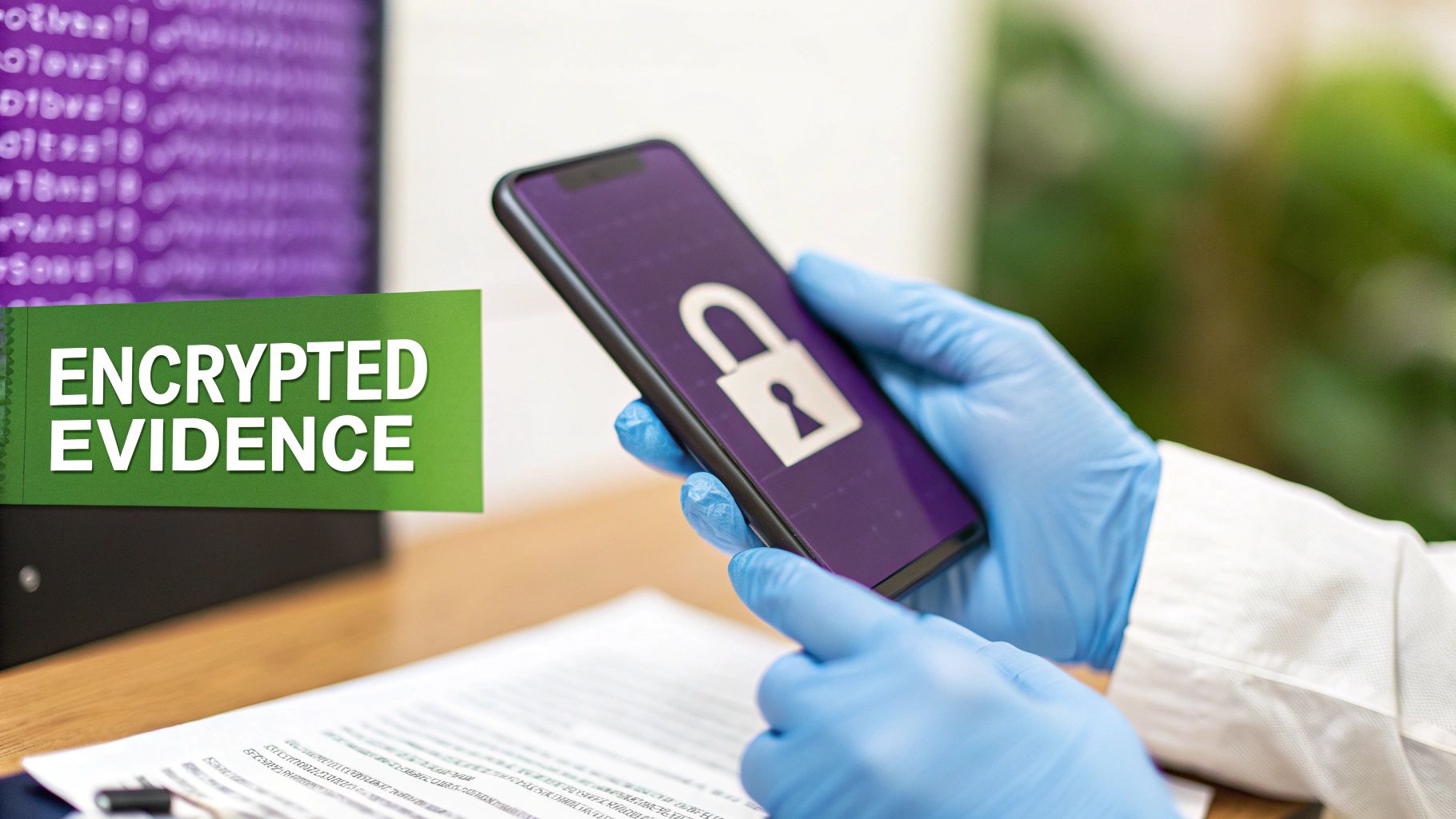
This isn't a niche issue anymore. Major tech companies have made strong encryption the default setting on smartphones and in messaging apps. While this is great for protecting an average user's privacy from bad actors, it also unintentionally shields criminal activity from lawful investigation, creating a massive hurdle for forensic examiners.
The Challenge of Default Encryption
This shift toward privacy-by-default has created a persistent and growing headache for digital forensics teams everywhere. In fact, a recent industry survey found that locked devices and encrypted apps are top obstacles for law enforcement, directly causing case backlogs and slowing down investigations.
Many of the most popular messaging platforms are now end-to-end encrypted, meaning not even a warrant served to the provider can reveal the message content. This leaves investigators trying to get the data directly from the device or hunting for other clues. In time-sensitive cases like child exploitation or terrorism, that delay can be devastating.
You can dig into more of these findings in the 2025 industry trends survey from Cellebrite.
This reality forces a major change in forensic strategy. Instead of just pulling the data, examiners now have to find vulnerabilities in device hardware or software—a constant, high-stakes cat-and-mouse game against some of the biggest tech companies in the world.
The core dilemma is balancing the public good of strong personal privacy against the public safety need for lawful access to evidence. There is no easy answer, and it remains one of the most debated topics in the field.
When encryption makes a direct hit impossible, the focus has to shift. Investigators pivot to alternative sources like metadata, location data from other apps, or the holy grail—an unencrypted cloud backup. But these are just pieces of the puzzle, and they're rarely as convincing as the original conversation.
Active Efforts to Obscure Evidence
Beyond the passive barrier of default encryption, investigators also run into anti-forensic techniques. These are active, deliberate measures someone takes to hide, alter, or completely wipe out digital evidence. The goal is simple: mislead the examiner or make the evidence vanish.
Common anti-forensic tactics include:
- Data Wiping: Using special software to overwrite data again and again, making it nearly impossible to recover.
- Steganography: Hiding an incriminating document or image inside a perfectly innocent-looking file, like a family photo or an MP3.
- Trail Obfuscation: Using tools like VPNs, anonymizers, or manipulated system logs to cover their digital tracks and send investigators down the wrong path.
- File Encryption Tools: Using third-party programs to encrypt specific folders or even an entire hard drive with a password nobody else knows.
To really get a handle on how evidence disappears, it's vital for teams to be familiar with the different methods out there. A key part of this is understanding data sanitization, which is all about the permanent destruction of data.
These techniques turn a digital crime scene into a contaminated one, where every potential piece of evidence is suspect. For forensic professionals, getting past these roadblocks requires more than just technical skill; it demands creativity, persistence, and a methodical approach to uncovering the truth buried under layers of digital protection.
Navigating a Maze of Digital Laws
Technical skills can only get you so far. When digital evidence zips across international borders in the blink of an eye, the real challenge begins. The hurdles in digital forensics often have less to do with ones and zeros and more to do with a tangled web of legal and jurisdictional nightmares. A top-tier investigator needs to be as fluent in international law as they are in code.
Think about it this way: imagine needing a different passport for every website you visit. That’s the kind of complexity investigators face when they need data from a global tech company. Evidence might be created in Germany, stored on a server in Singapore, and accessed from a device in Brazil. Each of those locations has its own laws, creating a legal minefield that can bring an investigation to a dead stop.
This reality forces a critical question at the start of every single case: "Under which country's laws can we legally get our hands on this data?" Answering that incorrectly can mean even your most damning piece of evidence gets tossed right out of court.
The Global Impact of Privacy Regulations
The explosion of data privacy laws has fundamentally changed the game. Regulations like Europe's General Data Protection Regulation (GDPR) lay down the law on how personal data can be touched, stored, and shared. These rules were built to protect consumers, but for forensic teams, they can be massive roadblocks.
Let's say an investigator in the U.S. needs data from a suspect's cloud account, which happens to be stored on an Irish server. Suddenly, they're juggling GDPR, U.S. laws, and quite possibly Irish law. This often kicks off a painfully slow legal dance involving Mutual Legal Assistance Treaties (MLATs). These processes can drag on for months—sometimes years—making the evidence practically worthless in a fast-moving investigation.
In a world this connected, digital evidence doesn't care about borders. The investigator's biggest fight is often just getting the legal green light to access the data in the first place, not actually recovering it.
This constant legal friction is a major source of frustration and delay. It means agencies have to pour resources into legal expertise and build solid relationships with their international counterparts. Every cross-border case becomes as much a diplomatic mission as a technical one.
Maintaining the Chain of Custody
The chain of custody is everything in forensics. It’s the meticulous, chronological log that tracks the seizure, custody, control, transfer, analysis, and disposal of evidence. It's the proof that what you're showing in court is the exact same evidence you collected, completely untampered with. With a physical item, it's pretty straightforward—you log it, bag it, and seal it.
But in the digital world? It's a whole different beast. How do you maintain a perfect chain of custody for data that only exists in the cloud, can be edited from halfway across the world, or is spread across a dozen volatile systems? Proving a file wasn't touched after you collected it is a monumental task.
This demands obsessive documentation and specialized tools that create cryptographic hashes—think of them as unique digital fingerprints—of the evidence at every step. One tiny break in this chain can sink the entire case. On top of that, investigators also need to understand specific guidelines like the NIST SP 800-88 Data Sanitization standard, which defines methods for data erasure, to prove that evidence wasn't improperly destroyed.
Without a rock-solid chain of custody, a sharp defense attorney can argue the evidence is unreliable, no matter what it shows. It's a stark reminder that in modern digital investigations, procedural perfection is just as critical as technical skill.
The Rise of AI and Deepfake Evidence
What happens when you can't trust your own eyes or ears anymore? That question used to be for science fiction, but it's now one of the most urgent problems in digital forensics. The explosion of artificial intelligence has thrown a new, and frankly, intimidating obstacle in our path: synthetic media, or as most people know them, deepfakes.
Think of it like a perfect art forgery. For centuries, experts could spot a fake painting by looking at the brushstrokes, the age of the canvas, or the chemical makeup of the paint. Now, imagine a forgery so perfect it fools even the most experienced authenticator. That’s what AI has brought to digital evidence. It's creating a world where seeing is no longer believing.
This new reality fundamentally undermines the integrity of evidence itself. An audio recording of a confession? It could be fabricated. A video that puts a suspect at the scene of a crime? It could be a complete digital invention. The burden of proof is flipping on its head—it's no longer about just presenting the evidence, but about proving it’s real in the first place.
The Escalating Arms Race
This has kicked off a frantic arms race between the AI that generates this content and the tools we build to detect it. As the AI models get smarter, the little tells that once gave away a fake—like weird blinking patterns or unnatural shadows—are disappearing fast.
Investigators are in a constant catch-up mode. A detection method that worked six months ago might be totally useless today. This frantic pace means forensic professionals have to be in a state of continuous learning, constantly updating their skills and tools just to keep up.
The real heart of the problem is that generative AI is asymmetrical. It is far easier, cheaper, and faster to create a convincing deepfake than it is to definitively prove a piece of media is fake. This puts forensic investigators at a constant disadvantage.
And this isn't just a theoretical headache. AI-generated media is already being used for widespread disinformation and fraud. It's only a matter of time before it becomes a common feature in criminal and civil cases. Learning to spot the subtle clues of synthetic media is now a non-negotiable skill. For anyone looking to get up to speed, learning how to spot a deepfake is a critical first step.
AI as Both Problem and Promise
But AI isn’t just the villain in this story. While it creates these massive challenges, it also offers some powerful solutions to other forensic headaches, especially the data overload problem we talked about earlier. The same technology that can generate a fake video can also be trained to analyze massive amounts of data with incredible speed.
Here's how AI is becoming an essential partner for investigators:
- Automated Data Triage: AI algorithms can tear through terabytes of data in minutes, flagging files that might be relevant. This cuts down the grueling manual review time immensely.
- Pattern Recognition: AI is brilliant at finding hidden connections and patterns in call logs, financial statements, and GPS data that a human analyst could easily overlook.
- Image and Video Analysis: Moving beyond deepfake detection, AI tools can automatically scan thousands of hours of security footage to find a specific face, object, or action.
This dual nature makes AI a true double-edged sword. It's muddying the waters of what's real while also giving us the tools we need to find the truth in the digital haystack. For the modern forensic expert, getting a handle on AI—both as a threat and an ally—isn't optional anymore. It’s central to the future of the entire field.
Actionable Strategies for Modern Forensic Teams
Getting ahead of the challenges in digital forensics isn't just about buying better software. It's about fundamentally changing how your team operates. You can't just react to incidents anymore; the technology is moving too fast for that.
The key is to build a resilient framework that anticipates problems before they happen. This means shifting from a purely reactive, case-by-case mindset to a state of forensic readiness—the built-in ability to collect and analyze digital evidence with speed, accuracy, and minimal disruption to business.
Embrace Continuous Training and Specialization
In this field, knowledge has a short shelf life. What you learned last year might be obsolete today. That's why a commitment to constant learning isn't just a good idea; it's a requirement for survival.
This is about more than just getting your annual recertification. A truly effective training program needs to be dynamic and targeted:
- Emerging Technologies: You need dedicated training on the quirks of IoT devices, the complexities of cloud platforms, and the nuances of vehicle forensics. Each has its own unique data structures and acquisition methods.
- Legal and Ethical Updates: Investigators must stay current on ever-changing data privacy laws like GDPR, new legal precedents for cross-border data, and evolving ethical guidelines. This is what keeps evidence admissible in court.
- Hands-On Workshops: There's no substitute for experience. Running simulated investigations with the latest tools against modern anti-forensic techniques builds the kind of practical muscle memory you can't get from a textbook.
The best forensic teams I've seen all share one trait: an insatiable curiosity. They're always hunting for new techniques and sharing what they learn, because they know that in a field defined by rapid change, standing still is the biggest risk of all.
Standardize and Automate Key Processes
In forensics, consistency is everything. Without standardized operating procedures, every case is a free-for-all, opening the door to mistakes, oversights, and evidence that won't hold up under scrutiny.
Creating standardized workflows, especially for tricky areas like cloud services and IoT devices, ensures every investigator follows the same legally defensible steps. This is absolutely critical for maintaining the chain of custody when there’s no physical device to bag and tag.
Of course, with the sheer volume of data we face, automation is no longer a luxury. It's a necessity.
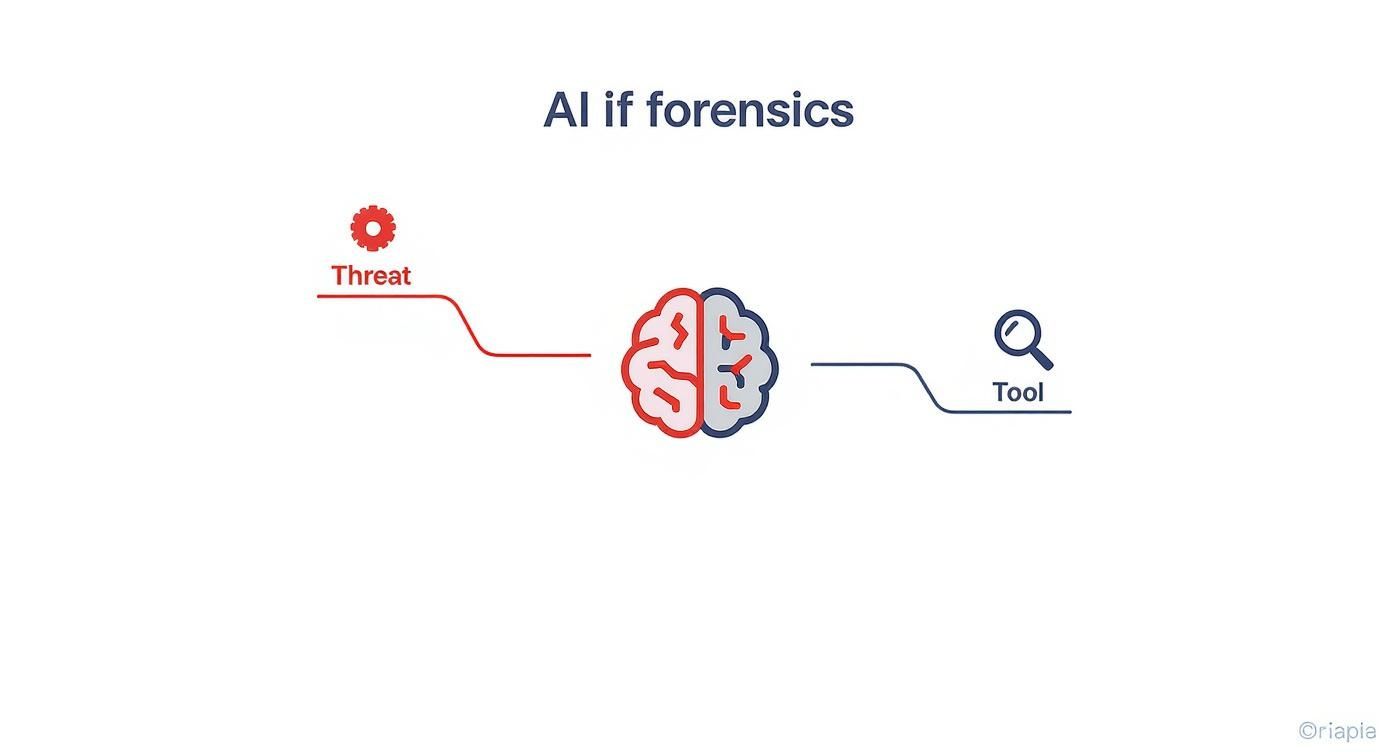
As this graphic shows, AI is a double-edged sword. It creates new threats like deepfakes and sophisticated malware, but it also gives us the powerful analytical tools needed to fight back.
Adopt AI-Powered Triage and Analysis
No human can manually sift through terabytes of data and hope to find the needle in the haystack. It's just not possible anymore. AI-powered tools are now essential for intelligent triage, helping teams cut through the noise and zero in on the most relevant evidence right away.
These systems can rip through massive datasets in a fraction of the time it would take a person, automatically flagging suspicious files, spotting unusual patterns, and connecting dots that might otherwise be missed.
With the explosion of AI-generated content, being able to verify authenticity is a core part of the job. If your team is grappling with this, you can find resources to help you detect AI-generated content and get ahead of this curve. Ultimately, bringing AI into your workflow isn't about replacing human expertise—it's about supercharging it, freeing up your best people to focus on the analysis and interpretation that truly matters.
Your Questions Answered: Navigating Today's Forensic Challenges
Diving into digital forensics, it’s easy to feel like the ground is constantly shifting beneath your feet. For every answer we find, technology seems to pose two new questions. This section is here to give you straight, clear answers to the most common questions we hear from people in the field.
We'll break down the biggest hurdles practitioners are facing right now, from the data avalanche to the rise of AI.
What Is the Single Biggest Challenge in Digital Forensics Today?
If you ask ten different experts, you'll likely get a few different answers, but one theme comes up again and again: the sheer volume and variety of data. It’s not just about one computer anymore.
Today, a single case can involve sifting through data from cloud accounts, dozens of IoT devices, multiple smartphones, and corporate servers. We're talking terabytes of information. It’s like being asked to find a specific sentence scribbled in the margin of one book in the Library of Congress.
This data deluge grinds investigations to a halt, drains budgets, and makes it terrifyingly easy to miss that one critical piece of evidence. It’s forcing a complete rethink of how we work, moving away from manual sifting and toward smarter, automated ways to find the signal in the noise.
We’ve gone from a world where we struggled to find evidence to one where we're drowning in it. The real danger now isn't the absence of a digital smoking gun; it's that the critical evidence gets buried under a mountain of irrelevant data.
This isn't a future problem; it's the reality teams are dealing with every single day.
How Can Professionals Keep Up with Changing Technology?
There's no magic bullet here—it comes down to a commitment to continuous, hands-on learning. The techniques that worked five years ago, or even one year ago, might be completely useless today. You have to be proactive.
Here are the habits I see in the most effective forensic professionals:
- Get Involved: Don't just read about it. Go to industry conferences, earn advanced certifications (like the CHFI or CFCE), and actually talk to people in online forums.
- Never Stop Reading: Make a habit of reading specialized journals, top security blogs, and tech news. You need to know what's coming before it lands on your desk.
- Talk to Your Peers: Some of the best learning happens when you share war stories and solutions with colleagues. Bouncing ideas off someone who's facing the same impossible problem is invaluable.
Will AI Make Digital Forensics Easier or Harder?
The honest answer? It's going to do both, and it’s already changing everything.
On one hand, AI makes our jobs much harder. It's the engine behind convincing deepfakes and sophisticated anti-forensic tools designed to fool investigators. Soon, one of our primary tasks will be proving that a video or audio file is even real. That’s a massive new challenge.
But on the other hand, AI is also becoming our most powerful ally. AI-driven platforms can tear through those massive datasets in minutes, not months. They can spot hidden patterns a human might miss and flag the most promising evidence for an examiner to review. It turns an overwhelming, impossible task into something manageable, effectively giving every investigator a superpower.
The explosion of AI-generated content is one of the most pressing challenges in digital forensics. At AI Image Detector, we build advanced tools that help investigators, journalists, and researchers get a clear answer on image authenticity. In a world of synthetic media, verifying the integrity of your evidence is everything. Learn how you can stay ahead of the curve at https://aiimagedetector.com.