

How to Check for AI Generated Content Like an Expert

When you need to check for AI generated content, the most effective strategy combines a quick, manual inspection with powerful detector tools. This two-pronged approach allows you to first spot the obvious giveaways—like a robotic tone in text or weirdly distorted hands in an image—before digging deeper with software for a more technical analysis.
The New Reality of Digital Content Verification
We're living in a new era of content creation, where the lines between human and machine are blurrier than ever. Being able to tell the difference is no longer a specialized skill for fact-checkers; it's now essential for students, professionals, and anyone consuming information online. Getting it right requires more than a gut feeling or a single tool. It demands a structured, multi-layered workflow.
The sheer scale of machine-generated content is hard to wrap your head around. By 2025, it’s estimated that AI could produce 30% to 40% of all content on active websites. This boom started in late 2022 with the explosion of powerful new language models. With roughly 2% of new web pages already featuring AI text, the need for reliable detection has become urgent across sectors like education, publishing, and marketing.
Why a Single-Tool Approach Is No Longer Enough
Relying on just one detection tool is a recipe for failure. It’s like trying to use a single key for a dozen different locks. AI models are constantly getting smarter, and so are the methods used to make their output sound more human. A checker that's reliable today could be less accurate tomorrow. This is why a solid verification process always pulls from multiple signals. For a good primer, you can learn more about what is ai-generated content and its common traits.
A much smarter workflow involves a few key steps:
- Your Initial Gut Check: First, train your own eyes and ears. Learn to spot the common AI tells, from unnaturally perfect grammar and repetitive phrasing to a noticeable lack of a personal voice or genuine anecdotes.
- Cross-Reference with Multiple Tools: If a piece of content feels off, run it through two or three different detectors. Compare their confidence scores and see if they agree. A consensus across tools is a much stronger signal.
- Analyze the Context: Always consider the source. Who is the author? Do they have a history of creating content on this topic? Is it from a reputable outlet or an anonymous account that just popped up?
In this environment, where AI-generated information is everywhere, the foundational skill of identifying credible sources has become absolutely critical. It’s the bedrock of any good verification process.
To give you a clearer picture, let's break down the different verification methods you can use. Each has its strengths and is best suited for different situations.
Overview of AI Content Verification Methods
| Method | Primary Use Case | Typical Accuracy | Key Signal |
|---|---|---|---|
| Manual Inspection | Quick, initial screening for obvious flaws | Low to Moderate | Unnatural patterns, logical errors, lack of human touch |
| Single Detector Tool | Fast, automated check for basic analysis | Moderate to High | Statistical patterns (e.g., perplexity, burstiness) |
| Multi-Tool Consensus | High-stakes verification (journalism, academic integrity) | High | Agreement between 2-3 independent detection models |
| Forensic Analysis | Deep-dive investigation, authenticating media | Very High | Metadata, watermarks, digital fingerprints, source code |
As you can see, no single method is perfect. The best approach is to start with a quick manual check and then escalate to more sophisticated tools as needed, depending on how important it is to get a definitive answer.
The goal isn't always to get a 100% "yes" or "no." It's about building a strong, evidence-based case for whether content is likely human, AI, or a mix of both. Adopting this mindset will prepare you for the inevitable gray areas you'll run into.
A Practical Workflow for Spotting AI Content
You don’t need a fancy software subscription to start spotting AI-generated content. The best approach is a layered one that starts with simple, manual checks and only escalates when necessary. Think of it as a triage system for the digital world.
This method helps you make quick, informed judgments and stops you from going down a rabbit hole on every piece of content you see. It’s about building a repeatable habit that sharpens your critical eye over time.
The process boils down to a simple flow: a quick initial scan, a deeper manual analysis, and finally, using dedicated tools if you’re still not sure.
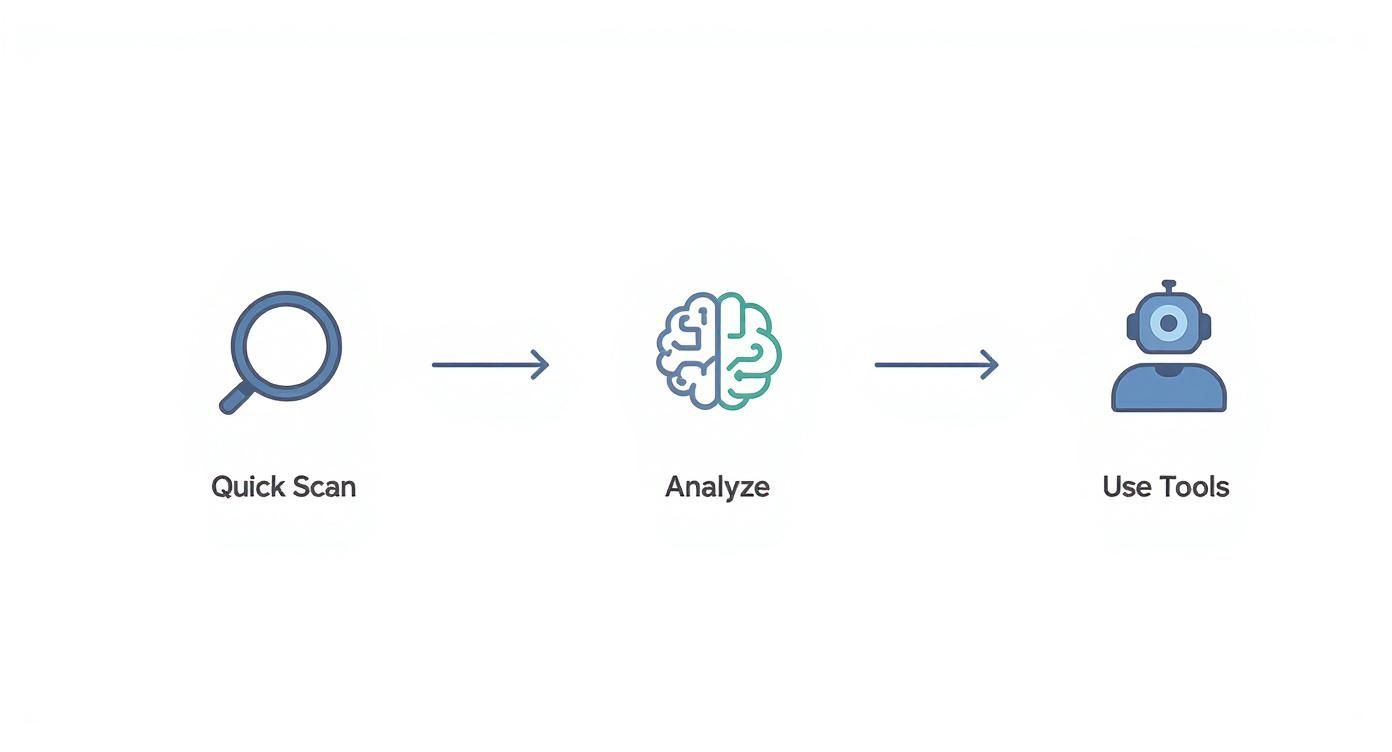
This tiered approach is crucial. It ensures you don't waste time on deep forensics for something that fails a basic sniff test.
The Initial Gut Check: Your Human-Powered Scan
Your first line of defense is always your own intuition, especially when you know what to look for. This first pass is fast, free, and surprisingly good at catching the low-hanging fruit of AI generation.
For images, I always go straight for the hands and faces. AI models still get tripped up on basic anatomy, often giving people six fingers, weirdly bent limbs, or skin that looks unnaturally smooth and waxy. Also, check the background for illogical details—text on signs that’s just gibberish, objects melting into one another, or shadows that make no physical sense.
When you're looking at text, be skeptical of anything that feels too perfect. AI is great at producing writing with flawless grammar, but it often has a sterile, impersonal voice. Keep an eye out for repetitive sentence structures and a lack of real personal stories or genuine emotion. It just feels… empty.
Pro Tip: A classic AI giveaway I see all the time is the overuse of em dashes—those long dashes used for emphasis. Humans use them, of course, but AI models seem to love them, creating a distinct, almost robotic rhythm in the text. Spotting this can be a solid early red flag.
Digging Deeper with Manual Analysis
If that initial scan makes you suspicious, it’s time to do some basic digital sleuthing. You don't need any special tools for this part, just a bit more focus. Here, you move from a gut feeling to gathering actual evidence.
One of the most powerful techniques is the reverse image search. Just upload a questionable image to a search engine, and you can uncover a few key things:
- Original Source: You might find the original photographer or artist, confirming if it’s a real photo or a known piece of digital art.
- Widespread Use: If the same image pops up on dozens of unrelated, spammy-looking websites, it's likely a generic, AI-generated stock photo.
- Similar Images: Some search engines can show you visually similar images, which can expose other AI pictures created from the same model or prompt.
For text, investigate the source. Does the author have a real history and actual expertise on the topic? Is the website reputable, or is it a new domain full of generic-sounding posts? Try copy-pasting a unique-sounding phrase into a search engine. You can often find out if the text has been copied or spun across different sites, a hallmark of AI-driven content farms.
Why This Workflow Is Becoming Essential
This hands-on approach is more critical than ever as the internet gets flooded with automated content. We're in the middle of a massive shift. In fact, research shows an explosive increase in AI-generated articles online, all thanks to tools like ChatGPT becoming publicly available.
Data shows that by late 2024, AI-written articles were on track to surpass human-written ones for the first time. They grew from just a 10% share in late 2022 and are projected to hit a 50-50 split with human content by mid-2025. You can read the research on this internet shift to see just how quickly the landscape is changing.
This new reality is exactly why having a personal verification workflow is no longer just a nice-to-have skill.
After running through these manual checks, you’ll have a much clearer picture. The content will likely fall into one of three buckets: clearly human, obviously AI, or stuck in a gray area. It’s for that third category—the stuff that’s ambiguous or requires definitive proof—that we finally turn to specialized detection tools.
Choosing and Using AI Content Detection Tools

When your gut tells you something’s off with a piece of content, it’s time to bring in the specialists. AI content detectors are your next line of defense, designed to analyze text and images for the subtle statistical fingerprints that generative models leave behind.
But these platforms aren't a magic bullet. Think of them as powerful analytical engines that offer a probability score, not a definitive verdict. Knowing how to pick the right tool for the job—and how to read its results—is the real skill.
How to Pick the Right Tool for the Job
The market is flooded with options, and they're not all created equal. Some are laser-focused on text, while others are built for deep image forensics. Your first step is to consider what you'll be checking most often.
Beyond that, look at the user experience. The best tools don't just spit out a percentage. They give you context, often highlighting the specific sentences or image regions that tripped their alarms.
Here’s a look at some of the most popular AI detection tools to help you decide which is best for your needs.
Comparing Popular AI Detection Tools
This table breaks down some leading detectors by what they analyze, their standout features, and who they're best suited for.
| Tool Name | Content Types | Key Feature | Best For |
|---|---|---|---|
| Specialized Text Analyzers | Text (essays, articles, emails) | Linguistic pattern analysis (perplexity, burstiness) | Educators, publishers, and SEO specialists |
| Image Forensic Platforms | Images (JPEG, PNG, etc.) | Artifact detection and metadata analysis | Journalists, fact-checkers, and designers |
| Hybrid (All-in-One) Tools | Text, Images, sometimes Audio | Broad-spectrum detection capabilities | General users, small businesses, and moderators |
| API-Based Services | Text, Images, Video | Scalable, automated verification via integration | Large platforms, marketplaces, and enterprises |
An interesting approach that's gaining traction involves using one AI to check another. For example, some workflows are now reviewing content using GPT-4, creating a different kind of analytical layer.
After comparing your options, the right choice usually comes down to the tool that fits most seamlessly into your existing workflow.
Making Sense of Confidence Scores
One of the biggest tripwires for new users is the "confidence score." You paste in a document and get a result like "87% Likely AI-Generated." It's incredibly tempting to treat that number as gospel, but that’s a rookie mistake.
A confidence score is an educated guess, not a final judgment. It's an indicator based on patterns.
A 90% score doesn't mean the content is definitively AI. It means that, based on the tool’s training data, the patterns present have a 9 in 10 chance of being machine-generated. That distinction is crucial.
Several things can throw these scores off:
- Human-AI Hybrids: Content that starts with AI and gets a heavy human edit can easily confuse detectors, leading to lower or wishy-washy scores.
- New or Niche Models: If a piece was generated by an obscure or brand-new AI, the detector might not have the training data to recognize it, resulting in a false negative.
- "Humanizer" Tools: Some AI services are specifically designed to rewrite AI text to evade detection, adding a whole new layer of cat-and-mouse to the game.
If you want to pull back the curtain on the tech, our guide on how AI detectors detect AI gets into the nuts and bolts of how these systems work. Understanding the "how" makes you much better at interpreting the results.
A Privacy-First Approach Is Non-Negotiable
Ever wonder what happens to the content you paste into a free online tool? It's a critical question, especially if you're checking proprietary information. Many free services use your submissions to train their own models.
To keep your data safe, always choose a privacy-first tool. Look for a platform that has a clear policy stating they do not store or use your submitted content for their own gain. For any business handling sensitive documents, this is an absolute must.
Follow these best practices to protect yourself:
- Read the Privacy Policy: Seriously. Take two minutes to see how they handle your data before you upload a single word.
- Use Anonymized Snippets: When possible, test small, non-sensitive chunks of text instead of the full document.
- Look for On-Device Options: A new wave of tools is emerging that performs all analysis locally on your machine, so your data never even hits the web.
For businesses needing to check content at scale, API integration is the only practical solution. An API lets you build detection right into your existing systems—like a content management platform or a forum submission form—automating the whole process securely.
Ultimately, never trust a single tool's verdict. The most reliable workflow is triangulation. Run your content through two or three different detectors and see where the results overlap. Combine that with your own manual check and contextual knowledge, and you'll have a conclusion you can actually stand behind.
Advanced Forensic Signals for Deeper Investigations
When the stakes are high—say, you're authenticating a photo for a news story or verifying a submission for an academic journal—a simple "likely AI" score just doesn't cut it. This is where you have to shift your mindset from a casual user to a digital forensic investigator. It means learning to spot the subtle, technical fingerprints that AI models leave behind.
These advanced signals take a more analytical eye and sometimes require specialized software, but they give you a much stronger foundation for your final judgment. It’s the difference between a quick once-over and a full-blown investigation.
Uncovering Hidden Clues in AI Images
A quick check for AI images might involve looking for obvious visual glitches like misshapen hands or weird backgrounds. A true forensic approach, however, digs into the file's underlying structure and data—clues that are often completely invisible to the naked eye.
Compression Artifacts: AI-generated images are born in a pristine digital environment and then compressed into formats like JPEG. This can create unique, eerily uniform compression patterns. A real photograph from a camera sensor, by contrast, has more chaotic and natural-looking artifacts. Specialized tools can actually visualize these differences for you.
Metadata (EXIF) Inconsistencies: Real photos are packed with EXIF data that tells a story: the camera model, shutter speed, f-stop, even the GPS location. AI-generated images almost always lack this information entirely. If you open a file and find the metadata is empty or makes no sense, that's a massive red flag.
Spectral Analysis: This is a seriously advanced technique that uses algorithms to analyze an image's frequency domain. It can pick up on subtle inconsistencies in noise patterns, lighting, and textures that suggest different parts of the image were generated separately—a dead giveaway for a sophisticated AI composite.
Developing this forensic mindset is becoming non-negotiable. The explosion of AI-generated content, especially deepfakes, presents a massive challenge. In fact, the amount of deepfake content is projected to surge from 500,000 files in 2023 to 8 million by 2025. That's a growth rate of over 900%.
What's really scary? Humans can only spot high-quality deepfakes about 24.5% of the time. And while AI detectors do better, their accuracy can plummet by 50% when faced with newer, more sophisticated fakes. You can dig into more of these staggering deepfake statistics on deepstrike.io.
Advanced Linguistic Patterns in Text
When it comes to written content, a forensic analysis goes way beyond just looking at tone and grammar. You have to start examining quantifiable linguistic metrics. The thing is, AI models write with a mathematical precision that often results in predictable, unnatural rhythms.
Key Takeaway: Human writing is messy. It has a natural ebb and flow, with sentences and ideas of varying complexity. AI writing, by contrast, tends to be statistically smooth and consistent, and that’s often how it gives itself away.
There are two key metrics I always look at to expose this artificial smoothness:
Perplexity: This is really just a fancy way of measuring how predictable a piece of text is. AI models are trained to pick the most statistically probable next word, which results in text with low perplexity. It’s smooth and logical, but it often lacks any element of surprise or creativity. Human writing is far less predictable and therefore has a higher perplexity score.
Burstiness: Think of this as the rhythm of sentence length. Humans naturally vary their sentences, creating a "bursty" pattern of long, complex thoughts mixed with short, punchy statements. AI often churns out sentences of a more uniform length, which gives the text a flat, monotonous rhythm. If you want to dive deeper, you can learn more about these signals by exploring our guide on what AI detectors look for.
The Future of Verification: Statistical Watermarking
Looking ahead, one of the most promising frontiers to check for AI generated content is statistical watermarking. The idea is to embed a subtle, invisible statistical signal directly into the AI's output as it's being created. This watermark is completely undetectable to a human reader but can be easily identified by a corresponding algorithm.
Unlike detection methods that hunt for artifacts after the fact, watermarking could provide a definitive "yes" or "no" answer, offering mathematical proof of an AI's involvement. It isn't universally adopted yet, but this technology could become a standard for responsible AI companies, giving us a reliable way to trace content to its source and fight misinformation.
For now, though, mastering these forensic signals remains your most powerful tool in the shed.
Tailoring Your Verification Strategy to Your Industry

The need to check for AI generated content isn't a one-size-fits-all problem. A journalist trying to verify a photo from a conflict zone has entirely different stakes than a teacher wondering about a student's essay. A generic checklist will only get you so far; what you really need is a game plan built for the specific risks and priorities you face every day.
What works for an e-commerce platform trying to stamp out fake reviews just won't cut it for a newsroom on a tight deadline. Each field has its own unique challenges, whether it's upholding academic standards, protecting a brand's reputation, or maintaining journalistic integrity. That’s why building a specialized protocol isn't just a nice-to-have—it’s absolutely essential for getting it right.
It all comes down to focusing your verification efforts on the signals that actually matter in your line of work.
Journalism and Fast-Paced Fact-Checking
In the news business, speed is everything, but accuracy is sacred. With misinformation spreading like wildfire, journalists need a verification process that's both lightning-fast and incredibly thorough, especially when a source sends in a photo from a breaking news event. The whole game is about authenticating content before it hits the airwaves or the front page.
It always starts with vetting the source. Who sent you this image or video? Do they have a credible history, or did their account just pop up yesterday? A brand-new profile with zero track record is an immediate red flag.
From there, it’s all about a quick forensic triage:
- A quick metadata check: The first thing I do is run the file through a metadata viewer. If a photo that was supposedly just taken "on the ground" has absolutely no EXIF data, that’s a huge warning sign.
- Cross-check with reverse image search: Don't just use one reverse image search engine—use several. Google Images, TinEye, and Yandex can all turn up different results. You might find that the image is actually five years old and from a completely unrelated event.
- Confirm the location: If the content is tied to a place, pull up mapping tools. Check the landmarks, the street signs, even the time of day based on shadows. Does what you see in the photo actually line up with the reality on the ground?
For journalists, the old saying was "trust but verify." When it comes to AI, my motto is closer to "distrust and meticulously verify." The burden of proof has never been higher, and every unvetted image is a potential reputation-killer waiting to happen.
Education and Academic Integrity
For teachers and professors, the challenge is really two-sided. You have to spot AI-assisted plagiarism, but you also need to guide students on how to use these powerful tools ethically. A heavy-handed, punitive approach rarely works. I've found that a clear, upfront policy paired with smart detection methods is a much better way to go.
The goal isn't just to catch students cheating; it's about reinforcing learning standards. This often starts with how you design the assignment in the first place. Prompts that demand personal reflection, in-class discussions, or connections to a specific lecture make it incredibly difficult for a generic AI answer to pass muster.
When you do get that feeling that something's off, a structured check is the next step:
- Watch out for the 'too perfect' paper: AI-written essays are often grammatically impeccable, but they feel… soulless. They lack a distinct authorial voice and tend to summarize information rather than build a compelling, original argument.
- Use multiple detectors: Don't rely on just one tool. Run the text through at least two different AI detectors. If they both come back with a high probability of AI, you have a much stronger basis for a conversation.
- The "tell me more" test: This is your most powerful tool, and it doesn't require any software. Just sit down with the student and ask them to explain a specific paragraph in their own words or define a complex term they used. A student who did the work can do this easily. One who relied on AI will almost always stumble.
This method turns a potential accusation into a teaching moment, reinforcing the value of original thought.
Digital Marketplaces and E-commerce
On sites like Amazon or Etsy, trust is the only currency that matters. A flood of AI-generated fake reviews or doctored product photos can completely shatter that trust. For these platforms, the verification process has to be automated and scalable enough to handle millions of daily submissions.
The main threat here is deception that directly sways a customer's decision to buy. A burst of fake five-star reviews can push a shoddy product to the top of the search results, while slick AI images can make a cheap item look like a premium one.
A solid defense for any marketplace should be built on a few key pillars:
- Behavioral analysis: The system should automatically flag suspicious user activity. For instance, a brand-new account that suddenly posts 20 glowing, generic reviews in an hour is a classic sign of bot activity.
- Linguistic pattern recognition: Use an API-based detector to scan all incoming reviews for the tell-tale signs of AI. This includes an overly formal tone, repetitive phrases, and a complete lack of specific, personal stories that real customers share.
- Image authenticity scans: New product photos should be automatically scanned for AI fingerprints. Look for those unnaturally perfect backgrounds, weirdly inconsistent lighting, or the subtle artifacts that scream "this product isn't real."
By building these automated checks directly into their platforms, marketplaces can proactively check for AI generated content and protect their customers from getting duped, which in turn protects the integrity of the entire ecosystem.
Answering Your Top Questions About AI Detection
As you get deeper into verifying AI-generated content, you're going to have questions. This is a field full of nuance, where black-and-white answers are rare. Let's tackle some of the most common questions head-on to clear up any confusion.
Getting these fundamentals right will make your entire verification process more effective and realistic.
Can AI Detectors Be 100% Accurate?
In a word, no. AI content detectors are powerful tools, but they aren't magic. They work by spotting statistical patterns that point towards machine generation, not by offering absolute proof. They operate on probabilities.
Think of a high AI score as a strong signal, not a final verdict. It's one important piece of evidence you should use as part of a larger investigation.
The accuracy of any detector is a moving target. It depends on the specific AI model that created the content, the detector's own training, and whether a human has edited the output. This is precisely why a multi-faceted approach is critical.
How Can I Check for AI Content Without a Tool?
You can absolutely do a solid first-pass check without any special software. The trick is to hone your human intuition and learn to spot the common tells that AI models often leave behind.
For written content, keep an eye out for these red flags:
- Unnatural Fluency: The writing is technically perfect but has no personality or unique voice. It just feels a bit… sterile.
- Repetitive Phrasing: You start noticing the same words or sentence structures appearing again and again.
- Factual Hallucinations: The text asserts something as fact with total confidence, but a quick search reveals it's completely wrong or nonsensical.
When it comes to images, your own eyes are the best tool to start with. Look for the classic AI artifacts, like mangled hands with too many fingers, bizarre lighting that defies physics, or garbled, nonsensical text on signs in the background.
What’s the Difference Between Checking Text and Images?
The process is fundamentally different because the underlying AI technologies are completely distinct.
Detecting AI-written text is really a form of linguistic analysis. Detectors are looking for statistical patterns in the language itself, like how predictable the word choices are (perplexity) or the unusual consistency in sentence length and rhythm (burstiness).
On the other hand, checking AI images is more like visual forensics. It's all about spotting physical and logical impossibilities—the kind of errors in anatomy, physics, or context that a human artist or photographer simply wouldn't make. Each medium demands a unique analytical mindset.
Are There Legal or Ethical Issues with AI Content?
Yes, and they are significant. The legal and ethical landscape is still being mapped out in real-time. From a legal perspective, questions around copyright and ownership of AI-created works are murky, with major court cases actively shaping the rules as we speak.
Ethically, the concerns are even broader. They touch on everything from the potential for spreading misinformation with deepfakes to academic dishonesty and the simple lack of transparency when AI is used without disclosure. In response, many organizations are now putting policies in place that require clear labeling for any and all AI-generated media.
Ready to move from manual checks to a powerful, privacy-first tool? AI Image Detector offers fast, reliable analysis to help you verify images in seconds. Get your free analysis now at aiimagedetector.com.
