

A Guide to Content Moderation Service in the Age of AI

Think of a content moderation service as the security and clean-up crew for your online platform. It's the system—a mix of smart technology and skilled people—that sifts through user-generated content to find and remove the harmful stuff: spam, hate speech, explicit images, you name it.
Without it, even the most promising online community can quickly devolve. It’s a must-have for keeping your platform safe, your brand’s reputation intact, and your legal risks in check.
What Is a Content Moderation Service
Picture a busy online marketplace, a lively social media feed, or a sprawling gaming world. Every single post, comment, photo, and video shared by users is a piece of user-generated content (UGC). A content moderation service is the organized system responsible for reviewing all that UGC against your platform's rules and community standards.
It’s like having moderators for a real-world town square. Just as a city needs rules to keep its public spaces safe and welcoming, an online platform needs moderation to prevent it from becoming a free-for-all of spam, scams, and abuse. This isn't just about deleting bad posts; it's about making sure your genuine users stick around.
The Core Purpose of Moderation
The whole point is to build and maintain a safe, positive, and trustworthy space for your users. Good moderation isn't just a defensive move—it's a core part of your business strategy. It stops misinformation from spreading, protects kids from seeing things they shouldn't, and shuts down illegal activities like the sale of fake products.
A proactive approach to this kind of digital hygiene helps you hit several key goals:
- Protect Your Users: Shielding people from harassment, bullying, and graphic content is the baseline for building a community people actually want to be a part of.
- Guard Your Brand: You don't want your brand associated with toxic or low-quality content. A clean platform protects your public image and keeps advertisers happy.
- Stay Compliant: Moderation ensures you're following local and international laws about illegal content, which helps you avoid hefty fines and legal battles.
At its heart, a content moderation service is about cultivating a healthy digital ecosystem. It’s the constant balancing act between encouraging free expression and ensuring the space remains safe and valuable for everyone.
Let's talk scale. YouTube users upload over 500 hours of video every single minute. Manually reviewing that much content is simply impossible. This is where a structured content moderation service becomes critical, blending automated tools with human judgment to handle the flood.
To get a better sense of how all this fits together, it helps to look at the bigger picture of online moderation and safety. A solid strategy can turn a massive operational headache into a real asset that fuels positive engagement and long-term growth.
Here's a quick breakdown of what these services actually do day-to-day.
Core Functions of a Content Moderation Service
| Function | Description | Example |
|---|---|---|
| Policy Enforcement | Applying the platform's community guidelines and terms of service consistently to all user-generated content. | Removing a comment that contains personal threats, as it violates the anti-harassment policy. |
| Content Screening | Proactively reviewing text, images, and videos for prohibited material before or shortly after it goes live. | An AI tool flags a newly uploaded image for nudity, sending it to a human for final review. |
| Risk Mitigation | Identifying and removing content that poses legal, financial, or reputational risks to the platform. | Deleting listings for counterfeit luxury goods to avoid trademark infringement lawsuits. |
| User Support | Handling user reports, appeals, and inquiries related to moderated content and account actions. | Responding to a user whose post was mistakenly removed and restoring it after review. |
| Trend Analysis | Monitoring for emerging threats, new types of harmful content, or coordinated abuse campaigns. | Noticing a sudden spike in a specific type of scam and updating filters to block it. |
Ultimately, these functions work together to create a cohesive defense system for any platform that relies on user contributions.
What Are the Three Models of Content Moderation?
Picking the right way to moderate content isn't a one-size-fits-all deal. The best strategy really hinges on your platform’s size, the kind of content you host, and how much risk you're willing to take. Generally, platforms lean on one of three core models: human moderation, automated moderation, or a hybrid that blends the two.
Getting a handle on these models is the first step toward building a solid defense for your online community. Each comes with its own set of pros and cons, so it’s important to see how they work on their own and, more importantly, how they can work together.
Human Moderation: The Nuanced Guardians
At its heart, human moderation relies on trained professionals to review user-generated content and make tough judgment calls. Think of these moderators as the guardians of your community, capable of understanding the subtleties of human communication that algorithms almost always miss.
A human moderator can pick up on sarcasm, interpret new slang on the fly, and grasp critical cultural context. They shine when dealing with borderline content that requires a real understanding of intent—something a machine just can't do. For instance, a person can tell the difference between a genuine threat and a heated, but ultimately harmless, debate on a gaming forum.
But relying only on people has some serious downsides. It’s slow, incredibly expensive, and doesn’t scale easily. On top of that, asking moderators to sift through a constant stream of disturbing content takes a heavy toll on their mental health, often leading to high burnout rates.
No matter the model, the end goals are always the same: building a safe, thriving community.
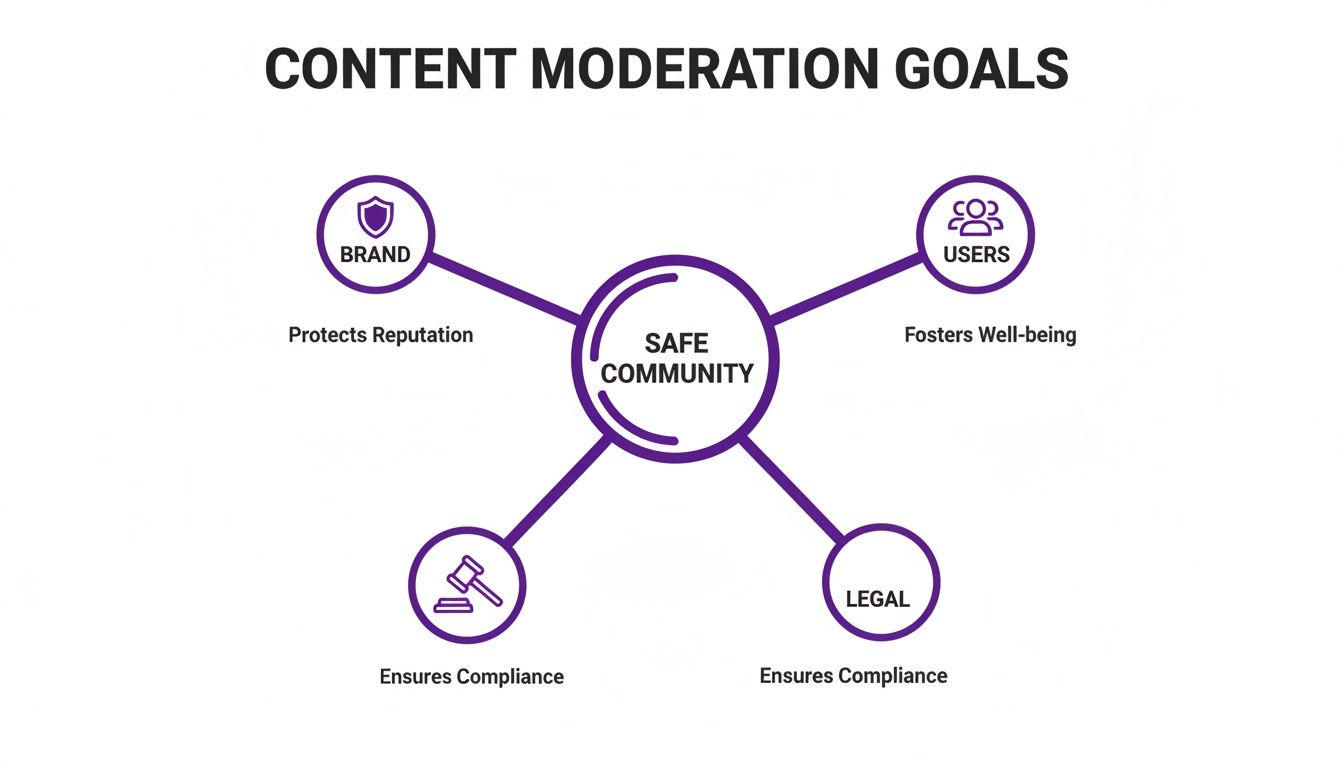
This image nails it. Protecting your brand, looking out for your users, and staying on the right side of the law are the three pillars that hold up any healthy online space.
Automated Moderation: The AI Sentinels
Automated moderation uses artificial intelligence and machine learning to screen content at an incredible scale. These AI sentinels are your first line of defense, working around the clock to catch obvious policy violations with superhuman speed. They can scan millions of posts, images, and videos in the time it takes you to drink your coffee.
AI models are typically trained to spot specific problems, like:
- Explicit Content: Finding nudity or graphic violence in images and videos.
- Hate Speech: Flagging text containing racial slurs or targeted harassment.
- Spam: Catching and blocking repetitive, low-quality, or malicious links.
The biggest weakness of AI, however, is its struggle with context. An automated system might mistakenly flag a historical photo with a swastika as hate speech or censor a breast cancer awareness campaign for nudity. These false positives can frustrate users and shut down important conversations. Our guide on user-generated content moderation dives deeper into these kinds of challenges.
The Hybrid Model: Combining Speed and Insight
The hybrid model has become the gold standard for good reason—it gives you the best of both worlds. It uses AI's raw speed and massive scale for the first pass, then brings in human intelligence for the tricky, borderline cases.
In a typical hybrid setup, AI acts as a powerful filter. It automatically approves perfectly safe content, removes clear-cut violations, and sends everything else to a human review queue.
This tiered system lets platforms manage huge amounts of content efficiently. It also ensures that the most nuanced decisions are still made by people who can actually understand context and intent. It’s all about focusing human brainpower where it’s needed most.
The explosion of online content has made effective moderation a must-have. By the mid-2020s, this field has grown into a multi-billion-dollar global industry, expanding right alongside the flood of user-generated text, images, and videos. Analysts predict the content moderation market will hit around USD 11.63 billion in 2025 and nearly double to USD 23.20 billion by 2030, growing at a 14.75% compound annual rate. This rapid growth shows why scalable, hybrid solutions are no longer just a nice-to-have; they're a core part of doing business online.
How a Modern Content Moderation Workflow Operates
If you pull back the curtain on a modern content moderation service, you won't find just one person hitting "approve" or "deny." Instead, you'll see a sophisticated, multi-stage process built for both speed and accuracy. Think of it as a highly efficient assembly line where technology and human expertise work in tandem to keep a platform safe.
The journey starts the instant a user submits something. Whether it's a comment, a photo, a video, or a product listing, it immediately enters a continuous workflow designed to enforce your community guidelines without missing a beat.
Stage 1: Content Ingestion
The first step is simple but absolutely critical: content ingestion. This is the moment user-generated content (UGC) officially enters the moderation system.
As soon as a user hits 'post,' their content is captured and logged. It gets tagged with essential metadata—like the user's ID, the submission time, and the format (text, image, etc.). This creates a clear digital trail, prepping the content for the more intensive steps ahead.

This visual breaks down how content flows from user submission through automated filters and human review, all the way to a final action. It really highlights the key decision points in the workflow.
Stage 2: Automated Filtering
With the content logged, it's immediately passed to automated filtering. This is where AI and machine learning tools perform the initial high-speed scan, acting as your first line of defense. These systems are trained to spot clear-cut policy violations with incredible efficiency.
It’s a bit like an airport security scanner for content. It can instantly flag items that match known threats based on predefined rules and patterns.
Common automated checks include:
- Keyword and Phrase Matching: Scanning text against a blocklist to catch hate speech, profanity, or spam.
- Image and Video Analysis: Detecting nudity, graphic violence, or other explicit visuals.
- Pattern Recognition: Spotting spammy behavior, like a single user posting the same link across hundreds of threads in just a few minutes.
Content that is either obviously safe or a blatant violation gets handled automatically. The clean stuff is approved, while the clear violations are removed. Anything that falls into a gray area gets escalated to the next stage.
Stage 3: Human Review
Content flagged by the AI as potentially problematic—or just too nuanced for a machine to judge—lands in the human review queue. This is where trained moderators step in to make the final call, applying the kind of critical thinking and contextual understanding that algorithms simply don't have.
These professionals assess the flagged content against the platform's specific guidelines. They consider things like sarcasm, cultural context, and artistic expression—subtleties that can easily fool an automated system. For a deeper dive into the strategies behind this phase, our guide on building effective trust and safety teams is a great place to start.
A human moderator can tell the difference between a news report showing violence and content that incites violence. This ability to understand intent is the cornerstone of fair and effective moderation.
Based on their assessment, moderators take a specific action. They might approve the content if the AI got it wrong, edit it to remove a minor violation (like a phone number in a comment), or remove it entirely if it breaks the rules.
Stage 4: Enforcement and Notification
The final step is enforcement and notification. Once a decision is made, the system executes the action. This might mean the content is published, edited, or deleted.
Just as importantly, this stage also involves communicating the outcome to the user. A transparent notification explaining why their content was removed and which policy it violated helps educate users and reduces frustration. Many systems also include an appeals process, giving users a chance to contest a decision they feel was made in error. This feedback loop is vital for maintaining user trust and constantly refining the moderation process itself.
Measuring the Success of Your Moderation Efforts
How can you be sure your content moderation is actually working? Relying on a gut feeling isn't enough. To truly understand the impact of your efforts, you need to translate your trust and safety goals into hard numbers. This is the only way to know what's effective, spot weaknesses in your system, and prove the value of your investment.
Without clear Key Performance Indicators (KPIs), you're flying blind. You might think your platform is getting safer, but you won't have the data to back it up, adapt to new threats, or make smart decisions about your budget.
Key Metrics for Platform Health
To get a clear picture of your moderation performance, you need to zero in on a few crucial KPIs. These numbers tell a story about your team's efficiency, the accuracy of your decisions, and, ultimately, the experience you’re creating for your users.
Here are some of the most important metrics to watch:
- Accuracy Rate: This is the big one. It measures how often your moderators—whether human or AI—make the right call based on your policies. A high accuracy rate, ideally shooting for 95% or more, shows that your rules are being applied consistently.
- Turnaround Time (TAT): How long does it take from the moment content is flagged to when a final decision is made? A short TAT is absolutely critical for pulling down harmful content before it spreads.
- Moderator Productivity: This is a simple measure of volume—how many pieces of content can one moderator review in an hour? It's a key metric for staffing and figuring out if your team needs better tools or more training.
Balancing Safety and User Freedom
Great moderation is a tightrope walk. If you're too aggressive, you risk frustrating users and stifling legitimate conversation. If you're too lenient, your platform becomes a breeding ground for harmful content. Two specific KPIs help you find that sweet spot.
The false positive rate tells you how often perfectly fine content gets mistakenly removed. A high rate here is a huge red flag; it can drive users away and lead to accusations of censorship. On the flip side, the false negative rate tracks how much policy-violating content slips through the cracks. This is a direct measure of the risk your community is exposed to.
The goal is to minimize both rates simultaneously. This delicate balance ensures you protect your community from harm without accidentally silencing legitimate voices, which is the core challenge of any content moderation service.
Keeping a close eye on these metrics isn't just good practice—it's also a big part of staying compliant. A methodical approach to tracking performance is invaluable, and you can get a better handle on it with a compliance risk assessment template like this one.
The need for professional, data-driven moderation is only growing. Back in 2019, around 85% of customers said user-generated content impacted their purchasing decisions, which seriously raises the stakes for platforms that don't manage it well. You can dig into more data on this trend in this detailed industry report.
At the end of the day, these numbers are far more than just points on a dashboard. They are a direct reflection of your platform’s health, your users' trust, and your operational savvy. By tracking and analyzing these KPIs, you can constantly refine your strategy, improve your tools, and build a digital space that’s both safer and more engaging.
Content Moderation in Action Across Industries
Theories and workflows are one thing, but the real test of any content moderation service is how it holds up in the wild. This isn't just a tool for one type of platform; it's a critical function for any digital space where people can share content. From newsrooms to online stores, moderation is the invisible force that keeps things civil and trustworthy.
Seeing these services in action really highlights how flexible and necessary they are. Every industry has its own unique set of problems, which means the approach to content review and policy enforcement has to be just right. These real-world examples show how moderation goes from a lofty concept to an indispensable, hands-on tool.

Journalism and News Media
When big news breaks, outlets get flooded with user-submitted photos and videos. The real challenge is sifting through it all to find genuine eyewitness accounts while filtering out doctored images or old content passed off as new. A solid content moderation service is absolutely essential for this kind of verification.
By combining smart AI analysis with a human touch, news organizations can:
- Verify Authenticity: AI tools are great for quickly spotting signs of digital manipulation. Then, human moderators can step in to cross-reference images with other sources and confirm they're the real deal.
- Combat Misinformation: Identifying and pulling down fake content fast stops false narratives from spreading during sensitive moments. This is crucial for protecting the outlet's credibility.
This two-step process helps ensure journalists report facts, not fabrications, which goes a long way in maintaining public trust when it matters most.
Education and Academia
Academic integrity is the bedrock of education, but the explosion of AI-generated text has thrown a wrench in the works. Educators need reliable ways to figure out if a student's essay was written by them or by a large language model. This is a perfect use case for specialized moderation tools.
Services like an AI Image Detector can be adapted to analyze text submissions for the subtle fingerprints of synthetic generation. This gives institutions the power to uphold their academic standards and make sure students are actually developing critical thinking skills, not just outsourcing their homework to an algorithm.
E-commerce and Marketplaces
Online marketplaces, from giants like Amazon to niche communities like Etsy, rely on user-generated listings to exist. But that openness is a double-edged sword, inviting scams, counterfeit goods, and wildly misleading product descriptions. An effective content moderation service is their first line of defense.
Automated systems can scan millions of new listings for red flags, like spammy keywords or images that don’t match the product title. When something gets flagged, a human moderator takes a closer look, removing fraudulent sellers and protecting buyers from getting ripped off. This proactive screening is the key to building a safe and trustworthy place to shop.
A marketplace without strong moderation is like a physical store with no security. It quickly becomes a target for bad actors, driving away legitimate customers and damaging the brand's reputation for good.
This kind of vigilance ensures a positive experience for everyone, which encourages repeat business and fosters a healthy community for honest sellers.
Social Media Platforms
Nowhere is the sheer scale of the moderation challenge more obvious than on social media. These platforms are on the front lines, trying to manage billions of daily posts while fighting off harmful narratives, hate speech, and coordinated harassment campaigns.
Social media is basically the epicenter of modern content moderation, and the amount of money being spent shows just how massive the problem is. The market for social media moderation was valued at about USD 8.34 billion in 2024 and is expected to climb to USD 9.11 billion in 2025. Projections show it rocketing to USD 23.89 billion by 2033, which gives you an idea of the huge, ongoing investment needed to keep these platforms safe. You can dive deeper into the numbers with this thorough market analysis.
Hybrid moderation is the only way to survive here. AI handles the incredible volume, while human teams tackle the tricky, context-heavy cases that need nuanced judgment. It’s a constant, tireless effort that's vital for protecting vulnerable communities and maintaining some semblance of civility in our online public square.
How to Choose and Integrate a Moderation Service
Picking the right content moderation service is a make-or-break decision for your platform’s future. Think of it less like buying a tool and more like hiring a partner to help you build and protect your community. The wrong choice can lead to a mess of inconsistent enforcement, angry users, and harmful content slipping through the cracks—all of which can seriously damage your brand's reputation.
Before you even start looking at vendors, you need to know exactly what you’re looking for. A simple checklist can help you cut through the marketing noise and compare your options based on what truly matters for your platform and your users.
Your Vendor Selection Checklist
When you're comparing providers, it's easy to get fixated on price. But the cheapest option is rarely the best. A truly effective moderation solution needs to be reliable, adaptable, and built on a foundation of trust. Use this checklist to find a service that won't just solve today's problems but will also grow with you.
- Scalability: What happens if a post goes viral? Can the service handle a massive, unexpected spike in content without buckling? You need a solution that can flex its resources on demand, ensuring performance never suffers, even during periods of explosive growth.
- API Access and Documentation: For your developers, a clean, well-documented API is everything. It’s the bridge that connects the moderation service to your platform, allowing for a smooth, automated flow of content. Without it, you're looking at a clunky, manual process.
- Compliance and Data Privacy: This is non-negotiable. Does the vendor adhere to major regulations like GDPR and CCPA? You need to be absolutely certain they have iron-clad policies for handling, storing, and processing user data.
- Customization Options: Your community guidelines are unique to your platform. A good service will let you tailor the moderation rules and workflows to fit your specific policies, not shoehorn you into a generic, one-size-fits-all model.
- Support and Partnership: When things go wrong, how responsive is their support team? Look for a true partner who offers not just technical help but also strategic advice to help you fine-tune your moderation approach over time.
Choosing a content moderation service is like hiring a security team for your entire digital community. You need to trust their judgment, rely on their technology, and be confident they can handle any situation that arises.
Once you've found a vendor that ticks all the boxes, it's time to get their tools working within your platform. This integration process usually takes one of two forms, depending on your team's size and technical muscle.
Integrating the Service Into Your Platform
Connecting a moderation service can be as simple as a few clicks in a dashboard or as complex as a fully automated, code-driven workflow. The right path for you will hinge on how much content you're dealing with and what kind of resources you have on hand.
Option 1: UI for Manual Checks
For smaller teams or platforms where the content volume is still manageable, starting with a user interface (UI) for manual checks makes a lot of sense. This approach lets your moderators upload individual files—like an image, video, or block of text—directly into the service's web-based dashboard for instant analysis.
It’s the perfect way to spot-check suspicious content or follow up on user reports without needing to pull in a developer. Our own AI Image Detector, for example, has a simple drag-and-drop UI that’s great for journalists or community managers who need a quick authenticity check on an image.
Option 2: API Integration for Automated Workflows
For any platform operating at scale, processing hundreds or thousands of posts an hour, API integration is the only way to go. This method hooks the moderation service directly into your platform’s backend, creating a seamless, automated pipeline. When a user uploads content, it’s automatically fired off to the moderation service’s API for a real-time scan.
The service then sends back its analysis, which can trigger an immediate action on your end—like approving the post, deleting it, or flagging it for a human moderator to review. This is how you moderate content at scale and stop harmful material in its tracks, often before it ever goes public.
Frequently Asked Questions
When you're trying to build a healthy online community, a lot of questions come up. Let's tackle some of the most common ones to clear up any confusion around content moderation.
Content Moderation vs. Censorship
This is probably the most important distinction to get right. People often use these terms interchangeably, but they mean very different things.
Think of content moderation as setting house rules for a party you're hosting. You create community guidelines—a code of conduct—to make sure everyone has a good time and feels safe. Moderation is simply enforcing your rules within your space.
Censorship, however, is when a government or other powerful entity steps in to suppress information or silence speech across the public sphere. It’s about control, not community health.
The real difference comes down to scope and intent. Moderation is about curating a specific community experience based on its own rules. Censorship is about controlling what a broader population is allowed to see or say, often without their consent.
How Much Does a Content Moderation Service Cost?
This is a classic "it depends" answer, but for good reason. The price tag for content moderation can swing wildly based on a few key factors:
- Volume: How much content are we talking about? A small forum with a few hundred posts a day has very different needs than a social network with millions of uploads per hour.
- Content Type: Text is one thing, but moderating live video streams is a whole different beast. Real-time content requires immediate attention and is naturally more expensive to handle.
- The Model: A team of human moderators is the gold standard for nuance, but it's also the most expensive option. An AI-only system costs less upfront, while a hybrid model often hits the sweet spot between cost and quality.
- Complexity: Simple keyword filtering is cheap. But if you need moderators to make nuanced judgments on misinformation, hate speech, or other complex policy violations, the cost will reflect that expertise.
For a small business, you might be looking at a few hundred dollars a month. For a massive enterprise, the bill can easily run into the hundreds of thousands.
How Can Small Businesses Afford Moderation?
You don't need a giant, round-the-clock team to start protecting your community. The trick for small businesses is to be smart and lean.
A hybrid approach is often the perfect starting point. You can use automated tools to do the heavy lifting—catching obvious spam and clear-cut violations. This first pass handles the bulk of the noise, leaving only the tricky, ambiguous cases for a small team (or even just one person) to review. Many services also offer flexible, tiered pricing, so you can start with a basic plan and scale up as your user base grows.
What Is the Future Role of AI in Content Moderation?
AI is already a huge part of moderation, and its role is only going to get bigger and more sophisticated. We're quickly moving past basic keyword flags.
The next wave of AI can understand context, spot subtle bullying that doesn't use obvious slurs, and even identify manipulated media like deepfakes. We'll also see AI models that can be trained on a platform's unique community norms, making them far more effective than one-size-fits-all solutions.
But the goal isn't to replace people. It's to give them superpowers. AI will handle the staggering volume of content, freeing up human experts to focus on the tough calls, shape policy, and make the complex ethical judgments that machines can't.
Ready to protect your platform from AI-generated fakes and misinformation? The AI Image Detector offers a powerful, easy-to-use solution for verifying images in seconds. Try it for free or explore our API to integrate advanced detection into your workflows. Learn more about the AI Image Detector.