

Deep Fake Websites: How to Spot and Stay Safe Online

Picture a digital workshop where almost anyone can walk in and create a believable video of a person saying or doing something they never actually did. That's essentially what deep fake websites are: online platforms that put advanced AI video and audio manipulation tools into the hands of the public. These sites let users, even those with zero technical skill, generate incredibly realistic synthetic media with just a few clicks.
Understanding Deep Fake Websites and Their Impact
Deep fake websites have turned a once highly complex and specialized technology into a simple, consumer-friendly service—a model often called "Deepfake-as-a-Service." Forget needing powerful computers or knowing how to code. Now, someone can just upload a few photos or a short video, pick a target, and let the website’s automated systems handle all the complex work.
This shift from a niche technical skill to an accessible online tool is exactly why their impact is growing so fast. The implications are huge, stretching far beyond harmless pranks or entertainment. The easy availability of these platforms has created a perfect storm for misuse, leading to serious consequences for individuals and society as a whole. When the barrier to creating deceptive content is this low, the potential for harm skyrockets.
The Explosion in Accessibility and Content
The real danger of deep fake websites is how they've democratized such a powerful AI technology. What used to be confined to research labs and special effects studios is now available through a simple web browser. This has led to an unprecedented flood of synthetic media online.
The growth has been staggering. Cybersecurity firm DeepStrike.io estimates that the number of deepfake files online exploded from around 500,000 to 5.5 million in just one year. That's a nearly 900% annual growth rate, and it's still climbing. You can see more of the latest deepfake statistics and trends from Keepnet Labs.
This massive increase in volume brings a few immediate and serious risks to the forefront:
- Rapid Spread of Misinformation: Fake videos of politicians or public figures can be created and unleashed on social media in minutes, all with the goal of swaying public opinion, meddling in elections, or destroying reputations.
- Creation of Harmful Content: A huge portion of deepfake content is non-consensual explicit material. This is a weapon used primarily against women, causing severe emotional and psychological trauma.
- Erosion of Public Trust: As more people realize any video or audio clip could be a complete fabrication, our collective trust in genuine media and institutions starts to crumble. It becomes much harder to agree on a shared set of facts.
The core issue isn't just the technology itself, but its packaging into an easy-to-use service. When creating a convincing fake becomes as simple as uploading a file, the potential for malicious use multiplies exponentially.
For a clearer picture, let's break down the primary threats these platforms introduce.
Key Risks Posed by Deep Fake Websites at a Glance
The table below summarizes the main dangers stemming from the rise of accessible deepfake technology, offering a quick overview of what we're up against.
| Risk Category | Description | Primary Victims |
|---|---|---|
| Misinformation & Disinformation | Creating fake videos of public figures to sway elections, incite social unrest, or manipulate financial markets. | The general public, political institutions, and financial markets. |
| Personal Harassment & Abuse | Generating non-consensual explicit content or defamatory videos to blackmail, humiliate, or silence individuals. | Private citizens, particularly women and activists. |
| Financial Fraud & Scams | Impersonating executives for CEO fraud, creating fake customer testimonials, or crafting elaborate phishing schemes. | Corporations, employees, and individual consumers. |
| Erosion of Digital Trust | As synthetic media becomes common, it undermines trust in all digital evidence, including authentic videos and audio recordings. | Journalism, the legal system, and historical archives. |
| Intellectual Property Theft | Using an actor's likeness without permission in advertisements or other media, violating copyright and personal image rights. | Actors, artists, and content creators. |
Ultimately, these websites make it disturbingly easy to create high-quality manipulated media, also known as synthetic media. Understanding this foundational concept is key to grasping the full scope of the issue. To go deeper, you can explore our detailed guide on what is synthetic media. The accessibility of deep fake websites means we all have to become more critical consumers of the content we see online.
How Deepfake Technology Actually Works
To really get good at spotting a convincing fake, you first have to understand how it's made. The technology powering deepfake websites might sound incredibly complicated, but it all boils down to a clever duel between two artificial intelligence systems.
Think of it like an apprentice painter learning from a master.
One AI, called the Generator, is the apprentice. Its only job is to create fake images or video frames. The other AI, the Discriminator, is the master. Its job is to spot the difference between the apprentice's fakes and the real, authentic art it has already studied.
This back-and-forth is what experts call a Generative Adversarial Network, or GAN. The Generator works tirelessly to create forgeries, and the Discriminator just as tirelessly points out every mistake. With each failure, the Generator gets a little bit better at mimicking reality, and the Discriminator gets even sharper at spotting the tiniest flaws. This creative battle continues until the apprentice’s work is so convincing it can consistently fool the master.
The Step-by-Step Creation Process
Making a deepfake isn't a simple one-click affair. It's a multi-stage process that involves collecting data, training the AI, and then carefully refining the final output. While many deepfake websites automate these steps for the user, the underlying mechanics are always the same.
- Data Collection: It all starts with data—and lots of it. The AI needs hundreds, sometimes thousands, of images and video clips of the target person. The more high-quality material you feed it from different angles, with varied facial expressions, and in diverse lighting, the more believable the final deepfake will be.
- Model Training: Next, the AI model gets to work studying this dataset. It learns every nuance of the target's facial structure, their signature expressions, and even subtle mannerisms. At the same time, it analyzes a second video—the one the target’s face will be swapped onto—to understand the movements and expressions it needs to replicate.
- Generation and Refinement: Finally, the Generator AI begins creating new video frames, meticulously overlaying the target’s face onto the source video. It synthesizes a new face that perfectly mimics the expressions and head movements of the original actor. The Discriminator then acts as quality control, flagging any imperfections until the output looks seamless.
This concept map shows how the core parts of deepfake websites—easy access, the spread of misinformation, and real-world harm—are all dangerously connected.
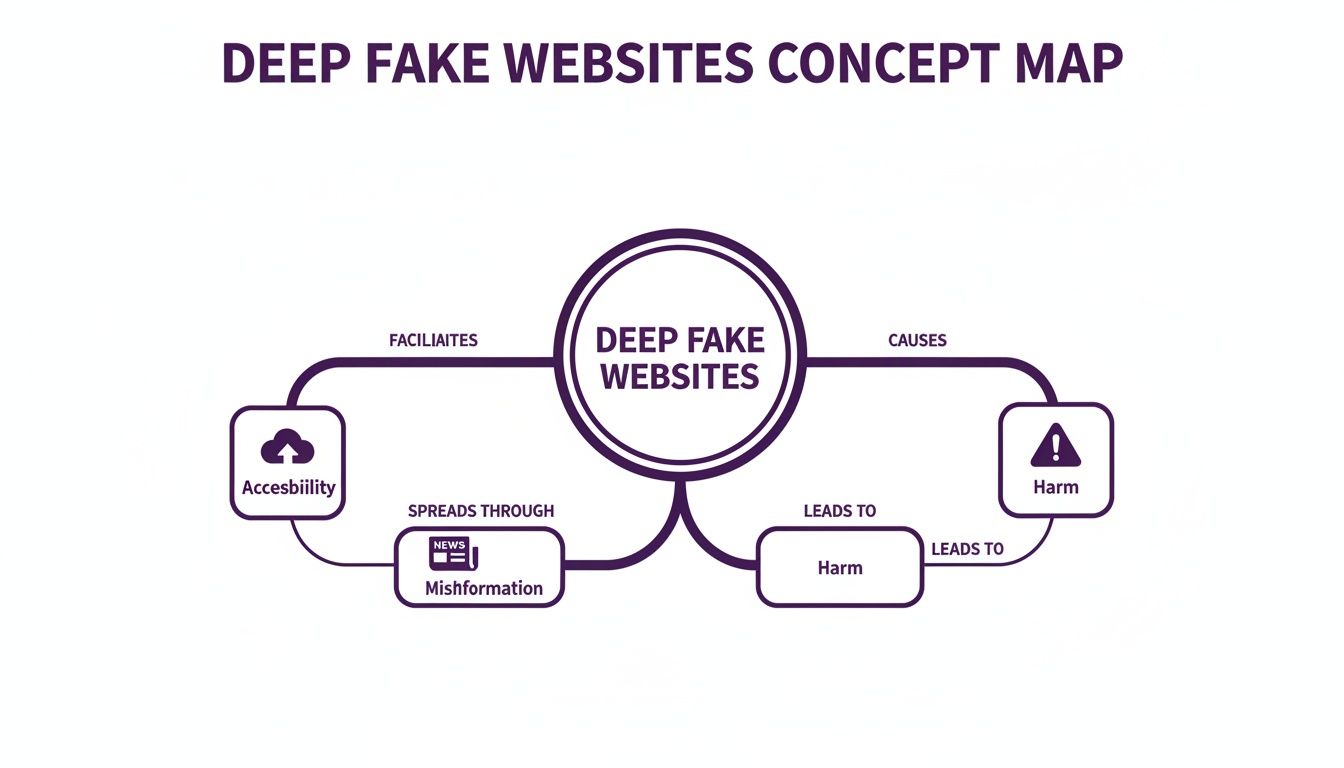
As the graphic illustrates, making this technology easy to access directly fuels the spread of false narratives, which in turn causes tangible harm and creates a vicious cycle.
From Face Swaps to Voice Clones
The same core ideas apply to all kinds of synthetic media, though the specific methods can change. Getting a handle on these variations is key to spotting the subtle red flags of digital manipulation.
- Face Swapping: This is the classic deepfake, where one person's face is digitally grafted onto another's body in a video. The early versions were often easy to spot because of flickering or blurry edges around the face, but the latest models have gotten much cleaner.
- Lip Syncing: In this case, the AI manipulates an existing video of someone to make it look like they're saying something completely different. The model alters their mouth movements to match a new audio track, which can also be entirely AI-generated.
- Voice Cloning: This involves training an AI on recordings of a person’s voice. Once it has learned their vocal patterns, the model can generate brand-new speech that sounds just like them, reading any script you give it. This is the tech behind voice phishing scams, where criminals impersonate CEOs or family members over the phone.
The little giveaways in a deepfake often come from the AI's "guesses." It might struggle with inconsistent lighting, unnatural blinking patterns, or hair that doesn't quite move right. These are the subtle artifacts left behind by the digital forgery process.
Understanding this creation process is the first step toward effective detection. The very methods used to generate a deepfake leave behind a faint digital trail. And while the technology is constantly improving, these tiny errors are often the first clues that what you're seeing isn't real.
For a closer look at the tools driving this trend, our guide on the deepfake image maker offers more detailed insights.
The Growing Threat of Fraud and Misinformation

The easy availability of deep fake websites has dragged synthetic media out of the realm of theory and into our daily lives. This isn't a future problem; it's a clear and present danger. We’re seeing tangible consequences that range from personal financial ruin to widespread social division as scammers and bad actors actively weaponize these tools to exploit trust.
These platforms have moved far beyond creating silly memes. They represent the new frontier for sophisticated, large-scale fraud, and the numbers are staggering. Global fraud losses have skyrocketed to $1.1 billion, a threefold increase from the previous year's $360 million. What's truly shocking is that 83% of these losses trace back to social media, with Facebook ($491 million), WhatsApp ($199 million), and Telegram ($167 million) leading the pack.
Financial Scams Powered by AI
Criminals are breathing new life into old scams by giving them a terrifyingly convincing new face. Instead of a clumsy, typo-filled email, you might now get a video message from a celebrity you trust endorsing a crypto scheme. Or maybe it's a voice note from your "CEO" demanding an urgent wire transfer.
These new-age scams work because they exploit the inherent trust we place in what we see and hear. A few of the most common schemes are:
- CEO Fraud and Voice Phishing (Vishing): Scammers use voice-cloning tech to impersonate a high-level executive. They'll call an employee with an "urgent, confidential" request to transfer company funds, and the voice is often indistinguishable from the real person's.
- Fake Celebrity Endorsements: Malicious ads featuring deepfaked videos of public figures are all over social media. They're used to promote bogus investment platforms, especially in the crypto world, luring victims with promises of guaranteed high returns.
- Synthetic Identity Scams: Deepfakes can create entirely fabricated yet realistic-looking identities. These are perfect for romance scams or for bypassing the identity verification checks used by banks and other financial services.
And as the technology gets better, the scams get more complex. We’re now seeing sophisticated deepfake video call scams where a live video call is manipulated in real-time. Without specialized tools, spotting the deception is nearly impossible.
The core principle of these scams is to hijack trust. By impersonating a familiar face or a trusted voice, criminals bypass our natural skepticism, turning our own perceptions against us.
Weaponizing Information to Erode Trust
Beyond straight-up theft, the broader societal impact of deep fake websites is arguably even more damaging. When anyone can create a believable video of a politician announcing a false policy or a health official spreading dangerous misinformation, the very foundation of our shared reality starts to crumble.
This weaponization of information serves several destructive goals. It’s a powerful tool for manipulating public opinion, disrupting elections, and pouring fuel on the fire of social discord. The aim often isn’t just to make people believe a single lie, but to foster a pervasive sense of distrust where people no longer know what or who to believe at all.
The Societal Consequences
The long-term effects of this erosion of trust are profound, threatening the stability of our most important institutions.
| Impact Area | Description |
|---|---|
| Journalism & Media | Bad actors can dismiss real footage as "just a deepfake," undermining the credibility of news organizations and making it harder for journalists to report the truth. |
| Political Stability | Deepfakes can fuel polarization by creating "evidence" for conspiracy theories and allow foreign adversaries to interfere in elections with highly targeted disinformation. |
| Legal System | It creates huge challenges for authenticating video evidence in court. This could potentially allow guilty parties to walk free or, even worse, incriminate innocent people. |
| Public Safety | It can be used to incite panic, spread false alarms during a crisis, or impersonate law enforcement officials, leading to chaos and incredibly dangerous situations. |
Ultimately, the flood of content from deep fake websites forces all of us into a defensive posture. It demands a much higher level of critical thinking and verification for everything we see online. This is a fundamental shift in how we have to consume information, and it highlights just how badly we need reliable detection tools to help us separate fact from fiction.
Practical Methods for Detecting Deep Fake Content
Knowing the threat is one thing; knowing how to fight back is another. It's time to shift from understanding the problem to deploying the solution. The good news is that even though the technology behind deep fake websites is sophisticated, it's rarely perfect. Many fakes, especially those produced in a hurry, leave behind subtle traces of their artificial origins.
Learning to spot these digital fingerprints is your first line of defense. It means moving from being a passive consumer of content to an active, critical analyst. Think of yourself as a digital detective examining a crime scene—the smallest, most overlooked details often tell the whole story.
Training Your Eyes and Ears
Believe it or not, your own senses are a powerful first-pass filter. AI models often stumble when trying to replicate the tiny, chaotic details that make us human. If you know what to look for, you can often catch a fake before it has a chance to fool you.
Keep an eye out for these common giveaways:
- Unnatural Blinking or Gaze: Humans have a natural, almost rhythmic blink rate. AIs sometimes get this wrong. A subject might blink too frequently, not at all, or with a strange, jerky motion. Their gaze can also seem "locked" or fail to track movement in the scene naturally.
- Mismatched Lighting and Shadows: Pay close attention to how light falls on the subject. If the shadows on their face are inconsistent with the lighting in the environment, that's a massive red flag. For example, a person under a bright ceiling light should have distinct shadows under their nose and chin.
- Blurry or Warped Edges: Look right at the border of the person's face, hair, and neck. In many deepfakes, the area where the manipulated face is layered onto the source video will look slightly blurry, distorted, or have a "wavy" quality, especially when they move quickly.
- Awkward Facial Expressions: While AIs are great at swapping faces, they can struggle to mimic genuine emotion. Smiles might look plastered on, skin can appear too smooth (like a digital filter), and facial movements might not quite sync with the emotional tone of their voice.
A Verification Checklist for Professionals
For journalists, fact-checkers, and researchers on a tight deadline, a structured approach is key. A quick mental checklist can help you triage suspicious content and decide if it's worth a deeper dive.
- Check the Source: Where did this video or image come from? Was it a reputable news outlet or an anonymous account with no history? The context surrounding a piece of media is often your first and most telling clue.
- Look for Visual Flaws: Run through the common tells listed above. Pause the video and go frame-by-frame. Do you see any oddities with lighting, shadows, or reflections in the eyes?
- Analyze the Audio: Is the audio perfectly synced with their lip movements? Listen for a robotic, monotone quality in the voice, or strange background noises that don't fit the setting.
- Cross-Reference and Corroborate: Has any other credible source reported this? A quick search can often confirm if a video is a known fake or if it completely contradicts the established facts. Robust verification is crucial, and new tools using AI for cross-checking facts are becoming invaluable in this process.
This manual review process is a critical skill. However, as deepfake technology improves, even the most trained eye can be deceived. The most sophisticated fakes are virtually flawless to human perception.
When Manual Checks Are Not Enough
This brings us to the hard truth about human detection: it has its limits. The most advanced generative AI models can produce content that sidesteps all the classic giveaways. They can create realistic blinking, perfect lighting, and clean edges, making manual checks unreliable when the stakes are high.
This is where automated tools become non-negotiable. An AI-powered deep fake detector goes beyond what the eye can see, analyzing content at the pixel level. It hunts for statistical anomalies and digital fingerprints left behind during the AI generation process—clues that are completely invisible to us.
These platforms provide a fast, data-driven assessment, often giving you a confidence score on the media's authenticity. For professionals who need to make accurate calls in minutes, not hours, these tools aren't a luxury anymore. They're an essential part of the modern verification workflow. To get a better sense of how these systems work, you can explore our guide to finding the right deep fake detector for your needs.
Building a Professional Verification Workflow

When you're on the front lines—whether you're on a trust and safety team, in a newsroom, or managing corporate risk—playing whack-a-mole with individual deepfakes just doesn't cut it. The sheer volume of content pouring out of deep fake websites demands a system. A structured, scalable, and defensible verification workflow isn't a luxury; it's a necessity.
Without a solid process, you're just reacting. Threats get missed, and enforcement becomes a guessing game. A well-designed workflow acts as a multi-stage filter, catching everything from sloppy fakes to sophisticated, state-sponsored disinformation. It’s about combining sharp human intuition with powerful automated tools to move from simple detection to holistic risk management.
The Three Pillars of a Solid Workflow
A truly effective workflow isn't just one step. It's built on three distinct but connected stages. Think of it as a funnel that ensures you're using your resources—both human and technical—in the smartest way possible.
- Manual Triage: This is your first line of defense, led by human analysts. The goal here is speed. Your team is looking for the obvious giveaways—the uncanny valley stuff. Think weird blinking patterns, inconsistent lighting, or blurry edges where a face meets a body. This quick scan filters out the low-hanging fruit so you don't waste heavy-duty tools on amateur fakes.
- Technical Analysis: Anything that looks remotely convincing gets kicked over to the tech. This is where you bring in specialized software, like an AI-powered detector, to scrutinize the media at a pixel-by-pixel level. These tools can spot the subtle digital fingerprints and statistical oddities that are completely invisible to the naked eye, giving you a clear, data-driven verdict.
- Contextual Verification: Just because a tool gives a piece of media the all-clear doesn't mean your job is done. The final—and arguably most important—step is to verify the context. Is this event being reported by reputable news outlets? Can you find the original, unedited footage anywhere? This is old-school investigative work, and it's what separates a good guess from a confirmed fact.
This three-pillar approach ensures every suspicious piece of media gets the right level of scrutiny without overwhelming your team.
Don't Overlook Privacy in Your Toolkit
As you assemble your detection toolkit, one feature is absolutely non-negotiable: privacy. If you're a journalist working with a sensitive leak, a lawyer reviewing confidential evidence, or a company handling proprietary data, you cannot afford to use a tool that saves your uploads to its servers. That's a massive security risk.
A privacy-first tool processes media in real time without ever storing the files you submit. This is a critical feature for any professional workflow, ensuring that your sensitive information—and that of your sources or clients—remains completely confidential.
Making this a hard requirement protects your organization from potential breaches and gives you the confidence to handle even the most sensitive material.
Scaling Your Defenses with Automation
Let's be realistic: even the most efficient manual workflow will eventually buckle under the sheer scale of content being created today. To seriously counter the threat from deep fake websites, you have to bring in automation. This is where an Application Programming Interface (API) becomes a game-changer, especially for trust and safety teams.
By plugging a detection API directly into your content moderation queue or digital asset management system, you can build a defense that scales automatically.
- Automated Flagging: The API can scan every single image or video the moment it's uploaded, flagging suspicious media for human review before it has a chance to go public.
- Reduced Moderator Load: This pre-screening dramatically cuts down the amount of content your human moderators have to sift through. It frees them up to apply their expertise to the most complex, high-risk cases that truly need a human eye.
- Consistent Enforcement: Automation ensures that every piece of content is checked against the same objective standards. This leads to fairer, more consistent moderation decisions across your entire platform.
Ultimately, building a professional verification workflow is an investment in your organization's resilience. It equips your team to not only spot deepfakes but to do so with speed, accuracy, and a clear process that can hold up under pressure.
Navigating the Legal and Ethical Landscape
The rise of deepfake websites has thrown us into a tricky situation where the technology is sprinting far ahead of the law. For legal pros, educators, and anyone in compliance, this whole area is a confusing gray zone. It's forcing us to ask tough questions about consent, identity, and intellectual property that our current laws simply weren't built to handle.
When someone’s face or voice is used without their permission, it opens up a Pandora's box of legal problems. The core issue is that a deepfake can make a person appear to say or do something they never did, which completely muddies the waters of accountability. Depending on the situation, the fallout can range from deep personal harm to massive brand damage.
Key Legal and Ethical Battlegrounds
To grasp the potential damage, you first have to understand the specific violations. Most of the legal headaches deepfakes create fall into a few clear categories, each with its own victims and consequences.
- Copyright and Right of Publicity: Imagine using a famous actor’s face to sell a product without their okay. That's a classic violation of their "right of publicity," which protects their identity from being used for commercial gain without permission.
- Defamation and Slander: A deepfake showing someone in a fake criminal act or spewing hateful rhetoric is textbook defamation. The content is created specifically to tank their reputation, and that's illegal.
- Non-Consensual Explicit Material: This is one of the ugliest sides of deepfake tech—creating explicit videos of people without their consent. Many places now have specific laws on the books that treat the creation and sharing of this material as a serious crime.
While these legal frameworks offer some ways to fight back, actually enforcing them is a huge challenge. The creators behind these websites are often anonymous and hard to trace. Plus, when the creator is in one country and the victim is in another, it creates a jurisdictional nightmare for legal action.
The Evolving Regulatory Response
Governments around the world are starting to wake up to the threat, but the response has been slow and inconsistent. We're seeing new laws being proposed to specifically target malicious deepfakes, trying to plug the legal gaps that creators are currently slipping through.
The heart of the ethical debate isn't about the technology itself, but how it's used. Sure, deepfakes can be used for a good laugh or to create incredible art. But those same tools can be weaponized for harassment, fraud, and political chaos, forcing a difficult conversation about where to draw the line between regulation and creative freedom.
This ongoing debate shows just how carefully lawmakers have to tread. The challenge is to write rules that stop the bad actors without crushing legitimate uses in industries like film and art.
As this legal world continues to take shape, it’s vital for everyone—from individuals to large organizations—to understand their rights and liabilities. The rulebook for deepfakes is still being written, making a strong ethical stance and constant vigilance more critical than ever.
A Few Common Questions About Deepfake Websites
As synthetic media becomes more common, a lot of questions pop up. Let's tackle some of the most frequent ones with clear, direct answers.
Can I Legally Use a Deepfake Website for Fun or Creative Projects?
This is a tricky area, and the short answer is: it depends. The two biggest factors are always consent and intent. If you use someone's likeness without their direct permission, you could easily land in legal hot water for violating their right of publicity or even for defamation if the content is harmful.
Creating non-consensual explicit material is flat-out illegal in many places. Even if you're just messing around on a personal project, always think about the ethical side of things and how easily this tech can be misused.
How Can I Protect Myself From Deepfake Scams?
Your best defense is a healthy dose of skepticism and a habit of verification. Be on high alert for urgent requests for money or "once-in-a-lifetime" investment opportunities, even if they seem to come from someone you trust in a video or voice message.
If you get a strange video call or an odd audio message, just hang up. Then, contact that person through a different channel you know is legitimate, like a phone number you already have saved for them. When it comes to images, run them through a reliable verification tool to check for signs of manipulation before you believe what you see.
Here’s a simple rule of thumb: if a message makes you feel panicked or rushed, stop. Scammers thrive when you don't have time to think. Taking a moment to verify is your single best move.
Are There Any Positive Uses for This Technology?
Yes, definitely. For all the serious risks, the AI behind deepfakes has some genuinely positive and creative uses.
In the film industry, for example, it’s used to dub movies into other languages with perfectly synced lips or to de-age actors without expensive CGI. But its potential goes much further:
- Education: Imagine creating historical simulations where students can "talk" to figures from the past.
- Healthcare: It can be used to build hyper-realistic training modules for surgeons to practice delicate operations.
- Accessibility: The technology can help create personalized voice assistants for people who have lost their own voice.
The technology itself isn't good or bad—it's neutral. The legal and ethical problems almost always come from how people choose to use it.
Stay ahead of digital deception. With AI Image Detector, you can quickly and accurately verify the authenticity of any image, protecting yourself and your organization from the risks of AI-generated content. Check any image for free on aiimagedetector.com.
