

What Is the Difference Between Images and Photos?

The distinction between an 'image' and a 'photo' seems simple on the surface, but it's a crucial one. At its heart, a photo is a specific type of image—one that's captured from the real world using a camera or another light-sensitive device. An image, on the other hand, is a much broader umbrella term. It covers any visual representation you can think of, from drawings and diagrams to digital graphics and AI-generated visuals.
So, while every single photo is an image, not every image can be called a photo.
Defining the Modern Image vs the Timeless Photo
The real difference comes down to origin and authenticity. A photograph is fundamentally tied to a real-world event. It’s a direct record of light, shadow, and form as they existed in a particular moment. An image, however, can be completely fabricated—dreamed up by an artist, built from scratch in design software, or generated by an algorithm with a simple text prompt.
This distinction has become more important than ever. Think about it this way: a painting of a mountain is an image. A snapshot of that same mountain is a photo. Both show you the mountain, but only the photo is a direct document of that physical place at that time. Understanding this is the first step in navigating visual media today. We explore this concept of authenticity further in our guide on what is a real image.
Key Distinctions at a Glance
To quickly break down the core differences, this table highlights what sets an image apart from a photo.
Core Distinctions Between an Image and a Photo
| Attribute | Image (The Broad Category) | Photo (The Specific Type) |
|---|---|---|
| Origin | Can be created, generated, or captured. | Always captured from a real-world scene. |
| Scope | Includes photos, graphics, diagrams, art, etc. | A specific subset of images. |
| Reality | May or may not represent reality. | Directly represents a moment in reality. |
| Medium | Can be digital, painted, drawn, or printed. | Traditionally film-based or digitally captured. |
This isn't just a matter of semantics. The difference has real-world consequences, influencing everything from legal evidence and journalism to art and marketing. You can find more detail on the evolution of this in a guide to digital vs traditional photo collection. As we dig deeper, you’ll see just how this fundamental separation plays out across technical, legal, and practical applications.
Exploring the Technical and Semantic Divides
While it's easy to say photos are captured and images are created, the real distinction runs much deeper. It’s written in their technical DNA and the meaning they carry in professional circles. A photograph isn't just a picture; it's a data-rich file born from the physics of light, whereas an image is a far more flexible, and often simpler, digital creation. For anyone whose work relies on visual media, understanding this difference is non-negotiable.
On a technical level, the biggest giveaway is metadata. A real photograph from a digital camera comes packed with a trove of information called EXIF (Exchangeable Image File Format) data, embedded right into the file itself.
This isn't just fluff. EXIF data acts like a digital fingerprint, giving you a detailed backstory of the exact moment the photo was captured.
The Data Behind the Visual
A photograph’s metadata contains a precise log of the camera’s settings and its environment when the shutter clicked. This is the technical proof that ties a photo to a specific point in reality.
- Camera and Lens Details: The make and model of the gear used.
- Exposure Settings: The nitty-gritty details like aperture, shutter speed, and ISO.
- Time and Date Stamps: An exact record of when the photo was taken.
- GPS Coordinates: Many modern cameras and smartphones even log the precise location.
An image created from scratch—whether it's a vector graphic, a digital painting, or an AI-generated scene—usually has none of this rich, device-generated history. Its metadata is typically sparse, containing only basic info like file dimensions, color profile, or the software it was made in. This technical void is a huge red flag for a synthetic origin.
A photograph carries its history within its code. An image, on the other hand, often has a much simpler, digitally constructed past, making its origin less transparent.
Semantic Weight and Professional Context
Beyond the technical bits and bytes, the words "photo" and "image" carry completely different weight in the professional world. This semantic gap dictates how they’re used and how much trust we put in them. The word you choose signals your intent and sets the audience's expectation for authenticity.
In fields like journalism, law, and scientific research, the word "photo" is chosen deliberately. It signals a direct, unaltered record of an actual event. Here, a photo is evidence, a document of truth. If you alter a photo beyond basic edits, it loses its credibility and becomes a manipulated image, a serious breach of ethical standards. For a journalist, passing off an image as a photo could end a career.
On the flip side, the term "image" is right at home in marketing, graphic design, and advertising. In these industries, the goal isn't to document reality—it's to create a feeling or a specific visual message. An image might be a composite of several photos, a purely digital illustration, or an AI-generated scene. Its value is in its power to persuade and its aesthetic appeal, not its factual accuracy. This makes "image" the perfect term for any visual that’s been created or heavily modified, where strict authenticity isn't the point.
How Generative AI Is Redefining Visual Authenticity
Generative AI has thrown a massive wrench into our traditional understanding of visual truth. The latest models can pump out synthetic images that are so realistic they completely erase the line between a genuine photograph and a digital fabrication. This isn't just about tweaking reality anymore; it's about inventing it from thin air.
This seismic shift makes it more crucial than ever to nail down the difference between a photo and an image. We've moved past simple Photoshop edits into the age of synthetic media, where visuals can be conjured up on demand, with zero grounding in a real-world event. If you want to dive deeper, our guide explains in detail what is synthetic media. The consequences are huge, opening the door to everything from breathtaking art to dangerously effective misinformation.
The New Frontier of Deception and Creation
Here’s the problem: AI-generated images don't have the subtle flaws or digital signatures that authentic photos do. Instead, they have their own tell-tale signs—artifacts that are often completely invisible unless you know exactly what to look for. And as the AI gets better, telling them apart by eye becomes a fool's errand, which is why automated verification is becoming so essential.
To get a sense of how dramatically AI is changing the game, it's worth exploring the new dynamic of AI vs. Real Photography. This resource gives great context on where things stand. Being able to spot an AI image isn't just a party trick anymore; it's a fundamental skill for anyone who needs to trust what they see.
At its core, generative AI challenges our fundamental assumption that seeing is believing. It forces us to question the origin of every visual we encounter, making verification an essential step in modern communication.
This technological arms race has kicked off a boom in verification tools. The global market for AI detectors, which includes this kind of advanced image analysis, was valued at around USD 453.2 million and is growing like crazy. Forecasts predict it will rocket to somewhere between USD 2.06 billion and USD 5.226 billion by 2030-2033, all fueled by the desperate need for reliable authentication.
The Role of Advanced AI Detection
To fight back, specialized tools like AI Image Detector are becoming non-negotiable. These platforms are designed to scan visuals for the subtle, mathematical fingerprints that AI models leave behind.
This screenshot shows how a good detection tool gives a straightforward verdict and a confidence score, letting you quickly judge an image's origin. By digging into pixel patterns and other digital breadcrumbs, these tools provide a critical line of defense against convincing fakes, making them vital for professionals whose work depends on authentic content.
A Practical Guide to Verifying an Image’s Origin
Telling a real photograph apart from a convincing AI creation isn't just a party trick anymore; it's a critical skill for navigating the modern world. The most reliable way to do this is by combining a bit of old-fashioned detective work with the power of modern technology. This layered approach gives you the best shot at knowing exactly what you’re looking at.
Start With the Basics: Manual Checks
Before you turn to any fancy tools, there are a few simple things you can do yourself.
First, run a reverse image search. Pop the image into a tool like Google Images or TinEye and see where else it has popped up online. If it appears in a bunch of unrelated places or on stock photo sites with weird descriptions, that’s a pretty good sign something is off.
Next, it’s time to play "spot the difference." AI models, for all their power, still get tripped up by the little things. Zoom in and look closely at the details.
- Hands and Fingers: AI often messes these up. You might see six fingers, a thumb bending the wrong way, or just a waxy, unnatural texture.
- Text and Symbols: Any text in the background is a dead giveaway. AI-generated words often look like gibberish, with warped letters and nonsensical spelling.
- Background Logic: Does the scene make sense? Look for shadows that fall in the wrong direction, impossible architecture, or objects that seem to melt into each other.
Bring in the Big Guns: Automated Detection Tools
If your manual checks don't give you a clear answer, it's time to bring in a specialist. This is where an AI Image Detector comes into play. These tools go far beyond what the human eye can see, analyzing the deep digital structure of the file itself. They’re looking for the subtle fingerprints that generative models leave behind—things like pixel patterns, digital noise, and lighting inconsistencies that are completely invisible to us.
This simple decision tree helps visualize the workflow.
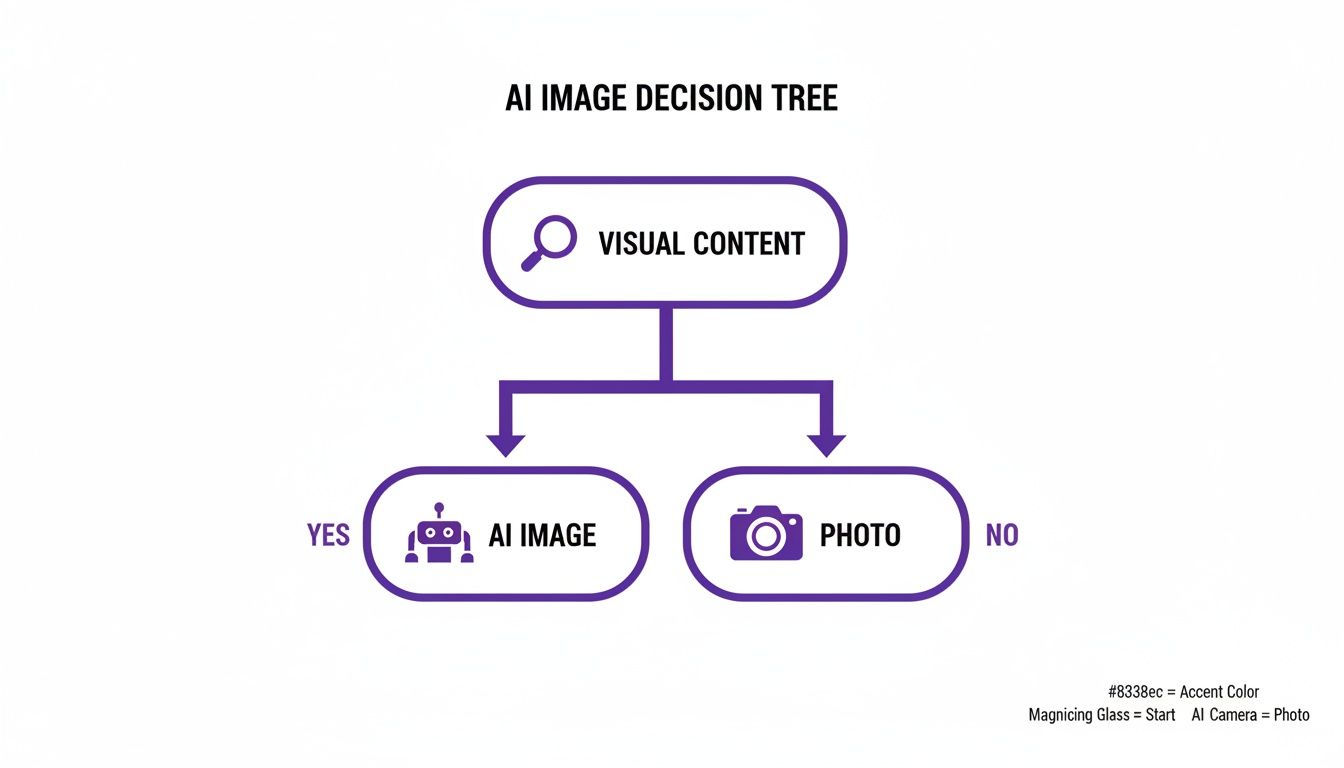
As the chart shows, the final call on whether something is a genuine photo or an AI image comes down to a process of verification.
Putting It All Together
Most detection tools won't just give you a flat "yes" or "no." Instead, you'll get a confidence score that tells you the likelihood of an image being AI-generated. This nuance is key to making a well-informed judgment. For a deeper dive into this, check out our guide on how to check if a photo is real.
The real goal of verification isn't just to slap a 'real' or 'fake' label on something. It's about understanding its origin story. The combination of your own critical thinking and a solid automated analysis is the most reliable way to get to the truth.
The demand for this kind of verification has skyrocketed, and the market for AI detectors has exploded right along with it. The top platforms are incredibly good at what they do, with some reaching 99.1% detection accuracy and others reporting 99% accuracy with less than 1% false positives. They prove just how powerful this technology has become. By integrating these manual and automated steps, you can create a solid process for figuring out where any visual actually came from.
Why This Distinction Matters in Your Profession
The line separating a photograph from a digital image isn't just about semantics; it's a critical distinction with very real consequences. For professionals in almost any field, getting this wrong can kneecap your credibility, open you up to legal trouble, and shred ethical standards. And with visual information getting easier to fake every day, the stakes have never been higher.
Getting this right is fundamental to your professional integrity. It doesn't matter if you're reporting the news, teaching a class, or designing a website—how you label, use, and verify visual content speaks directly to how trustworthy you are.
Journalists and Fact-Checkers
For anyone working in news, the difference between images and photos is everything. A photo is evidence. It’s a record that something actually happened. If you publish a manipulated image and call it a photograph, you've committed one of journalism's biggest sins and can lose the public's trust in a heartbeat.
Fact-checkers are on the front lines of this battle, fighting the flood of misinformation. An altered or generated image is a potent propaganda tool, built to stir up emotions and mislead. By confirming whether a visual is a genuine photo with a real origin, they can shut down false narratives before they spread and cause real harm.
In the fight against disinformation, the first question must always be, "Is this a photo or an image?" The answer determines its value as evidence and its potential to deceive.
Educators and Researchers
In the academic world, authenticity is the coin of the realm. Educators have a duty to teach students how to think critically about sources, and that includes telling the difference between a primary-source photo and a simple illustration. Using a synthetic image as if it were a historical photograph in a history lesson, for instance, isn't just a mistake—it's teaching a lie.
Researchers, too, have to be militant about the integrity of their data. If a study in biology, sociology, or forensics relies on photographic evidence, a single unverified image could compromise the entire project. Academic credibility is built on rigorous verification, and treating every visual as if it were a factual record is a recipe for disaster.
Artists and Designers
Creatives have to navigate a tricky path between inspiration and outright theft. Using a photograph without the right permissions can land you in serious legal hot water over copyright. On the other hand, an AI-generated image might seem like a safe bet, but it brings a whole new set of ethical questions about authorship and originality.
Knowing whether you’re working with a photo or a synthetic image is essential for:
- Copyright Compliance: You have to license photos properly to avoid expensive legal battles.
- Ethical AI Use: It's important to understand where your AI model's training data came from and to steer clear of replicating an artist's copyrighted style without permission.
- Creative Authenticity: Being transparent with your audience about the tools you used to create your work is key to building trust.
Legal and Compliance Teams
In a courtroom, the distinction is crystal clear. A photograph can be submitted as evidence, but only if its chain of custody is solid and it’s proven to be untampered with. Its metadata can back up timelines and locations, making it a powerful tool for establishing the facts of a case.
An image, especially one generated by AI, has almost zero evidentiary value on its own. It requires a mountain of verification to be taken seriously. For compliance teams, this is a huge deal in areas like fraud detection and identity verification. A doctored ID or a synthetic profile picture is a common tool for criminals, which makes having robust detection methods a core part of managing risk.
Growing global regulations around AI transparency have fueled a massive 50% increase in the adoption of AI detectors across businesses and universities. In fact, 60% of organizations in these sectors have rolled out detection tools to meet new digital safety rules and content authenticity standards. This wave of adoption, driven by regulation, marks a pivotal shift in how institutions approach image verification, a trend highlighted in recent reports on the growth of AI detector tools.
Answering Your Questions About Images and Photos
Even with the definitions sorted out, a few common questions always seem to pop up. Let's tackle them head-on to clear up any lingering confusion about how images and photos work in the real world.
Can a Photograph Be Edited and Still Be a Photo?
Absolutely. Almost every photo you see has been edited in some way. Basic adjustments like tweaking the brightness, correcting colors, or cropping the frame are standard practice and don't change the fact that it's a photograph. These edits enhance the original capture, they don't fundamentally alter its reality.
The line gets crossed when the edits start to change the story the photo tells. If you add a person who wasn't there or remove a key object from the scene, it’s no longer just a photo—it’s a manipulated image. This is a huge deal in fields like photojournalism, where strict ethical codes are in place to ensure a photograph remains a truthful record of a moment.
Are All Digital Images Just Pixels?
That's a common misconception, but no. Digital images actually come in two primary flavors: raster and vector.
- Raster Images: This is where photos live. Formats like JPEGs, GIFs, and PNGs are all raster images, meaning they're built from a grid of tiny colored squares called pixels. If you zoom in close enough on a photo, you'll see them.
- Vector Images: Think of logos, icons, and many illustrations. Formats like SVG are vectors, and they aren't made of pixels at all. Instead, they use mathematical formulas to draw lines, points, and curves. The huge advantage here is that you can scale a vector image to the size of a billboard without it ever getting blurry or pixelated.
How Can I Prove an Image Is a Real Photo?
The gold standard for proving a photo’s authenticity is the original, untouched file right off the camera. This file contains a treasure trove of information called EXIF (Exchangeable Image File Format) data.
Think of EXIF data as the photo’s birth certificate. It records the camera model, shutter speed, aperture, the exact date and time the photo was taken, and sometimes even the GPS coordinates.
In high-stakes situations, like legal proceedings or investigative journalism, maintaining a clear "chain of custody" for the digital file is crucial. Experts can even analyze a photo’s unique digital noise pattern, which is like a fingerprint, to trace it back to the specific camera that took it.
Is a Screenshot a Photo or an Image?
A screenshot is 100% an image, not a photo.
It might feel like you're "taking a picture" of your screen, but you aren't capturing light from the physical world. A screenshot is just a digital snapshot of the data your screen is displaying at that moment. It's generated by software and has none of the rich EXIF data that comes from a camera sensor, which is what truly defines a photograph.
Knowing the difference between a real photo and a synthetic one has never been more important. For a quick and reliable way to check your visuals, the AI Image Detector is your best bet. Our tool analyzes any image in seconds, giving you a clear confidence score to help you spot AI-generated content and keep your work authentic. Try the AI Image Detector for free today.

