

Digital Image Forensics: How Investigators Spot Fakes

You've probably seen it happen in a newsroom, a classroom, or a case file. A single image lands in front of you, and everyone starts asking the same question, is this real, or did someone change it? In that moment, digital image forensics is less about computer science than about judgment under pressure, because the file on your screen may be carrying clues in its pixels, its metadata, its compression history, and even the way light falls across the scene.
The hard part is that no single clue settles the question. A photo can look believable and still be edited. It can also look suspicious because it was recompressed, cropped, or shared through a platform that changed it along the way. That's why a layered approach matters, especially when the image could affect a headline, a grade, or a legal decision. For a practical parallel, see this overview of fake news detection use cases.
Why a Single Image Can Change Everything
A photo arrives in the middle of a breaking story. The subject line says “exclusive,” the caption sounds urgent, and the image seems to confirm what people already fear. An editor wants speed, a reporter wants certainty, and a fact-checker has only minutes before the image spreads further. In that kind of moment, digital image forensics becomes a decision tool, not an academic exercise.
The temptation is to ask for one clean answer. But the evidence inside an image rarely works that neatly, because a real photo can carry weak metadata, platform recompression, or a camera signature that's been partially erased by editing. A fabricated image can also borrow enough realism to pass a quick glance. That's why the field asks a different question, not “Does it look fake?” but “What evidence supports or weakens authenticity?”
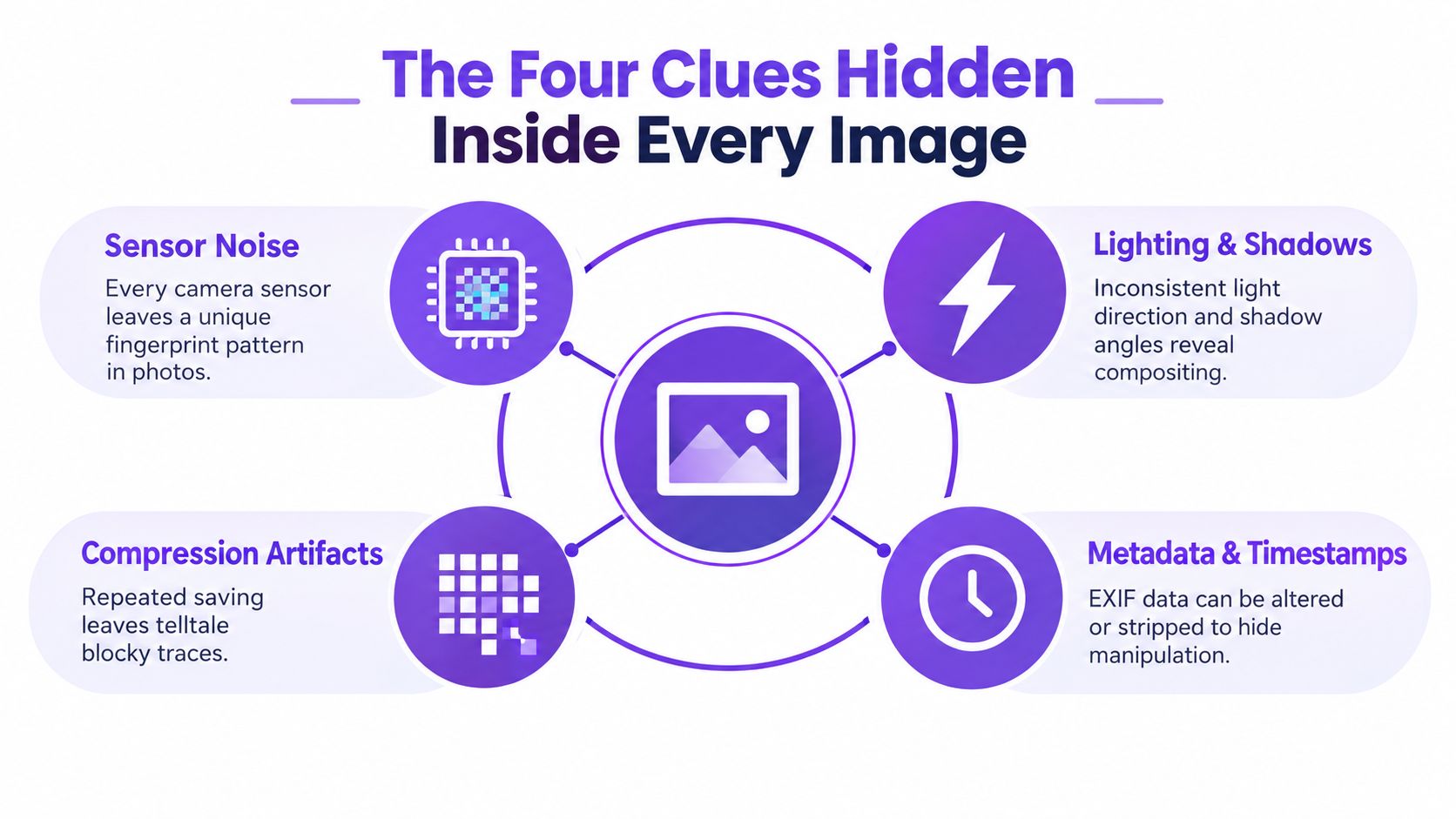
The strongest way to think about this discipline is as a set of clues that have to agree with one another. The machine-readable trail, the visual physics, and the file structure each tell part of the story. When they line up, confidence grows. When they conflict, caution should rise.
Practical rule: treat every image as a bundle of evidence, not a verdict.
That mindset matters for journalists, investigators, educators, and moderators alike. It's also why image verification shouldn't begin and end with a single detector score. A good workflow checks whether the image behaves like an authentic file across multiple layers, then asks whether those layers still make sense after editing, reposting, or synthetic generation.
The Four Clues Hidden Inside Every Image
An image leaves traces the way a document leaves fingerprints. Some of those traces come from the camera, some from the file format, and some from the scene itself. A forensic analyst looks at these clues together, because any one of them can be misleading on its own.
Sensor and noise traces
Every camera sensor produces tiny irregularities. In practice, that means two photos taken by different devices don't leave exactly the same background “grain,” even if the scenes look similar. In forensic work, that pattern can help with source-device identification, because camera-specific residual noise can act like a signature when the original pixels still exist in usable form. Research on sensor noise treats this as a provenance clue, not a magic answer, especially because JPEG compression, resizing, and denoising can weaken it.
Metadata and provenance
Metadata is the file's paperwork. It can include camera settings, timestamps, and software markers, and newer provenance systems can attach more formal history to the asset. But paperwork can be missing, altered, or stripped by an app. That means metadata helps most when it matches the rest of the evidence, and least when someone expects it to prove authenticity by itself.
Lighting and geometry
This is the part non-technical readers often understand fastest. If shadows point in different directions, reflections don't match the room, or a face seems pasted into a scene with the wrong perspective, the image may be unreliable. These checks are powerful because they're tied to real-world physics. They don't always tell you how an image was altered, but they can tell you that something doesn't fit.
Compression and format artifacts
A JPEG behaves differently from a raw file or a PNG. Saving and re-saving can leave block patterns, inconsistent compression histories, and resampling traces. Forensic analysts use those artifacts the way a mechanic reads wear marks on an engine, not as proof of fraud on their own, but as signs that the file's history deserves scrutiny. For a deeper technical overview, this guide to JPEG image analysis is a useful companion.
Analogy: metadata is the label on the box, noise is the texture of the object inside, lighting is how the object sits in the room, and compression is the wear left by handling.
The key idea is simple. Real images often show a mix of clues that fit together. Suspicious images often create mismatches between those clues, and that mismatch is where the investigation starts.
Algorithmic, Manual, and Hybrid Detection Explained
A single image can mislead in different ways, so no one method sees the whole scene. Algorithms are good at spotting repeatable patterns, human review is good at reading context, and hybrid systems try to compare both. That layered view matters because editing, recompression, or cross-model generation can leave one signal looking normal while another looks off.
Algorithmic methods
Algorithmic analysis includes PRNU fingerprinting, JPEG double-compression analysis, Error Level Analysis, and neural-network classifiers. PRNU tries to match a questioned image against a sensor fingerprint, which helps when the image is expected to come from a real camera. JPEG analysis looks for repeated-saving signatures and inconsistent compression blocks. Neural methods scan for learned patterns that may correlate with synthetic or manipulated content. For a plain-language explanation of how such detectors are built and where they fail, this detection algorithm overview is a useful reference.
These methods are strong at scale and consistency. They are weaker when training data, file history, or manipulation type shifts. A detector trained on one kind of forgery may miss another if the generator, camera, or platform changes. Algorithmic output should therefore be treated as evidence to weigh, not as a final ruling.
Manual review
Human analysts still catch things machines miss. An eye can notice a shadow that bends the wrong way, a reflection that does not belong, duplicated texture in a background wall, or a caption that conflicts with the image's claimed origin.
Manual review is slower, but it is good at spotting obvious physical impossibilities and context clues that a detector may ignore. In practice, that human step often catches the mismatch first, then the software helps confirm where to look next.
Hybrid workflows
Hybrid systems are usually stronger because they combine complementary signals. In one reported CASIA v2.0 experiment, a hybrid Error Level Analysis and convolutional-neural-network approach reached 74.32% overall accuracy, improved by 7.2 percentage points over ELA alone, reduced the false-positive rate from 50.2% to 34.8%, and reported 0.84 sensitivity for altered regions source. The lesson is clear. Pairing methods helps because it reduces blind spots, yet it still leaves room for error.
| Detection Families at a Glance | ||
|---|---|---|
| Approach | Best at detecting | Common weakness |
| Algorithmic | Sensor traces, compression anomalies, learned manipulation patterns | Can overfit to familiar datasets and file histories |
| Manual | Lighting mistakes, geometry errors, context mismatches | Slower, and easy to miss subtle edits |
| Hybrid | Mixed evidence across pixel-level and learned signals | Still depends on dataset quality and post-processing |
For teams building or reviewing workflows, the table works best as a checklist of strengths and weak points. It helps explain why one signal rarely settles the question by itself, and why a layered evidence model is safer than relying on a single score.
Workflows for Journalists, Educators, and Legal Teams
Different professionals need different levels of speed, documentation, and defensibility. A journalist often needs to decide whether to run with a claim, an educator needs to explain why a submission is questionable, and a legal team needs a record that can survive challenge. The tools may overlap, but the workflow does not.
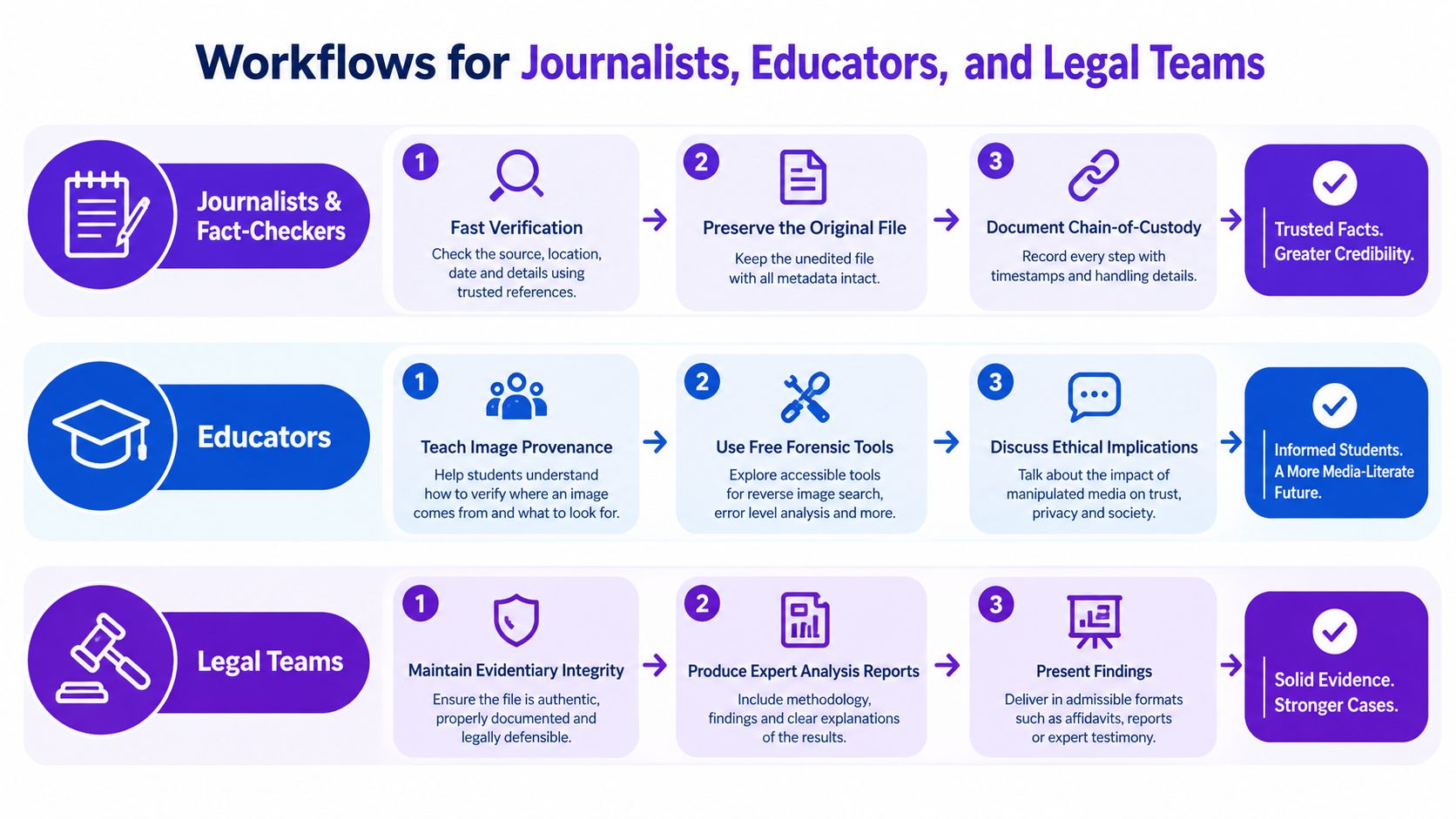
For journalists and fact-checkers, the first move is preservation. Keep the original file, document where it came from, and note every repost, crop, or re-encoding you can identify. After that, reverse-image search and metadata checks can help establish context, while a first-pass detector can flag whether deeper review is warranted. The point isn't to prove authenticity instantly, it's to prevent a hurry-up decision from erasing the evidence trail.
Educators and academic-integrity officers usually need explainable steps. If a student submits a suspicious image, the reviewer should be able to say which clue failed, whether the metadata was stripped, whether the lighting was inconsistent, or whether the file showed recompression artifacts. That makes the conversation teachable, and it also keeps the process fair.
Legal and compliance teams need something stricter. They should log the file hash, preserve the original, record each tool used, and keep the confidence score tied to the exact file examined. In legal settings, every claim has to be defensible later, which means the workflow matters as much as the final conclusion.
If you need a lightweight first-pass check, AI Image Detector can fit into that front-end triage step by analyzing an uploaded image for likely human or AI generation and returning a confidence score with an explanatory verdict. It doesn't replace the workflow, but it can help decide which files deserve a deeper look.
Practical rule: fast screening is useful only when it leads to better documentation, not when it substitutes for it.
The overlap across all three groups is obvious. Preserve the original, compare what the file says with what the scene shows, and corroborate before drawing conclusions. The difference is how much detail each audience needs to justify the next move.
Why Confidence Scores Are Not Proof
A percentage looks precise, so people treat it like a verdict. That reading is too strong. A confidence score is one clue among others, and its meaning depends on the file, the model, and the path the image took before analysis. Recompression, cropping, screenshotting, filtering, and partial edits can all change what a detector sees.
Generalization is the harder problem. A 2025 cross-model detection study in IEEE Open Journal found that retraining for new generators improved results by 29.1 percentage points for diffusion-generated images and 15.1 points for GAN-generated images. The same journal reported a false-negative rate as high as 99.85% on certain deepfake morphs. The lesson is simple, a detector that works well on familiar material can fail when the generator changes, or when the forgery type is different from the one it was tuned to catch.
What a score can tell you
A score can sort files for review. It can point an investigator toward an image that deserves metadata checks, compression analysis, or scene validation. It also helps teams handle large sets of files faster, which is useful when the goal is triage rather than final judgment.
What a score cannot tell you
A score cannot prove intent. It cannot prove authorship. It cannot tell you whether a human image was altered by AI, or whether a valid photo was compressed until it looked strange. That limitation becomes sharper when the image passed through social platforms or editing apps before it reached you.
A detector's output is a lead, not a conclusion.
A confident-looking number should trigger review, not end it. The closer the consequences are to journalism, education, or law, the less acceptable it is to treat a score as final proof.
A Layered Evidence Model for Verification
The most reliable way to read an image is to stack the evidence. Start with preservation, because once the original is gone, a lot of the useful history goes with it. Then move through metadata and provenance, compression and noise, lighting and geometry, and finally cross-check the image against source context and independent corroboration.
Each layer adds weight, but no single layer gets to rule alone. A valid provenance credential can be useful, but it documents history, not truth. No metadata does not mean AI. An odd compression pattern does not automatically mean fabrication. The job is to see whether the clues reinforce each other.
A practical checklist looks like this:
- Preserve the source file: Keep the original, note the hash, and avoid working only from screenshots or reposts.
- Check metadata and provenance: Look for EXIF, XMP, or content credentials, then ask whether they fit the file's path.
- Inspect compression and noise: Compare local regions for inconsistent JPEG history or sensor fingerprints.
- Read the scene itself: Test lighting, shadows, reflections, and geometry for contradictions.
- Verify context: Run reverse-image search, compare captions, and look for earlier versions.
- Seek independent corroboration: Match the image against other reporting, documents, or eyewitness material.
That layered approach also fits what fast tools can do well. A detector such as AI Image Detector can serve as an early signal, especially when you need to decide whether a file deserves closer inspection. The important part is keeping it inside the broader evidence model rather than letting it stand in for one.
Ethics, Admissibility, and What Forensic Findings Cannot Do
Forensic findings can support an editorial call, a classroom decision, or an investigation, but they don't settle every question. They can suggest that an image is inconsistent, manipulated, or likely synthetic. They can't, by themselves, prove motive, authorship, or the truth of a wider event. That's why uncertainty has to stay visible in the reporting.
The ethical risk is overclaiming. A single confidence score can lead to a false accusation if it's treated like proof, especially when the file has been recompressed or partially edited. Good practice is to preserve the evidence, document the steps, and state what the findings do and do not support. For teams building staff training around responsible verification, the VideoLearningAI engaging video platform is a useful example of how structured learning can help people retain process discipline.
What should always be documented? The original file, the file history you can verify, the tools used, the exact findings, and the limits of those findings. What should readers always demand? A clear explanation of why the image raised concern, not just a score or a label.
If you need a fast first pass before you move into a fuller verification workflow, AI Image Detector can help you screen an image and read the result as one layer of evidence, not the whole answer. Use it alongside metadata review, compression analysis, and source corroboration, especially when the image could affect a story, a decision, or a case.
