

Detection Algorithm: How AI Image Detection Works

A photo arrives in a newsroom showing a flooded street, complete with emergency vehicles and worried residents. It looks plausible, the caption matches a developing story, and the image is spreading quickly. A reporter can't rely on instinct alone, because a convincing synthetic image may contain no obvious distortion and an authentic image may look strange after heavy editing or compression.
The same problem appears in classrooms, marketplaces, social networks, and corporate investigations. A detection algorithm can help teams measure signals that people miss, but its output is evidence for a decision, not a substitute for one. Understanding how that evidence is produced makes it easier to use automated checks quickly without treating a confidence score as proof.
Why Detection Algorithms Matter Now

A journalist may receive a dramatic image from an unknown account while an event is still unfolding. An educator may see a polished illustration in a student submission that doesn't match the student's earlier work. A platform safety team may need to review a large stream of images before misleading material gains reach. In each situation, the human eye can identify obvious mistakes, but it struggles with subtle, repeated, or high-volume judgment.
Generative image systems have made visual production faster and more accessible. They have also changed the verification task. Reviewers now encounter images that combine realistic lighting, familiar photographic composition, and small structural inconsistencies. At the same time, authentic photographs can be resized, filtered, re-encoded, or assembled into collages, which makes visual appearance an unreliable signal by itself.
Speed is only part of the problem
Manual review remains valuable, especially for consequential decisions. It doesn't scale well when teams must triage thousands of files, compare reports from multiple reviewers, or document why a piece of content was escalated. A detection algorithm supplies a repeatable first pass, so people can spend their time on source checking, context, consent, and corroboration.
The risk isn't limited to missing synthetic content. A false accusation can damage a student's reputation, delay legitimate journalism, or remove an artist's work from a platform. Teams need a working mental model of what automated detection can measure, where it becomes uncertain, and which transformations make its output less reliable.
Practical rule: Treat an algorithmic verdict as a review signal. Pair it with provenance, source context, and a human decision appropriate to the stakes.
The sections that follow focus on that operational gap. You'll learn how a detection algorithm models deviation, how different model families approach the task, why benchmark results can fail in the field, and how professionals can build defensible workflows around uncertain evidence.
How Detection Algorithms Work
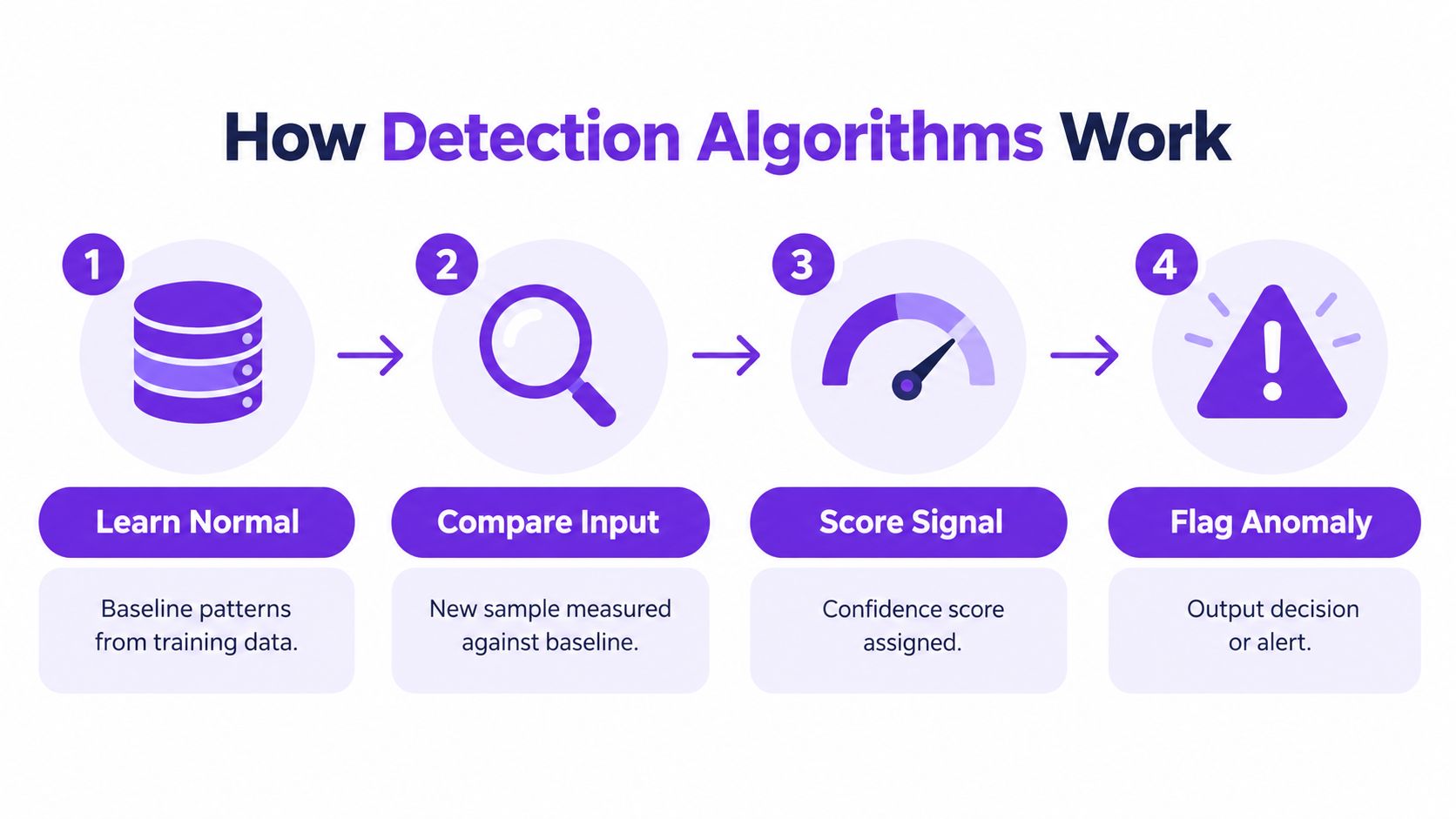
The simplest useful mental model is normal versus deviation. A system studies examples that establish expected visual patterns, measures signals in a new image, and assigns an abnormality or confidence score when those signals differ from the learned baseline. A review of anomaly detection methods describes this statistical lineage across approaches such as statistical, density-based, distance-based, clustering-based, isolation-based, ensemble, and subspace methods, with classic tools including z-scores, modified z-scores, IQR boxplots, Grubbs' test, Dixon's test, and the Shapiro-Wilk test (the survey of anomaly detection methods).
The four-part cycle
Learn normal. During training, the system encounters examples of authentic and synthetic images, or it learns a distribution of visual features associated with a target class. This baseline might include texture, color relationships, edges, frequency patterns, or higher-level representations.
Compare the input. The new image is transformed into measurable signals. The system isn't asking whether the scene feels believable in the human sense. It's comparing the image's features with patterns it has learned.
Score the signal. The model combines the evidence into a score. Depending on the design, that score may represent anomaly strength, class probability, or confidence that the file resembles one training category more than another.
Flag or route. A threshold converts the score into an action, such as allow, review, block, or request more evidence. The threshold isn't a universal truth. A newsroom and a social platform may choose different thresholds because the consequences of delay and error differ.
This process resembles a visual fingerprint, but the fingerprint isn't a single mark hidden in every generated image. It is a collection of statistical relationships. Two images can have similar resolution and composition while producing different scores because their textures, noise patterns, compression history, and structural details differ.
For a more visual explanation of image recognition and model behavior, see how AI image recognition works.
The same logic supports unsupervised methods. IBM's overview explains that Isolation Forest isolates unusual observations through random feature and split selection, and places it alongside one-class SVM, k-nearest neighbors, local outlier factor, k-means, and autoencoders (IBM's anomaly detection overview). The important idea is not the name of one method. It's the shift from hand-written rules toward systems that can identify unusual patterns in large, messy datasets.
Main Categories of Detection Algorithms
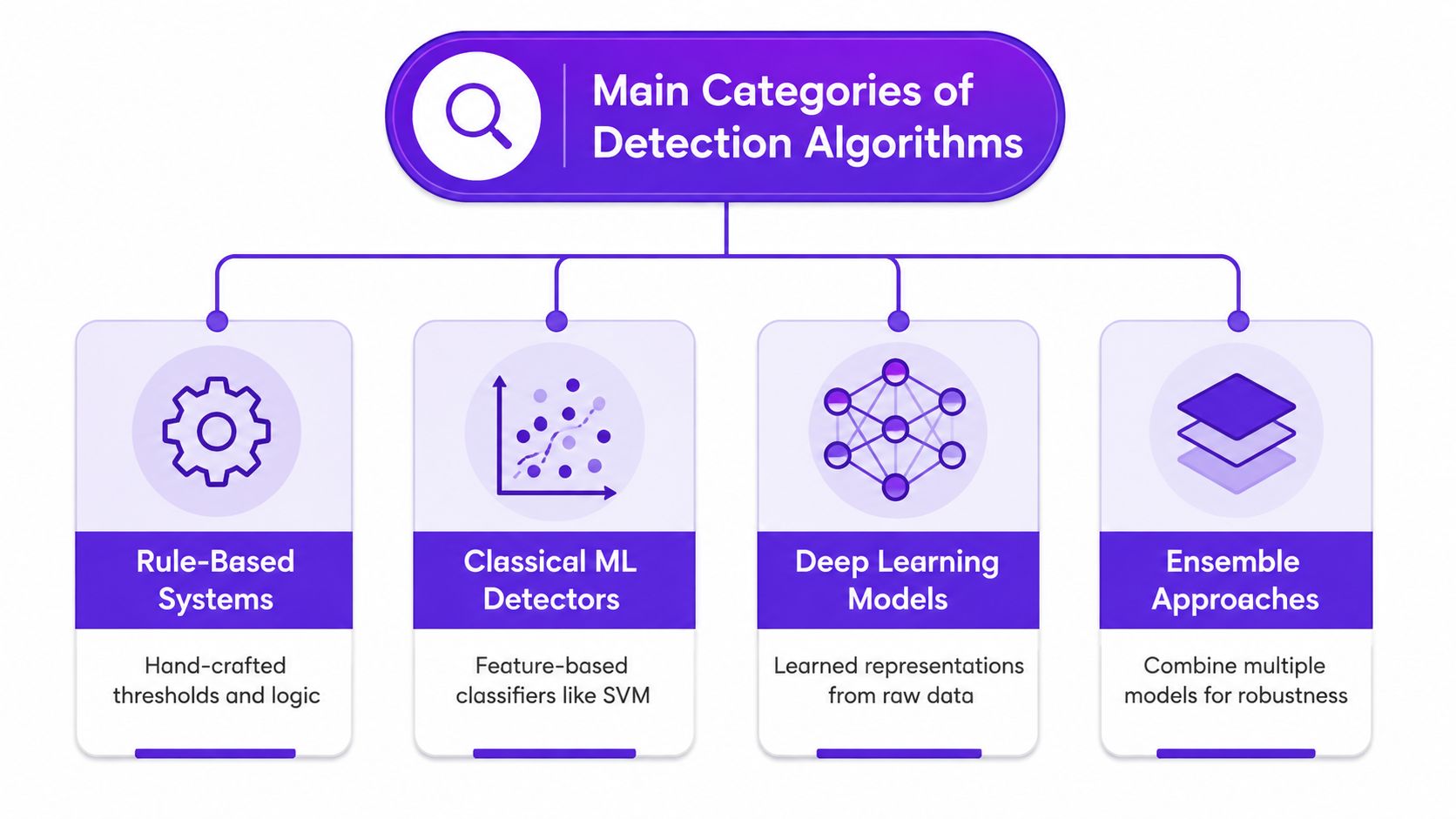
No model family solves every verification problem. Each family emphasizes a different source of evidence, and production systems often combine them because a weakness in one method can be offset by another.
Rule-based systems
Rules use explicit conditions. A system might flag an impossible file property, an unusual metadata combination, or a visual measurement outside an accepted range. They're easy to inspect and fast to run, which makes them useful for intake checks and predictable policy requirements.
Their weakness is brittleness. A determined editor can remove metadata, and a new generation pipeline may avoid the exact pattern covered by the rule. Rules also struggle to represent relationships between many visual signals.
Classical machine learning
Classical detectors first convert images into engineered features, then apply a classifier such as an SVM or another feature-based method. Features might describe texture noise, edge behavior, color-channel relationships, or frequency-domain energy. This approach can be efficient and interpretable when the team understands which signals matter.
It depends heavily on feature design and data coverage. If the chosen features capture camera artifacts found only in a narrow set of authentic images, the detector may confuse camera type, editing style, or compression with authorship.
Deep learning models
Deep models learn representations directly from image data. They can detect combinations of signals that are difficult to specify manually, including local texture relationships and broader structural coherence. They're powerful when training data represents the images that will appear in deployment.
They can also learn shortcuts. A model may associate a particular generator, resolution, or dataset style with the synthetic label, then perform poorly when those conditions change. High capacity doesn't remove distribution shift. It can hide it behind a confident score.
Ensemble approaches
An ensemble combines outputs from multiple detectors or signal families. One component may inspect spectral patterns, another may analyze texture, and a third may compare learned embeddings. The system can route disagreement to human review rather than forcing a single definitive label.
| Approach | Useful strength | Common failure |
|---|---|---|
| Rules | Fast and auditable | New or altered patterns bypass them |
| Classical ML | Efficient feature-based decisions | Feature choices limit coverage |
| Deep learning | Learns complex representations | Sensitive to training distribution |
| Ensembles | Combines complementary evidence | More complex calibration and maintenance |
Forensic and statistical methods deserve a place beside learned models. They can reveal deviations in noise, resampling, color channels, or frequency behavior, while deep models can capture relationships across the whole image. The practical question isn't which category sounds most advanced. It's whether the combined system has been tested on the transformations and sources your workflow receives.
How Systems Detect Synthetic Versus Authentic Images
A detector doesn't read an image's intent. It measures patterns that correlate with the way an image was produced, edited, stored, or transformed. Those patterns can appear in several layers, and a strong result usually comes from evidence distributed across more than one layer.
At the pixel level, a system may inspect texture consistency, local noise, edge transitions, and color-channel behavior. At a broader level, it may examine whether lighting appears coherent across objects, whether reflections follow the scene geometry, and whether repeated elements share plausible structure. Frequency-domain analysis can expose unusual energy distributions that aren't obvious when a reviewer looks at the image normally.
Signals that raise or lower confidence
Synthetic images may contain subtle transitions in skin, fabric, foliage, or text. They may also show structural problems such as inconsistent hands, impossible object connections, or shadows that don't agree with the apparent light source. These clues aren't guaranteed. An image can be synthetic without obvious artifacts, and an authentic image can acquire strange patterns through aggressive editing.
Compression fingerprints complicate the picture. A screenshot, social-media upload, crop, or re-encoding step can change the measurable evidence. A detector may therefore be evaluating both the image's generation history and its distribution history, even when it cannot identify either history directly.
Benchmark evidence supports a useful caution. A large-scale study reported that humans and models detected longer-prompt, more detailed synthetic images more easily than short-prompt images, and that an AI detector also performed better on the longer-prompt subset (the Frontiers study on AI-generated image detection). More detail can create more visible opportunities for structural or semantic artifacts. Cleaner generations may offer fewer obvious cues, so a low-confidence result shouldn't be read as proof of human authorship.
A confidence score is best understood as a ranking of evidence under uncertainty. It answers a narrow question, such as whether the image resembles examples from a learned category. It doesn't establish who created the image, whether a person edited it, whether the depicted event occurred, or whether the image is legally admissible evidence.
Read the score as a prompt for the next check, not as a replacement for the next check.
For consequential cases, preserve the original file when possible, record the detector version and input conditions, inspect the source account or submission history, and seek independent corroboration. Those steps address questions that visual pattern analysis cannot answer.
Evaluation Metrics and Real-World Benchmarks
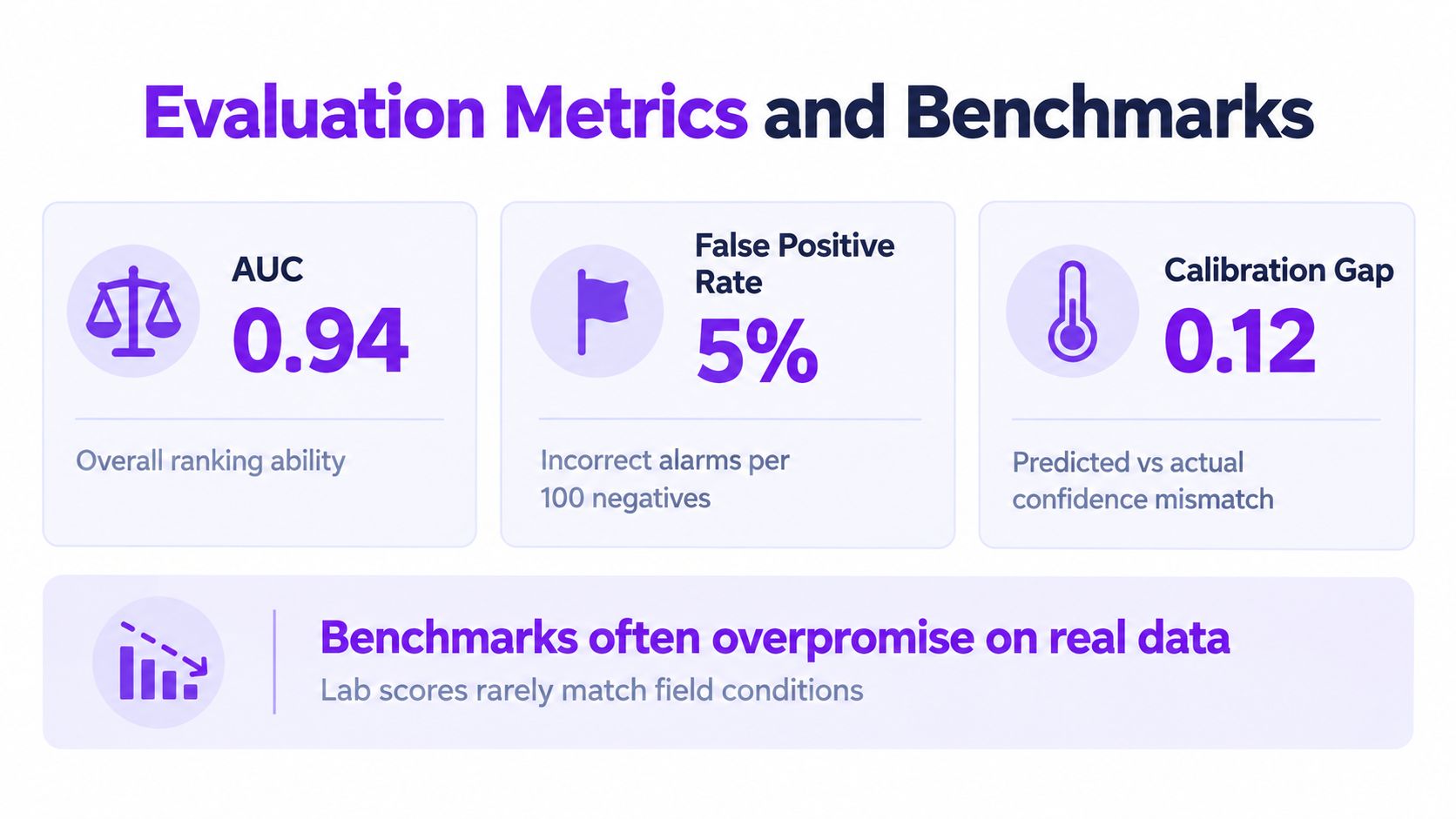
A benchmark score describes performance on a test set. It doesn't describe how a detector will behave after an image is downloaded from a messaging app, cropped by a user, recompressed by a platform, or produced by a generator absent from training data.
Two common ranking metrics are area under the ROC curve, or AUC, and average precision, or AP. AUC summarizes how well a system ranks positive and negative examples across thresholds. AP focuses more directly on the precision and recall trade-off, which matters when positive examples are uncommon or when reviewers can handle only a limited queue. Neither metric tells a safety manager how many innocent submissions will be escalated at the chosen operating threshold.
What to test beyond the headline score
False positives deserve their own measurement. If a system flags authentic images too often, reviewers face alert fatigue and may start dismissing warnings. Calibration adds another layer. A well-calibrated score should correspond reasonably to the observed frequency of outcomes, but a model can rank images well while expressing confidence badly.
A CVPR workshop study found that a CLIP-based detector matched state of the art on in-distribution data, while improving out-of-distribution AUC by 6% and resilience to impaired or laundered images by 13% (the Microsoft Research study on detecting AI-generated images). Those results show why domain shift and post-processing must be part of evaluation, not an afterthought.
A vendor or internal team should demonstrate performance under the conditions your users create:
- Transformation coverage: Test resized, compressed, cropped, screenshot, and re-encoded files.
- Source coverage: Include multiple generators, camera sources, editing tools, and image subjects.
- Threshold reporting: Show precision, recall, false-positive behavior, and calibration at the actual review threshold.
- Abstention behavior: Identify when the system should return uncertain rather than force a binary verdict.
- Monitoring design: Track drift, reviewer overrides, source changes, and sudden shifts in score distributions.
The phrase “high accuracy” is incomplete without the test distribution and decision threshold. Ask for confusion matrices, evaluation slices, examples of failures, and a plan for refreshing the test set. A practical guide to performance metrics can help teams frame those questions, but the final validation must use their own content and workflow.
Deployment Pitfalls and Adversarial Risks
A detection algorithm can perform well in a controlled evaluation and still create operational trouble. The field pipeline may contain missing metadata, duplicate uploads, low-quality previews, inconsistent labels, and images that have passed through several services. Each change can alter the signals on which the model relies.
False positives are particularly damaging because they consume human attention. A 2026 security analysis found that an average organization had 47% of detections needing attention, with reported failure modes including logic bugs, missing telemetry, incorrect data sources, duplicate detections, and noisy alerts that analysts learn to ignore (the 2026 security analysis). The lesson applies beyond cybersecurity. A queue that overwhelms reviewers can reduce practical safety even when the underlying model has useful detection ability.
Design for uncertainty
Don't route every score directly to an irreversible action. Use graduated responses:
- Low concern: Allow normal processing while retaining the result for monitoring.
- Uncertain: Request source details, preserve the file, or send it to a trained reviewer.
- High concern: Escalate for corroboration and apply policy action only after checking context.
- Sensitive case: Restrict access, document the decision, and provide an appeal path.
Attackers may deliberately resize, compress, crop, re-encode, or strip metadata to weaken detection. Even without malicious intent, ordinary platform processing can have the same effect. A well-designed workflow tests these transformations and records them rather than treating the submitted file as an untouched original.
Privacy matters too. Image review may involve faces, identity documents, medical scenes, private communications, or unpublished creative work. Teams should define retention, access, deletion, and audit policies before connecting a detector to production systems. For broader guidance on building controlled AI workflows, see AI integration patterns for secure delivery, especially when the detector feeds moderation or compliance decisions.
A safe deployment preserves the path from image to decision. Store the relevant input conditions, model output, reviewer action, and escalation reason so someone can audit the outcome later.
Use Cases Across Journalism, Education, and Platform Safety
A fact-checker receives a viral image with a claim about a breaking event. The detector returns an uncertain result, so the fact-checker doesn't publish a label based on that score. Instead, they preserve the file, compare available versions, inspect the earliest traceable source, check shadows and landmarks, and look for independent photographs or video from the location. The algorithm narrows attention. It doesn't verify the event.
Journalists benefit most when detection sits early in the intake workflow. Editors can use it to prioritize files for provenance checks, while reporters document uncertainty in the story notes. A synthetic-looking image may still illustrate a fictional scenario, and an authentic photograph may be misleadingly captioned, so image authorship and claim accuracy remain separate questions.
Education and creative work
An instructor sees a highly polished submission and wants to know whether the image was generated, heavily edited, or created by the student. A detector can support a conversation, but it shouldn't serve as the sole basis for a disciplinary decision. The instructor can compare drafts, ask the student to explain the process, review permitted tool use, and evaluate the work against the assignment's rules.
Artists and designers face a related problem when their work is copied, altered, or falsely attributed. Detection may help identify suspicious patterns in a review queue, but it can't prove authorship by itself. Files, project history, signed records, publication dates, and original assets provide different kinds of evidence.
Platform safety at scale
Trust-and-safety teams need consistent triage across large volumes. They can combine a detector's score with account history, upload behavior, content policy signals, user reports, and human review. High-risk categories should receive stronger safeguards because an incorrect automated decision can affect vulnerable people or public information.
For teams building misinformation workflows, Sift AI's discussion of misinformation detection offers useful context on combining automated analysis with broader signals. Role-specific real-world examples of AI image detection can also help teams map the technology to daily review decisions.
The operational pattern is consistent across all four groups:
- Journalists: Use scores to prioritize source and provenance checks.
- Educators: Use results to open a documented review process, not to declare misconduct.
- Artists: Combine detection with creation records and attribution evidence.
- Safety teams: Route uncertain cases to humans and monitor false-positive pressure.
A detection algorithm becomes valuable when it makes review faster, more consistent, and easier to audit. It becomes risky when a single score replaces context, corroboration, and accountable judgment.
AI Image Detector analyzes images for patterns and artifacts associated with AI generation and provides a confidence-oriented verdict for workflows such as journalism, education, creative review, and platform safety. Visit AI Image Detector to test an image, understand the reasoning signals, and decide where automated screening fits in your verification process.


