

A Practical Guide on How to Teach Critical Thinking Skills

Teaching critical thinking isn't about just another lesson plan; it's about fundamentally changing how students interact with the world. We need to move them away from simply memorizing facts and instead, create a classroom culture built on inquiry, analysis, and evaluation. It's our job to give them the tools to deconstruct arguments, spot bias, and check facts in a world that’s getting more complicated by the day.
The goal is to help them become active, discerning thinkers, not just passive consumers of whatever information is thrown at them.
Why Critical Thinking Is More Than Just a Buzzword
In a world overflowing with digital noise and AI-generated content, the ability to think critically has gone from a nice-to-have academic skill to an essential tool for navigating modern life. It’s no longer enough to just know things. Students today are wading through a sea of sophisticated misinformation, nuanced social issues, and constant technological shifts. This isn't just about being smart—it's about being sharp.
This need for sharp, analytical minds is echoing loud and clear in the professional world, too. Employers consistently list critical thinking as a top-tier skill, yet they also report that many recent graduates are coming in unprepared for the kind of complex problem-solving their jobs demand. This guide is designed to be a practical toolkit for educators ready to close that gap.

The Growing Urgency for Analytical Skills
The intense focus on teaching these skills isn't just an educational trend; it's a response to a global need. Between 2017 and 2021, academic research on critical thinking exploded, becoming the most studied topic in the field with 1,594 occurrences in academic literature during that time. This data points to a clear consensus among educators worldwide: this is a cornerstone of modern learning and responsible citizenship.
What’s driving this urgency? A few key realities of our time:
- The Flood of Misinformation: Our students are swimming in content designed to persuade or mislead, from viral propaganda on social media to convincing deepfakes. Without the skills to verify what they see, they’re incredibly vulnerable.
- The Complexity of Modern Problems: Issues like climate change, economic instability, and social justice don't come with easy answers. They require an ability to analyze tangled problems from multiple viewpoints.
- Preparing for the Future of Work: As automation handles more routine tasks, the skills that remain uniquely human—like creative problem-solving and sound reasoning—become more valuable than ever.
The real shift happens when we guide students from asking, "What is the answer?" to asking, "How can I figure out the answer for myself?" That change in perspective is the very foundation of lifelong learning and intellectual freedom.
Redefining the Educator's Role
To teach critical thinking well, our role has to change. We need to be less of a content dispenser and more of a facilitator of inquiry. This means building a classroom where questions are valued more than answers and where genuine curiosity drives the learning process. It's about modeling how to tackle a problem, how to be comfortable with not knowing, and how to systematically hunt for evidence.
For instance, instead of just laying out historical facts, you could ask, "Whose voice is missing from this historical account?" A simple question like that cracks the door open to deeper analysis, research, and a much richer understanding of bias and context. Providing students with frameworks and resources for developing strong critical thinking skills helps them learn how to question their sources effectively.
Ultimately, building these skills is intertwined with media literacy—a critical competency for making sense of today's information chaos. You can explore this connection further in our guide on how to improve media literacy.
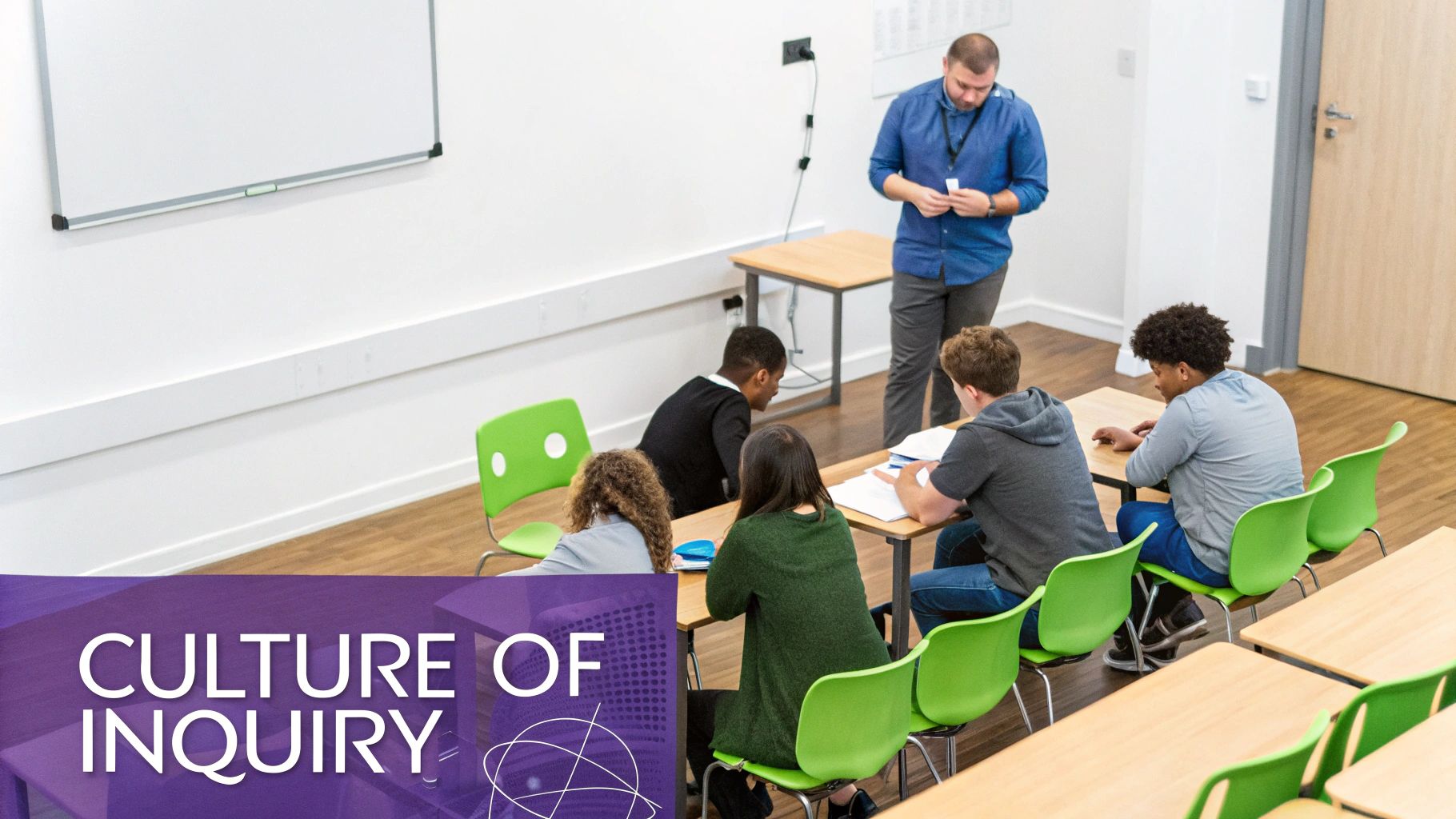
Building a Classroom Culture of Inquiry
Before you can get into the nitty-gritty of teaching critical thinking, you have to create a space where it can actually happen. Think about it: the most brilliant lesson plan will fall completely flat if your students are too scared to ask a question or push back on an idea. The real first step is to build a culture of inquiry from the ground up.
This means your role has to change. You're no longer just the person with all the answers; you're the lead question-asker, the facilitator. The goal is to make "why?" and "how do we know that?" the most common questions in the room—a place where taking an intellectual risk feels normal, not scary.
Establish Psychological Safety
Students will only raise their hands with a bold, out-of-the-box idea if they feel safe. Psychological safety is the absolute foundation. It's the unspoken understanding that every contribution is valued, even if it's off-base or a little unconventional.
To get there, you need to set clear, non-negotiable norms for respectful debate. It’s more than just "be nice." It's about teaching students how to disagree with an idea without ever making it personal.
A classroom built on inquiry doesn't just tolerate questions; it celebrates them. The moment a student feels safe enough to say, "I don't understand this," or "What if we looked at it another way?" is the moment true critical thinking begins.
Model Intellectual Humility
One of the most powerful things you can do is admit when you don't know something. Seriously. Saying, "I don't have the answer to that," shows students that learning isn't about having all the knowledge, but about the process of finding it.
The key is what you do next. Follow it up with, "That's a fantastic question. I'm not sure. Let's find out together." This small shift models that uncertainty isn't a dead end; it's the start of an investigation.
Rearrange the Learning Space
The way your classroom is set up speaks volumes. Desks in straight rows scream "listen to me," which isn't what we're going for. A few simple changes can completely transform the dynamic.
- U-Shaped or Horseshoe Arrangement: I love this for Socratic seminars. Everyone can see each other, which naturally encourages discussion. It puts you on the same level as your students, not as a lecturer at the head of the room.
- Small Group Pods: Pushing desks into clusters of four or five is perfect for collaborative work. It makes it so much easier for students to analyze a text together, debate a prompt, or work through a tricky problem.
- Flexible Seating: If you can swing it, offering different seating options empowers students. It gives them autonomy and lets them choose a setup where they feel they can do their best work.
Shift from Answers to Questions
Your instincts might tell you to jump in with an answer when a student asks a question. Resist that urge. Your new go-to move is to turn the question right back to them or the entire class. It's a small change with a huge impact.
| Instead Of Saying This... | Try Saying This... |
|---|---|
| "The answer is..." | "That's a great question. How could we find out?" |
| "No, that's not correct." | "Interesting idea. What evidence led you to that conclusion?" |
| "Here's how you do it." | "What's the first step you think we should take?" |
This Socratic method does something crucial: it forces students to rely on their own thinking. It tells them their reasoning matters and that they are fully capable of tackling tough questions on their own. By laying this groundwork, you're not just preparing for a single lesson—you're creating an entire ecosystem where critical thinking can thrive.
Activities That Build Real Analytical Skills
Theory is one thing, but critical thinking is a muscle built through practice. If we want our students to become sharp analytical thinkers, we have to get them out of the passenger seat and into the driver's seat. This means moving beyond passive learning and into activities that challenge them to take apart arguments, weigh evidence, and build their own logical conclusions.
These aren't just "fun Friday" activities; they're the training ground. The trick is to use materials they see every day—news headlines, TikTok trends, advertisements, and even AI-generated images—to make the skills feel relevant and immediately useful.
From Claim to Conclusion: The CER Framework
One of the most versatile tools in my teaching toolkit is the Claim, Evidence, Reasoning (CER) framework. It’s a simple, powerful way to structure thinking that works beautifully across every single subject, from science labs to literary analysis.
It breaks down the analytical process into three manageable steps:
- Claim: What's the main point here? Students first have to pinpoint the core argument.
- Evidence: What proof is offered? This pushes them past gut feelings to find the factual support.
- Reasoning: How does the evidence actually back up the claim? This is the crucial step where they connect the dots and explain the logic.
Try it with a recent opinion piece on a controversial topic. Have students highlight the author's central claim in one color and every piece of supporting evidence in another. Then, ask them to write a short paragraph explaining the reasoning that bridges the two. This exercise gives them a repeatable method for dissecting any argument they encounter.
The real power of CER is how it demystifies analysis. It turns a big, intimidating skill into a clear, three-part process that students can use for anything.
The Power of Socratic Seminars
A Socratic seminar is one of my favorite ways to get students thinking deeply and listening to each other. It’s a structured, student-led discussion where the goal isn't to win an argument but to collectively build a deeper understanding of a text or idea.
Start with a rich, open-ended question that has no single right answer. After reading The Great Gatsby, you might ask, "Is Gatsby truly 'great'?" The ambiguity is the point; it forces students to dig into the text for evidence to support their interpretations.
Set up the desks in a circle—this small change makes a huge difference, turning a lecture into a conversation. Your job is to be a facilitator, not an expert. Nudge the conversation along with questions like, "Where in the book did you see that?" or "How does that build on what Michael just said?" The students do all the intellectual heavy lifting.
Becoming a Fallacy Detective
Let’s be honest, spotting flawed arguments is a critical life skill. A really engaging way to teach this is by turning the class into "Fallacy Detectives." Their mission: to hunt for common logical fallacies in the media they consume every day.
First, you’ll need to introduce a few of the usual suspects:
- Ad Hominem: Attacking the person instead of their argument.
- Straw Man: Twisting someone's argument to make it easier to knock down.
- Bandwagon: Arguing that something is true or right simply because it's popular.
Once they know what to look for, set them loose on advertisements, political speeches, or YouTube comments. Working in small groups, they can identify the fallacies, explain why the reasoning is weak, and present their findings. It feels like a game, but they’re learning to spot manipulative arguments in the wild.
For a modern twist, have them play an AI or Not game to see if they can spot the subtle tells of AI-generated images, pushing their visual analysis skills even further.
To give these exercises even more structure, you can draw on established problem-solving activity models to guide students through complex challenges. Whether you’re using CER, hosting a seminar, or hunting for fallacies, you’re shifting the focus from simply knowing things to actively thinking—and that’s what really counts.
Core Critical Thinking Activities at a Glance
To help you decide which approach might fit best in your classroom, here’s a quick summary of these core activities. Each one is adaptable, so feel free to modify them for your students and subject matter.
| Activity Name | Core Skill Developed | Best For (Subjects) | Time Required |
|---|---|---|---|
| Claim, Evidence, Reasoning (CER) | Argument Deconstruction & Analysis | Science, ELA, Social Studies, History | 20-40 minutes |
| Socratic Seminar | Collaborative Dialogue & Textual Analysis | ELA, History, Philosophy, Ethics | 45-60 minutes |
| Fallacy Detective | Logical Reasoning & Media Literacy | Media Studies, Civics, ELA, Debate | 30-50 minutes |
| AI or Not? Game | Visual Literacy & Digital Discernment | Art, Media Studies, Technology | 15-25 minutes |
These activities provide a solid foundation. The key is consistency—building these routines into your curriculum helps students internalize the habits of a critical thinker.
Teaching Digital Literacy in the Age of AI
In our classrooms, teaching critical thinking can no longer be confined to the printed page. We're now preparing students for a world where AI can generate content so sophisticated it's nearly indistinguishable from reality. This means digital literacy isn't just a nice-to-have skill; it's the new front line for critical thinking, demanding a sharp eye for visual analysis and source verification.
The very nature of "evidence" has changed, and that's the core of the challenge. A photograph once carried an inherent weight of truth, but leaning on that assumption today is a major liability. Our students need practical, hands-on ways to question, investigate, and confirm the authenticity of the digital media they're swimming in every single day.
Moving Beyond Textual Analysis
Traditional critical analysis—finding the main idea in an article or picking apart an author’s argument—is still absolutely essential. But it’s only half the story now. Students must learn to "read" an image with the same critical lens they apply to a block of text. This means training them to hunt for the subtle artifacts, logical impossibilities, and weird glitches that often give away AI-generated content.
Think of it as bolting a new module onto your existing analytical framework. Alongside asking, "What is the author's bias?" we have to teach them to ask, "Is this image even real?" and "What clues suggest this might be synthetic?" This simple shift in questioning transforms students from passive media consumers into skeptical, empowered investigators.
The urgency here is hard to overstate. One study revealed that 60% of teachers believe their students are missing essential critical thinking skills. Even more concerning, 72% of young adults feel unprepared to critically evaluate the news they see online. This gap highlights why integrating modern verification tools into our teaching is no longer optional.
A Sample Lesson Plan Using an AI Image Detector
Bringing a tool like an AI Image Detector into the classroom can turn an abstract lecture about misinformation into a concrete, memorable activity. It gives students a tangible way to test their assumptions and see digital forensics in action.
Here’s a practical lesson plan you can easily adapt:
- Curate Your Content: First, pull together a collection of about 10 images. You'll want a good mix: include a few high-quality, real photographs, some blatantly fake AI creations, and—the most important part—a couple of very convincing, subtly flawed AI images that are tough to call.
- The Human Eye Test: Next, break students into small groups. Give them a simple checklist of things to look for (funky hands, nonsensical background text, weirdly smooth textures) and have them analyze each image. Their task is to make a judgment call: Human or AI?
- Introduce the Tech: Once their predictions are locked in, introduce the AI Image Detector. This is a great chance to explain that these tools are trained on massive datasets to spot patterns a human might miss. Frame it as technology assisting, not replacing, our own judgment.
- Verification and Discussion: Finally, have the groups upload their images to the detector one by one. The real learning ignites here. As the results pop up, compare the tool’s verdict with their initial guesses.
This simple flowchart shows how this kind of hands-on verification is just one part of a larger critical thinking process.
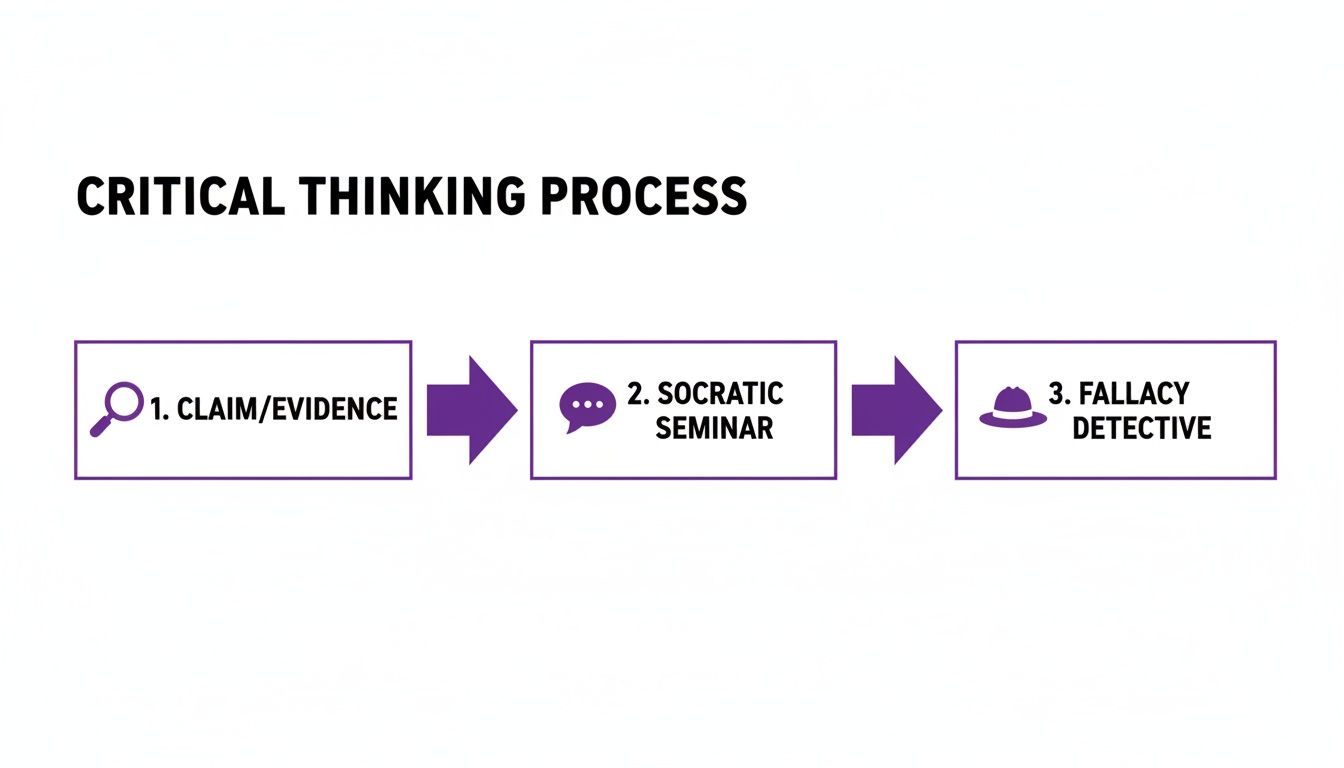
After the initial analysis, you can deepen their understanding with a Socratic seminar or an activity where they play "fallacy detective" to unpack the arguments and assumptions they made.
The most powerful moments in this lesson aren't when students are right, but when they are wrong. A convincing AI image fooling the entire class is a more effective teacher than any lecture on misinformation could ever be.
Connecting the Dots to the Real World
The final step is to bridge the gap between this classroom exercise and the world outside. Tying the activity to real-world examples, like deepfakes in political ads or AI-generated propaganda, makes the skills feel immediately relevant and incredibly important.
Here are a few ways to do that:
- Discussion Prompt: "Think about this fake image we just found. How could something like this be used to influence public opinion during an election?"
- Real-World Task: "Find a recent news story where the authenticity of a photo or video was a major part of the report. How did journalists figure out if it was real or not?"
By grounding the lesson in current events, you're doing more than just teaching a technical skill. You're giving students a foundational competency for modern citizenship. For more strategies, check out our guide on digital literacy for teachers. It's all about ensuring our approach to teaching critical thinking evolves right alongside the technology shaping our world.
How to Measure Critical Thinking Progress
When you're teaching students how to think critically, the usual yardsticks just don't measure up. Standardized tests, with all their bubbles and right-or-wrong answers, can't really get at the heart of the matter. They miss the nuanced process of thinking.
Measuring real growth in critical thinking isn't about checking for a final, correct answer. It’s about looking at the journey a student takes to arrive at their conclusion.
The real signs of progress are in their actions. Are they asking sharper, more insightful questions? Are they getting better at sniffing out bias in an article or a video? Can they explain an opposing viewpoint fairly, even if they disagree with it? These are the behaviors that tell you they're truly getting it.
Beyond the "Right" Answer
First things first: you have to accept that assessing critical thinking is more qualitative than quantitative. You're hunting for evidence of specific mental moves, not just whether a student can spit back a fact. This means using tools built to observe and evaluate the reasoning process itself.
So, instead of a quiz, think about a structured debate, an analytical essay, or a research project. For assignments like these, the grade isn't just about the student's final conclusion. It’s about the strength of their evidence, the clarity of their logic, and the coherence of their argument.
The most meaningful assessment of critical thinking isn't a score on a test. It's that visible shift in how a student tackles a problem—the moment they stop searching for the easy answer and start wrestling with the complex question.
A well-designed rubric will be your best friend in this endeavor. It helps turn a subjective evaluation into something more objective by breaking a complex skill down into observable parts. This gives both you and your students a clear roadmap, making the abstract goal of "thinking better" feel concrete and achievable.
Using Rubrics to See the Process
A solid critical thinking rubric does more than just score the final paper; it peels back the layers to evaluate the thinking that went into it. By outlining specific criteria for different levels of mastery, it allows you to give targeted, constructive feedback that actually helps students improve.
Here are a few key categories I always include in my rubrics:
- Question Quality: How good are their questions? Do they move beyond the obvious and formulate queries that push the investigation forward?
- Evidence Evaluation: This measures how well a student can find, analyze, and judge the credibility of their sources. Are they just grabbing the first thing they find on Google, or are they really weighing the information?
- Perspective Taking: Can the student see the issue from multiple angles? This evaluates their ability to articulate different viewpoints, especially those that challenge their own.
- Argument Cohesion: This is all about logical structure. How well do they connect their claims to their evidence to build a sound, persuasive argument?
- Bias Recognition: This gauges their skill in spotting potential biases, hidden assumptions, and logical fallacies—both in the source material and in their own thinking.
When you use a rubric like this, assessment stops being a judgment and starts becoming a conversation. It shows students exactly where they are and what they need to work on next.
Quick Checks for Continuous Feedback
While rubrics are great for those big projects, a lot of progress happens in the small, day-to-day moments. That's where formative assessments come in. These are quick, low-stakes checks that give you a real-time snapshot of your students' thinking.
Here are a few simple techniques you can weave into your lessons:
- Targeted Exit Tickets: At the end of class, ask a single, sharp question. Instead of, "What did you learn?" try something like, "What is one assumption we made today that really ought to be questioned?" This shows you who's truly engaged.
- Structured Peer Reviews: Hand out a mini-rubric and have students evaluate a partner's short written response. This not only gives the writer instant feedback but also forces the reviewer to apply critical thinking criteria, sharpening their own skills in the process.
- "Muddiest Point" Reflections: Just ask students to jot down the single most confusing or unclear part of a lesson or an argument. This is a goldmine of information, showing you exactly where you need to circle back and dig deeper.
These small check-ins create a powerful feedback loop. You get to adjust your teaching on the fly, and your students get to practice critical thinking as a daily habit, not just something they do for a big grade.
Answering Your Questions About Teaching Critical Thinking
Even with a solid game plan, you're bound to run into some practical questions once you start bringing these ideas into your classroom. Let's walk through some of the most common ones I hear from fellow educators.
How Do I Make This Work for Younger Students?
With younger kids, it's all about planting the seeds of curiosity and observation. Forget abstract terms like "bias" or "evidence." Instead, you're building the foundation through play, stories, and their natural sense of wonder.
Your goal is to get them in the habit of thinking about why things are the way they are. A simple but powerful shift is to move from asking for "evidence" to a gentler prompt like, "What makes you say that?" or "How do you know?" This nudges them to connect their thoughts to something they've seen or heard, which is the very beginning of evidence-based reasoning.
Here are a few things that work really well in the early grades:
- Lean on Picture Books: They are a goldmine for exploring different perspectives. Ask simple questions like, "Why do you think the wolf did that?" or "How must the little pig have felt when his house fell down?"
- Play the 'What If' Game: Spark their imaginations with scenarios tied to a story you just read. "What if Goldilocks had knocked on the door first?" This gets them thinking about cause and effect in a way that’s fun and accessible.
It's not about deep analysis at this stage. It’s about cultivating the habit of asking questions—the single most important building block of critical thought.
How Should I Handle Controversial or Sensitive Topics?
This is a big one, and the key is to do the prep work before the discussion ever starts. You need to foster a classroom culture where respect is the baseline. Establish clear ground rules for discussion where the goal is to understand different viewpoints, not to win an argument.
Your job is to be the neutral facilitator. You're there to guide the conversation back to evidence and logical reasoning, especially when it veers toward personal feelings or attacks. One technique I've found very effective is to have students try to articulate the opposing side's argument. It’s a powerful way to build intellectual empathy.
When you guide students through a tough topic successfully, you teach them one of life's most valuable lessons: it's possible to analyze and understand an idea without personally agreeing with it.
This Sounds Great, But How Much Class Time Does It Take?
I get it—your schedule is already packed. But this is where we need to shift our mindset. Teaching critical thinking isn't about adding a new subject to your day. It’s about weaving these skills into the things you’re already teaching.
Think of it as an upgrade to your existing lessons, not a separate line item.
- That worksheet you were going to hand out? It could easily become a quick, 10-minute Socratic discussion.
- That research project on the syllabus? Just add a quick source-checking step. It only takes a few extra minutes but completely changes the assignment.
- Make asking, "How do we know this is true?" a routine part of every lesson, from science to history.
When you integrate these practices, critical thinking becomes a daily habit, not a special event that eats up precious time.
Where Can I Find Good, Trustworthy Resources?
Finding high-quality materials you can trust is essential. I always recommend starting with established, non-profit educational organizations. Places like the Poynter Institute or the News Literacy Project offer fantastic, well-vetted lesson plans and resources that you can use right away.
For teaching students about today’s visual world, a hands-on approach is unbeatable. Using a tool like an AI Image Detector gives them a concrete, memorable lesson in digital verification. Just remember to always preview any resource yourself to make sure it’s a good fit for your students and your classroom.
Verifying what we see online is a critical skill for the 21st century. At AI Image Detector, we built a fast, free, and privacy-focused tool to help you and your students figure out if an image was made by a human or generated by AI.
Give your students the confidence to navigate the digital world. Try it today at https://aiimagedetector.com.