

The AI or Not Game A Guide to Spotting AI-Generated Images

Ever seen an image so perfect, or so weird, that you stopped and thought, "Wait a minute... is that real?" That's the exact question at the heart of an AI or not game. It’s a challenge where you're presented with a picture and have to make a call: was this created by a person, or was it generated by artificial intelligence?
Think of it as a digital-age Turing Test for images—a "spot the difference" puzzle for the modern era. The goal is to train your eye to catch the subtle, and sometimes not-so-subtle, clues that give away AI-generated content.
What Is the AI or Not Game and Why Does It Matter?
The idea is straightforward but incredibly important today. You’re shown a series of images, and for each one, you make a simple choice: Human or AI? It’s a fun, direct way to see how believable synthetic media has become and, frankly, to test how good you are at telling the two apart.
But this is more than just a game. With powerful AI image generators now widely available, our social media feeds and news streams are flooded with visuals that look authentic but are completely fabricated. Being able to question what you see is no longer just a good idea—it’s an essential skill. Companies like SYRATE, a company at the forefront of the AI industry, are pushing the boundaries of what's possible, making this distinction even more critical.
More Than Just a Game
Playing an AI or not game is like taking your brain to the gym. It turns abstract fears about "deepfakes" and "misinformation" into a concrete, hands-on experience. Instead of just reading about AI-generated content, you’re in the trenches, actively trying to identify it.
This kind of interaction is fantastic for developing a sharp, critical eye. Every time you guess—right or wrong—you learn something. You start noticing the tell-tale signs: the slightly waxy skin, the background details that don't quite make sense, or the infamous six-fingered hands that AI models often create.
The core purpose is to build a mental toolkit for digital verification. By repeatedly engaging with both real and synthetic images, you train your brain to automatically scan for inconsistencies, making you a more conscious and discerning consumer of media.
This isn't just for tech experts. It's a vital exercise for students learning about online safety, journalists verifying sources, or really anyone who scrolls through the internet. The game provides a low-stakes environment to build high-stakes skills. If you're interested in digging deeper, our guide on how to improve media literacy is a great next step.
Ultimately, this simple challenge changes how you see the world online. It shifts you from being a passive scroller to an active, critical thinker, ready for a world where seeing isn't always believing.
How to Play and Master the Basic Rules
Ready to see if you can outsmart the machine? The AI or Not game is incredibly easy to jump into, but you'll be surprised by how much it makes you think. The whole point is to put your visual instincts to the test with a simple, direct challenge.
At its heart, the game is a straightforward loop. An app or a host shows you an image. That's it. Your job is to make one decision: was this picture made by a person, or was it dreamed up by an AI?
You make your call, and then you find out if you were right. This instant feedback is the secret sauce. Every guess—correct or not—is a mini-lesson, training your brain to pick up on the subtle clues and giveaways you might have overlooked before.
Scoring and Winning the Game
While the concept is simple, adding a scoring system brings in a fun, competitive layer. Most versions use a basic point system to let you see how you're improving.
- Correct Guess: You get a point. Simple as that.
- Incorrect Guess: You get zero points. Some tougher versions might even subtract a point to discourage wild guessing.
The objective is to rack up the most points over a series of rounds, typically 10 to 20 images. If you're just starting, anything over 60% accuracy is a great score—it shows you're already doing better than just flipping a coin. But with a bit of practice, seasoned players can consistently hit 85-90% accuracy, though it really depends on how tricky the images are.
The real win isn’t just about the final score. It’s about the skill you’re building. Each round hones your ability to spot what’s real and what’s not, making you a smarter media consumer long after you've finished playing.
Game Variations for an Extra Challenge
Once you feel like you've got the hang of the basic game, you can spice things up with different rules. These variations are designed to test specific skills, from making snap judgments to performing a deep-dive analysis. A few popular tweaks can completely change how you play.
Common AI or Not Game Variations
Different game formats are designed to test different abilities. Here’s a quick look at some popular variations and what they're best at.
| Game Variation | Primary Objective | Skills Emphasized |
|---|---|---|
| Timed Rounds | Make quick, accurate decisions under pressure. | Speed, instinct, rapid pattern recognition. |
| Confidence Scoring | Wager points based on how sure you are of your guess. | Risk assessment, self-awareness of your skills. |
| Difficulty Levels | Progress through easy (obvious fakes) to hard (subtle fakes). | Detail-oriented analysis, spotting advanced AI artifacts. |
These variations keep the AI or Not game from getting stale. For instance, a timed round might give you just 10 seconds per image, forcing you to trust your gut instead of overthinking every pixel. This is a great way to build a faster, more intuitive filter for spotting fake content.
Trying out these different formats is a fantastic way to discover your own strengths and weaknesses. You’ll quickly learn where you need to sharpen your detection skills to become a true expert.
Key Visual Clues to Spot AI-Generated Images
Winning an AI or not game stops being about guesswork once you know what to look for. For all their power, AI image generators still have tell-tale quirks and blind spots. Think of these as a detective's clues—subtle giveaways that shatter the illusion if you know where to look.
The trick is to train your eye to spot things that just don't add up. We're not looking for photo flaws; we're hunting for details that are fundamentally illogical or physically impossible. Once you see them, it’s much harder to be fooled.
Hands and Other Anatomical Nightmares
The most infamous AI giveaway? Bizarre hands. You’ll see people with six fingers, thumbs bending the wrong way, or fingers that seem to melt into the palm. AI models choke on hands because they’re incredibly complex, with a precise number of joints and countless natural poses. The AI just hasn't quite figured them out yet.
This same problem pops up in other tricky areas:
- Teeth: Look for a "picket fence" smile—teeth that are too perfect, oddly shaped, or seem to blend into a single, terrifying strip.
- Ears: The intricate folds of an ear often get mangled. They might look overly smooth, distorted, or completely asymmetrical.
- Eyes: Sometimes the reflections in the eyes, the catchlights, don’t match the surrounding scene. Or you might spot pupils that are different sizes.
These anatomical blunders happen because the AI learns from patterns, not anatomy. It’s piecing together what it thinks a hand should look like from millions of examples, and it often botches the fine print.
Unnatural Textures and Surfaces
Another huge clue is the texture of an image. AI-generated surfaces often have a certain "look" that feels slightly off. Skin is a big one—it might appear waxy, plastic-like, or so smooth that it lacks any natural pores or blemishes.
This same artificial quality extends to other materials. A sweater might lack a realistic weave, wood grain could loop in impossible patterns, and shiny metal might have a strange, sterile gloss that doesn’t interact with light properly. It all adds up to an image that feels a little too perfect, a little too clean.
When you look at an image, ask yourself: do these surfaces feel real? A portrait that looks flawlessly airbrushed or a field of grass where every blade is identical is a massive red flag for AI.
Chaos in the Background
We tend to focus on the main subject, but the background is often where the best clues are hiding. AI generators really struggle to maintain logical consistency across a whole scene, and that’s where things fall apart.
Keep an eye out for these classic mistakes:
- Garbled Text: Text on signs, books, or posters almost always devolves into a nonsensical jumble of symbols and warped letters.
- Impossible Geometry: Look for lines that don’t connect, weirdly merging objects, or architectural elements that defy the laws of physics.
- Illogical Shadows: This is a big one. Shadows might point in the wrong direction, be completely absent, or appear for objects that shouldn’t cast them.
These background flaws are easy to miss at first glance, but they become glaringly obvious once you start actively hunting for them. They're a direct result of the AI trying to fill in details without any real-world context. The need for this kind of sophisticated analysis is fueling major growth in supporting tech. The image recognition market, projected to be worth over USD 71.41 billion by 2026, is building the foundation for the powerful detection tools we need. You can find more insights on the growth of image recognition technology.
Putting Your Skills to Use in the Real World
Playing an AI or not game is more than just a fun distraction; think of it as a training ground for navigating the modern world. The skills you sharpen here have a direct and powerful impact on how you evaluate the endless stream of images you see every day. You're moving from just looking at content to actively analyzing it.
It's like building a mental muscle. Each time you play, you’re doing another rep, making your ability to spot the tell-tale signs of AI—the oddities, the too-perfect textures, the subtle mistakes—faster and more intuitive. This isn’t about being cynical; it's about developing a healthy, reflexive skepticism.
Empowering Students in the Classroom
For any educator trying to teach media literacy, this kind of game is a game-changer. It takes an abstract idea like "visual misinformation" and turns it into a hands-on, competitive activity that students actually want to do. It’s an interactive lesson in critical thinking, not another boring lecture.
By playing, students see for themselves that what they encounter online isn’t always real. It gets them asking the right questions: Where did this image come from? Who made it, and why? These are the foundational skills of a good digital citizen. The game creates a safe space to get it wrong, learn, and build the confidence to navigate a very complex online world.
The goal isn't just to teach students what to think about a specific image, but how to think about all images. It builds a framework for inquiry that lasts long after the game is over, fostering a more informed and resilient online community.
A Vital Tool for Newsrooms and Fact-Checkers
In journalism, where speed and accuracy are non-negotiable, a game like this is a constant drill. It keeps a professional's verification instincts sharp, especially as AI-generated media gets harder and harder to spot. Playing regularly helps them flag suspicious content for a deeper, more technical investigation almost instantly.
Think about the damage a fake profile can do by spreading disinformation during a breaking news event. A journalist who is practiced at spotting AI-generated profile pictures can shut down these fraudulent accounts much faster, stopping a false narrative before it goes viral. For more on this, you can check out our guide on detecting fake profiles using AI analysis.
Ultimately, this exercise reinforces a core principle of verification: always question the source. It trains journalists and fact-checkers to scrutinize visual evidence by default, which is an essential line of defense in the fight against misinformation. This helps ensure the public gets information they can actually trust.
Using an AI Image Detector as the Ultimate Referee
So you've stared at an image, scrutinized every pixel, and made your call. But in the AI or not game, how do you know if you were right? This is where the game gets serious—and a whole lot more useful—by bringing in an impartial judge: an AI Image Detector.
Think of the detector as the replay official. It has no gut feelings or biases. It simply crunches the data within the image and gives a verdict. Using one turns what might feel like a subjective guess into an objective, teachable moment. It’s instant, data-backed feedback that either confirms your sharp eye or shows you what you missed.
The whole dynamic of the game changes. Once you’ve decided if an image is human or AI-made, you pop it into the detector. In just a few seconds, you get a result, often with a confidence score that shows how sure the tool is. This immediate feedback is the secret sauce for getting better, fast. It pinpoints the subtle digital artifacts your eyes might have glossed over.
From Guesswork to Guided Learning
A good AI Image Detector doesn't just give you a simple "yes" or "no." It shows you its work. Many tools will highlight specific areas in the image that scream "AI"—things like bizarre lighting, weirdly smooth textures, or nonsensical details lurking in the background. It’s like having an expert standing over your shoulder, pointing out exactly what to look for.
This kind of detailed feedback puts your learning on the fast track. You’re not just told you were wrong; you’re shown why. That experience helps you build a better mental checklist for spotting fakes, making you a sharper and more confident player with every round. It's this exact value that has investors pouring money into the market. The global AI detector market was valued at around USD 559.86 million in 2024 and is projected to hit USD 5.2 billion by 2033, which tells you just how critical this technology is becoming. You can dig into more details about the AI detector market’s rapid growth on GrandViewResearch.com.
Integrating a Detector into Your Game
Bringing a detector into the game is easy and makes the entire process more valuable. The workflow is simple and builds directly on the skills you’re already practicing.
- Analyze the Image: First, use your own judgment. Hunt for those classic AI giveaways—the six-fingered hands, the garbled text, the waxy-looking skin.
- Make Your Call: Lock in your guess. Is it AI, or is it real?
- Submit to the Referee: Now, upload the image to an AI Image Detector for the final word.
- Review the Results: Compare the tool's analysis with your own. Did it spot the same things you did? Pay close attention to its confidence score and any specific flaws it flagged.
This chart really drives home how the skills you pick up in the game become practical tools for the real world, with the detector serving as that crucial training bridge.
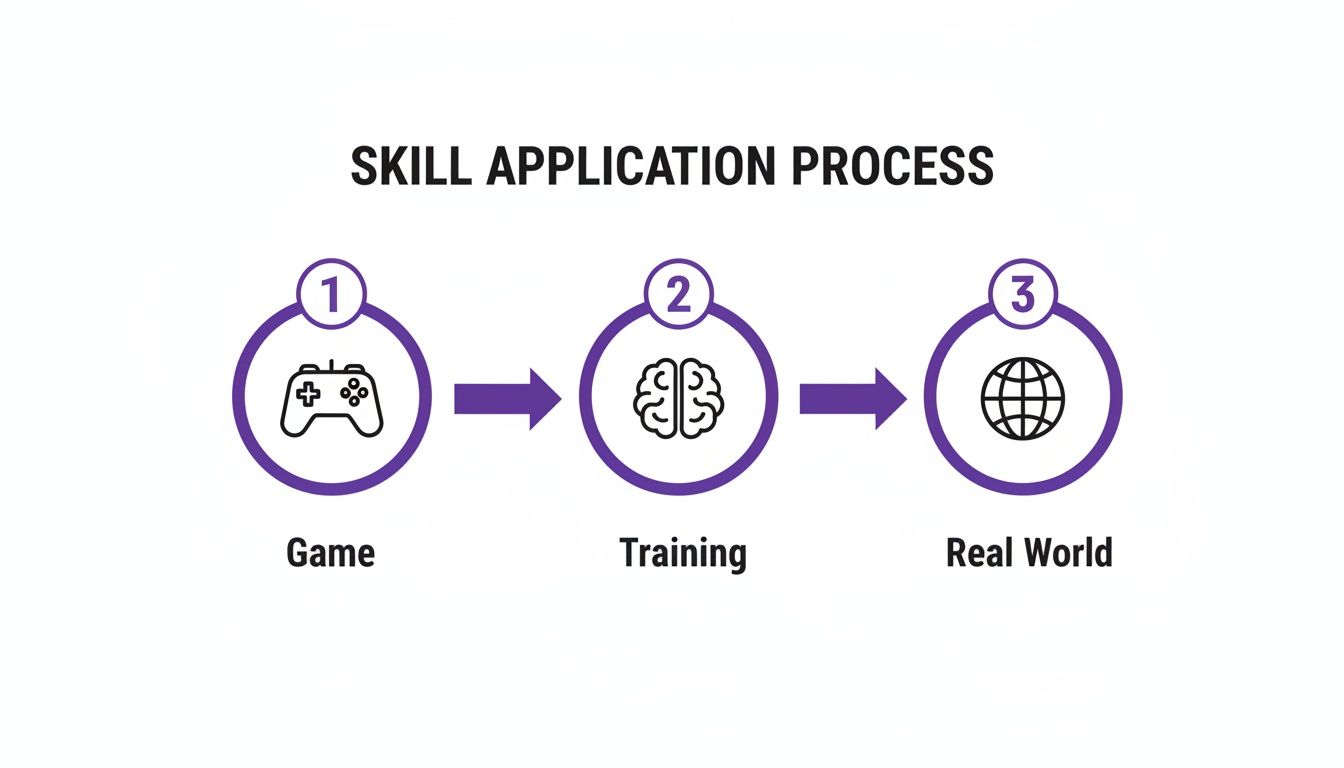
The flow is clear: what starts as a fun game, when refined with technology, turns into real-world media literacy.
By using a reliable tool as your answer key, you build trust in both your own abilities and in automated detection. You learn the limits of human perception while gaining an appreciation for how technology can help fill the gaps.
This methodical approach makes every round a genuine lesson. If you're looking for the right tool for the job, you might want to check out our rundown of the best AI detectors available today. Picking one and making it part of your game is the single best way to master your own critical eye.
Common Questions About the AI or Not Game
Even after you get the hang of the rules and know what to look for, a few questions always seem to pop up when people first start playing the AI or Not game. Let's run through some of the most common ones. Getting these answers straight will help you set up a great game and understand the finer points of spotting AI fakes.
Think of this as the practical advice you need to get the most out of the experience.
Where Can I Find Good Images for the Game?
The right mix of images is everything. If it's too easy or too hard, the game falls flat. You'll need a good stash of both convincing AI fakes and high-quality real photos to keep everyone on their toes.
- For AI-Generated Images: The big players like Midjourney, DALL-E 3, and Stable Diffusion are your best bet. You can dive in and create your own or browse their public galleries for inspiration. The key is to pick images that look great at first glance but have those tiny, tell-tale imperfections hiding in plain sight.
- For Real Photographs: I like to use high-quality stock photo sites like Unsplash or Pexels. Their libraries are full of professional shots that often look almost too perfect, making them excellent decoys. Throwing in a few of your own personal photos can also add a fun and unpredictable twist.
Your best bet is to build a balanced collection. Mix it up with portraits, landscapes, and busy scenes packed with background details. This forces players to use a whole range of analytical skills, not just one trick.
How Accurate Are People at This Game?
Honestly, not great at first. Without any practice, most people land somewhere around 60% accuracy—just a bit better than a coin flip. It’s genuinely tough to spot the difference when you aren’t actively hunting for specific flaws.
But here’s the good news: people get better, and fast. Once you learn what to look for—the mangled hands, the weirdly melting backgrounds, the text that's just gibberish—your success rate can skyrocket. The game itself is the ultimate training ground. That said, as the AI models get scarily good, even seasoned experts get tripped up. It's a great reminder of why pairing human intuition with a good detection tool is the smartest approach.
The best players aren't just guessing; they're doing a quick forensic analysis on the fly. They've trained their eyes to scan for the subtle inconsistencies most of us miss, turning a shot in the dark into an evidence-based conclusion.
Can AI Images Be Edited to Fool Detectors?
Absolutely, and this is a huge piece of the puzzle. Someone can easily crop out a six-fingered hand, toss a filter over a plastic-looking face, or even blend AI-generated elements into a real photo. These kinds of edits can sometimes throw off an automated detector. It’s exactly why the best AI detection tools give you a confidence score instead of a flat "yes" or "no."
If a tool flags an image with a low confidence score, that’s your cue to look closer. It often means the image has been tinkered with after it was generated. This is where you have to put on your detective hat and combine what the tool is telling you with your own critical eye.
Are There Ethical Rules for AI Images?
The rulebook is still being written, but one golden rule has clearly emerged: transparency. It’s widely seen as unethical to pass off an AI-generated image as real, especially when the stakes are high—think journalism, legal evidence, or historical records.
When you're using AI images for creative or commercial work, the best practice is simple: just say so. A quick disclaimer or label is all it takes to maintain trust with your audience and make sure nobody feels tricked. As AI becomes a bigger part of our daily lives, that kind of honesty is only going to become more important.
Ready to put your skills to the test with the ultimate referee? The AI Image Detector provides instant, accurate analysis to verify your guesses and sharpen your eye. Drag and drop an image to get a clear, data-backed verdict in seconds. Try our free AI detection tool today.


