

Your Guide to Images of Fake People

Let's get straight to it: the "images of fake people" you're hearing about are hyper-realistic portraits created entirely by artificial intelligence. These aren't photos. No camera was involved. The people in these images simply do not exist.
Instead, they're the product of sophisticated algorithms that have been trained on massive libraries of real photographs.
The New Faces on the Block
It’s a strange new reality. For generations, if you wanted a picture of a human face, you needed a human, a camera, and someone to take the shot. Now, all it takes is a text prompt or a few clicks.
You can think of the AI as an incredibly skilled artist who has spent a lifetime studying millions of human portraits. After all that practice, it can now paint a completely original face from scratch, pulling features from its vast "memory" but never copying a single one directly.
And these synthetic portraits are popping up everywhere—on social media profiles, in marketing campaigns, even in news reports. What was once a fringe experiment for researchers is now a mainstream tool, accessible to almost anyone. That's why they seem to have appeared overnight.
This guide is here to help you make sense of it all. We’re going to pull back the curtain on:
- The technology that actually creates these faces.
- The legitimate, sometimes surprising, ways they're being used.
- The darker side—the risks of misinformation, fraud, and identity theft.
- Practical tips to help you spot a fake when you see one.
The sheer scale of this is staggering. The deepfake market, which is a major part of this technology, was valued at around USD 5.82 billion recently. It's projected to rocket to over USD 32 billion by 2032. That kind of money tells you just how deeply these tools are being woven into our digital lives, bringing both incredible potential and serious new challenges.
At its heart, this technology shatters a core assumption we've always held: that a photograph is proof of something real. When a face can be spun from thin air and pure data, seeing is no longer believing.
Getting a handle on this is no longer optional. These AI-generated images are a perfect example of a bigger trend called synthetic media—any content created or heavily altered by AI. To get the full picture, a great starting point is our explainer on what is synthetic media. Our aim here is to give you the tools you need to navigate this new terrain with your eyes wide open.
How AI Dreams Up a Face from Nothing
Ever seen a photo of someone online and had a gut feeling they weren't real? You might be right. The technology to create a completely fictional person from scratch isn't just science fiction anymore; it’s a reality, and it's shockingly good. But it’s not magic. It's a clever process where computers learn the very idea of a "human face" and then build a new one, pixel by pixel.
For a long time, the dominant technique behind these creations was something called a Generative Adversarial Network, or GAN.
The best way to think about a GAN is as a high-stakes game between a master art forger and a world-class detective.
The Generator (The Forger): This AI's whole purpose is to create fakes. It starts with a canvas of random static and tries to sculpt it into a human face. Its first attempts are, frankly, garbage—just a mess of digital noise.
The Discriminator (The Detective): This AI has studied millions of real photographs. Its job is simple: look at an image and declare if it’s a genuine photo or a fake from the forger.
These two are locked in a relentless duel. The forger makes a face, and the detective immediately calls it out as a fake. The forger takes that feedback, learns, and tries again, making a slightly better version. With each attempt, the forger gets more skilled, and in response, the detective gets even better at spotting tiny, almost imperceptible flaws.
After millions of rounds of this back-and-forth, the forger becomes so proficient that it can consistently fool the detective. What you're left with is a stunningly realistic portrait of a person who never drew a single breath.
A Different Way to Create: Diffusion Models
Lately, another incredibly powerful method has taken the spotlight: diffusion models. Instead of a competition, this approach works more like a careful restoration project.
Imagine taking a crystal-clear photograph and slowly adding layers of digital static or "noise" until the original image is completely lost. A diffusion model learns how to perfectly reverse that process.
It begins with nothing but a field of random noise—like an old TV set with no signal. Then, step by step, it begins to meticulously remove that noise, almost like an archaeologist dusting off an ancient artifact. It "sees" the structure of a face hidden within the chaos and carefully carves away the static to reveal it.
The concept map below helps visualize how these creation methods fit into the broader AI ecosystem, connecting the "how" to the very real uses and risks.
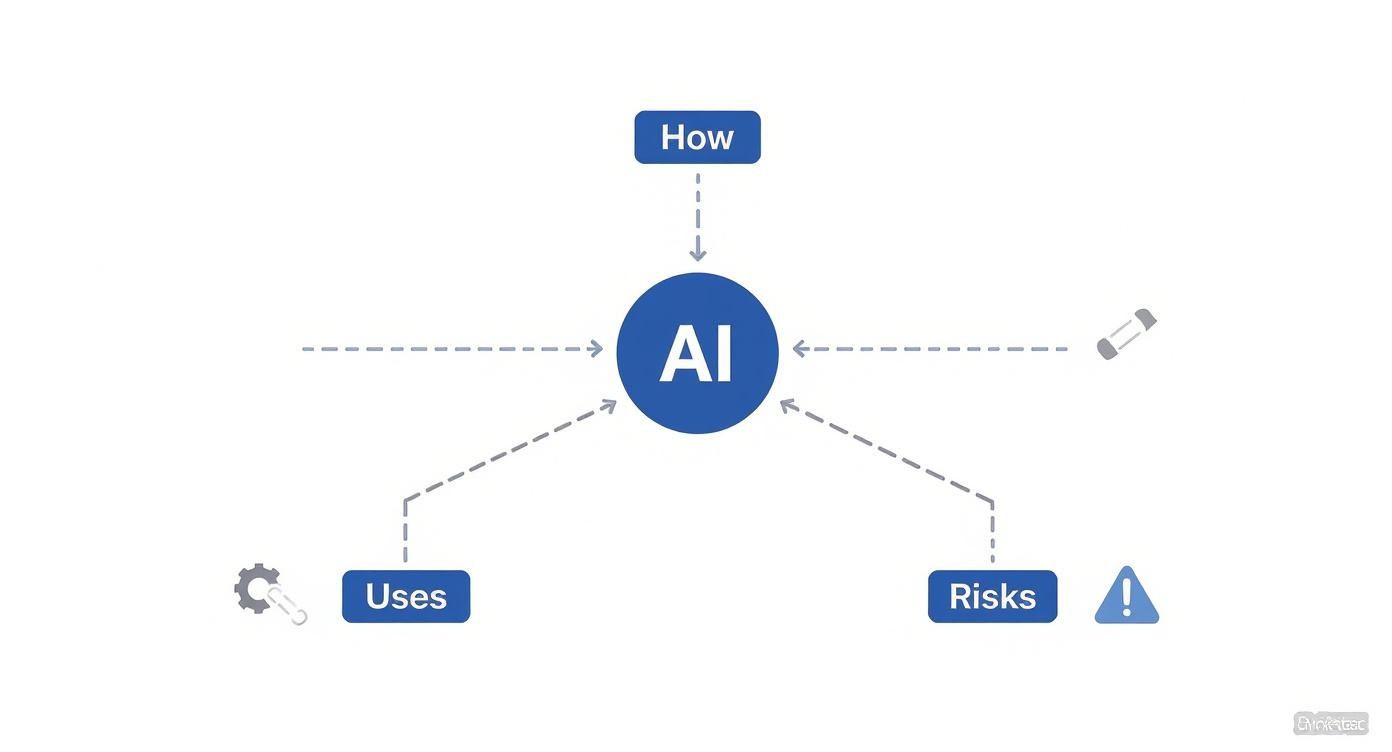
As the diagram shows, the generation process is just the starting point. The real-world implications branch out from there.
Comparing AI Image Generation Models
To get a clearer picture, it helps to see these two major technologies side-by-side. While both produce synthetic images, their methods and the tell-tale signs they leave behind can be quite different.
| Technology | Core Concept Analogy | Strengths | Common Artifacts |
|---|---|---|---|
| GANs | A forger and detective in a constant cat-and-mouse game. | Can produce extremely high-resolution and photorealistic portraits. | Oddities in backgrounds, asymmetrical earrings, distorted teeth, unnatural hair textures. |
| Diffusion Models | A sculptor carving a statue out of a block of random noise. | Highly coherent and detailed images, excellent at following text prompts. | Extra fingers or limbs, strange blending of objects, slightly waxy or "too perfect" skin. |
Ultimately, both paths lead to the same destination: a convincing, computer-generated image. They just take a different route to get there.
The Technology Under the Hood
Whether it's a GAN or a diffusion model, the engine driving it is a complex neural network trained on absolutely massive datasets of images. To see how this applies to other forms of media, check out this guide on Messi AI Explained: A Guide to the Tech Behind Viral Videos. These systems aren't just memorizing photos; they're learning the unspoken rules of what makes us look human—the way light hits the skin, the typical proportions of a face, the texture of an eyelash.
The most important thing to grasp is that these AIs aren't cutting and pasting features from different people. They are building a face from a statistical understanding—a learned concept—of "human."
This is a world away from simply using Photoshop. The AI isn't just tweaking a real photo; it's generating a brand-new one from its own digital imagination. If you want to dig deeper into spotting these creations, our guide on AI image identification breaks down the technical clues these models leave behind. Understanding how these faces are born is the first critical step to spotting them in the wild.
The Good, the Bad, and the Ugly
AI-generated images of people are a classic double-edged sword. Think of it like a powerful new tool—in the right hands, it can build incredible things, but it can just as easily be used to tear them down. It all comes down to who is using it and why. Let's look at the full picture, from the genuinely helpful applications to the seriously destructive ones.
On the bright side, these synthetic portraits solve some very real problems. For marketers and designers, they're a dream come true. Need a diverse cast of models for an ad campaign? Instead of organizing a complex and expensive photoshoot, you can now generate the exact faces you need, royalty-free, in a matter of seconds.
Privacy is another huge win. People who need an online presence but can't risk revealing their true identity—like activists, whistleblowers, or anyone trying to avoid online mobs—can use a synthetic avatar. It gives them a face without putting them in danger.
The Positive Applications
The upsides go well beyond just marketing and privacy. AI-generated faces are starting to pop up in some fascinating and practical ways.
- A Creative Spark: Artists and game developers often use AI faces as a starting point for character design or as placeholders, which helps speed up the early, messy parts of the creative process.
- Privacy-First Research: In medical fields, researchers can create synthetic patient data and images to train diagnostic AI. This way, they can build powerful new tools without ever touching a real person's private health information.
- More Inclusive E-Commerce: Some forward-thinking clothing brands are using generated models to show their apparel on a huge range of body types, giving shoppers a much better idea of how clothes might actually fit them.
And that's just scratching the surface. The technology is also behind innovations like virtual dressing rooms powered by AI try-on technology, which are completely changing the way we shop online. These examples prove this isn't just a novelty; it can deliver real, tangible value.
But for every positive use, there’s a dark reflection. The same tools that empower artists and protect activists also arm scammers and propagandists. The consequences are getting more serious every day.
The Darker Side of Synthetic Portraits
The widespread availability of this tech has opened a Pandora's box. Because it's so easy to create a believable image of a fake person, we're seeing an explosion of deception that’s eroding trust across the internet.
These synthetic identities are the new foot soldiers for disinformation. They're used to build entire armies of fake social media profiles—a practice called astroturfing—to amplify a political message, harass opponents, or create a false sense of grassroots support for a radical idea. These bot farms can quietly manipulate online conversations and warp public opinion.
Beyond politics, the financial threat is growing at a terrifying pace. The rise of these fake faces has fueled a massive surge in deepfake-related fraud. Globally, fraud attempts using this tech are skyrocketing. The Philippines recently saw a jaw-dropping 4,500% year-over-year increase, while the United States saw a 303% jump. Industries like crypto and fintech are prime targets, where criminals use fake identities for everything from scams to outright theft.
This digital deception is making it easier than ever to pull off a wide range of damaging schemes:
- Sophisticated Scams: Fraudsters create convincing fake profiles on professional networking sites to steal company secrets or on dating apps to run devastating romance scams.
- Identity Theft: A fake persona, built around a face that doesn't belong to anyone, can be used to open bank accounts, apply for loans, or breeze through identity verification checks.
- Harassment and Defamation: Malicious actors can whip up a fake profile in minutes to slander a person, spread vicious rumors, or coordinate targeted harassment campaigns.
Trying to navigate this new reality demands a whole new level of digital awareness. The line between what's real and what's fake has never been blurrier, and being able to tell the difference is quickly becoming an essential survival skill.
How to Spot Images of Fake People
While AI is getting scarily good at creating lifelike faces, it’s not infallible. For now, at least, the algorithms still make consistent, tell-tale mistakes that a trained human eye can catch. Think of yourself as a digital detective—once you know what clues to look for, the fakes start to pop.
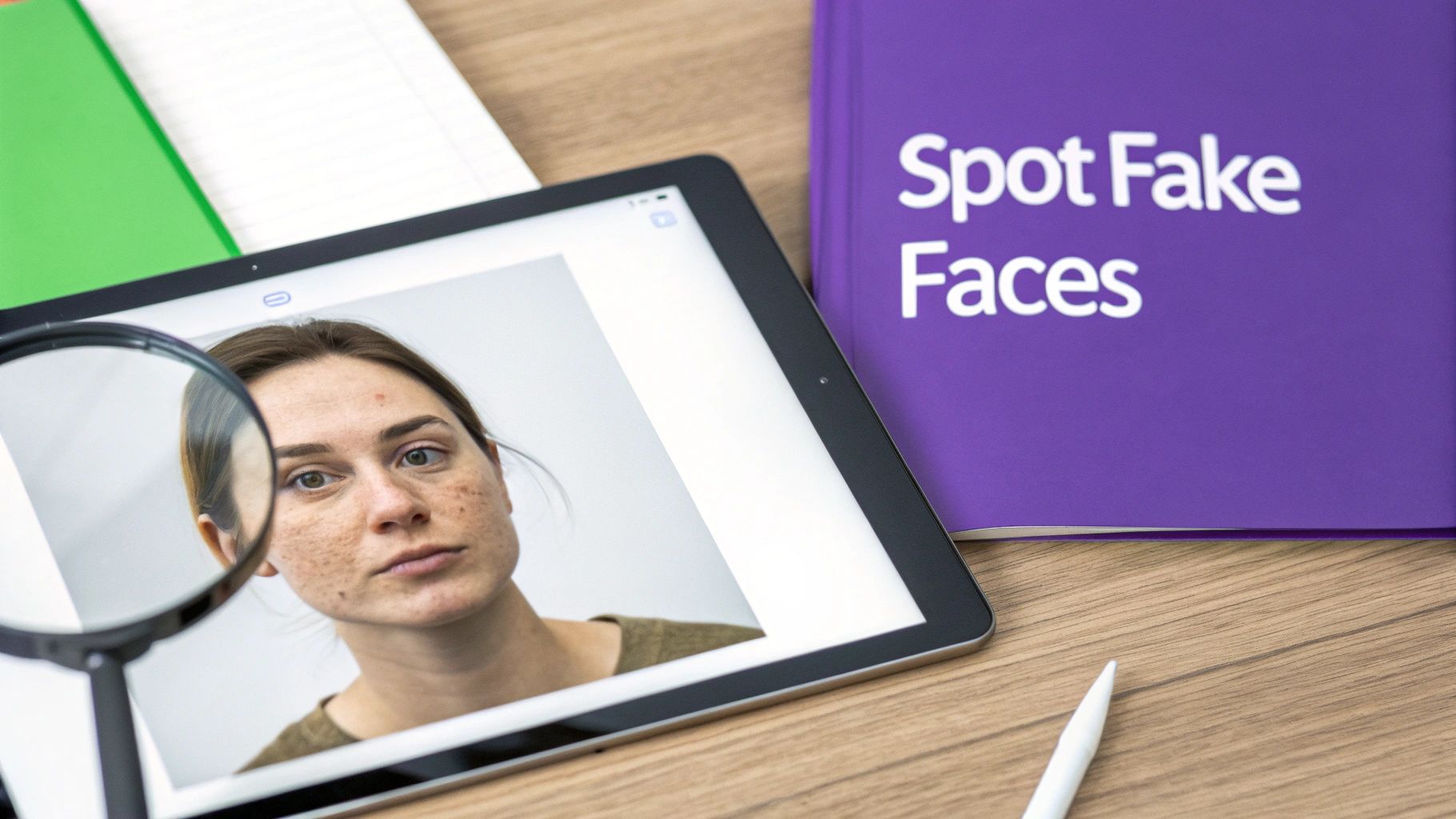
The first step is simply to pause and look closer. Most of us scroll past images in a fraction of a second, which is exactly what creators of fake content count on. By taking just a few extra moments, you can start to notice the subtle red flags that give an AI-generated image away.
Pay Attention to the Details
AI models learn by crunching data from millions of real photos, but they still have a hard time logically piecing together complex or inconsistent details. This is where you’ll find the most glaring errors.
Start by zeroing in on the areas where human anatomy gets tricky. These are often the first places an AI will slip up and reveal its non-human origin.
Here are the key hotspots to check:
- Eyes and Teeth: Look for pupils that are different sizes, mismatched light reflections in each eye, or an unnaturally smooth iris. Teeth can also be a dead giveaway; they might appear oddly shaped, suspiciously perfect, or even blend into each other.
- Ears and Hair: Ears are notoriously tough for AI to get right. Check for weird shapes, asymmetry, or lobes that look waxy and undefined. Hair is another challenge; individual strands might melt into the background, look painted on, or have an unnatural, uniform texture.
- Hands and Jewelry: Hands are a classic AI failure point. You might spot extra fingers, limbs that bend at impossible angles, or fingers that are weirdly long. Similarly, check jewelry like earrings—they are often asymmetrical or seem to melt right into the skin.
The core idea here is consistency. A real photograph, taken in a real environment, has to obey the laws of physics. Light, shadow, and anatomy should all make sense. When they don't, it’s a huge sign you might be looking at an image of a fake person.
Scrutinize the Background and Surroundings
After checking the person, zoom out and look at their environment. AI generators often pour most of their processing power into making the central subject—the face—look flawless. The background, on the other hand, is frequently where the illusion falls apart.
Keep an eye out for illogical or distorted elements. You might see walls with strange, warped patterns, objects that blend into one another nonsensically, or trees with bizarrely repeating branches. The background of an AI image often feels like a blurry, half-finished thought.
Another major tell is text. If the person is wearing a t-shirt with a logo or standing near a sign, try to read it. AI models are terrible at rendering coherent letters, often producing garbled, nonsensical squiggles that look like an alphabet you’ve never seen. This happens because the AI sees text as a visual pattern, not as a system of language with rules.
For a deeper dive into the specific patterns and artifacts left by AI, you might find it helpful to learn how to spot a deepfake in both images and videos.
Use Technology to Verify Your Suspicions
Even the sharpest eye can be fooled, especially as the technology behind these images gets better every day. When visual inspection isn't enough, your best defense is to fight fire with fire by using an AI-powered detection tool.
These tools don't just look at the surface-level weirdness you can see. They dig into the image's digital DNA, searching for subtle artifacts and statistical fingerprints that are unique to machine-generated content.
Here’s a simple verification workflow you can follow:
- Conduct a Visual Check: First, do the manual inspection we just covered. Look for those classic inconsistencies in the eyes, hair, hands, and background. This initial step can often flag obvious fakes right away.
- Perform a Reverse Image Search: Use a tool like Google Images or TinEye to see if the photo has appeared anywhere else online. A real person's photo will often be connected to social media profiles or company websites. An AI image may have no history or only show up on sites known for synthetic content.
- Use an AI Image Detector: This is the most crucial step for confirmation. Upload the suspicious image to a specialized tool like the AI Image Detector. It will analyze the file for hidden signs of algorithmic creation and give you a confidence score on whether it's likely human or AI-generated.
This structured process combines your own critical thinking with the power of technology, giving you a solid method for telling real people from fakes. As images of fake people become more common, mastering this workflow is no longer just a neat trick—it’s an essential skill for digital literacy.
Real-World Examples of Fake Images
It's one thing to talk about the theory behind AI-generated fakes, but it’s another thing entirely to see them in the wild. Looking at real-world cases is where the rubber meets the road—it shows you exactly how these images of fake people are used to deceive and, more importantly, how they get caught.
These examples are more than just stories; they're a masterclass in applying the detection skills we've been covering. They turn abstract concepts into tangible threats and prove that a sharp, critical eye is your best weapon.
Let's break down a couple of fascinating case studies. They reveal the high stakes involved and illustrate the constant cat-and-mouse game between the creators of synthetic media and the people trying to spot it.
The LinkedIn Spy Who Never Existed
In a striking case of modern corporate espionage, intelligence agencies unmasked a sophisticated network of fake LinkedIn profiles. These personas were designed to connect with influential people in tech and government to quietly siphon off information. One profile, supposedly a high-flying tech executive, was particularly convincing, complete with a polished headshot that almost fooled everyone.
But "almost" isn't good enough when you're up against trained analysts. A closer look revealed the tiny, tell-tale flaws that gave the game away. When you pieced them together, the synthetic portrait was obvious.
- Asymmetrical Earrings: This is a classic AI mistake. The person in the photo had earrings, but one was a simple stud while the other was a slightly warped, dangling piece that seemed to melt right into the earlobe.
- Background Warping: The office background, blurred for effect, had bizarre artifacts. A bookshelf behind the "executive" appeared to bend at an impossible angle, and the lighting didn't make any sense across the frame.
- Unnatural Hair Strands: At a glance, the hair looked real. But zooming in, a few strands near the forehead just seemed to dissolve into the skin instead of lying naturally on top of it.
This wasn't just some random scam; it was a wake-up call. It proved that well-funded groups were using AI-generated identities for serious intelligence gathering, taking the threat to a whole new level.
The corporate spy profile teaches us a vital lesson: scammers count on their targets being too busy to look closely. Just taking an extra ten seconds to scrutinize a profile picture can be the difference between connecting with a spy and blocking them.
Debunking Viral Disinformation
During a period of intense political turmoil, a shocking image went viral on social media. It appeared to show a well-known activist shaking hands with a controversial foreign leader, implying a secret alliance. The picture spread like wildfire, sparking outrage and deepening social divides.
Almost immediately, online investigators and fact-checking groups went to work. Their process is a fantastic blueprint for how to dismantle a viral fake by blending sharp visual analysis with a bit of digital detective work.
Here’s how they broke it down:
- Initial Visual Gut Check: First, they just looked at it. They noticed the lighting on the two figures was slightly off, as if they weren't actually in the same room. The handshake itself looked weird—the fingers seemed to merge together in an unnatural way.
- Reverse Image Search: Using tools like TinEye and Google Images, they hunted for the original photos. It didn't take long. They found the two separate, real images that had been mashed together to create the fake.
- Source Verification: They traced the original, untouched photos back to their roots. One was from a major news agency's archive, while the other came from the activist's own social media feed. The pictures were taken years apart, on different continents.
- Public Debunking: With solid proof in hand, the organizations published their findings. They showed the two original photos side-by-side with the viral fake, making the deception instantly clear to everyone. This visual evidence was crucial for stopping the disinformation in its tracks.
This incident is a powerful reminder of how images of fake people or manipulated scenes can be weaponized to sway public opinion. But it also shows that we have the power to fight back. By combining a trained eye with freely available tools, anyone can learn to question what they see online and uncover the truth.
Staying Safe in a World of Synthetic Media
Knowing how to spot the little tells in an AI-generated image is a great skill to have, but it’s only half the story. As this technology gets better, those visual glitches will eventually disappear, making it nearly impossible to rely on our eyes alone. The real goal isn't just reacting to fakes after they appear; it's about building a proactive defense so that checking sources becomes second nature.
This really comes down to a mindset shift—moving from passively scrolling to actively thinking about what you see. Your most powerful tool is a healthy dose of skepticism. Before you share, react to, or even believe something that seems surprising or emotionally charged, just pause. Ask yourself where it came from. That simple habit is the bedrock of staying safe online.
Best Practices for Everyone
You don't need a degree in computer science to protect yourself. It just takes a few consistent habits that anyone can build into their daily routine.
Start by being cautious with online profiles, especially those that look a little too perfect or have almost no history. And before you share anything, try to confirm it with a couple of reputable sources. A single, unverified image can easily spark a wildfire of misinformation if it strikes an emotional chord.
Here are a few core strategies to keep in mind:
- Trust But Verify: If a new connection request on a professional network feels strange, or an image in your social feed just seems off, take a second. A quick reverse image search or a run through an AI detection tool can save you a lot of trouble.
- Question Your Gut Reaction: Misinformation is often designed to make you feel something strong—outrage, shock, or fear. When you feel that emotional pull, take it as a sign to slow down and investigate, not to hit the "share" button.
- Look for Digital Fingerprints: It's helpful to understand the basics of things like digital watermarking and content provenance. These are emerging technologies designed to create a verifiable trail for media, proving where an image or video really came from.
The biggest challenge we face is a massive gap in public awareness. Most people simply don't know the technology behind images of fake people even exists, which leaves them wide open to being manipulated.
This lack of awareness is a serious problem. A recent global survey found that a shocking 71% of people don't know what a deepfake is. That means less than a third of the population is even familiar with the concept. The numbers are even higher in some places, with 75% of people in both Spain and Germany reporting they'd never heard the term. This knowledge gap is exactly what bad actors exploit for scams and disinformation campaigns. You can learn more by reading the full report on deepfake awareness and biometric security.
Tailored Guidance for Professionals
For anyone in a position of public trust, the responsibility to verify information is even more critical. Journalists, educators, and platform moderators are on the front lines, and their actions can have a huge ripple effect.
For Journalists and Fact-Checkers
Verifying sources is everything. Never treat an image submitted by a user as credible without putting it through its paces. Your workflow should include multiple steps: communicating with the source, running reverse image searches, analyzing metadata, and, of course, using a reliable AI detector. Documenting your process is also key to maintaining transparency and earning your audience's trust.
For Educators
Digital literacy is no longer just a special topic—it's a core life skill. It’s vital to integrate lessons on synthetic media and source evaluation into your curriculum. Teach students the practical detection skills we've covered here and encourage them to build a habit of questioning the media they see every day. The best long-term defense we have is empowering the next generation with these skills.
Ultimately, tackling the risks posed by images of fake people is a team effort. It’s about more than just spotting fakes. It's about building a culture of verification, where we all take a moment to confirm what we see before we let ourselves believe it—and certainly before we share it. By making these practices a part of our online lives, we can all help build a smarter, more resilient digital community.
Frequently Asked Questions
It's completely normal to have questions as this technology for creating fake people seems to advance overnight. Getting a handle on what's legal, how to spot these images, and how to use them the right way is more important than ever.
Here are some clear, straightforward answers to the questions we hear most often.
Is It Illegal to Create Images of Fake People?
The legality all comes down to how you use the image. If you're creating a synthetic portrait for a marketing campaign or a piece of digital art, you're generally in the clear.
But the moment you use these images for something malicious—like committing fraud, spreading disinformation, creating non-consensual explicit material (deepfake porn), or harassing someone—you've likely crossed a legal line. Laws are catching up fast to deal with the problems synthetic media can cause.
Can I Use an AI Image for My Business?
Absolutely, and many companies do. It can be a fantastic, budget-friendly way to get images for websites, social media ads, or product mockups without the cost of a photoshoot.
The key is to be upfront about it. A little transparency about the AI origin of your images goes a long way in keeping your audience's trust.
One critical detail: always double-check that the AI service you're using gives you a commercial license for the images. The terms can be wildly different from one platform to another, and you don't want to get into legal trouble.
Are AI-Generated Faces Based on Real People?
No, not in a one-to-one way. Think of it like this: an AI model studies millions of real photos to learn what makes a human face look like a human face—the patterns, textures, and features.
Then, it uses that knowledge to create a brand new face from scratch. The final image is a unique statistical blend, a composite that doesn't belong to any single person from the original photos it learned from.
How Can I Tell if an Image Is AI if It Looks Perfect?
It's getting tougher, isn't it? As the tech gets better, the obvious visual tells are disappearing. You can still check for the classic AI mistakes—weird hands, wispy hair that doesn't make sense, or bizarre backgrounds—but that's no longer a foolproof method.
Honestly, the most reliable way is to use a tool designed for this. AI detectors don't just look at the surface; they analyze the image's digital DNA, searching for the subtle fingerprints and artifacts left behind by the generation process.
When you need certainty, your best bet is to use a dedicated tool. The AI Image Detector can analyze a picture in seconds and give you a clear answer on whether you're looking at a real person or a synthetic one. Protect yourself from scams and misinformation—give it a try for free at https://aiimagedetector.com.


