

Is Outlier AI Legit? An Honest Review of the SEO Tool

With so many AI content tools out there, it's smart to ask the big question: is Outlier AI legit? For freelancers and content teams trying to get ahead, Outlier positions itself as a tool for building out SEO-driven topic clusters and detailed content briefs. The real test is whether it actually delivers an advantage or just spits out data you could find yourself.
What Is Outlier AI And Who Is It For?

Think about the last time you tried to map out a content strategy. You probably spent hours jumping between competitor articles, keyword tools, and what felt like a hundred different Google search pages. It's a grind, and a lot of it feels like pure guesswork. Outlier AI was built to automate all that heavy lifting. It acts more like an intelligent research assistant than just another AI writer.
At its heart, Outlier AI looks at the top-ranking content for any keyword you give it. It pulls apart what makes those pages win and uses that information to help you build a complete content plan. This isn't just about giving you a list of keywords; it’s about creating entire hubs of interconnected content.
How It Works in Practice
The platform's main job is generating topic clusters. Picture it like building a small, specialized library. Instead of one giant, rambling book, you create a central "pillar" article and support it with several smaller, in-depth articles on related subtopics. This is a classic SEO strategy that shows search engines you're an authority on the subject.
Here’s a simple breakdown of the Outlier AI process:
- You start with a keyword: Just provide the main "seed" keyword you're hoping to rank for.
- It analyzes the SERPs: The tool gets to work, scanning the search engine results pages to see who's ranking and what topics they're all covering.
- It generates a cluster: From that analysis, it suggests a whole network of related articles and keywords to build out your content hub.
- It creates the briefs: For every topic it suggests, it creates a detailed content brief complete with an outline, questions to answer, and even internal linking recommendations.
The real objective isn't just to write one article. It's to build a complete topical map that helps you own a niche. Outlier's core promise is to give you the blueprint for that map, potentially saving you dozens of hours of manual research.
Who Is This Really For?
So, who gets the most out of a tool like this? Outlier is designed for people who already get the basics of SEO but need a way to create content more efficiently and at a larger scale. It's probably not for total beginners, but it's perfect for anyone ready to level up from writing one-off articles to building strategic content clusters.
The ideal user often falls into one of these camps:
- SEO Agencies and Content Teams: They need to pump out high-quality, data-backed briefs for multiple clients without burning out their team.
- Solo Bloggers and Niche Site Owners: They want to establish topical authority and compete with bigger players, but they don't have a huge team to help them.
- In-House Marketing Managers: They're responsible for growing organic traffic and need a repeatable system for their content strategy.
At the end of the day, Outlier AI is for anyone who looks at their content plan and wonders if they're covering all their bases. Understanding what it does and who it's for is the first step in figuring out if Outlier AI is legit.
Investigating the Company's Credibility Signals
So, how do we really know if Outlier AI is the real deal? To get a clear answer, we need to do more than just look at its features. A slick website is easy to fake, but true credibility comes from things you can actually verify—like who’s running the show, what their track record is, and what other people are saying about them.
Think of it like a background check. You want to see a consistent and trustworthy history before you commit.
The first clue is transparency. Who is actually behind Outlier AI? It turns out, it's operated by Scale AI, a major player in the AI and data space with a headquarters in San Francisco. This connection is a big deal. It adds a layer of corporate accountability that you just don't get with a small, anonymous startup. Knowing an established company is involved instantly lowers the risk of it being some fly-by-night operation.
Founder Background and Team Expertise
A company's legitimacy is often a direct reflection of the people who built it. While Outlier AI is part of Scale AI, its sharp focus on SEO and content strategy tells you someone with deep industry knowledge is steering the ship.
A solid team will almost always have a verifiable history in tech, data science, or digital marketing. This kind of background ensures the product is grounded in real-world problems and solutions, not just some abstract technical exercise.
When you're sizing up any new tech tool, it's smart to have a process. A good place to start is our own vendor due diligence checklist, which gives you a great framework for your own investigation.
External Validation and Social Proof
Okay, so the company behind it is solid. But what are actual users saying? Independent reviews and social proof are where the rubber meets the road. This is one of the most powerful ways to gauge legitimacy.
Here's what to look for:
- Review Platforms: Check out what people are saying on trusted sites like G2, Capterra, or Trustpilot. These platforms often verify that the reviews are from real customers, which helps cut through the noise.
- Case Studies: A company that’s proud of its results will show them off. Look for detailed case studies with specific data and real-world examples that prove the tool actually works.
- Industry Mentions: Has Outlier AI popped up in well-known SEO or marketing publications? A nod from a respected industry voice is a strong vote of confidence.
This kind of external validation is crucial, especially in a booming market. Consider the AI Detector market, a space focused on content verification. It was valued at USD 1.08 billion in 2025 and is predicted to explode to USD 13.68 billion by 2035. This massive growth, detailed in the full AI Detector market report from novaoneadvisor.com, shows just how much people need AI tools they can trust.
Key Takeaway: Legitimacy isn't just about whether a product works. It's the whole package: a transparent company, an experienced team, and positive proof from real users and industry experts.
For a quick overview of our findings, here’s a simple checklist summarizing Outlier AI’s credibility.
Outlier AI Legitimacy Checklist
| Legitimacy Signal | Status for Outlier AI | Why It Matters |
|---|---|---|
| Corporate Backing | Strong. Operated by Scale AI, a well-established company in the AI industry. | Provides corporate accountability and resources, reducing the risk of being a scam. |
| Team Transparency | Good. While specific team members aren't highlighted, the connection to Scale AI implies expert involvement. | A visible, experienced team builds confidence that the product is built on solid expertise. |
| Founder History | Linked to Scale AI Founders. The parent company was founded by Alexandr Wang and Lucy Guo. | Strong founder backgrounds signal industry knowledge and a long-term vision. |
| External Reviews | Growing. Reviews can be found, but it's not as established as older tools. | Unbiased user feedback is one of the most reliable indicators of a product's real-world value. |
| Industry Press | Present. Mentions in tech and marketing publications are increasing. | Positive press from reputable sources acts as a third-party endorsement of the company's credibility. |
All in all, when you piece these signals together—from its connection to Scale AI to the emerging social proof—the picture becomes much clearer. The evidence strongly suggests Outlier AI is a credible player, not a questionable outlier. Now, let's see if the tool's performance lives up to these positive signs.
Alright, let's roll up our sleeves and put Outlier AI to the test. All the background checks and trust signals are great, but the real question is: does it actually work? I decided to take it for a spin to see what happens when you go from a blank page to a full-blown content plan.
The whole process kicks off with just one keyword. For this walkthrough, I chose a classic B2B topic: "benefits of remote work." You plug that into the dashboard, and Outlier AI gets to work crawling the current search results to see what’s already ranking. The idea isn’t just to target that one phrase but to build an entire ecosystem of content around it.
A few minutes later, the tool spits out a complete cluster map. This isn't just some flat list of keywords; it’s a visual hierarchy. My main "pillar" topic, "Benefits of Remote Work," sat right in the middle, surrounded by smart suggestions for supporting articles like "Managing Remote Teams Effectively" and "Best Tools for Remote Collaboration."
From Cluster to Content Brief
With the map laid out, it was time to move on to the next step: creating a content brief. I picked one of the suggested topics—"Managing Remote Teams Effectively"—and told the tool to create a blueprint for the article. This is really where the rubber meets the road and where you see if Outlier AI can deliver on its promises.
The brief it generated was far more than a simple outline. It’s a comprehensive, multi-part document built to give a writer everything they need to get started. It’s broken down into a few key modules:
- Competitor Analysis: This section pulls in the top-ranking articles for your keyword, showing you their word counts, heading structures, and the main themes they cover. It’s a quick and dirty way to see what’s already resonating with Google.
- 'People Also Ask' (PAA) Data: The tool scrapes relevant questions directly from Google's PAA boxes, which is a goldmine for making sure your content answers what real people are actually searching for.
- Recommended Outline: You get a full H2 and H3 structure for the article, already populated with suggested talking points for each section.
- Internal Linking Suggestions: It even points out other topics from your newly created cluster that you should link to. This is crucial for building that topical authority right out of the gate.
The entire point is to take the guesswork out of content creation. Instead of a writer staring at a blinking cursor, they get a data-backed roadmap telling them what to write about, which questions to answer, and how to structure it all for the best possible SEO performance.
Interpreting the Output
The brief for "Managing Remote Teams Effectively" was genuinely impressive. It didn't just give me generic advice; it suggested detailed sections on specific communication strategies, performance metrics, and tips for building a strong remote team culture.
What really stood out was how closely the recommendations were tied to the actual SERP analysis. For instance, it didn’t just say, "talk about communication." It specifically told me to cover asynchronous communication tools and virtual team-building activities because its analysis showed these were recurring themes in the top-ranking articles.
That level of specific, actionable guidance is a strong sign that Outlier AI is doing more than just scraping keywords. My hands-on test shows it provides a genuinely solid foundation for creating content that’s built to compete.
How to Validate the Quality of Its SEO Recommendations
Any AI tool is only as good as what it spits out. When you're trying to figure out if Outlier AI is legit, you have to treat its suggestions like a set of well-researched hypotheses, not gospel. If you just follow its instructions blindly, you could waste a ton of time and money on content that completely misses the mark.
The first thing you absolutely must do is double-check its keyword recommendations. Outlier AI will give you a whole cluster of related keywords, but you need to run them through a trusted tool like Ahrefs, Semrush, or even the free Google Keyword Planner. You're looking for two things: verifiable search volume and a realistic keyword difficulty. If the tool is spitting out keywords with zero search volume or a difficulty score that's off the charts, that’s a big clue its data might be a bit wonky.
Next, you have to put on your critical thinking hat and really dig into the content briefs it creates. A great brief does more than just list a few competitors; it needs to nail the search intent. Ask yourself: does this outline actually match what someone is looking for when they search this term? If the keyword is "best running shoes," a solid brief will be all about product comparisons, buyer guides, and reviews—not a history lesson on the invention of sneakers.
Scrutinizing the Data and Structure
Once you've got the basics down, it's time to get granular. Look at the "People Also Ask" questions it suggests. Are they actually relevant, or did it pull them from some loosely related topic? What about the internal linking ideas? Do they create a smart, logical path for a user to follow, or does it feel like it's just throwing links at the wall to see what sticks? A truly useful AI tool will help you build a structure that makes sense strategically.
Here’s a simple flowchart you can use to gut-check Outlier AI’s output at every step of the process.
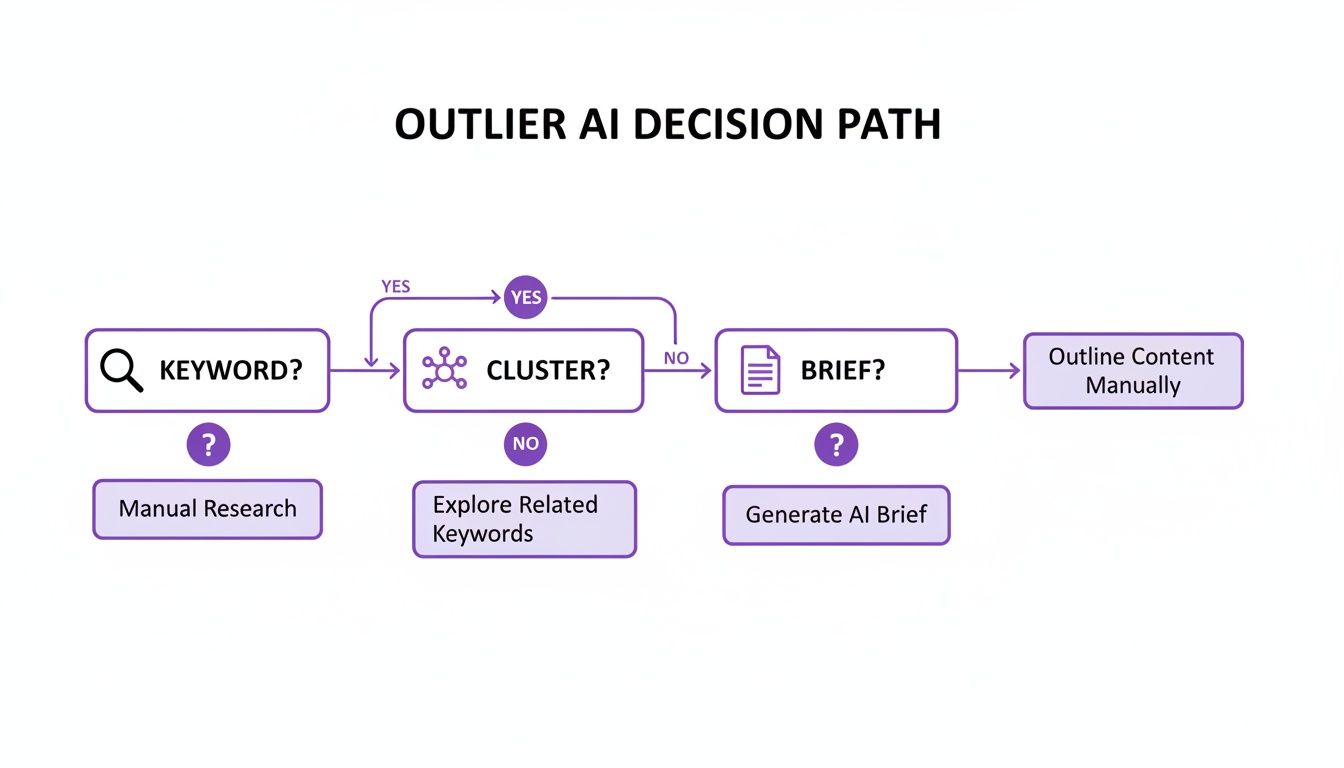
Think of this as your quality control checklist. Every AI suggestion needs a human checkpoint before it gets the green light.
Running Outputs Through AI Detectors
One final, powerful trick is to test its outputs with AI content detectors. Outlier AI is more about building briefs than writing full articles, but you can still copy and paste its suggested headings, questions, and structural elements into these tools. If a detector flags the output as super generic or formulaic, that’s a red flag. It might mean the final content won't stand out to readers or search engines.
Tools like these give you a quick reality check, helping you spot those robotic patterns that can make content feel lifeless. The goal isn't to play "gotcha" with the AI; it's to use it as a smart starting point. Your job is to take its data-driven foundation and apply your own expertise to refine, adapt, and ultimately create something much better.
This need for verification is becoming more critical everywhere. For instance, the market for AI Image Detectors was already valued at US$308 million in 2025 and is expected to jump to US$554 million by 2032. Why? Because we're swimming in deepfakes—they make up over 96% of manipulated videos online—and we need tools to sort fact from fiction. If you want to learn more, you can explore our guide on how to detect AI. By taking this "trust but verify" approach, you can harness what Outlier AI does well without letting it steer your SEO strategy off a cliff.
How Outlier AI Stacks Up Against the Competition
No tool exists in a bubble, so to really understand if Outlier AI is legit, we need to see how it performs next to the big names in the SEO world. When you line it up against giants like Surfer SEO or MarketMuse, you start to see exactly where it fits in. It’s less about finding one "best" tool and more about finding the right one for your specific goals, budget, and how you work.
Outlier AI really shines when it comes to topic clustering and generating content briefs. Think of it as your high-level content strategist. It's fantastic at taking a single keyword and mapping out an entire content hub, giving you a bird's-eye view of your content strategy. This is what sets it apart from tools that are hyper-focused on tweaking a single article for on-page SEO.
Core Feature Showdown
While the established players have platforms packed with features, Outlier AI keeps its focus tight. Surfer SEO, for example, is famous for its powerful content editor that gives you a real-time score as you write. MarketMuse, on the other hand, uses some pretty sophisticated AI to analyze all of your existing content and find where the gaps are.
Outlier AI doesn’t pretend to do everything. Its real power is in the initial planning phase, before you even start writing. To get a better sense of the landscape, it's worth seeing how it compares to the 5 Best AI Tools To Help Businesses With SEO.
Here’s a quick breakdown to see how they compare on key features.
Outlier AI vs Key Competitors
| Feature | Outlier AI | Surfer SEO | MarketMuse |
|---|---|---|---|
| Primary Use Case | Topic clustering & content strategy planning | On-page content optimization & SERP analysis | Content inventory, gap analysis & strategy |
| Content Briefs | Core feature, detailed and structured | Strong, with competitor data and NLP terms | Excellent, based on comprehensive site data |
| Real-Time Editor | No | Yes, with real-time scoring | Yes, with integrated optimization guidance |
| Topical Authority | Excellent, its main focus | Good, through individual article optimization | Excellent, with content inventory analysis |
| Pricing Model | Credit-based for reports | Subscription-based (monthly/annual) | Premium, often for enterprise-level teams |
| Best For | Strategists, agencies, niche site builders | Writers, editors, SEO specialists | Large content teams, enterprises |
As you can see, the right choice really depends on what you're trying to accomplish.
Who Is Each Tool For?
Looking at the ideal user for each tool makes it even clearer where Outlier AI fits into the puzzle.
- Outlier AI: This is for the content strategists, agency teams, and niche site builders who want to build topical authority from the ground up with well-organized content clusters.
- Surfer SEO: Perfect for writers and editors who need clear, actionable steps to optimize a single article and outperform specific competitors on the search results page.
- MarketMuse: A go-to for enterprise-level teams that are juggling massive content libraries and need deep analytics and inventory tools to scale their efforts.
The simplest way to put it is this: Outlier AI helps you figure out what to write about to own a topic. Other tools are often more focused on how to write one specific article to rank for a keyword. This makes it a great first step before you fire up other optimization tools.
This focus on strategy over tactical, word-by-word execution is what makes Outlier AI different. It’s also what makes it a solid option for anyone on a tighter budget who needs to get their research and planning done efficiently before spending money on content creation. Its legitimacy is rooted in being a specialized planner, not an all-in-one platform. You can explore more options in our guide to the best AI content detection tools.
The entire field of AI-powered analysis is exploding. Just look at the AI Image Recognition market—it was valued at USD 27.33 billion in 2025 and is expected to hit USD 57.70 billion by 2032. This massive growth shows how much we're coming to rely on specialized AI to make sense of complex data, whether that’s spotting a fake image or planning a year's worth of SEO content. You can read more about this trend at 360iresearch.com.
The Final Verdict on Outlier AI's Legitimacy

So, after digging into the company, its features, and how it performs, what’s the final call? It’s pretty straightforward: Outlier AI is a legitimate tool. This isn't some fly-by-night operation or a scam. It's a serious platform backed by Scale AI, a heavy hitter in the AI space, which gives it a level of credibility many new tools just don't have.
Its real power is in the big-picture content strategy. If you need to build out massive topic clusters or create data-driven content briefs, Outlier AI shines. It’s built for the planning phase, giving you a solid strategic roadmap before you even think about writing.
But it’s not meant to be a Swiss Army knife for SEO. You won't find the real-time content editors or in-depth site analytics that platforms like Surfer SEO or MarketMuse offer.
Think of Outlier AI as your strategic planner, not a line-by-line editor. It tells you what to write about to build topical authority, but the how—the actual writing and optimization—is still up to your team or other tools.
This laser focus makes it a fantastic fit for a few specific groups:
- SEO Agencies that need to pump out high-quality content briefs at scale.
- Niche Site Builders who want to establish authority in a new vertical, and fast.
- Content Strategists whose main goal is building long-term organic growth through well-organized content hubs.
Frequently Asked Questions About Outlier AI
Even after breaking down all the details, you probably still have a few specific questions floating around. Let's tackle some of the most common ones that pop up when people are trying to figure out if Outlier AI is the real deal.
What's This Going to Cost Me?
Outlier AI doesn’t follow the typical monthly subscription model you see everywhere else. Instead, you'll likely find its pricing is credit-based or tied to specific projects. This means you pay for the content briefs and reports you actually generate.
This pay-as-you-go approach can be pretty smart for teams that do their strategic planning in intense bursts rather than needing access every single day. While there isn't a classic "free trial," this model lets you dip your toes in the water with a small project to see if you like the results before going all-in.
How Hard Is It to Get Started?
If you already speak the language of SEO—things like topic clusters and keyword research—you'll find the learning curve is surprisingly gentle. The dashboard is clean and to the point: you plug in a keyword, and it gives you back a strategic map.
The real challenge isn't operating the tool, but learning how to interpret and question what it tells you. Someone brand new to SEO might see the data and feel like they're drinking from a firehose. But if you have some experience, you can pull out genuinely useful ideas in just a few minutes.
The tool is built for big-picture strategy, not the nitty-gritty of technical SEO. As long as you understand why content clusters matter, figuring out how to use Outlier AI is a breeze.
Can I Finally Ditch My Other Keyword Tools?
In a word, no. You shouldn't think of Outlier AI as a replacement for heavy-hitters like Ahrefs or Semrush. It’s designed to be a strategic partner that works with them.
Here’s a good way to think about it:
- Ahrefs/Semrush: These are your microscopes. You use them for the fine-grained details—digging into search volume, checking keyword difficulty scores, and obsessively tracking your rankings.
- Outlier AI: This is your telescope. It’s for macro-level planning, helping you see the entire content universe and how individual topics connect to build that all-important topical authority.
The best workflow is to use your main SEO tool to double-check and validate the keyword suggestions and data you get from Outlier AI.
Is the Output Actually Unique?
The output is unique in its organization and presentation, but not necessarily in the raw data itself. The tool is scraping and pulling information from publicly available sources—think Google search results, "People Also Ask" boxes, and related queries.
Its real value is in how it intelligently sorts, groups, and structures all that scattered information into a cohesive content brief and cluster map. That process is what saves you dozens of hours of mind-numbing manual research, and that’s where its legitimacy truly lies.
Ready to verify with confidence? Use AI Image Detector to instantly check if an image is human-created or AI-generated. Get clear, fast results at https://aiimagedetector.com.