

Originality AI Detector: How It Works and Why It Matters

A features editor has a viral op-ed open on one screen and the writer's previous work on another. The arguments are plausible, the grammar is polished, and nothing in the article proves that a language model helped produce it. A high-school English teacher faces the same uncertainty when two essays share an unusually smooth rhythm. In both cases, suspicion is easy. Reliable judgment is harder.
That's the problem an Originality AI detector tries to help solve. It can identify patterns associated with generated text, accelerate review, and support decisions in publishing, education, marketing, and trust and safety. It can't reconstruct authorship with certainty, and it shouldn't replace context, source checks, or human review.
Why Everyone Is Suddenly Talking About AI Detection
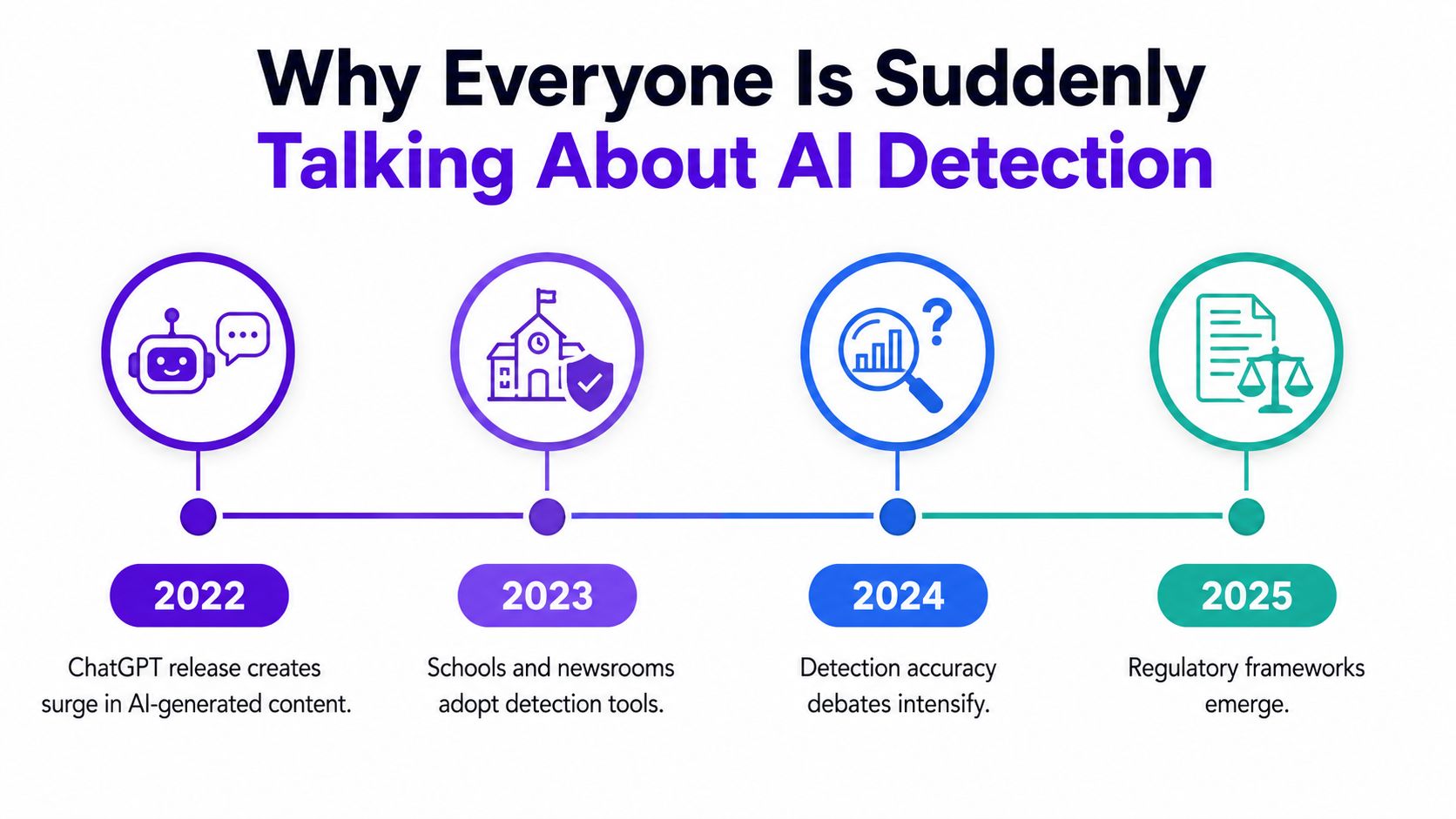
Public concern changed quickly after conversational AI became widely visible in late 2022. Originality.ai describes itself as the first commercial AI detector to launch before ChatGPT, with a launch date of November 26, 2022, while ChatGPT launched on November 30, 2022. Its early beta could detect content from GPT-2, GPT-Neo, GPT-J, and GPT-3, giving publishers and educators an early practical response to a problem that soon became much larger. Originality.ai's history of AI detectors documents that early development.
The pressure expanded beyond text. Image-generation systems made synthetic photographs, illustrations, product images, and social posts easier to create and harder to verify. Newsrooms began adding visual checks to source calls and reverse-image searches. Schools started discussing acceptable AI assistance alongside plagiarism. Creative platforms faced questions about synthetic submissions, copied styles, and images presented as documentary evidence.
A useful first response, not a final answer
The phrase “AI detector” can create the wrong expectation. It sounds like a scanner that finds a hidden label inside a document or image. Most detectors instead estimate whether a sample resembles material produced by known generative systems.
That distinction matters because the result is probabilistic. A high score can justify closer examination, but it doesn't establish misconduct. A low score doesn't prove that a person wrote every word or created every pixel. Hybrid work, paraphrasing, translation, editing, and unfamiliar subject matter can change the evidence a detector sees.
Practical rule: Treat an AI detection score as a reason to ask better questions, not as the answer to an authorship dispute.
The historical lesson is straightforward. Detection tools arrived because editors, teachers, and platform teams needed faster triage. They became useful in workflows where a person still checks provenance, drafts, sources, and context. That remains the responsible way to understand the Originality AI detector today.
What an Originality AI Detector Actually Does
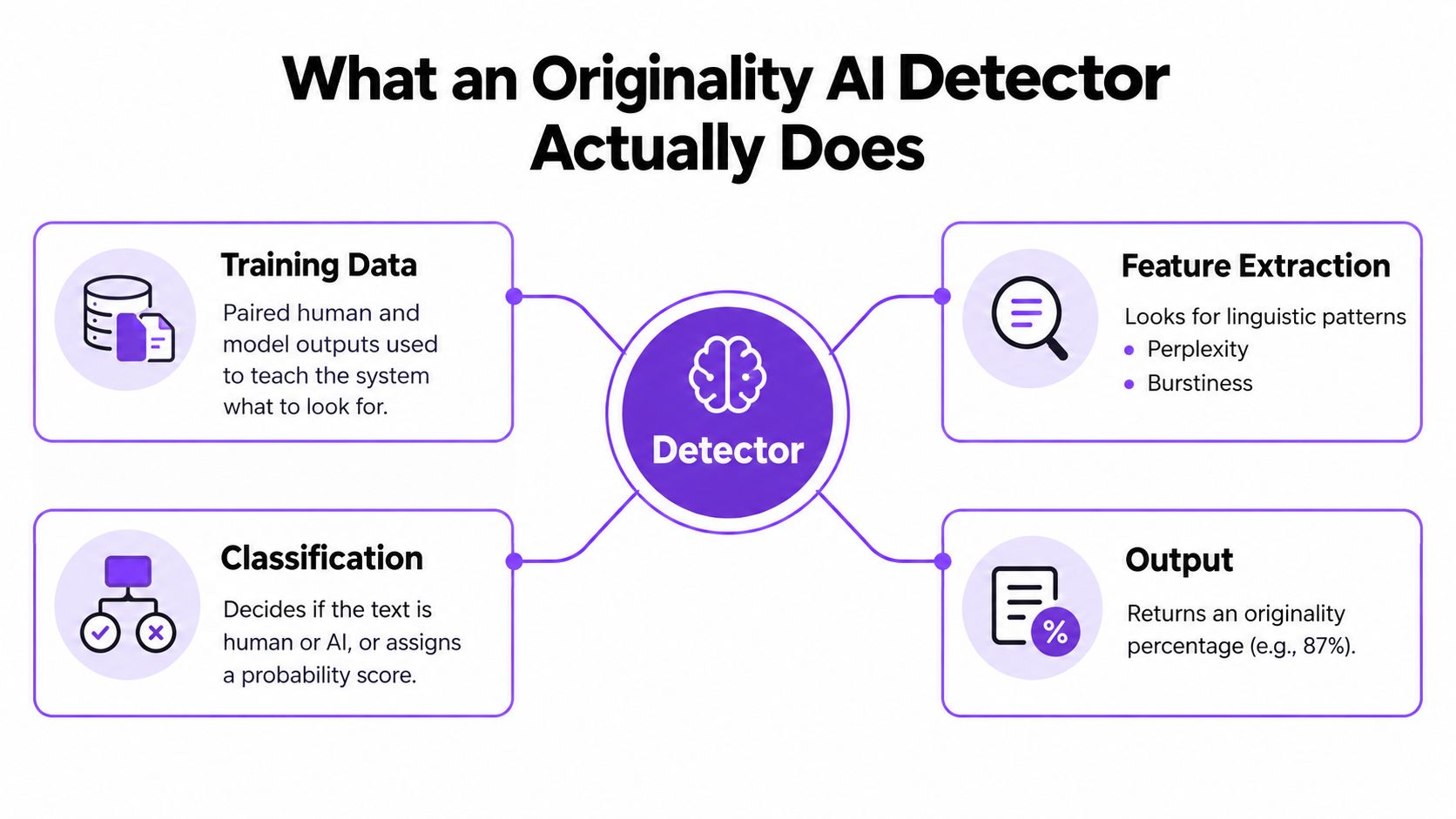
Start with the detection problem, not the product name. A detector receives a new sample and estimates whether its characteristics resemble human-created material, machine-generated material, or a mixture of both. Developers train classifiers on examples whose origins are known, then use the resulting model to evaluate text or images it hasn't seen before.
For text, the model may examine token patterns, word predictability, sentence structure, punctuation, repetition, and changes in style. Measures such as perplexity describe how surprising a sequence of words is to a language model. Burstiness describes how unevenly vocabulary and sentence patterns vary. These signals can be informative, but none is a secret watermark that appears in every machine-written passage.
For images, a detector examines visual evidence instead. It may look at pixel relationships, lighting, texture, compression behavior, edges, and artifacts associated with image-generation systems. A photograph that has been resized, recompressed, edited, or combined with generated elements can present a more difficult classification problem than an untouched synthetic image.
The output is a probability, not a forensic label
A report might show an originality percentage, a confidence score, or a classification such as likely human or likely AI-generated. The interface varies, but the underlying idea is similar. The system is ranking possibilities based on learned patterns.
That means users need to ask what the score represents. Is it a whole-document estimate or a sentence-level signal? Does the model support the language being tested? Was it evaluated on current generators, paraphrased writing, scientific prose, or mixed-authorship samples? Without those details, a precise-looking number can encourage more confidence than the evidence deserves.
For a concise explanation of the broader detection process, see this guide to how AI detectors detect AI.
A detector can specialize in text, images, or both. Even when two tools use similar language, their evidence differs because words and pixels behave differently. The safest interpretation is always conditional: this sample resembles one class under this tool's model and test conditions.
How AI Text and AI Images Leave Different Fingerprints
Text and images can both carry statistical traces, but the traces arise from different production processes. A text detector studies the choices that form a sequence. An image detector studies relationships among pixels, textures, shapes, and visual structure.
Text signals
Generated writing can show lower lexical surprise, repeated phrasing, predictable transitions, or a uniform rhythm. A paragraph in which every sentence has similar length and complexity may look different from a human draft that moves unevenly between short observations and longer explanations. Earlier generative systems often produced recognizable habits, but newer systems can vary style more effectively.
Watermarking takes a different approach. Instead of detecting a pattern after generation, a system can bias token selection during decoding so that generated text contains a statistically detectable signature. That method depends on the watermark being used, preserved, and detectable. Ordinary editing, translation, or paraphrasing can weaken or remove the signal.
Image signals
Synthetic images may reveal inconsistent lighting, reflections that don't agree with the scene, awkward hand anatomy, distorted lettering, or repeated textures. Frequency-domain analysis can expose regularities that aren't obvious to the eye. Neural detectors may learn these patterns directly, while classical forensic methods may focus on measurable image properties such as noise, compression, or editing traces.
Neither track is permanent. A person can rewrite a generated paragraph until its original token distribution changes. An editor can crop, resize, recompress, or composite an image until some visual artifacts disappear, although new inconsistencies may appear.
| Signal Category | AI Text Detection | AI Image Detection |
|---|---|---|
| Statistical regularity | Predictable word sequences, low surprise, repeated phrasing | Repeated textures, unusual pixel relationships, frequency patterns |
| Structural clues | Similar sentence lengths, consistent syntax, formulaic transitions | Inconsistent lighting, reflections, anatomy, edges, or perspective |
| Model-specific evidence | Token distributions or possible watermark patterns | Artifacts associated with diffusion or other image-generation systems |
| Effect of editing | Paraphrasing and rewriting can smooth away text signals | Cropping, resizing, recompression, and compositing can alter visual signals |
| Typical output | Likelihood or originality score | Confidence score with a likely-human or likely-AI interpretation |
The practical difference is important. Text analysis often depends on language and domain. Image analysis depends on resolution, format, editing history, and the type of visual content. A detector that performs well on one category may not transfer cleanly to another.
Where AI Detectors Are Already in Real Use
A newsroom receives a dramatic photograph during a breaking story. The image appears to show an event that would matter to readers, but the sender provides no original file or reliable location details. An editor can run a detection check, inspect metadata, search for earlier copies, contact the source, and compare the image with independent reporting. The tool speeds up triage. It doesn't publish the verdict.
Education follows a similar pattern. An instructor reviewing a thesis may notice a sudden change in vocabulary or argument structure. An Originality AI detector score can identify passages worth discussing, but the instructor should also review outlines, drafts, citations, revision history, and the student's ability to explain the work. A short conversation can reveal context that a classifier cannot.
Three workflows with the same human decision point
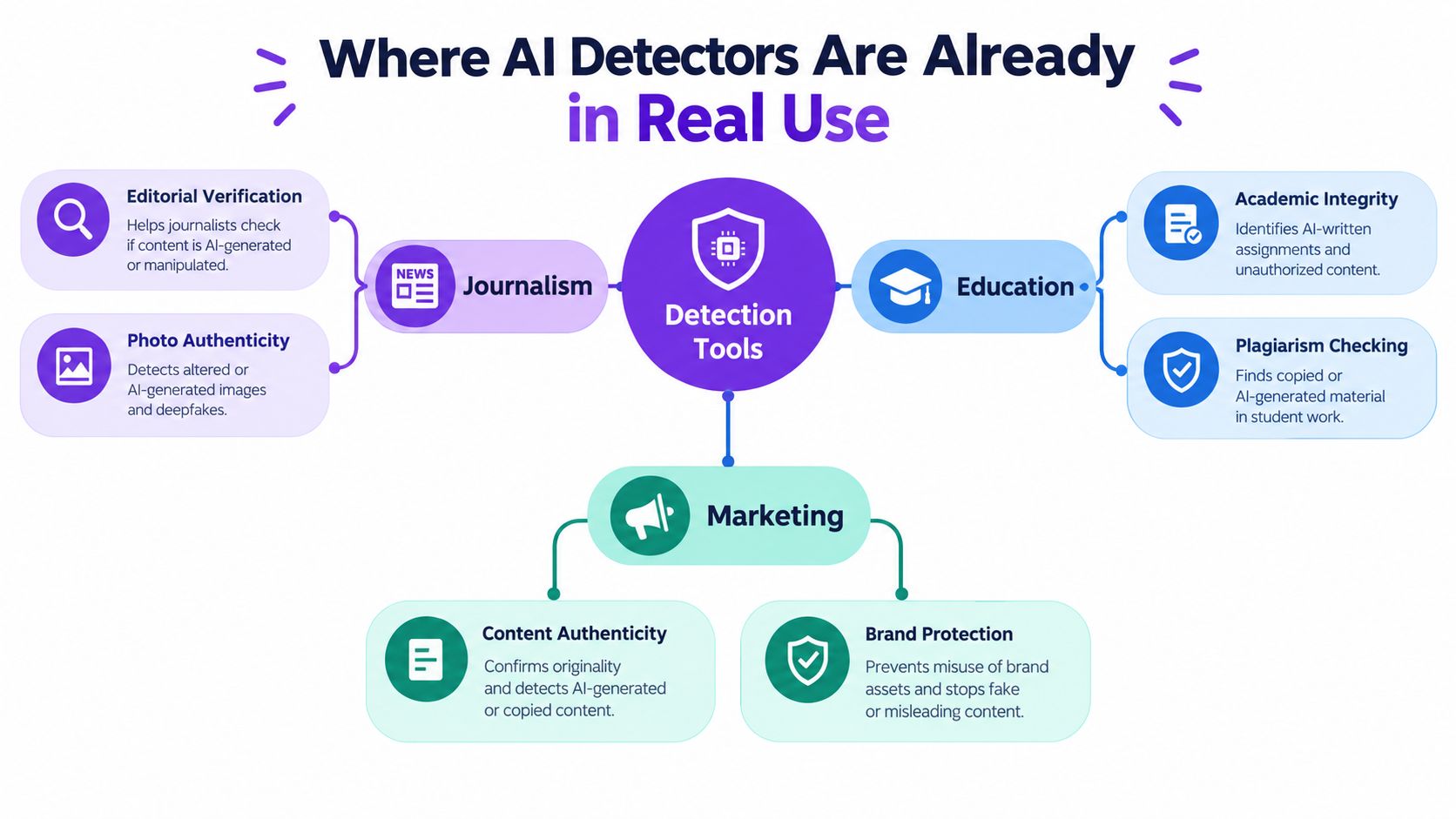
- Journalism: Editors use text and image checks alongside interviews, source confirmation, reverse-image searches, and editorial judgment.
- Education: Teachers use scores to select work for further review, then examine the writing process rather than relying on a single report.
- Marketing and creative work: Teams screen submissions, product imagery, reviews, and brand assets for signs of synthetic production or unauthorized reuse.
Marketing teams also face a different problem from schools. They may need to know whether a marketplace image is synthetic, whether a campaign asset misrepresents a product, or whether a competitor's material imitates protected creative work. Detection helps a reviewer prioritize files, while rights and brand decisions still require evidence beyond the score.
Organizations building automated systems can also place detection inside broader governance practices. A resource on AI safety tools for agents and workflows is useful for teams thinking about monitoring, review gates, and escalation rather than isolated scanning.
These fields share a practical pattern: detectors reduce the number of items requiring immediate human attention. They work best as filters in a documented process, not as automated judges.
For additional examples of how image checks fit into everyday verification, see these real-world examples of AI detection.
Where Detectors Quietly Fail
The hardest material isn't always fully generated. Hybrid writing creates a larger blind spot. A student may develop the argument and evidence independently, then ask a language model to polish transitions. A journalist may rewrite a draft with an AI editing tool. The final text can retain human ideas while adopting machine-shaped phrasing, producing a mixed signal that a binary detector wasn't designed to interpret.
Paraphrasing creates another problem. It changes the surface form that detectors analyze while preserving the underlying meaning. The RAID shared benchmark evaluated Originality.ai at 85% accuracy on its base dataset, the highest among 12 detectors tested, and 96.7% accuracy on paraphrased content in the company's report, but the broader research record still shows that paraphrase, humanization, and domain changes can materially reduce reliability. The RAID benchmark discussion provides that specific benchmark context.
Why a strong benchmark doesn't settle the question
Academic writing, translated prose, code comments, and specialized scientific language can differ sharply from the material used to train or test a detector. A study comparing Originality and Turnitin found overall accuracy of 0.69 versus 0.61, with macro-average recall of 0.60 versus 0.51, while concluding that neither system was reliable enough for high-stakes academic decisions. The peer-reviewed comparison illustrates why a higher comparative score still isn't a disciplinary standard.
Independent and company-published summaries report widely varying results, including 97%, 98%, 96% with an 8% false positive rate, and 98.2% on ChatGPT content with an average of 85% across 11 models. The same round-up cites more modest real-world ranges from 76% to 92% accuracy, with false positive rates around 4.8% to 5.7%, depending on the data and conditions. The AI detection studies round-up makes the central point: performance depends on the sample, language, model, and attack method.
| Failure Mode | Signal Disrupted | Typical Accuracy Drop |
|---|---|---|
| Hybrid authorship | Mixed human and machine patterns don't fit a clean binary class | Academic evaluations report near-zero recall for some mixed-authorship samples. Hybrid-text findings |
| Paraphrasing or humanization | Word choice and token-level regularities change | Accuracy can fall sharply on lightly paraphrased or humanized text. Peer-reviewed analysis |
| Domain shift | Training patterns don't match specialized or translated writing | Results become less dependable outside the detector's tested domain. |
| Adversarial editing | Synonym swaps, invisible characters, and deliberate style changes disrupt features | Evasion can produce false negatives, while unusual human prose can produce false positives. |
A detector may also flag a human writer whose style is unusually formal, consistent, or shaped by second-language learning. That risk makes a score unsuitable as the sole basis for punishment, rejection, or public accusation.
Privacy as a First-Class Feature
A detector's privacy policy deserves the same attention as its accuracy claims. Before uploading a manuscript, thesis, interview transcript, unpublished artwork, or client file, ask what happens between selecting the file and receiving the result.
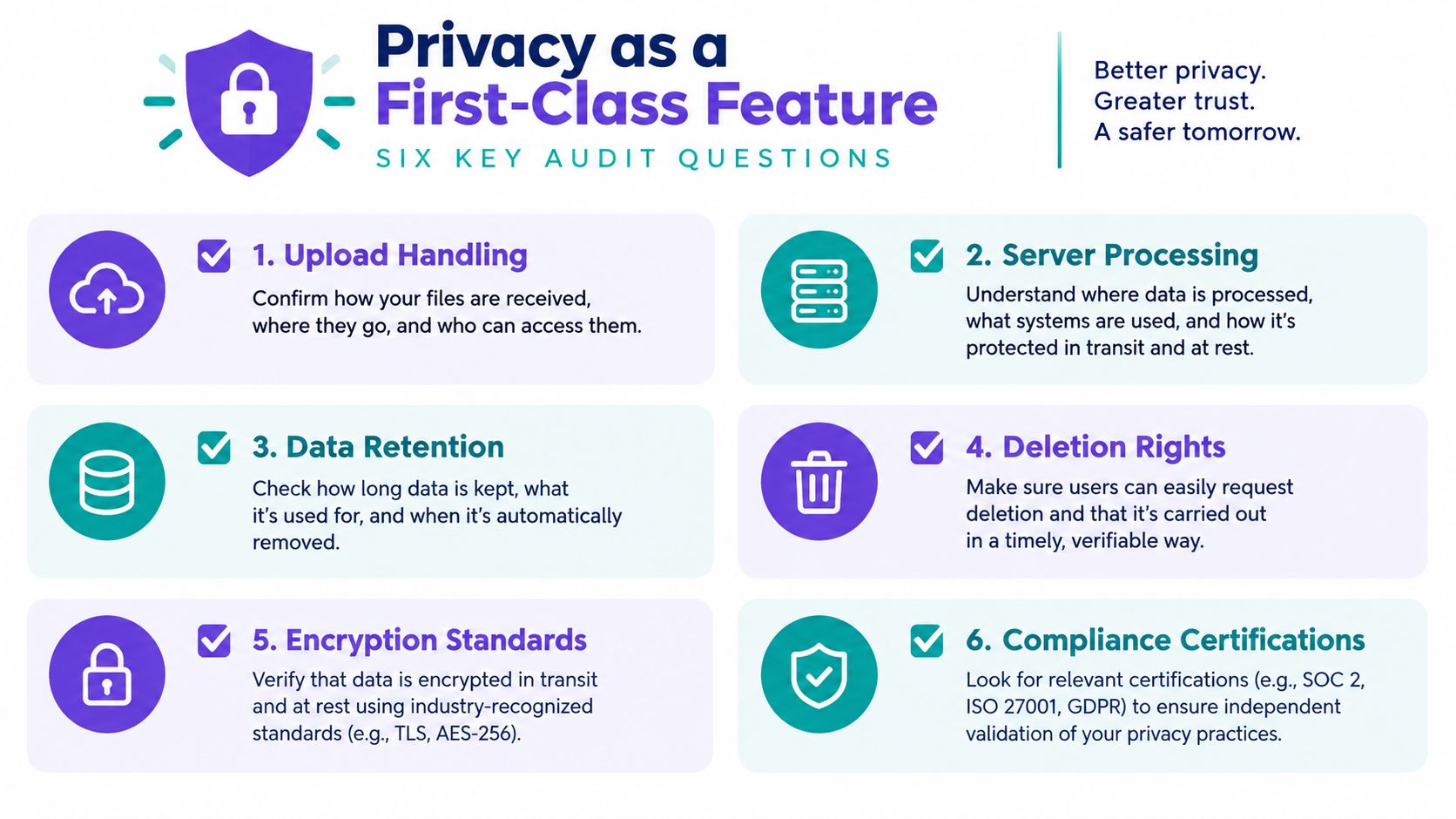
Six questions for any tool
- Where is the upload processed? Does the file stay in the browser, or does it travel to a server?
- Is the result cached? A temporary result can still become a stored copy if the policy doesn't explain deletion.
- How long is the content retained? Look for a clear retention period or a zero-retention commitment.
- Can you delete the data? Check whether deletion applies to uploaded files, derived features, logs, and account records.
- Is the content used for training? A tool should state whether customer material improves future models.
- Who can access the payload? Review third-party processors, abuse monitoring, support access, encryption, and compliance terms.
Account requirements matter too. A mandatory login links every scan to an identity and creates a record of what was checked, when, and potentially by whom. Enterprise APIs may offer stronger controls, but they can also log payloads for abuse prevention or operational debugging. Read the API terms instead of assuming that a private interface means private processing.
A useful example of transparent disclosure is a page explaining how we handle your data. The specific policy of every tool will differ, but the reader should be able to find concrete answers rather than broad assurances.
Privacy also affects future risk. If a vendor retains sensitive documents or uses them to retrain a model, the upload can expose unpublished work long after the original check. That makes privacy accuracy-adjacent. A tool that protects the evidence you're evaluating helps preserve the integrity of the evaluation itself.
Choosing a Detector You Can Trust
Choose an Originality AI detector by answering four questions before you compare dashboards or pricing pages.
What signal does it actually measure?
Text, images, and mixed media require different evidence. Ask whether the tool specializes in one modality, supports the language and file type you need, and publishes tests against current generators. A claimed accuracy figure means little without the dataset, false-positive information, and conditions behind it.
Who built and tested it?
Look for model provenance, methodology, benchmark details, and independent evaluation. Company testing can reveal useful product behavior, but peer-reviewed comparisons and adversarial benchmarks add a different kind of scrutiny. The RAID results, for example, are more informative because they specify the evaluation setting instead of presenting an unsupported universal promise.
Will it fit the workflow?
Check batch scanning, file limits, supported languages, API access, browser behavior, team permissions, export options, and account requirements. A tool can be technically impressive yet inconvenient if an editor can't review individual passages or a moderator can't process the formats arriving through a platform.
What happens to the file?
Review retention, training use, deletion rights, server location, encryption, and anonymous access. For image-focused work, AI Image Detector offers a privacy-first reference point: a user can upload a JPEG, PNG, WebP, or HEIC file up to 10MB, receive a confidence score and explanatory result, and use the core check without registration. Its stated workflow processes images in real time without storing them on servers, while accounts add history and workflow features.
Test any candidate with three deliberately different samples:
- A clearly human-made image or document.
- A clearly generated sample.
- A real sample that has been heavily edited, resized, paraphrased, or recompressed.
The third test is the one many buyers skip. It reveals whether the tool remains useful in the messy conditions where real investigations happen.
Using Detection as One Signal, Not a Verdict
A responsible verification workflow combines detection with provenance. For images, that can include C2PA manifests when available, reverse-image search, original-source confirmation, metadata review, and comparison with earlier versions. For text, it can include outlines, drafts, revision history, citations, interview notes, and a conversation about the author's reasoning.
Source checks should stay concrete. Who published the file? When did it first appear? Which account or organization supplied it? Does the alleged location match the weather, architecture, shadows, or other visible details? Does the writer understand the claims and references in the submitted work?
Match the response to the stakes
A casual question can justify a quick scan. A contested school submission or editorial claim requires a deeper review. A high-stakes decision involving discipline, employment, reputation, or publication needs independent corroboration and a documented opportunity for the person involved to respond.
The errors are asymmetric. A false positive can damage a student's record, a writer's reputation, or an artist's livelihood. A false negative usually means that a reviewer must continue checking. Because the consequences differ, a high score shouldn't trigger an automatic penalty.
Good authorship practice matters even when no detector is involved. Guidance on how to avoid plagiarism correctly helps writers document sources, distinguish their own reasoning, and preserve a credible process.
Human review remains the final filter: context, motive, consistency, provenance, and the creator's process all matter more than one isolated score.
Readers should also revisit their tools as generative systems change. A detector evaluated against yesterday's outputs may behave differently on tomorrow's models, new paraphrasers, mixed-authorship documents, or edited images. Re-test candidates with fresh samples and updated benchmarks at regular intervals, rather than treating an old accuracy claim as permanent.
For a deeper look at interpreting results, review this guide to AI detector accuracy. The sensible conclusion is not that detection is useless. It's that detection works best as one signal inside a chain of evidence.
AI Image Detector checks whether an image is likely human-made or AI-generated, returning a confidence score and explanatory indicators without storing uploaded images on its servers. Try the free core check for a suspicious photo, classroom submission, or creative asset by visiting AI Image Detector.


