

Unmasking the Machine: Your Guide to AI Human Detection

So, What Is AI Human Detection Really?
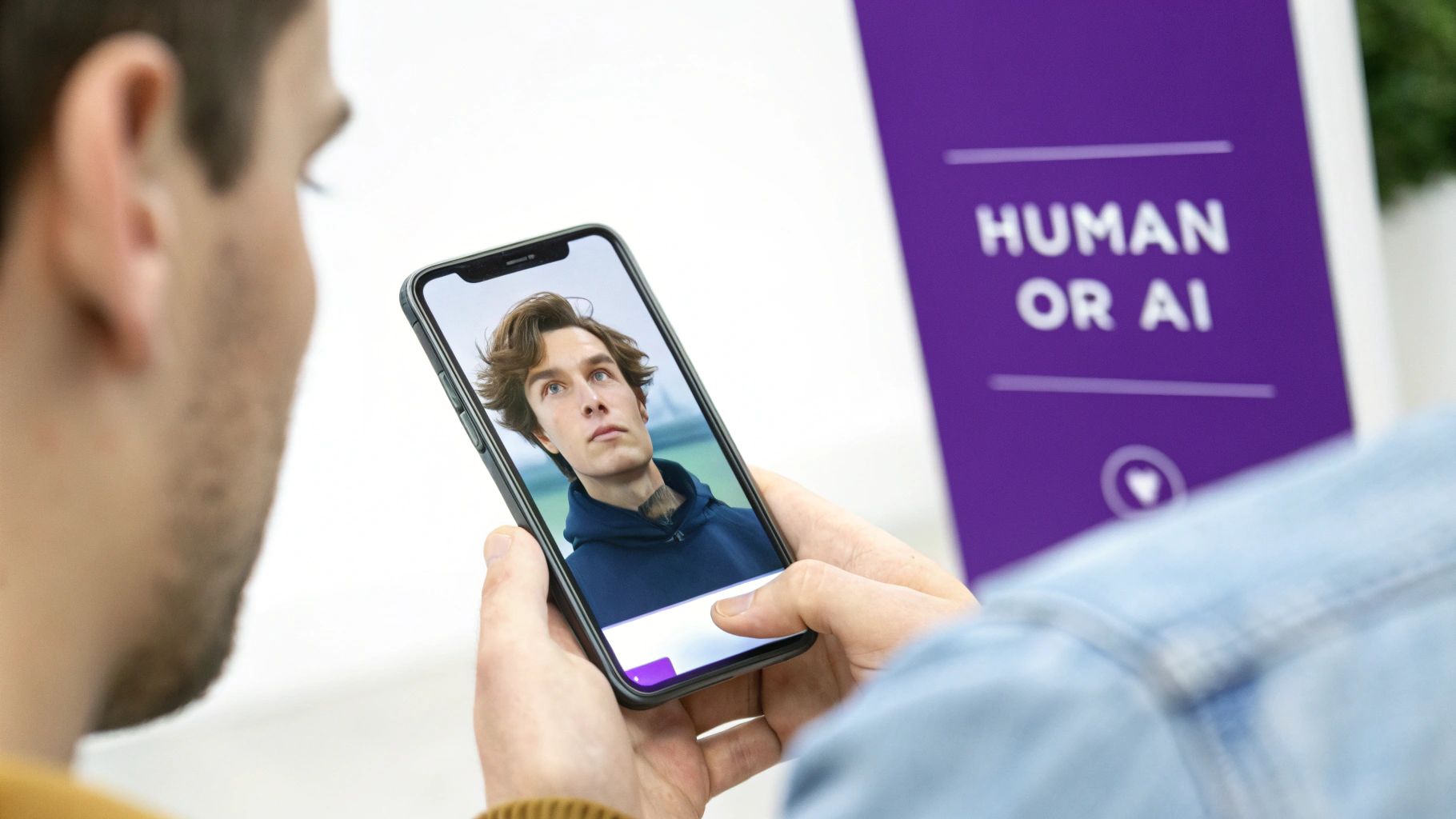
Ever seen a photo that just looked a little too perfect and wondered if a human actually took it? That's where AI human detection comes in. This isn't about spotting robots walking down the street; it's about teaching computers to be digital detectives.
Think of it like an art authenticator who can spot a forgery by noticing microscopic brushstrokes the average person would miss. These AI systems do something similar, analyzing images, text, and audio for the subtle, tell-tale "digital fingerprints" that generative AI models leave behind.
How It Works Under the Hood
At its core, AI human detection is a highly specialized classification system. It learns its craft by sifting through massive datasets filled with millions of examples—some created by people, others by machines.
During this intense training process, the model learns to pick up on the distinct patterns, textures, and tiny imperfections that give away each source. This groundwork allows it to make a remarkably educated guess when it encounters a brand new piece of content.
This technology is becoming critical in a few key areas:
- Building Trust: On social media, it helps platforms identify and flag synthetic media, which is a huge step in slowing the spread of misinformation and fake profiles.
- Protecting Creators: For artists and photographers, it's a way to verify the authenticity of their work and protect their intellectual property from being passed off as original.
- Upholding Integrity: In schools and newsrooms, it provides a vital check for AI-generated text or images, helping to maintain originality and credibility.
AI doesn’t just create; it creates with a signature. Detection models are trained to read that signature, whether it's hidden in pixel arrangements, lighting that doesn't quite make sense, or bizarre geometric patterns that defy real-world physics.
Why This Matters More Than Ever
Powerful generative AI tools have seriously blurred the lines between what's real and what's synthetic. Figuring out the difference is no longer just a technical puzzle for experts—it's a mainstream necessity for all of us.
As machine-made content becomes more common, our ability to verify authenticity is essential for keeping our digital world trustworthy. You can get a deeper understanding by reading our guide explaining what is AI generated content and its broader impact.
Getting a handle on how AI human detection works is the first step toward using these tools smartly and responsibly.
How AI Detectives Uncover Digital Fingerprints
Think of an AI detection model as a digital forensics expert. A real-world investigator might dust for fingerprints or analyze microscopic fibers at a crime scene. In the same way, an AI model hunts for subtle digital fingerprints—the tiny, often invisible patterns and artifacts that AI generators leave behind as a byproduct of how they work.
These aren't flaws you'd necessarily catch with a quick look. They're tell-tale signs buried deep within an image's data, revealing its synthetic origins. A proper AI human detection system is trained on millions of examples to spot these specific clues with startling precision.
The Telltale Signs of AI Creation
So, what exactly is this digital detective looking for? The evidence usually falls into a few key categories, each one a kind of signature of the generation process. These models learn to recognize these markers by studying massive libraries of both authentic and AI-generated content side-by-side.
One of the most common clues is unnatural pixel patterns. AI models build images from mathematical noise, a process that can create textures that are just a little too perfect, too smooth, or repetitive in a way that doesn't happen in the real world. Imagine a patch of sand or a close-up of skin where the texture repeats in a subtle but mathematically perfect way—that’s a huge red flag.
Another dead giveaway is inconsistent lighting. Human photographers and artists have an intuitive grasp of how light and shadow behave. An AI, on the other hand, might render an image where shadows fall in the wrong direction, a reflection in a window doesn't match its source, or multiple light sources seem to defy the basic laws of physics.
Looking Beyond the Obvious Clues
The investigation doesn’t just stop with pixels and light. The best AI human detection models dig deeper, analyzing more complex elements to build a solid case.
- Geometric Flaws: Pay close attention to the backgrounds of AI images. You’ll often spot strangely warped architecture, nonsensical perspectives, or objects that just kind of melt into each other in impossible ways.
- Anatomical Oddities: While AI is getting scarily good, it still fumbles details like hands (often with too many or too few fingers), eyes that don’t quite align, or faces that are unnervingly symmetrical.
- Artifacts and Noise: The generation process itself can introduce specific kinds of digital "noise" or compression artifacts that are different from those a real camera sensor would produce.
The core principle of AI human detection is simply pattern recognition on a massive scale. The model isn't "seeing" a fake image in the human sense; it's identifying a statistical probability based on thousands of tiny data points that all scream "machine-made."
This is what separates a powerful detector from just eyeballing it. To see how these concepts are put into practice, you can explore the features of a real-world AI detection tool and see how they analyze these digital footprints. The whole goal is to build a system that can reliably tell the difference between a human creator's touch and a machine's algorithmic output.
From Training Data to a Final Verdict
How does a model get so good at this detective work? It all boils down to its training. Developers feed the model two absolutely enormous sets of images: one containing millions of real photos taken by humans, and another packed with millions of images created by every AI generator out there.
During this training phase, the model pores over every single image, constantly tweaking its internal algorithms to get better at telling them apart. It learns the statistical signatures of a real camera lens, the beautiful chaos of nature, and the subtle imperfections that come with human creation.
At the same time, it memorizes the calling cards of AI generators—the overly smooth skin, the perfectly rendered but soulless eyes, and the tell-tale weirdness in the background. This constant comparison allows it to build a complex internal map of what looks "human" versus what looks "AI."
This intensive training is why modern detectors can often identify a synthetic image with such high accuracy. For a deeper dive into this fascinating process, you can learn more about how AI detectors detect AI and the technology that makes it all possible. When you upload an image for analysis, the detector isn’t just guessing; it’s running the digital fingerprints in your image against a massive library of evidence it has already studied, giving you a verdict based on cold, hard data.
How Accurate Are AI Detection Tools, Really?
When we talk about the accuracy of an AI human detection tool, it’s a bit like a car's top speed. The number on the spec sheet looks incredible, but that was achieved on a perfect test track. Out on the real road, with traffic, potholes, and bad weather, performance is a different story.
It’s the same with AI detectors. In a sterile lab environment, they can post amazing accuracy scores. But their real-world effectiveness can take a hit when dealing with the messy, unpredictable nature of the internet.
Things like heavy image compression, common on social media, can scrub away the subtle digital fingerprints that these tools rely on. Plus, AI image generators are constantly evolving, meaning detectors are in a perpetual cat-and-mouse game to keep up with the latest models.
False Positives vs. False Negatives
To get a true picture of accuracy, we have to look past a single percentage and understand two critical types of errors: false positives and false negatives. Getting your head around these is essential for using any AI detection tool responsibly.
- A false positive is when the tool incorrectly flags human-created work as AI-generated. This is a big deal. It can unfairly tarnish the reputation of an artist or photographer, leading to false accusations of dishonesty.
- A false negative is the opposite: an AI-generated image slips through the cracks, passing as human-made. This error allows sophisticated deepfakes and synthetic media to spread, eroding trust and causing real harm.
Finding the perfect balance is tricky. A tool that’s too aggressive will have a high rate of false positives, while one that’s too cautious will miss more AI content. We dig deeper into this balancing act in our guide on whether AI detectors are accurate.
The Gap Between the Lab and Reality
The performance drop from the lab to the real world is no small thing. Research from 2023–2024 shows that while many commercial AI systems claim accuracy rates above 90% in controlled tests, their performance plummets when analyzing content "in the wild."
For example, some deepfake video detectors that hit over 90% accuracy on pristine test data fell into the 60–80% range—or worse—when faced with videos that were compressed or intentionally modified.
This diagram shows some of the tell-tale visual clues—like weird pixel patterns, unnatural lighting, and bizarre geometry—that detection models are trained to spot.

A tool’s ability to consistently find these flaws, even after an image has been saved, shared, and compressed, is what separates a reliable detector from an unreliable one.
The goal of an AI detector isn't to be an infallible judge. Think of it as a powerful assistant. It gives you a data-backed probability, empowering you to make a more informed final decision—not a final verdict to be accepted without question.
Because of this performance gap, it’s crucial to treat detection results as a strong signal, not as undeniable proof. These tools add a vital layer of scrutiny, but they are most effective when paired with human critical thinking. Always consider the context and what’s at stake before drawing a conclusion. This balanced approach helps you use the power of AI human detection without being tripped up by its limitations.
Where AI Human Detection Is Making an Impact

The real test of any technology isn't how it works, but what problems it solves. While the mechanics of AI human detection are impressive, its practical uses are what truly shape our digital lives. This tech is quickly becoming a critical layer of verification everywhere, from keeping social platforms safe to protecting creative professionals.
Think about the torrent of content hitting a platform like Instagram or X every single minute. It's an impossible workload for human moderators. This is where AI detection acts as the first line of defense, scanning for synthetic media used to push disinformation or create armies of fake accounts.
By automatically flagging images that have the tell-tale signs of AI generation, platforms can pump the brakes on harmful narratives, shield users from sophisticated scams, and maintain a more trustworthy ecosystem. It's not about censorship—it's about adding a label that says, "this might not be what it appears to be."
Upholding Integrity in Academia and Beyond
Academic integrity is another field where AI detection has become a must-have. With incredibly powerful AI tools that can write essays and generate images just a click away, educators are scrambling to ensure students are still building their own critical thinking skills.
AI human detection tools give instructors a way to check if student submissions contain AI-generated content. This helps maintain academic standards and fosters an environment of genuine learning. It’s less of a "gotcha" tool and more of a catalyst for discussing the ethical use of technology in education. At the end of the day, the goal is to protect the value of original thought.
This need for verification isn't just for the classroom; it extends right into the professional world. For a concrete example of how AI analyzes human-related data to drive decisions, check out this case study on real-time AI applications in recruitment.
AI detection is less about catching cheaters and more about preserving authenticity. Whether in a newsroom, a classroom, or a courtroom, the ability to verify the origin of digital media is fundamental to trust.
Protecting Creative and Financial Assets
For artists, photographers, and designers, their work is their livelihood. The explosion of AI image generators poses a real threat, as their unique styles can be mimicked in seconds, devaluing their entire portfolio. AI human detection offers a sort of digital watermark, helping prove the authenticity of an original piece.
This capability is a game-changer for:
- Copyright Protection: Creators can use detection results as evidence to defend their intellectual property from infringement.
- Marketplace Trust: Online art marketplaces can integrate these tools to assure buyers they are purchasing genuine, human-created art.
- Brand Integrity: Companies can ensure that user-submitted content tied to their brand is authentic, not synthetic.
In finance, the stakes are even higher. Scammers are now using AI-generated faces to create fake IDs to get past identity verification systems—a tactic known as "deepfake fraud." Financial institutions are fighting back by deploying AI human detection to analyze ID photos and spot the subtle giveaways of a synthetic identity. This adds a crucial security layer to stop account takeovers and financial theft, protecting both the bank and its customers.
AI Human Detection Applications Across Industries
As generative AI becomes more and more common, the applications for AI human detection continue to grow. The table below offers a quick snapshot of its impact across different sectors.
| Industry | Problem Solved | Primary Benefit |
|---|---|---|
| Social Media | Disinformation & Fake Profiles | Increased Platform Trust & Safety |
| Academia | AI-Generated Assignments | Upholding Academic Integrity |
| Finance | Synthetic Identity Fraud | Enhanced Security & Fraud Prevention |
| Creative Arts | Intellectual Property Theft | Protection of Original Work & Copyright |
| Digital Forensics | Verifying Digital Evidence | Ensuring Authenticity of Evidence |
| Journalism | Authenticating Source Images | Combating Fake News & Misinformation |
From confirming that a photo submitted as evidence in court is legit to helping a news outlet verify a viral image before publishing, the applications are as diverse as they are critical. Our world is becoming saturated with machine-generated content, and the ability to ask, "Is this real?" and get a data-driven answer is no longer a luxury—it’s a necessity. This makes AI human detection a foundational technology for building digital trust.
Navigating the Ethical Minefield of AI Detection
AI image detectors are an incredible defense against the flood of synthetic media, but they aren't a silver bullet. They bring a whole new set of ethical challenges to the table, and in a world where one wrong call can have huge consequences, we have to be careful. Wielding this kind of power means we have a serious responsibility to get it right.
The most glaring problem is the false positive—when the algorithm slaps an "AI-generated" label on a piece of authentic, human-made art. For a photographer, graphic designer, or digital artist, this isn't just a technical glitch. It can get you kicked out of competitions, booted from online platforms, and do real damage to your professional reputation, all because an algorithm made a mistake.
The Hidden Bias in the Code
These mistakes aren't always random, either. They often come from hidden biases cooked right into the model's training data. If a model is trained almost exclusively on art from Western cultures, it might get confused when it sees art with different cultural styles or aesthetics, unfairly flagging artists from underrepresented backgrounds.
This can create a chilling effect where certain creative styles are more likely to get flagged, which stifles artistic freedom and puts up unfair barriers. An AI might learn to associate hyper-realistic paintings or certain abstract patterns with AI generation, not because they are, but because its limited training data created that connection. The system ends up punishing human creativity it wasn't trained to recognize.
An algorithm is only as good as the data it’s fed. If that data isn't diverse, the detector develops blind spots and starts mistaking unique human expression for the signature of a machine.
Privacy and the Rise of Algorithmic Authority
Beyond just getting it wrong, the very act of using these detectors raises big questions about privacy. To work, platforms have to scan and analyze every single image people upload. This opens up a can of worms about data ownership and consent. Do people even know their personal photos and creative projects are being put under an algorithmic microscope?
This brings us to an even bigger issue: algorithmic authority. When we let an automated system become the final judge of what's real and what's not, we start to sideline human expertise and critical context.
Here are some of the tough questions we all need to ask:
- Transparency: How much should companies reveal about how their detectors work? People deserve to understand why a decision was made, not just be handed a score.
- Accountability: When the detector messes up, who’s on the hook? The platform? The tool's developer? Or is it the artist who has to clean up the mess?
- Avenues for Appeal: Is there a straightforward way for a real person to challenge the machine's verdict? Without a fair appeals process, people are left with no way to fight back against an error.
Ultimately, handling these ethical issues means we have to build and use these tools responsibly. It requires constant checks for bias, being upfront with users about how the tech works, and creating clear rules to ensure the hunt for authenticity doesn’t trample all over fairness, privacy, and creative expression. The goal should be to build tools that support human judgment, not replace it without any oversight.
Putting AI Detection to Work Responsibly

Rolling out an AI human detection tool isn't just a technical task; it requires a real strategy. It’s easy to think of it as a plug-and-play fix, but doing it right means building a system that fosters trust and verifies content without unfairly penalizing creators based on an algorithm's guess.
The whole point is to add a layer of verification, not to create a rigid gatekeeper. Success starts with being completely upfront about what the tool can and can't do. Whether you're plugging an API into your platform or just using a tool internally, you have to avoid presenting the results as gospel.
Embrace Probabilities Not Absolutes
Here’s one of the biggest mistakes I see: using binary, all-or-nothing labels like "AI" or "Human." These kinds of definitive verdicts are not just misleading—they’re often wrong. They completely ignore the reality of mixed-media content and the simple fact that every tool can make a mistake.
A much smarter, more responsible approach is to lean into confidence scores.
Think about the difference between a flat "AI-Generated" flag and a result that says, "85% confidence of being AI-generated." The second one provides crucial context. It frames the tool’s output for what it is: a statistical assessment, not a final judgment. This simple shift empowers your team to use the score as a data point, combining it with their own critical thinking.
A confidence score transforms the tool from an intimidating judge into a helpful assistant. It provides a strong data point that informs a final decision rather than making the decision for you, which is the cornerstone of responsible implementation.
Building a Fair and Effective Workflow
The best AI human detection systems never rely on just one signal. To get a truly accurate picture, you need to build a workflow that pulls from multiple sources and always keeps a human in the loop.
Here are a few best practices to consider integrating:
- Multi-Signal Analysis: Don't stop at the image analysis. Look at the metadata. Check the user’s history. Consider the context where the image appeared. All of these are clues that help build a stronger case.
- Establish a Clear Appeals Process: No detector is perfect, period. You absolutely must have a simple, clear way for users to appeal a flag if they feel their work was misidentified. This isn't just about being fair; it builds trust and provides an essential human check on the whole system.
- Commit to Continuous Updates: The models that generate AI images are evolving at a dizzying speed. Your detection tools have to keep up. Make sure you’re working with a provider who is constantly updating their models to spot the newest generation techniques.
By combining clear communication, probabilistic scoring, and a human-centric workflow, you can use AI human detection both effectively and ethically. It's an approach that focuses on building trust, not just deploying the latest tech.
Common Questions About AI Detection, Answered
Let's tackle some of the most common questions people have about AI human detection. My goal here is to give you straightforward answers, cutting through the noise.
Can AI Detection Tools Be Fooled?
Yes, they absolutely can be. Think of it like a cat-and-mouse game. While the best detectors are very good at spotting unaltered AI images, they aren't foolproof.
Things like "humanizer" tools, or even simple digital filters and manual Photoshop edits, can throw a detector off the trail. This is precisely why you should treat a detection result as a strong signal, not as a final, unchallengeable verdict.
Are These Detectors 100% Accurate?
No tool is perfect, and anyone who claims 100% accuracy is selling you a fantasy. The top-tier detectors are excellent at minimizing mistakes, but they will never be flawless.
An image's origin (was it made with Midjourney or a less common model?) and any later edits can impact the result. That's why credible platforms give you a confidence score—like "85% Likely AI-Generated"—instead of a binary "yes" or "no."
It’s critical to see AI detection for what it is: a game of probabilities, not certainties. The tool is there to support human judgment with data, not to make the final call on its own. A low false-positive rate is often the most important metric, as it prevents wrongly flagging human work.
Is It Legal To Use an AI Image Detector?
In most cases, yes. Simply analyzing an image with a detector is perfectly legal—it's no different than using a search engine to find information about a picture.
The legal and ethical lines get blurry with what you do with that information. Accusing someone of fraud or cheating based only on a detector's output, without any other proof or a proper review, is a recipe for trouble. Always use these tools as one part of a larger investigation.
Can a Detector Pinpoint Which AI Model Made the Image?
This is the next frontier, but we're not quite there yet. Some of the most advanced detection models are starting to experiment with identifying the source generator (like telling Midjourney apart from DALL-E 3).
However, this isn't a standard feature. For now, most tools are laser-focused on the primary question: was this made by a human or a machine? Differentiating between specific AI models is a much tougher challenge that the industry is still working to solve.
Ready to check your images with a tool you can trust? The AI Image Detector provides fast, free, and completely private analysis. You get the insights you need to tell human-created content from AI-generated fakes, and your images are never stored on our servers. Get your results in seconds.


