

Unlock ai image manipulation: How It Works for Creative Professionals

At its most basic, AI image manipulation is simply using artificial intelligence to create or alter digital pictures. But that simple definition doesn't quite capture the seismic shift this represents. Instead of painstakingly using manual tools in software like Photoshop, AI-powered systems can now understand and change visual content based on simple text commands. It's like having a professional photo editor on call, ready to execute complex tasks instantly.
What Exactly Is AI Image Manipulation
Think of it this way: traditional photo editing is like a sculptor carefully chipping away at a block of marble. You can refine, polish, and perfect what’s already there, but you’re working with the original material. AI image manipulation, on the other hand, is like being handed a magical lump of clay that can reshape itself into anything you can imagine with just a few words.
This technology doesn’t just tweak brightness or crop the edges of a photo. It can fundamentally reconstruct reality within the frame. It’s capable of adding objects that were never there, seamlessly removing people from a crowded street, or even generating an entirely new, photorealistic scene from scratch.
The Brains Behind the Magic
So, how does it work? At its core, an AI model learns visual concepts by analyzing millions upon millions of images scraped from the internet. It doesn't "see" a cat the way you or I do. Instead, it recognizes a complex web of patterns—the statistical relationships between pixels that form the shapes, textures, and colors we associate with the word "cat." This massive dataset becomes its creative library.
When you give an AI a prompt like, "add a smiling golden retriever to this park photo," it taps into that vast knowledge base. It generates new pixels that match its understanding of a "golden retriever" and then intelligently integrates them into your original image, even attempting to match the existing lighting and shadows. The whole process follows a few key steps:
- Understanding Your Request: The AI first has to parse your text prompt to figure out what you want to change.
- Accessing Its Knowledge: It then pulls from its training data to find the right visual patterns for your request.
- Generating New Pixels: The model creates the new visual data from scratch based on those patterns.
- Blending and Integrating: Finally, it seamlessly blends the new elements into the original photo, doing its best to make the final result look natural.
A Tool with Two Faces
This kind of power opens up incredible doors for creativity. Artists can bring fantastical worlds to life in minutes, and marketing teams can whip up stunning product shots without ever booking a photo shoot. But that same power carries some pretty significant risks. The technology used to create a beautiful piece of art can just as easily be used to generate convincing fake news images, fraudulent documents, or dangerously misleading social media posts.
The rise of AI that can generate images has heightened concerns about image integrity. This technology can corrupt research results, undermine society’s trust, and even endanger people if misused.
Understanding this dual nature is absolutely critical. As AI image manipulation tools become more widespread, the ability to spot the difference between an authentic photo and a generated one is no longer just a niche technical skill—it’s becoming an essential part of modern digital literacy.
To get a better handle on the foundational tech, check out our guide on photo recognition software, which breaks down how machines learn to see and interpret visual data in the first place. This concept is the key to both creating and detecting manipulated images.
A Look at Common AI Image Manipulation Techniques
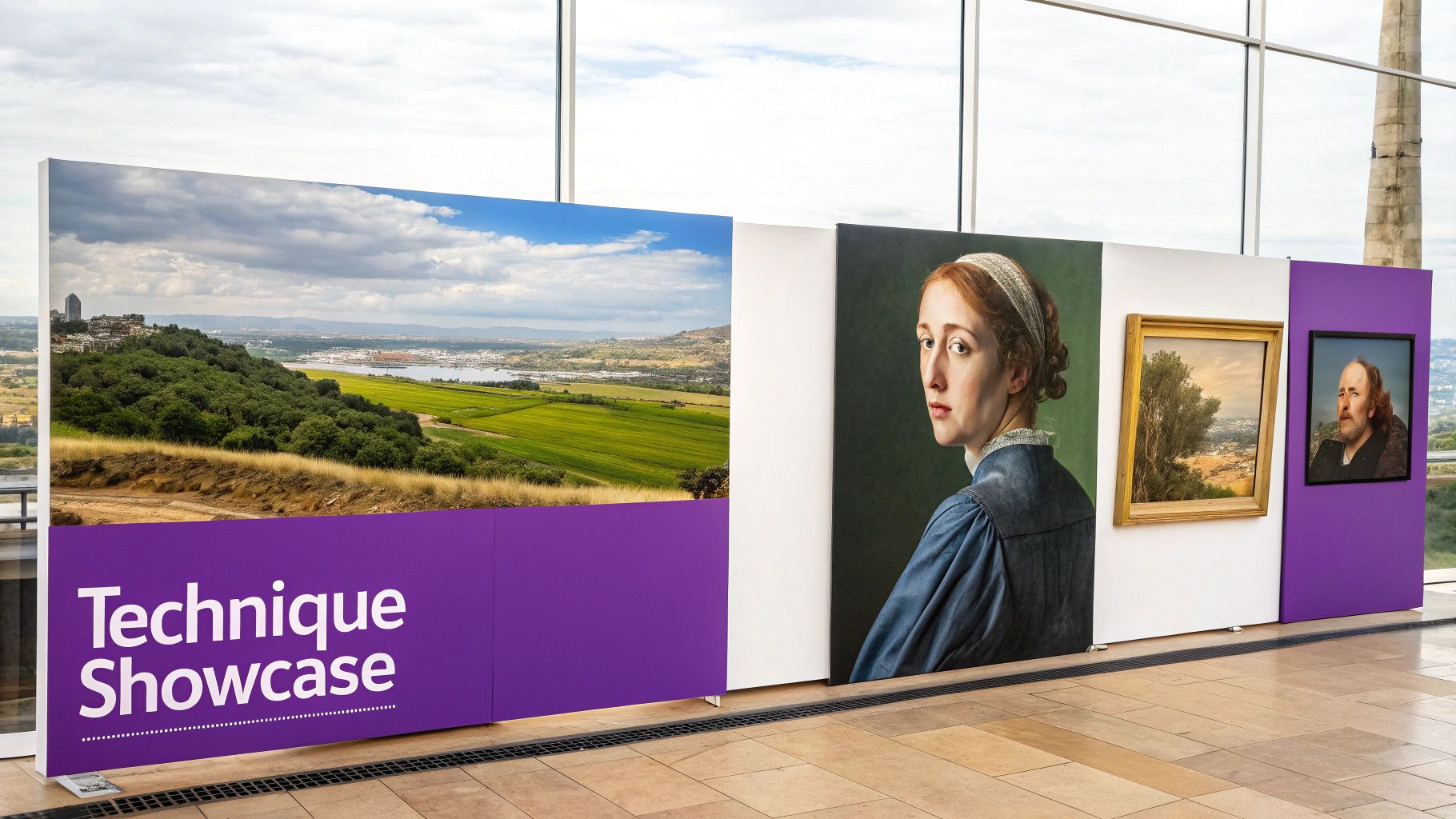
While AI image manipulation might sound like a single, complex concept, it’s really a collection of distinct digital tools. Each one is built for a specific task, whether it’s for creative expression or something far more deceptive.
Getting to know these core techniques is the first step in building a mental toolkit for spotting synthetic media. Instead of one big "edit" button, AI models use specific processes to alter images, and each one tends to leave its own unique digital fingerprints. Let's break down the most common methods you're likely to see.
Adding and Removing Content
One of the most frequent uses of AI is simply adding something to a photo that wasn't there or making something disappear. This is where you’ll hear terms like "inpainting" and "outpainting."
Inpainting works like a super-smart magic eraser. You can highlight an unwanted object in a picture—say, a stray coffee cup on a table or a person in the background of a landscape—and the AI fills in the gap. It analyzes the surrounding pixels to generate a background that looks like it belongs there.
Outpainting does the exact opposite. It expands an image beyond its original frame. Got a great portrait but wish it was a wider shot? An outpainting tool can invent the rest of the scene, creating a complete picture from a small fragment.
These features are fantastic for cleaning up photos, but they also open the door to removing crucial context from a news event or adding misleading objects into a scene.
Transforming Styles and Blending Realities
AI can go much further than just adding or removing objects. It’s also incredibly good at completely changing an image’s look or merging different photos into one seamless composition.
AI-generated imagery isn't just about creating fakes; it's about a new form of visual synthesis. The same technique that can create a beautiful piece of art can also be used to blend a real person’s face onto another body.
This is the world of style transfer and deepfakes.
Style Transfer Ever wanted to see a photo of your house painted in the style of Monet? That’s style transfer. An AI model separates the "content" of your photo (the house) from the "style" of another image (the painting) and then applies that style to your content. It’s a popular tool for digital artists and advertisers looking for a unique aesthetic.
Deepfakes The term deepfake, a mashup of "deep learning" and "fake," usually refers to swapping one person's face onto another's body. An AI is trained on images and videos of two people until it learns their unique facial expressions and mannerisms. It can then convincingly map one face onto the other in a new video or photo. While there are harmless uses in satire and entertainment, this is the technique most often linked to malicious misinformation and identity fraud.
To help clarify how these methods differ, here’s a quick breakdown of what to look for with each one.
Comparing Common AI Manipulation Techniques
This table outlines the purpose, application, and potential tell-tale signs of the most common AI image manipulation methods.
| Technique | Primary Purpose | Typical Use Case | Potential Red Flags for Detection |
|---|---|---|---|
| Inpainting | Removing objects | Erasing distracting elements from a photo, like a person in the background or a blemish. | Unnatural smoothness, blurry patches, or mismatched textures where the object was removed. |
| Outpainting | Expanding an image | Creating a wider scene from a cropped photo, like extending a landscape or finishing a portrait. | Repetitive patterns, illogical background elements, or inconsistent lighting at the new edges. |
| Style Transfer | Applying an artistic style | Making a photograph look like a painting by a famous artist or adopting a specific graphic style. | Distortions in fine details, unnatural textures, and a "painted-over" look on realistic objects. |
| Deepfakes | Swapping faces or bodies | Creating parody videos, placing actors in historical footage, or creating malicious fake content. | Uncanny valley effect, mismatched skin tones, flickering around the edge of the face, and unnatural blinking. |
Understanding the artifacts each technique can produce is key. While AI is getting better at covering its tracks, these subtle inconsistencies are often the first clue that an image isn't what it seems.
How AI Image Manipulation Is Changing the Business World
AI-powered image tools are doing a lot more than just creating fun filters and artistic experiments. They've become a serious economic force, completely changing how companies create, market, and sell their products. From small online shops to massive global brands, businesses are using this technology to gain a real competitive edge, and it's causing huge shifts in how they work and where they spend their money.
At its core, this tech lets businesses produce incredible visual content at a speed and scale that was once unthinkable. Think about what used to go into a professional photoshoot—expensive equipment, elaborate sets, and whole teams of designers. Now, a lot of that can be done with a few simple text prompts, slashing production times and costs. This isn't just a minor improvement; it's a complete overhaul of old-school operations.
The New Engine of E-Commerce and Marketing
Take the e-commerce world, for example, where great product photos can make or break a sale. In the past, creating lifestyle shots for a new product meant hiring models, scouting locations, and spending hours on editing. Today, an AI can drop a single product photo into hundreds of different realistic scenes in just a few minutes.
A furniture company can instantly show its new sofa in a sleek city apartment, a cozy cabin in the woods, and a modern office—all without the sofa ever leaving the warehouse. This opens the door to hyper-targeted ad campaigns, where the visuals are perfectly matched to different customer groups, boosting engagement and sales. Just a few years ago, that level of personalization was way too expensive for most businesses.
The power to create endless visual variations means marketing teams are no longer held back by tight budgets or deadlines. They can test different ad creatives constantly, see what works in real-time, and get a much better return on their investment.
This widespread business adoption is fueling a massive market. The global AI Image Editor Market shows just how seriously companies are taking these tools. Valued at USD 88.7 billion in 2025, the market is expected to explode to USD 229.6 billion by 2035, growing at a steady 10.0% each year. Big companies are leading the charge, already making up 42.3% of the market, primarily because AI helps them cut their operational costs so dramatically. You can dig deeper into these numbers in the full AI image statistics report.
More Than Just Advertising
But the impact of AI image manipulation goes far beyond the marketing department. It's shaking things up in industries from real estate to entertainment.
- Real Estate: Agents are using AI for virtual staging. They can digitally furnish empty properties, helping buyers see the potential of a space without the cost and hassle of moving real furniture.
- Fashion: Designers can create lifelike mockups of new clothing on different models, letting them test out ideas before ever cutting a piece of fabric.
- Entertainment: Film and game studios lean on AI to generate concept art, detailed backgrounds, and other visual assets, which speeds up the entire creative process.
This deep integration means that synthetic and heavily edited images are becoming standard-issue business assets. They're no longer a rarity but a common part of the visual world we interact with every day. Understanding this shift is crucial. The challenge isn't just about spotting a few fakes designed to deceive people; it's about learning to navigate a new reality where commercially produced synthetic images are everywhere. For journalists, researchers, and even casual consumers, this makes reliable detection tools an essential part of figuring out what's real and what's not.
Uncovering Misuse and Deception
AI image tools are amazing for creativity and business, but they have a serious dark side. The very same technology that can dream up a stunning ad campaign can also be twisted to spread convincing lies, pull off sophisticated scams, and chip away at public trust. When these tools are used with bad intentions, a creative asset quickly becomes a dangerous weapon.
This isn't some far-off problem; it's happening right now. The barrier to creating hyper-realistic fake images has crumbled. Just about anyone with a computer can now generate visuals that are incredibly difficult to distinguish from reality, making it easier than ever to push false stories, tamper with evidence, or impersonate people.
For anyone whose job depends on the truth—journalists, lawyers, educators—this is a massive challenge. "Seeing is believing" no longer holds up, and finding a trustworthy way to verify what we see is now an urgent, critical need.
The Rise of AI-Powered Fraud and Misinformation
The weaponization of AI image manipulation is most obvious when you look at financial scams and disinformation campaigns. Criminals are leaning heavily on AI-generated images to create fake identities, forge documents, and build elaborate schemes to trick people out of their money.
A classic tactic is creating a fake social media profile with an AI-generated headshot. These profiles look completely real and are used to build trust before launching into a romance scam, investment fraud, or phishing attack. We’re also seeing deepfake technology used in corporate fraud, where a video of an executive is faked to authorize a huge wire transfer, costing companies millions.
The cybersecurity numbers tell a grim story. A shocking 32% of business leaders say their AI applications have been attacked through prompt manipulation. On top of that, 62% of organizations have faced deepfake attacks, often as part of social engineering schemes or attempts to fool biometric security. These attacks are happening globally, hitting high-stakes industries in the US, Europe, and Asia, proving that AI-generated imagery is now a powerful tool for deception. You can find more details on these AI-driven cybersecurity threats.
Real-World Examples of Malicious Use
The ways deceptive AI images are being used are incredibly varied, affecting everything from personal reputations to court cases. Seeing these scenarios makes the threat feel much more real.
Political Disinformation: AI-generated images of political figures in fake, compromising situations pop up all the time, especially around elections. They spread like wildfire on social media, often going viral long before anyone has a chance to fact-check them.
Evidence Tampering: In a legal battle, a manipulated photo could be submitted as "evidence" to push a false story. An AI-altered image might wrongly place someone at a crime scene or create fake proof of damage for an insurance claim.
Brand Sabotage: Unscrupulous competitors can use AI to create fake images of a rival's faulty products or unsafe business practices, causing instant and often lasting damage to their reputation.
These examples point to a fundamental change. In the past, you needed serious skills and expensive software to create a convincing fake.
Today, the democratization of AI image manipulation means that sophisticated visual deception is accessible to almost anyone. This dramatically increases the volume and velocity of fake content online, overwhelming traditional verification methods.
Why Detection Is an Essential Defense
In this new reality, relying on gut feelings or a quick visual check just won't cut it anymore. The quality of AI-generated images is getting better at a breakneck pace, and the latest models can produce fakes that fool even a trained professional. This is why automated, technology-driven detection has become a non-negotiable tool.
For a journalist, an AI detection tool is that final, crucial check that can prevent the publication of a fake, reputation-destroying photo. For a legal team, it offers a solid, technical reason to question the authenticity of digital evidence. For the trust and safety teams at social media platforms, it provides a scalable way to find and remove harmful content before it spreads to millions.
Ultimately, fighting the misuse of AI image manipulation demands a proactive defense. It means building a process that starts with the assumption an image could be fake until it's proven authentic, and using reliable tools to make that call quickly and confidently.
How to Detect AI Manipulated Images
As AI image manipulation gets more sophisticated, telling a real photo from a fake one is becoming a vital skill. It’s not about guesswork; it’s a two-step process that combines sharp human observation with powerful technology. The good news is, you can train yourself to spot the tell-tale signs AI models often leave behind.
This chart breaks down the simple, yet effective, path of AI deception. It starts with the manipulation, moves to deployment online, and ends with the goal: deceit.
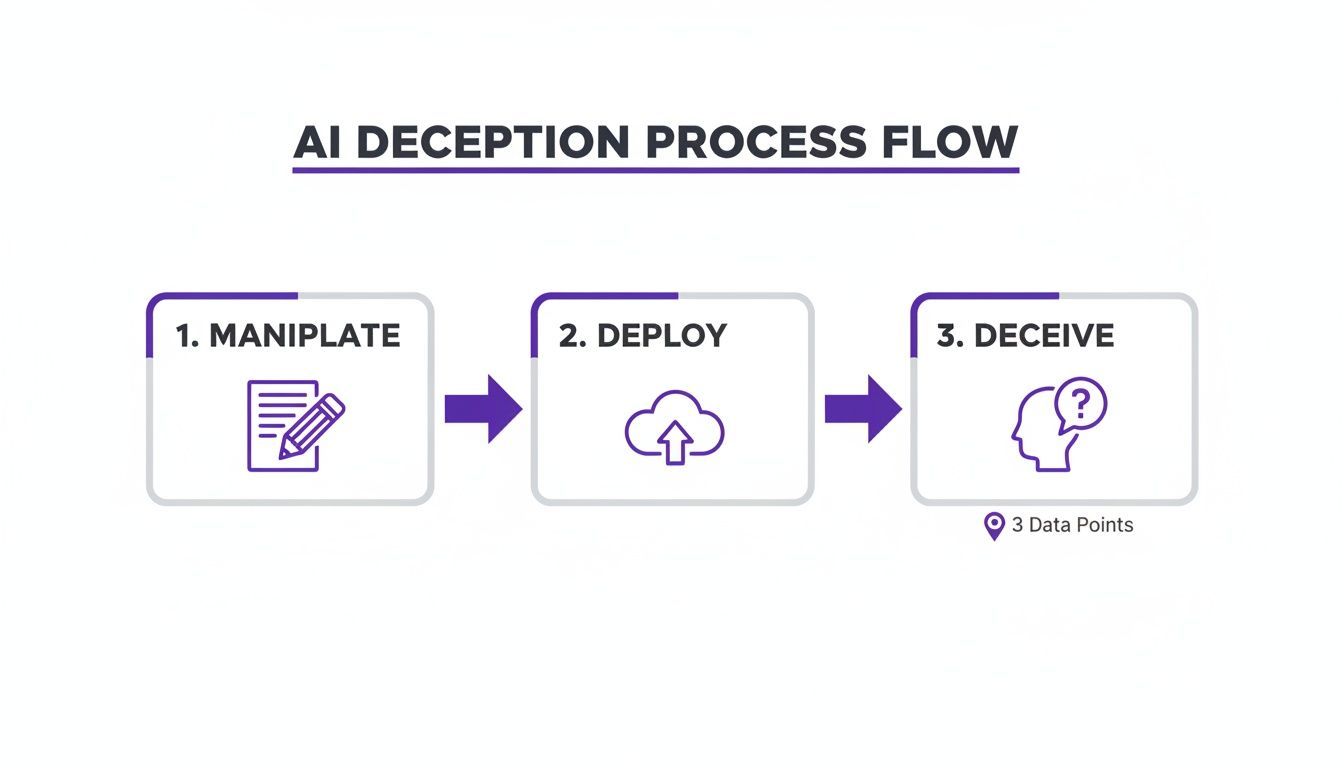
It’s a stark reminder of how easily a manipulated image can be used to mislead people, making detection a critical line of defense.
Training Your Eyes to Spot the Signs
Before you even think about using software, your own eyes are the first and most important tool. AI generators, for all their power, still fumble the small details we instinctively understand. Knowing what to look for can help you flag a suspicious image in seconds.
Start with the people. AI has a famously hard time with hands. You'll often see extra fingers, melted-together digits, or just plain bizarre shapes. Look for other strange anatomical details, too—limbs that seem too long, mismatched earlobes, or teeth that look like a single, uniform strip.
Next, zoom in on textures and surfaces. AI-generated skin can look unnaturally smooth, almost like plastic, missing the pores and tiny imperfections of real life. Hair is another dead giveaway; look for strands that blend weirdly into the background or have a flat, painted-on appearance.
The most convincing AI images often fail on the small details. Inconsistencies in shadows, garbled text on background signs, or reflections that don't match the environment are classic red flags that something is amiss.
Here are a few common visual artifacts to keep an eye out for:
- Shadow and Light Mismatches: Do the shadows make sense with the light sources? AI often messes up lighting, casting shadows that defy physics.
- Garbled Text: Check any text on signs, shirts, or books in the background. It’s often a jumble of nonsensical characters. The AI knows what text should look like, but it can’t actually read or write.
- Pattern Repetition: Look for unnatural repetition in things like brick walls, wood grain, or fabrics. Sometimes, an AI will just copy and paste the same small texture over and over.
- Uncanny Valley Effect: Does something just feel… off? If a face or an expression seems subtly unnatural or soulless, trust your gut. That feeling is often a sign of a synthetic image.
Using Automated Tools for a Deeper Look
A quick manual check is a great first step, but the most advanced AI images can fool even a seasoned expert. This is where automated detection tools come into play. These tools are built to see the invisible digital fingerprints that our eyes can't.
Tools like the AI Image Detector go beyond the surface, analyzing an image's hidden data for patterns and artifacts that scream "AI." It can spot subtle pixel-level weirdness, compression artifacts, and other statistical giveaways that expose an image's artificial origins.
This process gives you a clear, data-driven answer, often with a confidence score that helps you quickly verify whether an image is authentic. These tools aren't just looking for six-fingered hands; they run on complex algorithms trained on millions of real and AI-generated images. This allows them to spot the unique digital signatures left behind by different AI models.
If you're serious about verification, learning more about the process of analysing a photo with the right software is a critical next step.
By combining your own trained eye with the analytical power of an automated tool, you create a much stronger verification workflow. This dual approach gives you the confidence to navigate a visual world where seeing isn't always believing, protecting yourself from the very real threat of AI-driven deception.
Building Your Ethical Best Practices
Knowing how to spot a fake image is a critical technical skill, but understanding how to use AI image manipulation tools responsibly is just as important. For professionals in any field, having a clear ethical framework is no longer a "nice-to-have"—it's an absolute necessity for keeping trust. Without some ground rules, the line between creative enhancement and outright deception gets dangerously thin.
This isn't a call to ban the technology. It's about building smart, responsible habits that put integrity and transparency first. Whether you're a journalist vetting a source, a teacher grading a project, or a marketer designing a campaign, your decisions now carry the weight of this new reality.
A Framework for Journalists and Fact-Checkers
If you're in the media, the stakes couldn't be higher. A single unverified image can torpedo credibility and pour fuel on the fire of misinformation. A modern verification workflow has to be tough and layered.
Before any potentially sensitive image goes to print or online, journalists should:
- Mandate Disclosure: Insist that sources tell you if AI tools were used to create or alter an image. Make it a non-negotiable part of the submission process.
- Conduct Technical Scans: Make it standard procedure to run all user-submitted or questionable images through a reliable AI detection tool.
- Perform Visual Audits: Don't just trust the machine. Manually inspect images for the classic red flags—weird hands, garbled text, wonky lighting—even if a tool gives it the all-clear.
- Seek Corroboration: An image should never be the only proof for a story. Always hunt for separate, independent evidence that backs up what the image claims to show.
Guidelines for Educators and Academic Institutions
In the classroom, AI-generated images pose a two-sided problem: upholding academic honesty while teaching digital literacy. Educators have to tackle both. The first step is creating clear policies that spell out what’s an acceptable use of AI for a visual project versus what counts as plagiarism or cheating.
This challenge is also a massive teaching opportunity. Instead of just banning AI tools, instructors can design assignments where students have to critically analyze, detect, and ethically label AI-generated media. They'll build skills they'll actually need for the rest of their lives.
This hands-on approach helps students grasp the technology's power and its potential for misuse, turning them into sharper, more discerning digital citizens.
Best Practices for Creators and Businesses
For companies and creative professionals, it all comes down to one word: transparency. Using AI to generate incredible marketing visuals is a fantastic tool, but you can't mislead your customers. Being upfront is the only way to build and keep their trust.
Here are a few essential practices to live by:
- Label Synthetic Images: If an ad or promotional image is partly or fully AI-generated, say so. This is especially important when you're showing people or products in situations that aren't quite real.
- Respect Copyright: The laws around AI and copyright are still being written, and it's a messy situation. To stay out of trouble, train your models on data you have the rights to use and avoid mimicking the distinct style of living artists without their permission. For a deeper look, check out our guide on preventing copyright violations with AI.
- Avoid Deceptive Portrayals: Never use AI to create fake testimonials, exaggerate how well a product works, or generate photos of "satisfied customers" who are nothing more than pixels.
By weaving these ethical habits into your daily work, you can get all the benefits of AI image tools without sacrificing your integrity.
Frequently Asked Questions
As AI-generated images pop up more and more, it's totally normal to have questions. How does this technology work? What can't it do? Where is all of this headed? Let's clear up some of the most common questions with straightforward answers.
Think of this as a quick-reference guide to reinforce what we've already covered.
Can AI Detection Tools Be Fooled?
Yes, they can. It's a constant cat-and-mouse game between the people making AI image generators and the people building detectors. As the generators get better at mimicking reality, the detection tools have to get smarter, too.
The most sophisticated generators can sometimes trick a basic detector, but they almost always leave behind subtle digital fingerprints that more advanced tools can spot. The goal of a good detector isn't to be perfect 100% of the time, but to give you a solid, data-driven probability that helps a human make the final call. That's why the best approach is always a mix of tech and good old-fashioned critical thinking.
Will AI Images Ever Be Completely Undetectable?
It's highly unlikely. While AI images will get scarily realistic, the way they're made is fundamentally different from how a camera captures light in the real world. That core difference leaves a statistical trail in the pixel data.
Even if an image looks perfect to our eyes, it can still hold mathematical patterns that give it away as synthetic. Detection algorithms are built to hunt for these non-human patterns that we would never see on our own.
As long as AI models are generating pixels from learned data instead of capturing them from reality, there will probably always be some kind of digital breadcrumb trail for advanced tools to follow.
What Is The Biggest Challenge In AI Image Detection?
Simply put: speed and scale. Misinformation moves at the speed of social media, and the number of images uploaded online every second is staggering. A digital forensics expert could spend hours manually analyzing one suspicious photo, but that's just not possible when you're dealing with millions of images a day.
This is where automated tools become absolutely essential. They’re the only practical way for social media platforms, newsrooms, and fact-checkers to vet huge volumes of content quickly. The main challenge is making these tools fast enough to keep up with the torrent of new images without sacrificing accuracy.
Ready to add a layer of certainty to your visual content? The AI Image Detector provides fast, reliable analysis to help you distinguish between human-created and AI-generated images. Protect your work, verify your sources, and navigate the digital world with confidence. Try AI Image Detector for free today.


