

What Is a Fake Detector Machine and How Does It Work?

A fake detector machine is really just a sophisticated algorithm, not a physical device. Think of it as a digital detective that's been trained to spot the tiny, almost invisible clues that scream "this was made by AI." It looks for things like unnatural textures, wonky physics, or hidden data patterns that our human eyes usually glide right over, helping us sort real photos from AI-generated fakes.
The Rise of the Digital Detective
We're now at a point where AI can whip up a stunningly realistic image from a single sentence. That's incredible, but it also makes telling fact from fiction a huge challenge. Whether you're a journalist trying to verify a source or just scrolling through your social media feed, you need a way to know what’s real. That's precisely where a fake detector machine becomes an indispensable tool.
It works a lot like a digital forensics expert, combing through an image for the subtle fingerprints that AI models accidentally leave behind. These algorithms are trained on vast datasets containing millions of both real and AI-generated pictures, learning to pick up on the tell-tale signs that give away an image's artificial origins.
Some common giveaways include:
- Unnatural Physics: You might see shadows falling in the wrong direction or reflections that just don't look right for the scene.
- Anatomical Oddities: The classic example is a person with six fingers, but it's often more subtle, like oddly shaped ears or eyes that don't quite match.
- Flawed Textures: Look out for skin that's a little too perfect and smooth, hair that lacks individual strands, or backgrounds with a strange, blurry, almost painterly feel.
To help you get a better handle on these visual cues, here’s a quick rundown of what these tools are trained to find.
Common AI Image Artifacts at a Glance
| Artifact Type | Description & Example |
|---|---|
| Anatomical Errors | The AI struggles with complex biology. Look for extra fingers, misshapen limbs, or asymmetrical facial features like mismatched earrings or eyes. |
| Glossy/Plastic Skin | Skin textures often appear overly smooth, shiny, or "airbrushed," lacking natural pores, wrinkles, or imperfections. |
| "Spaghetti" Hair | Individual hair strands are hard for AI to render, often resulting in a messy, clumped, or stringy look that lacks realistic flow. |
| Garbled Text | AI models often have trouble generating coherent letters or words within an image, producing nonsensical or warped text in the background. |
| Inconsistent Backgrounds | The background may contain distorted patterns, illogical structures, or objects that blend into each other in a physically impossible way. |
Recognizing these artifacts is a great first step, but the technology is always improving, making manual detection harder every day.
Why Verification Has Become a Top Priority
The explosion of generative AI has kicked off a new kind of digital arms race. The same incredible tools that empower artists can just as easily be used to create convincing misinformation, fake social media profiles, or even counterfeit art.
This constant back-and-forth has fueled the creation of a whole new "fake detector machine" market. Analysts from firms like Grand View Research estimate the global AI detector market is already worth between USD 0.43–0.58 billion in 2024. Some projections even see it soaring to as high as USD 5.23 billion by 2033.
Take a look at the image below. It's a piece of AI art that famously won a competition, sparking a massive debate about authenticity.
When AI creations are this indistinguishable from human art, it really drives home the need for reliable verification tools. Honing these critical thinking skills is now a core part of being digitally savvy. To help you build a stronger foundation, we put together a guide on how to improve media literacy.
How a Fake Detector Machine Actually Sees AI Images
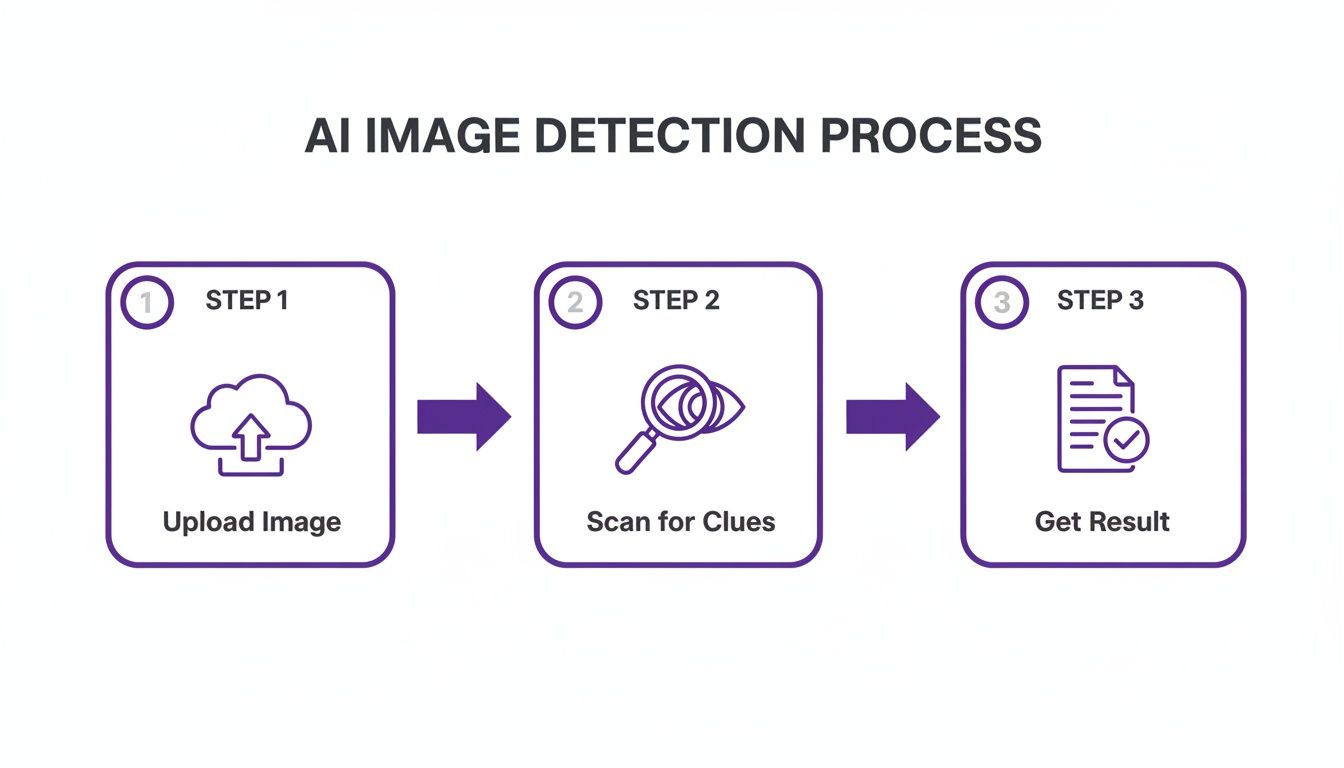
Let's clear up a common misconception right away. A fake detector machine isn't some clunky piece of hardware from a sci-fi movie. It’s actually a highly specialized algorithm—a piece of software trained to see what our eyes almost always miss. It doesn't just "look" at a picture; it dissects it pixel by pixel, searching for the subtle, almost invisible fingerprints that AI image generators leave behind.
Think of it like an expert art historian. They can spot a Rembrandt not just by the painting's subject, but by the unique brushstrokes, the way the paint is layered, and the texture of the canvas. An AI image detector does something similar, but its "brushstrokes" are digital artifacts, strange noise patterns, and mathematical quirks buried deep within the image's code.
These tools are trained on massive datasets filled with millions of real photographs and AI-generated images. Through this intense training, the software learns to recognize the distinct statistical patterns that separate a genuine camera capture from an algorithm’s creation.
Uncovering the Digital Fingerprints
Every AI model builds an image in its own unique way, leaving behind a sort of signature style. A good detector is trained to spot these tell-tale signs that give away an image’s artificial origin. This goes way beyond just looking for obvious mistakes, like a person with six fingers.
The real analysis is much, much deeper. It focuses on several key areas:
- Noise Patterns: Real photos from a digital camera have a natural, random "noise" caused by the sensor. AI-generated images often have noise that’s unnaturally smooth or perfectly uniform—a dead giveaway to a trained algorithm.
- Color Frequencies: The detector analyzes how colors are distributed. Certain AI models have a habit of creating images with specific color palettes or frequency spectrums that just don't match what a real camera lens would capture.
- Model-Specific Artifacts: Just as a painter might have a favorite brush, each AI model (like Midjourney or DALL-E 3) leaves behind its own subtle, unique artifacts. A sophisticated detector can often recognize these digital watermarks and even identify which "family" of AI models was used to create the image.
At its core, a fake detector machine isn't just looking for flaws. It's performing a sophisticated form of digital forensics, comparing an image's underlying data structure to known patterns of both authentic and synthetic content.
This multi-layered approach is what allows the tool to build a strong case for or against an image's authenticity, instead of just relying on a single visual clue.
Spotting What Just Doesn't Add Up
Beyond digging into the pixels, these detectors also check for things that are just plain illogical. They cross-reference details within the image to see if they hold up to the basic rules of physics and logic. Even as AI gets scarily good, it still struggles with the complex, unwritten rules of our physical world.
This is where some of the most compelling evidence comes from:
- Weird Lighting and Shadows: Does the light in the image actually make sense? An AI might create a scene where shadows fall in opposite directions or an object is brightly lit with no obvious light source anywhere nearby.
- Funky Reflections: Surfaces like water, glass, and mirrors are notoriously difficult for AI to get right. A detector will look for reflections that don't accurately mirror their surroundings or light that bends incorrectly as it passes through a glass of water.
- Anatomical Oddities: Yes, this includes the classic "too many fingers" problem, but it also covers much more subtle errors. An AI might generate facial features that are too perfect, like a pair of earrings that look identical despite being viewed from different angles—something that’s physically impossible.
By combining all these data points—pixel patterns, physical inconsistencies, and model-specific artifacts—the detector arrives at a conclusion. It weighs all the evidence and presents it as a confidence score, giving you a powerful ally for navigating an increasingly complex visual world.
For a deeper dive into the specific techniques used, our guide on AI image identification breaks down the entire process even further.
Navigating Accuracy, Limitations, and Confidence Scores
Let's get one thing straight: no fake detector machine is infallible. While these tools are incredibly powerful, they aren't a crystal ball that gives a perfect "yes" or "no" answer. Understanding their limits is just as crucial as knowing what they can do. This context is key to interpreting their results correctly and making truly informed decisions.
The truth is, these algorithms live in a world of probabilities, not certainties. That means they can, and sometimes will, get it wrong. The errors typically fall into two buckets: false positives and false negatives.
Understanding False Positives and Negatives
A false positive is when the detector mistakenly flags a genuine, human-made photo as being AI-generated. This isn't just a random guess; certain things can trick the algorithm:
- Heavy Digital Editing: Think of an image that’s been heavily airbrushed, smoothed, or had its colors dramatically altered. This process can strip away the natural noise and texture the detector expects from a real photo, making it look artificially perfect.
- Low-Resolution Images: A highly compressed or low-quality picture often lacks the fine details and subtle imperfections that scream "authenticity" to an algorithm.
- Unusual Artistic Styles: Sometimes a real photograph taken with a unique lens or edited for an abstract effect can display features that look a lot like common AI artifacts, confusing the tool.
On the flip side, a false negative happens when a detector fails to spot an AI-generated image, passing it off as human-made. This is most common when you're up against images from the very latest, most sophisticated AI models—the ones trained specifically to avoid the classic tells that older AIs used to have.
Think of a fake detector machine's verdict not as a final judgment, but as a highly educated opinion. It's a powerful piece of evidence, but it should always be considered alongside other contextual clues.
This cat-and-mouse game isn't unique to image detection. To get a bigger picture, it helps to understand the current capabilities and limitations of AI across various domains. It’s a great reminder that managing expectations is vital for any AI-powered solution. The constant race between AI generation and detection means no tool can promise 100% accuracy. For a deeper look at this, our own analysis explores just how accurate AI detectors are in the real world.
Decoding the Confidence Score
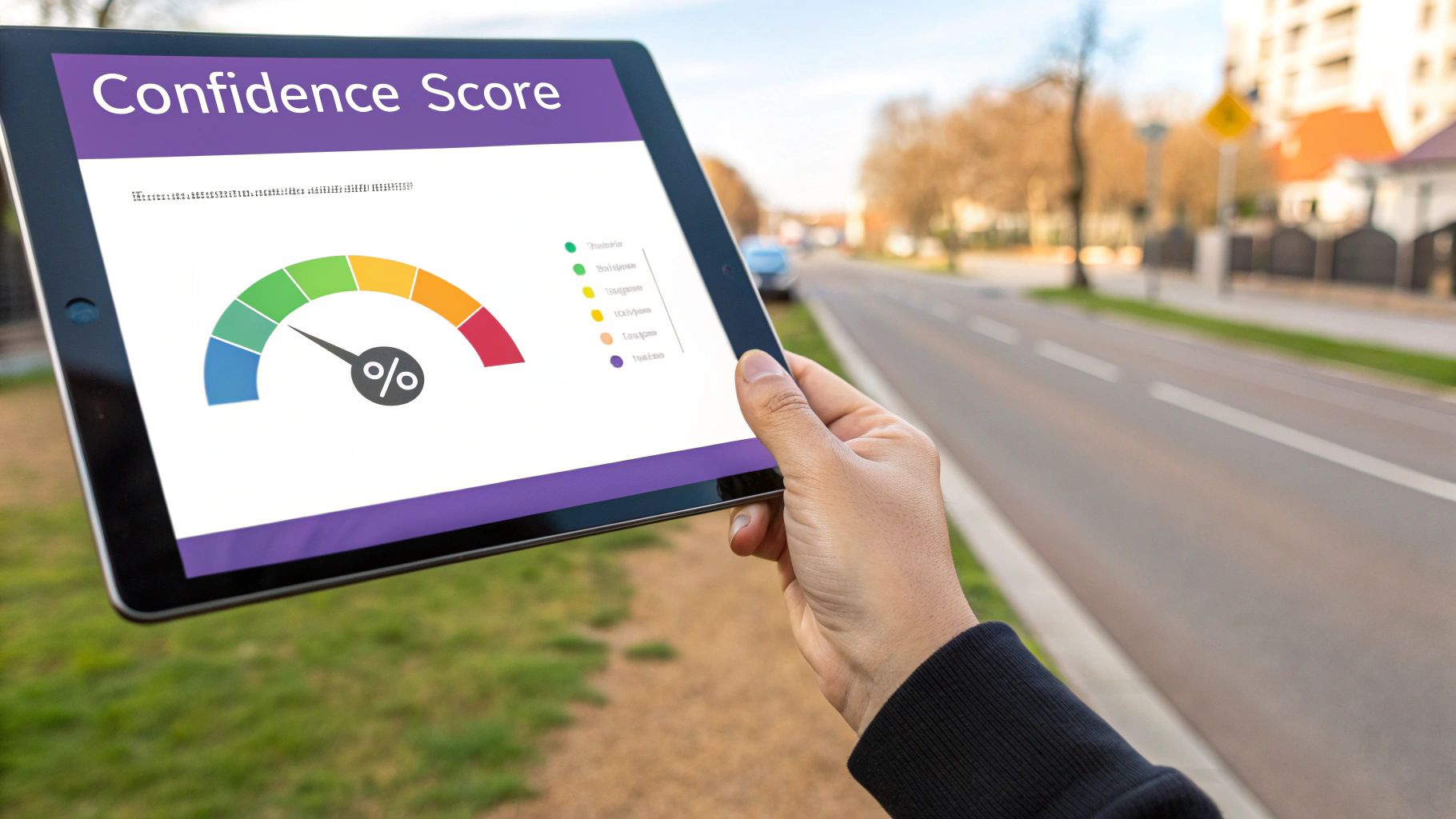
This is where the confidence score comes in, and it’s arguably the most important piece of information the tool gives you. Instead of a simple "AI" or "Human" label, good detectors provide a percentage. This number tells you how certain the algorithm is about its own conclusion.
Think of it like a weather forecast. A meteorologist might predict a 95% chance of rain. That doesn't mean it’s guaranteed to pour, but it’s a very strong sign that you should probably grab an umbrella. A 20% chance of rain means it's unlikely, but not impossible. The confidence score from a fake detector machine works exactly the same way.
Here’s a quick guide to reading these scores:
- Scores Above 90% (Either Way): This is a strong signal. If a tool says 95% Likely AI-Generated, you can be very confident in that result. The algorithm has spotted multiple, clear indicators of machine creation.
- Scores in the Middle (40%-60%): Welcome to the gray area. A score of 55% means the tool is on the fence. The image might have features of both human and AI work—for instance, a real photo that was heavily touched up with AI tools. Your own judgment is critical here.
- Scores Below 10%: This means the tool is very confident the image is not what it was flagged as. A result of 5% Likely AI-Generated is another way of saying it's 95% confident the image is human.
By learning to treat these scores as probabilities instead of absolute truths, you can use a fake detector machine far more effectively. A high score gives you a solid foundation for a decision, while a middle-of-the-road score is your cue to dig deeper and look for more evidence before making a final call.
Real-World Applications Where These Tools Are Essential
The tech behind these tools is fascinating, but their real value shines when you see them solving actual problems. A fake detector machine isn't just a novelty anymore; it's becoming a critical piece of infrastructure in any field where truth matters. From the chaos of a breaking news story to the quiet halls of a university, these detectors are already making a tangible difference.
Think about a journalist on a tight deadline. A dramatic, unverified photo claiming to be from a major event lands in their inbox. Before, they had a tough choice: publish it fast and risk spreading misinformation, or hold back and possibly miss a key part of the story. Now, they can run it through a detector in seconds for an immediate read on its authenticity.
That capability alone is changing the game and helping to rebuild trust.

Safeguarding Journalism and Media Integrity
In the media, speed and accuracy are everything. A single fake image can sink a story, tarnish a publication's reputation, and flat-out mislead the public. Newsrooms are now using AI detectors as a first line of defense against manipulated content.
- Verifying Breaking News: When images are flooding social media during a crisis, detectors help editors quickly filter the fakes from the facts.
- Investigative Journalism: Reporters can analyze photos from anonymous sources, checking for digital red flags before they pour resources into a potentially bogus lead.
- Fact-Checking Teams: These tools are becoming standard issue for fact-checkers, adding a layer of technical analysis to their traditional source verification methods.
This proactive screening is essential for upholding journalistic standards in a world awash with synthetic media. It frees reporters to focus on the story, giving them more confidence in their visual evidence.
Upholding Academic and Creative Honesty
The need for authenticity doesn't stop with the news. In education and the arts, proving that work is original is the bedrock of integrity.
Imagine an art professor getting a portfolio of incredibly photorealistic digital paintings from a student. With a detector, they can quickly check if the images were generated by an AI model instead of created with the student's own skill. It protects the integrity of the whole evaluation process.
It’s the same story for online art marketplaces and galleries screening new submissions. They use these tools to protect their own reputations and, more importantly, the livelihoods of real artists whose work could be devalued by a flood of low-effort AI creations. It's about making sure that when someone buys digital art, they’re paying for human creativity.
The institutionalization of these tools is a clear sign of their importance. From media outlets to universities, fake detector machines are becoming a standard part of the digital integrity toolkit, much like plagiarism checkers did a decade ago.
Market data backs this up. Content authenticity and plagiarism detection now make up 33.9% of all AI detector applications, making it the single largest use case. You can dive deeper into the trends with reports on the AI detector market at SNS Insider. This isn't a niche trend; it's a major shift toward automated verification across industries.
Protecting Platforms and Consumers
Social media platforms and online marketplaces have a massive moderation problem. Scammers and bad actors use AI-generated images for everything from fake profiles to deepfakes. An API-integrated detector can automatically scan new uploads and flag the suspicious ones for a human to review.
This helps in a few key ways:
- Fighting Romance Scams: It spots fake profile pictures used to build entirely fictional, yet convincing, personas.
- Marketplace Trust: It can identify AI-generated product photos used to sell items that don't exist or are counterfeit.
- Moderating Harmful Content: It helps flag deepfakes and other synthetic media created to harass people or spread dangerous lies.
The logic of verification extends into commerce, too. The same principles that identify AI fakes are also vital in other areas, like detecting counterfeit products and securing supply chains.
And in a legal setting, you absolutely have to be able to authenticate digital evidence. A lawyer can't present a photo in court without being certain it’s real. An AI image detector can provide the expert analysis to confirm a piece of visual evidence hasn't been algorithmically generated or tampered with, helping it stand up to intense scrutiny.
How to Choose and Use an AI Image Detector Effectively
Knowing these fake detector machines exist is one thing. Knowing how to pick the right one and actually use it well is something else entirely. With a flood of new tools popping up, choosing a reliable option and using it correctly is the only way to get results you can trust. The goal isn't just a quick verdict; it's about building a solid process that pairs powerful technology with your own critical eye.
The sheer volume of synthetic media makes this skill more critical than ever. We need these tools because of the explosive growth in generated images. Think about this: an estimated 34 million AI images are created every single day, and over 15 billion have been generated since 2022. If you want to dive deeper into those staggering numbers, you can find in-depth data on AI image generation at Statista. This tidal wave of content is exactly why picking a capable detector is your crucial first step.
Key Criteria for Selecting a Detector
Let's be clear: not all detection tools are created equal. When you're weighing your options, you need to focus on a few key factors that separate a great service from a mediocre one. It's important to look past the marketing fluff and see how the tool actually performs and, just as importantly, how it handles your data.
Here’s a simple checklist for your evaluation:
- Privacy Policy: What happens to the images you upload? A privacy-focused detector analyzes images on the fly without ever saving them to its servers. This is non-negotiable if you're dealing with sensitive or proprietary content.
- Speed and Efficiency: How fast does it give you an answer? In fast-paced fields like journalism or content moderation, you can't be left waiting. A good tool should deliver its analysis in seconds.
- Clarity of Results: Does it just spit out a simple "yes/no," or does it give you a detailed confidence score? The best tools provide a nuanced percentage and even explain why they reached a conclusion by pointing out potential artifacts.
- File Type Support: Make sure the detector handles common formats like JPEG, PNG, and WebP. The more file types it supports, the more useful it will be in your daily workflow.
A superior fake detector machine doesn't just give you an answer; it gives you evidence. It should act like an expert consultant, presenting its findings with context so you can make the final, informed judgment.
Best Practices for Effective Analysis
Once you've picked your tool, how you use it makes all the difference. Just uploading an image and taking the score at face value is a rookie mistake. A more thoughtful approach will always give you better insights and help you steer clear of common pitfalls.
For a more reliable analysis, follow these steps:
- Use the Highest Quality Image: Always, always upload the original, highest-resolution version of the image you can get your hands on. Heavy compression and screenshots can wipe out the very digital artifacts the detector is looking for.
- Look Beyond the Final Score: Pay close attention to the confidence score. A 55% "Likely AI" result is a world away from a 98% score. Anything in that murky middle ground is a signal to dig deeper, not jump to a conclusion.
- Combine Tech with Human Insight: Treat the detector's verdict as a powerful data point, not the final word. Cross-reference what it tells you with your own evaluation. Do the shadows and lighting look right? Are there weird inconsistencies in the background? Your own intuition is still an indispensable part of the process.
Got Questions? We've Got Answers.
As you get more familiar with AI image detectors, a few common questions always seem to pop up. Let's tackle them head-on to clear up any confusion about how this technology really works in the wild.
Think of this as your quick-reference guide.
Can These Detectors Be Fooled by Newer, Smarter AI?
Yes, they absolutely can. The relationship between AI image generators and detectors is a never-ending game of cat and mouse. As the generators get better, they learn to cover their tracks, avoiding the classic digital slip-ups that older detectors were trained to catch.
This means a top-tier detector from six months ago might get tripped up by images from a brand-new AI model. That's why the best detection tools have to be constantly retrained with fresh examples of the latest AI-generated content. It's an ongoing race, and no detector is permanently "future-proof."
The most advanced AI images have very few obvious flaws, forcing detectors to hunt for more subtle statistical clues hidden in pixel patterns and digital noise. While today's tools are incredibly sharp, a small number of sophisticated fakes will always slip through—which is exactly why a final human check is still so important.
What's the Difference Between Spotting AI Images and Deepfake Videos?
While they both fall under the umbrella of "synthetic media," telling a fake static image from a deepfake video are two completely different ballgames. The clues the algorithms look for, and the challenges they face, are worlds apart.
Here’s a simple way to think about it: checking a fake image is like examining a single photograph for mistakes. Analyzing a deepfake is like watching an entire movie, checking every single frame for continuity while also making sure the audio, motion, and lip-sync all line up perfectly.
The key differences boil down to this:
- Static vs. Dynamic Analysis: An image detector analyzes one frozen moment in time. A deepfake detector has to process sequences of frames, hunting for tells like unnatural blinking, odd facial tics, or movements that just don't feel right.
- Audio Clues: Videos have sound, and that's a huge source of evidence. Deepfake detectors can analyze audio for signs of AI voice cloning or for tiny sync issues between a speaker's lips and the words they're saying. Image detectors don't have this luxury.
- Sheer Processing Power: Analyzing even a 30-second video clip is a massive computational job compared to scanning a single JPEG. The volume of data in video makes detection a much heavier lift.
Because of this, a tool built to be a fantastic AI image detector won't necessarily be any good at spotting deepfake videos, and vice versa. They're specialized tools for related but very distinct problems.
It's a common myth that all AI detection is the same. The truth is, you need highly specialized models for text, images, audio, and video, because each one has its own unique set of synthetic fingerprints.
Will Digital Watermarks Make These Detectors Obsolete?
Digital watermarking is a really promising idea. The concept is that AI models would embed an invisible signal into every image they create. A special scanner could then instantly spot this watermark, confirming the image is AI-generated. Big players in tech are already working on standards like the C2PA (Coalition for Content Provenance and Authenticity) to make this a reality.
Even so, it's highly unlikely that watermarks will ever make detection tools obsolete. Here’s why:
- Not Everyone Will Play Along: Open-source and private AI models have no obligation to add watermarks. Anyone creating malicious fakes or disinformation will simply use tools that don't include them.
- Watermarks Can Be Broken: Just like you can damage a physical watermark, digital ones can be attacked. Someone determined enough can often strip or degrade these signals through heavy compression, cropping, or other edits.
- What About Old Content? Billions of AI-generated images already exist out there without watermarks. We'll still need detectors to analyze this massive backlog of existing content.
Ultimately, watermarking will be a fantastic partner to detection—another tool in the toolbox for verifying authenticity. But the core need for an AI image detector that can analyze any image, regardless of its origin, isn't going away.
Can I Run Images From Social Media Through a Detector?
You can, but there's a huge catch: always try to use the highest-quality version of the image you can find. Platforms like Facebook, Instagram, and X (formerly Twitter) slam images with heavy compression to save space and make their sites load faster.
This compression process can wreck the very data an AI detector relies on. It can erase the subtle pixel patterns and digital artifacts that scream "AI-generated," sometimes making a fake image look more like a blurry, low-quality real photo to the algorithm.
For the best results:
- Hunt down the original source if it was posted somewhere else first.
- Use a reverse image search to find a higher-resolution version online.
- If you have to use the social media version, just know that the detector's confidence score might be less certain because of that compression.
When analyzing compressed images, treat the detector's verdict as one clue among many, not the final word.
Ready to see for yourself? With the AI Image Detector, you can get a clear, reliable analysis in seconds. Our privacy-first approach means we never store your images, so you can check content with complete peace of mind.


