

What Is Real Image: (what is real image) and how to verify AI photos

What exactly makes an image "real"? It might sound like a simple question, but in a world flooded with digital content, the answer is more important than ever.
A real image is what we traditionally think of as a photograph. It’s a direct capture of a real-world scene, taken by a device like a camera. It represents a genuine moment in time, frozen by light hitting a sensor. This is fundamentally different from an AI-generated image, which is created—or synthesized—by an algorithm, not captured from reality.
Understanding What Makes an Image Real
When you scroll through your feed, telling the difference between what’s real and what’s not has become incredibly difficult. Think of a real image as a footprint in the sand; it's tangible evidence that something or someone was actually there. Light from an object or a scene passes through a lens, and that information is permanently recorded.
AI-generated images, on the other hand, don't record anything. They are built from scratch. An AI model analyzes millions of existing photos to learn patterns, and then it uses that knowledge to construct a brand-new image based on a text prompt. It isn't remembering a scene it saw; it's creating a plausible-looking collage of pixels. If you're curious about how this works, our guide on what is synthetic media dives deeper into the process.
This isn't just a technical detail. It’s a critical skill for navigating modern life. Knowing how to spot the difference between a captured reality and a generated one is the foundation of digital trust.
Real vs AI-Generated Image at a Glance
To make this distinction crystal clear, let's break down the core differences in a simple table. This gives you a quick reference for the tell-tale signs that separate a photograph from a synthetic creation.
| Characteristic | Real Image (Captured) | AI-Generated Image (Synthesized) |
|---|---|---|
| Origin | Captured from the physical world via a lens and sensor. | Generated by an algorithm based on data patterns. |
| Source | Light from a real scene. | A text prompt or another image input. |
| Imperfections | Contains natural flaws like lens flare, noise, and focus issues. | Often looks too perfect, or has strange, unnatural artifacts. |
| Metadata | Includes EXIF data (camera model, settings, timestamp). | Typically lacks detailed EXIF data from a camera. |
| Consistency | Follows the laws of physics (light, shadows, reflections). | May have inconsistent shadows, odd proportions, or illogical details. |
Seeing them side-by-side really highlights how different their DNA is. One is a record of reality, warts and all, while the other is an invention.
Why This Distinction Matters Now
The need to understand what is a real image has exploded thanks to the incredible power of modern AI. Fabricated images presented as fact can fuel misinformation at lightning speed. A 2023 study from Pew Research Center revealed that 62% of U.S. adults have encountered manipulated images, and a worrying number of them couldn't tell they were fakes. This just underscores the growing need for better digital literacy and reliable AI content authenticity verification tools.
At its core, defining a real image is about establishing a baseline for truth. It's the starting point for digital forensics—the practice of investigating and authenticating digital media to confirm its origin and integrity.
This knowledge empowers everyone, from professionals to everyday internet users, to start asking the right questions:
- For a Journalist: Is this photo a credible source, or is it a piece of propaganda?
- For an Educator: Is this student’s work their own, or was it created with an AI tool?
- For a Consumer: Is this product review showing the actual item, or is it a slick, deceptive ad?
By drawing a clear line in the sand, we can build the skills to navigate our visual world with more confidence. This guide will give you the practical know-how to verify images, helping you move from passively viewing content to actively understanding it.
What Makes a Real Image? The Hidden Clues
Every real photograph carries a kind of “digital DNA”—a unique set of fingerprints that tell the story of its creation. Think of it like a detective investigating a crime scene. The clues are subtle, but once you know what to look for, they can definitively separate a genuine moment captured in time from something created by an algorithm.
This isn't about guesswork. It's about understanding the technical markers that authentic photos leave behind.
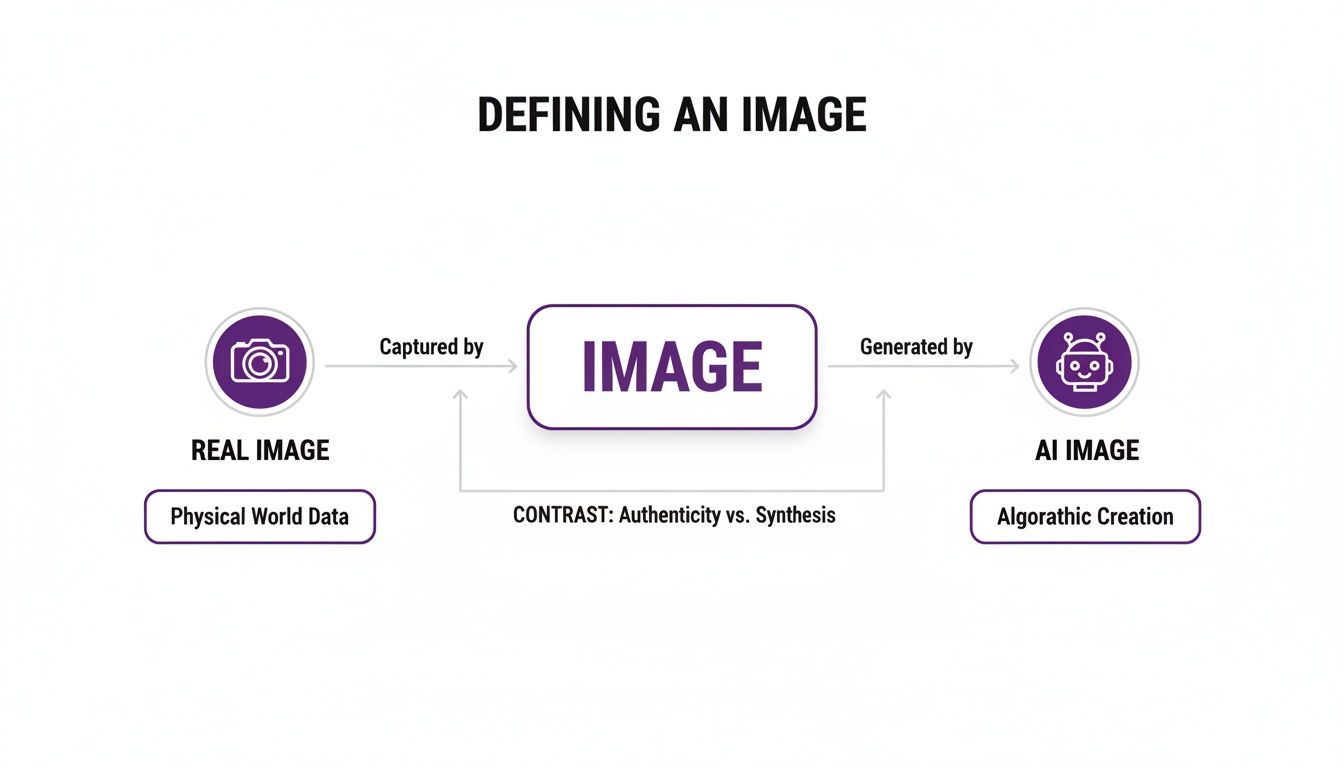
This image gets to the heart of the matter: a real photo is a record of physical data from the world around us, while an AI image is born entirely inside a computer.
The Story Hidden in the Metadata
The best place to start is with an image's metadata, which is like its digital birth certificate. When you snap a picture with a camera or phone, the device embeds a treasure trove of information directly into the file. This is known as EXIF data (Exchangeable Image File Format), and it’s one of the most reliable indicators of a photo's origin.
So, what does this data actually tell you?
- Camera Model and Make: It lists the specific device, like a "Canon EOS R5" or an "iPhone 15 Pro."
- Camera Settings: You'll find the technical details a photographer would set, including the aperture (f-stop), shutter speed, and ISO.
- Timestamp: The exact date and time the picture was taken are logged, creating a verifiable timeline.
- Geolocation Data: If the user has location services turned on, the GPS coordinates can pinpoint exactly where the photo was taken.
AI-generated images simply don't have this backstory. They are created in a purely digital space, so they lack the rich, device-specific data that comes from a physical camera capturing a real-world scene. While its absence isn't absolute proof of AI (since metadata can be stripped), its presence is a very strong clue that you're looking at a genuine photograph.
The Unbreakable Rules of Light and Shadow
Beyond the data, a real photograph must obey the fundamental laws of physics. Light, shadows, and reflections don't just happen randomly—they follow consistent rules. Light travels from a source, hits objects, and casts shadows in a predictable way.
This is where AI models often trip up.
Even the most sophisticated AI can struggle with getting the physics right. You might see an image where shadows from different objects fall in conflicting directions, or where a reflection in a window doesn't quite match the scene it's supposed to be reflecting.
When you look at a suspicious image, ask yourself a simple question: Does the lighting make sense? If a person's shadow falls to their left, every other shadow cast by that same light source should do the same. Any inconsistency is a major red flag.
These mistakes happen because AI learns from analyzing patterns in millions of images, but it doesn't truly understand the physics behind them. It knows what a shadow should look like in general, but it doesn't grasp the cause-and-effect relationship that governs how light works in the real world. That gap is often where its synthetic nature is revealed.
Embracing the Imperfections of Reality
Finally, there’s an organic "texture" to real photos that comes from the physical world. No camera sensor or lens is perfect, and these tiny flaws are actually powerful signs of authenticity.
Think about these real-world artifacts:
- Sensor Noise: In low light, camera sensors produce a fine, grainy pattern called digital noise. This randomness is a natural part of the process. AI-generated images, by contrast, can look suspiciously clean or may contain noise that appears too uniform and artificial.
- Lens Imperfections: A real camera lens can introduce subtle distortions, color fringing on high-contrast edges (chromatic aberration), or a characteristic lens flare when pointed at a bright light.
Paradoxically, these little flaws are markers of a real image. They are the natural byproducts of light passing through glass and hitting a digital sensor. AI generators, often striving for an impossible level of perfection, frequently fail to replicate these subtle, authentic imperfections, leaving you with a scene that feels just a bit too sterile.
How to Visually Spot the Telltale Signs of a Fake
Learning to spot a synthetic image is a lot like developing an expert's eye for anything, whether it's fine art or a designer handbag. You start by knowing the little giveaways. While AI-generated images are getting scarily good, they still make subtle mistakes that betray their artificial origins—flaws that pop up because an algorithm is just mimicking reality, not truly understanding it.
The most notorious red flag? Hands and fingers. For some reason, AI just can't get them right. Keep an eye out for people with six fingers, joints that bend in impossible ways, or hands that seem to blur or melt right into the background. This happens because AI learns from visual patterns but has zero real-world knowledge of anatomy—bones, muscles, and all.
Another classic tell is text that makes no sense. Newer AI models are getting better at this, but many still render letters as bizarre, abstract shapes. You'll see street signs with garbled characters or a book with a title that looks like an alien language. It's a dead giveaway that you're looking at something made by a machine.
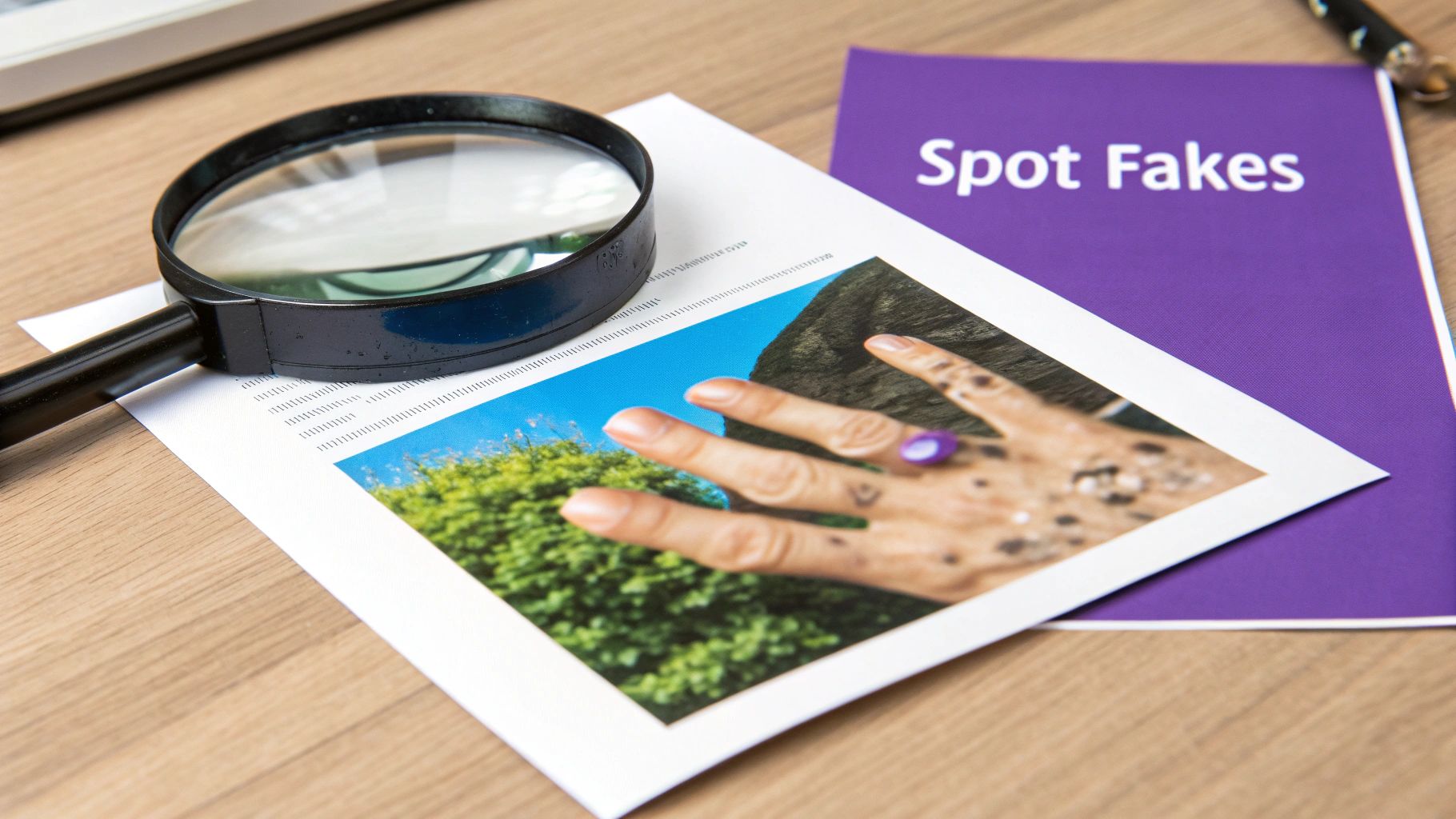
This image captures the essence of fact-checking perfectly. It’s all about looking closer, questioning the small details, and approaching every image with a healthy dose of skepticism.
Look for Illogical Details
Beyond the obvious tells, AI often gets tripped up on details that require a bit of common sense, something algorithms are still missing. These mistakes break the internal logic of a scene, creating a strange feeling even if you can't put your finger on why. It’s similar to how experts learn how to spot fake antiques by finding tiny inconsistencies in the materials or craftsmanship. You can do the same with fake images.
Be on the lookout for these common slip-ups:
- Impossible Reflections: Check any reflective surface—mirrors, puddles, shiny metal. Does the reflection actually match what should be there? AI frequently messes this up, showing distorted objects or reflecting something that isn't even in the scene.
- Weird Patterns and Textures: Look closely at repeating patterns like bricks, fabric, or even strands of hair. AI tends to make them too perfect or, conversely, creates waxy, artificial-looking textures. A real image will always have natural, organic variations.
- Asymmetrical Features: Pay attention to things that should be symmetrical, like a pair of glasses or earrings. AI often struggles to keep both sides perfectly matched. One lens might be slightly larger, or an earring might be misplaced. For more examples, check out our deep dive on how to spot AI-generated images.
The Uncanny Valley Effect
Have you ever looked at an image and just felt… off? That feeling has a name: the uncanny valley. The term was first used to describe robots that look almost human, but not quite, creating a sense of unease. The same exact principle applies to AI images.
The uncanny valley is that gut instinct screaming that something isn't right. It could be eyes that look vacant and soulless, skin that's too perfectly smooth, or a smile that doesn't quite reach the eyes. Trust that feeling. It’s usually your brain noticing thousands of tiny, imperceptible details that just don't add up.
The mission to reliably identify what's real became critical after 2016, as AI fakes grew so convincing that one study found they fooled 83% of people. That number alone shows we can no longer rely on our eyes alone. It’s a stark reminder that we need better tools to help us see the truth in a world filled with increasingly sophisticated fakes.
Moving Beyond the Naked Eye with Detection Tools
Learning to spot the visual giveaways of a fake image is a valuable skill, but it's a game that's getting harder to win. The most obvious AI flaws—like those infamous six-fingered hands or jumbled text—are quickly becoming a thing of the past as the technology improves. When your own eyes can no longer tell the difference, you need a better approach.
This is where dedicated detection tools step in, adding a crucial layer of verification. Think of a tool like an AI Image Detector as a digital microscope. It goes far beyond what we see on the surface to analyze the very pixels an image is made of, hunting for the microscopic clues that reveal its true origin.

These tools offer a reliable, data-driven verdict when your eyes can be fooled, giving you the confidence to trust what you see online.
How AI Image Detectors Work
So, how does this "digital microscope" actually work its magic? Instead of just looking at the content of an image—the people, places, and objects—an AI detector scrutinizes the underlying data and statistical patterns hidden within the pixels themselves. It’s been trained on massive datasets filled with both authentic photographs and millions of AI-generated examples.
This extensive training teaches the detector to recognize the subtle, almost invisible artifacts that different AI models leave behind.
Here are the key areas an AI detector digs into:
- Pixel-Level Analysis: It examines digital noise patterns, color compression artifacts, and frequency distributions that are completely different for a camera sensor versus a generative algorithm.
- Metadata Consistency: The tool checks for the presence, absence, or strange modifications of EXIF data. A total lack of camera and lens information can be a major red flag.
- Algorithmic Fingerprints: Every AI model builds images in its own unique way, leaving behind a faint but detectable "fingerprint" that a specialized tool is trained to spot.
The entire process is incredibly fast and built with user privacy as a priority. With AI Image Detector, you can simply drag and drop a file up to 10MB for a near-instant analysis, and your images are never stored on our servers.
Understanding the Results
After the scan is finished, the tool doesn’t just spit out a simple "yes" or "no." It gives you a clear, easy-to-understand verdict that acknowledges the complexity of modern images.
The goal isn’t just detection; it’s about providing clarity. A good tool gives you a confidence score, helping you understand the likelihood of an image being synthetic, which is far more useful than an absolute answer.
Typically, you'll see a result along a spectrum, such as:
- Likely Human: High confidence that the image was captured by a camera.
- Possibly AI-Generated: Some indicators point to synthetic elements. This could mean it's fully AI-generated or just a heavily edited photograph.
- Likely AI-Generated: Strong evidence suggests the image was created by an AI model.
This nuanced approach is vital because it accounts for the gray areas, like heavily retouched photos or composite images. By giving you a confidence score and a clear explanation, these tools empower you to make an informed decision instead of just guessing. Finding the right tool for your specific needs can make all the difference, which is why we put together a guide on the best AI detectors available.
The impact of these tools is already massive. For journalists on tight deadlines during global elections, detectors have been crucial in identifying 73% of viral AI fakes within seconds, helping to stop misinformation in its tracks. The growing reliance on this technology is reflected in the AI Image Detector market, which is projected to grow from USD 308 million in 2025 to USD 554 million by 2032.
Ultimately, using a detection tool is the modern solution to a very modern problem. It provides that essential verification step to confirm what a real image is in a world where seeing is no longer always believing.
Why Image Verification Matters in the Real World
Being able to tell a real photo from a fake one isn’t just a neat technical trick anymore—it has massive, real-world consequences. When a single image can shape public opinion, serve as courtroom evidence, or even start a conflict, knowing what’s authentic is fundamental to trust and safety. The stakes are incredibly high, and professionals across many fields are on the front lines.
For journalists and fact-checkers, verifying an image is the first line of defense against a tidal wave of misinformation. A cleverly manipulated or AI-generated picture can do anything from sparking an international incident to ruining someone's reputation with a false accusation. At the end of the day, journalistic integrity hangs on making sure every visual source is airtight before it goes public.
Protecting Truth in Media and Journalism
During a breaking news event, a fake photo can spread faster than the truth ever could. Think about it: a synthetic image showing police brutality at a protest goes viral. If a news outlet publishes it without checking, it could easily ignite real-world violence and shatter the credibility of that organization for good.
On the flip side, a real, verified photo is one of the most powerful tools we have for holding people accountable. Proper verification protects those genuine moments, giving them the weight they deserve as an undeniable record of what actually happened. This is what separates responsible reporting from the chaos of unchecked rumors.
The core mission of journalism is to present the truth. In the visual age, this mission directly translates to authenticating every image to ensure it represents a real event, not a fabricated narrative.
Upholding Justice in Legal Proceedings
The entire legal system is built on the integrity of evidence. A photograph brought into a courtroom—whether for a criminal trial, an insurance dispute, or a custody battle—is supposed to be a piece of reality. If that evidence can be convincingly faked, the foundation of our justice system starts to crack.
This isn't just a hypothetical problem. Here are some situations where the line between real and fake is everything:
- Insurance Fraud: Someone submits a doctored photo of a car wreck to make the damage look worse. It's a simple way to try and scam millions from insurers, but verification tools can spot the digital manipulation and stop the fraud in its tracks.
- Criminal Evidence: A fake image could be used to create a false alibi or, even worse, to frame an innocent person by placing them at a crime scene. Finding justice is impossible without authentic evidence.
- Brand Protection: A company might use a damaging, AI-generated image in an ad campaign to slander a competitor, causing huge financial and reputational harm.
In all of these scenarios, knowing what is a real image isn't an abstract question. It’s the key to a fair outcome.
The growing challenge of image-based misinformation has a measurable impact on different industries. The ability to verify visual content is shifting from a specialized skill to a core operational necessity.
Table: Impact of Image Verification Across Industries
| Industry | Challenge | Impact of Verification Tools |
|---|---|---|
| Journalism & Media | Rapid spread of AI-generated images during breaking news events. | 85% of newsrooms report that fighting misinformation is a top priority, with tools reducing verification time by over 50%. |
| Legal & Insurance | Submission of digitally altered photos as evidence in legal or claims cases. | Prevents millions in fraudulent payouts annually. Upholds the "beyond a reasonable doubt" standard of evidence. |
| Education | Students submitting AI-generated art or photos as original work. | Helps maintain academic integrity standards; ensures fair and accurate assessment of student skills. |
| Online Platforms | Proliferation of fake profiles, counterfeit goods, and deepfake content. | Automated detection can remove over 90% of fake accounts at the sign-up stage, protecting community safety. |
These numbers highlight a clear trend: as digital fakes become easier to create, the tools to detect them become indispensable for maintaining trust and operational integrity.
Maintaining Integrity in Education and Beyond
The problem of fake images has also found its way into classrooms and corporate offices. Teachers are now grappling with students who submit AI-generated artwork and pass it off as their own. To uphold academic honesty, educators need a reliable way to tell the difference between human effort and an algorithm’s output.
Platform moderators for social media sites and online marketplaces are in a similar boat. They're tasked with identifying fake profiles that use AI-generated headshots, stopping scammers who use misleading images to sell counterfeit products, and taking down harmful deepfakes. The safety and trustworthiness of entire online communities depend on having strong, scalable image verification. From the newsroom to the courtroom to the classroom, the need for it has never been clearer.
Answering Your Questions About Image Authenticity
As we wrap up, let's dig into some of the most common questions people have when trying to figure out if an image is real. Think of this as a quick-reference guide for those moments when you're looking at a picture and something just feels a little off.
My goal here is to give you clear, practical answers you can use right away, so you can feel more confident navigating the visual information you see every day.
Can an Edited Photo Still Be a Real Image?
Yes, absolutely. An edited photo is still considered a real image because it started its life as a genuine photograph—a moment captured by a camera sensor. The reality is, almost every photo you see has been tweaked in some way.
This is the key difference: editing alters an existing reality, while AI generation creates a reality from pure data.
- Standard Edits: Things like cropping a photo for better framing, adjusting brightness, or tweaking colors to match what you saw with your own eyes are all normal. This is just standard practice and doesn't change the fact that the photo is real.
- Heavy Manipulation: Now, the line starts to blur when you get into heavy-duty alterations. Think adding or removing a person from a group shot, or blending different photos to create a scene that never actually happened. While the pieces might be from real photos, the final image is a fabrication.
This is where advanced detectors come in handy. They can often spot the digital seams and artifacts left behind by heavy editing—the kind of inconsistencies that don't show up in a natural photo.
What if an AI Image Looks Perfectly Real?
This is precisely why we can no longer rely on our eyes alone. The best AI image generators can now create visuals so convincing they can fool even seasoned experts. When a picture looks too good to be true—or just plain perfect—human intuition simply isn't enough.
Even in a flawless-looking synthetic image, an AI detector can find clues hidden deep within the pixels. It's a bit like digital forensics, searching for evidence that's completely invisible to us.
The human eye sees a picture; an AI detector sees a statistical map of pixels. Even the most advanced AI generators leave behind subtle, mathematical fingerprints from their creation process.
These fingerprints might be unnatural noise patterns, lighting that defies the laws of physics, or other tiny artifacts left behind by the algorithm. This gives you a data-driven verdict when your eyes might be tricked.
How Can I Check if a Photo Online Is Real?
Using a tool like the AI Image Detector is quick and surprisingly simple. You don't need to be a tech wizard to get a clear answer in just a few seconds.
It really just takes three simple steps:
- Save the Image: First, download the photo you’re curious about from a website or social media feed to your computer or phone.
- Upload for Analysis: Head over to the detector’s website and just drag and drop the image file into the analysis box.
- Get Your Verdict: The tool scans the image in a matter of moments and gives you a clear result, like 'Likely Human' or 'Likely AI-Generated,' often with a confidence score to show how sure it is.
The whole process is usually free for basic checks, doesn't require you to sign up, and is built with privacy in mind—your images aren't kept or stored.
Why Does AI Struggle with Hands and Text?
This is a fascinating peek into how AI "thinks." Models learn by studying patterns from millions of images, but they don't have a real-world, contextual understanding of what they're looking at. This is why they so often mess up complex, rule-based things like hands and text.
Hands are just incredibly difficult for an algorithm. They have a complex internal structure of bones and muscles that allows for a nearly infinite range of motion and poses. Without a true understanding of anatomy, AI often spits out hands with the wrong number of fingers, impossible joints, or just bizarre, twisted proportions.
Text is a similar story. An AI model sees letters not as a system for communication, but as a collection of intricate shapes. It tries to replicate the look of words without understanding the underlying rules of a language. This is why you so often see garbled, nonsensical script that looks like writing but means absolutely nothing. These weaknesses are still some of the most reliable giveaways that an image isn't real.
Ready to verify images with confidence? The AI Image Detector provides fast, free, and private analysis to help you distinguish between real photos and AI-generated fakes. Try it now and see the truth behind the pixels.


